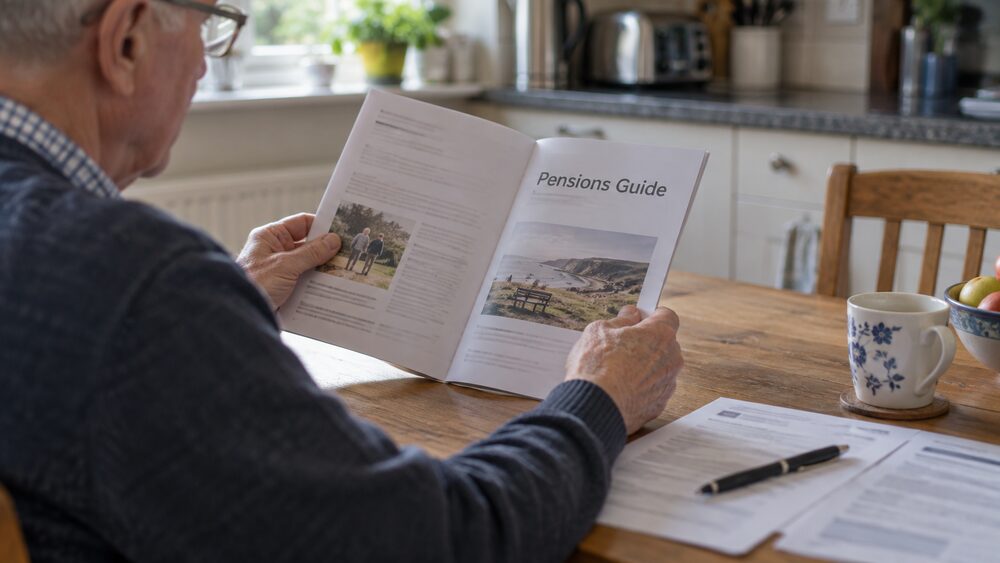
Saving for retirement in the UK rests on three things: the State Pension, a workplace pension and any personal pension you arrange yourself. The full new State Pension is £241.30 a week in 2026/27, and you need 35 qualifying years of National Insurance to get that full amount1. Most employees are now automatically enrolled into a workplace pension, into which employers must pay at least 3% of salary2. Personal pensions are pensions you arrange yourself, for example if you are self-employed3.
Money you pay into a pension gets tax relief added by the government, and up to 25% of the pot can usually be taken as tax-free cash. The catch is that the money is locked away: the earliest you can normally take a personal or workplace pension is age 55, rising to 57 from April 20284.
How pensions work: State, workplace and personal
A workplace pension is a way of saving for retirement that is arranged by your employer: a percentage of your pay is put into the pension scheme automatically every payday, and you may also get tax relief from the government6. Workplace pensions go by several names, and you may see them called "occupational", "works", "company" or "work-based" pensions7. In a defined contribution workplace scheme, your employer chooses a pension provider to invest your contributions8.
A personal pension is one you arrange yourself: you choose the provider and decide how your contributions are paid, possibly through an independent financial adviser9. Personal pensions are available from banks, building societies and life insurance companies10, and some employers offer personal pensions as workplace pensions3. All personal pensions are defined contribution schemes, which means the money is put into investments such as shares by the provider and the eventual pot depends on how those investments perform4.
The State Pension is different: it is paid by the government, based on your National Insurance record, and your State Pension age is worked out from your gender and date of birth11. State pensions and benefits are normally paid by direct payment into your account12. If you are tracking down an old pension, yours or a deceased relative's, the Pension Tracing Service can find contact details for a personal or workplace pension13.
You do not have to stop working to receive any of these. You can claim the State Pension while working once you reach State Pension age, and you can usually claim a personal or workplace pension from the age agreed with your provider14.
The three types are explained in more detail on how a pension works, workplace pensions, personal pensions and the new State Pension.
State Pension: £241.30 a week at the full rate
The full rate of the new State Pension in 2026/27 is £241.30 a week1. That figure was set in legislation from 6 April 2026, replacing the previous rate of £230.2515. After you have claimed, the pension is usually paid every four weeks rather than on the same date each month1.
Which State Pension you claim depends on when you reach State Pension age. People who reach State Pension age on or after 6 April 2016 claim the new State Pension; those who reached it before that date claim the basic State Pension and Additional State Pension16. The full basic State Pension is £184.90 a week17.
The new State Pension builds up from your National Insurance record: each qualifying year after 6 April 2016 increases your State Pension amount, up to the full rate18. If you delay claiming, you can get a higher weekly payment, and the extra amount usually increases each year in line with the Consumer Price Index once you do claim19. Deferral is explained in full on deferring your State Pension.
The State Pension rises each year under the triple lock: the increase matches the highest of three percentages, being inflation as measured by the Consumer Price Index in the previous September, the average wage increase between May and July of the previous year, or 2.5%1. The rules are covered in how the State Pension goes up each year.
Your State Pension is paid without tax taken off. Instead, your tax code is usually changed so that you pay the extra tax from your other income1.
Qualifying years: 10 to get anything, 35 for the full amount
You need at least 10 qualifying years on your National Insurance record to get any new State Pension at all, which is currently around £68.90 a week, and 35 qualifying years of contributions to get the full amount of £241.30 a week1. Between 10 and 35 years, you get a pro rata amount: the more qualifying years, the larger the payment.
Qualifying years usually come from paying National Insurance through work, but they can also come from credits, for example while you are claiming certain benefits or caring for someone. Gaps in your record can sometimes be filled with voluntary National Insurance contributions, which is covered in paying voluntary National Insurance to fill gaps.
What your National Insurance record is worth, from no pension to the full amount.
You can check where you stand through a State Pension forecast, which shows your record to date and what you are on track to receive. How to do this is explained in checking your State Pension forecast and your National Insurance record.
When you can claim the State Pension and how to apply
The earliest you can get your State Pension is when you reach your State Pension age16. Anyone who retires before that age has to wait to claim16. A letter with an invitation code is sent around four months before State Pension age, and claims can be made online, by phone or by post depending on where you live. There is no time limit to apply, so nothing is lost by claiming later1.
You can make a claim up to four months before your State Pension age21. If you are claiming from abroad, you must be within four months of your State Pension age to claim22. To claim by post, you need to phone the Pension Service to get a claim form sent to you, then return the completed form to the Pension Service23.
State Pension age is rising over time. It is worked out from your gender and date of birth11, and for people born between 6 April 1977 and 5 April 1978 it falls between age 67 and 68, on a set date depending on the exact date of birth1. Under current law, State Pension age is due to rise from 67 to 68 between 2044 and 2046, though the timetable could be changed24.
How State Pension age is scheduled to change over the coming decades.
If you do not want to claim yet, you can delay your State Pension and receive more later19. Your own date is explained in what is my State Pension age?, and the position in Northern Ireland is covered in the State Pension in Northern Ireland.
Workplace pensions: employer contributions of at least 3%
Most employees are automatically enrolled into a workplace pension by their employer. You are eligible for automatic enrolment if you earn more than £10,000 a year and are aged over 22 but under State Pension age27. Once enrolled, a percentage of your pay goes into the scheme automatically every payday6.
The minimum contributions are set in law: employers contribute a minimum of 3% and employees 5%, including tax relief2. A report by the House of Commons Treasury Committee describes the same rule, that employers must make a minimum pension contribution of 3% of the employee's salary, as long as the employee does not opt out28. Because the employer's money is extra pay you only receive by staying in the scheme, opting out means giving up that 3% as well as your own contributions.
Your workplace pension belongs to you, even if you leave your employer in the future29. If you stop paying into the scheme, you will still get that pension when you reach the scheme's pension age30. When you change jobs, the pension stays yours: you can usually leave it where it is, transfer it, or combine it with another scheme, as explained in what happens to your workplace pension when you leave a job.
You can opt out if you ask, and your employer must refund the money you have paid if you opt out within one month31. Employers are also banned from certain practices: they cannot encourage or force you to opt out, cannot unfairly dismiss or discriminate against you for staying in the scheme, cannot imply someone is more likely to get a job if they opt out, and cannot close a scheme without automatically enrolling all members into another one31.
Your circumstances can affect how the pension works. On paid leave such as maternity leave, you and your employer continue making contributions, based on your actual pay during that time; on unpaid leave you may be able to make contributions if you want30. If your employer goes out of business, you will still get your pension, but in a trust-based defined contribution scheme your pot might be reduced because administration costs are paid from members' pots8. Defined benefit schemes have their own protection, covered in the Pension Protection Fund.
The detail on enrolment is in automatic enrolment and auto-enrolment minimum contribution rates, and the different scheme types in defined contribution pensions and defined benefit pensions.
Personal pensions if you're self-employed or arranging your own
A personal pension is one you take out yourself, for example if you are self-employed32. You choose the provider and decide how your contributions are paid, and you can pay regular monthly amounts or a lump sum, which the provider invests on your behalf33. A personal pension may suit you if you are self-employed and do not have access to a workplace pension, if you are not working but can afford to pay into a pension, if you want to save more for retirement on top of a workplace pension, or if your employer offers one as a workplace pension scheme33.
The self-employed are not automatically enrolled into a pension scheme, because automatic enrolment is done by employers34. If you are self-employed or a single person director, you do not have to enrol yourself in a workplace pension; your options include a personal or stakeholder pension from various providers, or NEST27. The evidence on take-up shows why this matters: over the past decade, pension scheme participation among the self-employed has remained fairly stable at between 16% and 20%35, and a Work and Pensions Committee summary put self-employed pension saving at 16%, compared with 88% of workers eligible for auto-enrolment36.
Stakeholder pensions are a type of personal pension with similar suitability: they can suit the self-employed without a workplace pension, people not working who can afford to save, those saving on top of a workplace pension, or where an employer offers one37. The differences are set out in personal pension vs stakeholder pension.
There are some fixed features worth knowing. You can start most personal pensions from age 18, or open one on behalf of someone younger4. Other people and family members can pay into a personal pension on your behalf33. The provider may charge you for starting and running the pension, usually taking a percentage from your pension fund33. You usually cannot open or pay into a personal pension after you reach age 75, unless you are transferring across a pension you already have4.
There are no comparison sites for personal pensions, so you will either need to search and compare options yourself or pay a financial adviser4. The options are laid out in pensions for the self-employed, personal pensions, SIPPs and SIPP or standard personal plan.
Who provides pensions in the UK
Workplace pension providers are chosen by your employer8. Personal pension schemes, including stakeholder pension schemes, are provided by insurance companies, banks and building societies10, and personal pensions are available from banks, building societies and life insurance companies38.
Providers are regulated. PensionBee, for example, states in its terms that the money managers it uses are authorised and regulated by the Financial Conduct Authority, and that individuals may seek compensation through the FSCS for any shortfall in recovering cash held in a customer bank account39. The FSCS and the Pension Protection Fund protect different types of pension in different ways, which is compared in PPF vs FSCS protection.
The main names in each part of the market are described, without ranking any of them, in workplace pension providers and master trusts, personal pension and SIPP providers and pension providers, investment platforms and fund managers.
Tax relief: how the government adds to what you pay in
Tax relief means the government adds money to your pension savings to reflect the income tax you would otherwise pay on that money. You can get tax relief on what you pay into a workplace pension, up to 100% of your earnings, as long as you are under 7540. Workplace pension members may also get tax relief from the government6.
If you pay Income Tax at a higher rate than 20%, you will need to claim the extra tax relief yourself, through HMRC or a Self Assessment tax return4. How the relief actually reaches your pension depends on the scheme's method, which is compared in relief at source or net pay and, for people who pay Scottish Income Tax, pension tax relief for Scottish taxpayers.
Some employers run pension contributions through salary sacrifice, where you give up salary in exchange for pension contributions. From 6 April 2029, salary sacrifice pension contributions above a £2,000 annual cap will attract both employer and employee National Insurance contributions, under a reform announced by the government. How salary sacrifice works now is covered in salary sacrifice for pension contributions and salary sacrifice vs relief at source.
The full mechanics, including how to claim the extra relief, are in pension tax relief and claiming higher-rate tax relief.
How much you can pay in and still get tax relief
There are two limits to be aware of. The first is earnings: tax relief applies to what you pay in up to 100% of your earnings, provided you are under 7540. If you earn under £3,600, you can still get tax relief on up to £2,880 of pension contributions4.
The second is the annual allowance. The maximum you can pay into your pension each year while benefiting from tax relief is either £60,000 or your salary, whichever is lower5. Contributions above the annual allowance do not get relief, and a tax charge can apply. Unused allowance from earlier years can sometimes be carried forward, which is explained in pension carry forward, and the allowance itself in the pension annual allowance.
People with very high incomes may face a reduced allowance through the tapered annual allowance, covered in the tapered annual allowance. Once you have started taking a taxable income from a defined contribution pension, a lower money purchase annual allowance can apply, covered in the money purchase annual allowance. Paying in after age 75 is dealt with in can I pay into a pension after 75?.
Taking your pension pot from age 55, rising to 57
The earliest you can take a personal pension is usually age 55, rising to 57 from April 2028, unless you need to retire early due to poor health4. The same minimum applies to drawdown: the earliest you can usually move a pension into drawdown is age 55, rising to 57 from April 202841. You cannot withdraw any of your pension before age 55, rising to 57 in 20285. Taking a pension early because of ill health has its own rules, covered in taking your pension early because of ill health.
Many schemes are designed to start paying from around age 65, but that is a design choice, not a legal limit4. The money is locked away until you are at least 55, or 57 after April 2028, which is the trade-off for the tax relief4. The full detail is in when can I access my private or workplace pension?.
When the time comes, you do not have to take the money all at once or in one particular way. You may be able to take a scheme pension, buy an annuity, or draw an income directly from your pension fund as a drawdown pension42. You may also be able to draw all or some of your lump sum and pension while still working full or part time for the same employer, depending on the scheme's rules42.
Drawdown or an annuity: how each one pays you
The two main ways to turn a pot into an income are drawdown and an annuity, and they behave very differently.
With drawdown, you keep your money invested and draw an adjustable income from it. The earliest you can usually move your pension into drawdown is age 55, rising to 57 from April 202841. The income is not guaranteed: it depends on how the investments perform and how much you take out, and the pot can run down. Drawdown is explained in pension drawdown explained and compared with the alternative in income drawdown or an annuity.
With an annuity, you use some or all of your pot to buy a guaranteed income, typically for life. An annuity removes the investment risk but is usually fixed once bought. How annuities work, and the importance of shopping around, is covered in annuities explained and annuity providers and shopping around.
A third option is taking the whole pot in one go. If you do this, up to 25% is tax-free and the rest is added to your income and taxed, which can push a large withdrawal into higher tax bands43. Taking smaller lump sums instead, through what is known as UFPLS, is compared in tax-free lump sum vs UFPLS and taking lump sums from your pension.
Whichever route you take, up to 25% of your pension savings can usually be accessed as tax-free cash4. The full set of choices is set out in your options for taking money from a pension, and the tax-free element in tax-free cash from your pension.
How pensions are taxed in retirement and when you die
All pensions, whether scheme pensions, annuities or drawdown, are taxable in the hands of the individual as pension income at their marginal rate44. In practice this means that after any tax-free cash, the income you draw is added to your other income and taxed at the rates that apply to you. The State Pension counts too: it is paid without tax taken off, and your tax code is usually changed so the tax due is collected from your other income1. How this works, including why a first withdrawal is sometimes taxed at an emergency rate, is covered in how pension income is taxed and emergency tax on pension withdrawals.
What happens on death depends largely on your age. If you die before the age of 75, death benefits, including lump sums and inherited drawdown pensions, are typically taken free of Income Tax45. If you die on or after age 75, these benefits are usually taxed as income at the recipient's marginal rate45. Pension Wise puts the same rule plainly: in all other cases, including if you die after age 75, your pension usually cannot be inherited tax-free, and the inherited amount is normally added to your beneficiary's other income to calculate how much Income Tax is due41. Beneficiaries might pay Income Tax to receive the money, depending on how old you are when you die43.
Who receives the money is not automatic. Your pension provider will ask you to complete an expression of wish form telling them who you would like to receive your pension, and it is worth keeping this up to date4. In most cases the money goes to whoever is nominated, though the organisations running pension schemes are allowed to pay it to someone else if necessary, for example where a nomination is out of date30. Nominations are covered in how to nominate a beneficiary.
The State Pension follows different rules: payments generally stop when you die, but a spouse or civil partner might be able to inherit some of your State Pension1. That is explained in inheriting your partner's State Pension, and the wider picture in what happens to your pension when you die and pensions and inheritance tax.
Divorce and moving abroad
When a marriage or civil partnership ends, pensions are part of the financial picture and the rules differ between England and Wales and Scotland. How pensions can be shared or offset is covered in pensions on divorce or dissolution and pensions on divorce in Scotland, and the two main approaches in sharing or offsetting on divorce.
Moving abroad raises different questions. You can claim the State Pension abroad if you have paid enough UK National Insurance contributions to qualify46. You must choose which country you want the pension to be paid in: it cannot be paid in one country for part of the year and another for the rest22. You can make a claim up to four months before your State Pension age21.
Whether the pension keeps rising is the big variable. Benefits payable abroad are not normally increased when pension rates go up in the UK20, so a pension frozen at its original level loses value to inflation over time. The rules depend on the country you move to, and the detail is in your pensions if you move abroad and claiming your State Pension from abroad.
Working abroad before State Pension age can affect your record: you might not gain qualifying years towards your State Pension for years worked abroad, depending on circumstances such as whether you work for a UK or a foreign company20. A pension from an occupational scheme will still increase each year in line with the scheme rules and current legislation if you are living abroad when you retire30. Transferring a UK pension overseas carries its own risks, covered in what are the risks of transferring my pension?.
Pension scams, free guidance and where to get help
Pension scams tend to strike at predictable moments: when members seek to transfer their benefits to a different arrangement, take early retirement, or take their benefits25. The Pensions Regulator expects the bodies running pension schemes to give clear information on how to spot a scam in all relevant communications to members, including the retirement wake-up pack and annual benefit statements, and to place scam warnings on the scheme's website25. The warning signs, and what to do if you fear you have been scammed, are in pension scams and scams and fraud.
Free guidance is available before you make decisions about taking your pension. Pension Wise, the government-backed service, provides free, impartial guidance on the options for your pension pot, online and over the phone41. How to use it is covered in Pension Wise: free guidance on your pension options. MoneyHelper also explains the basics of personal pensions and how they work4.
If something has gone wrong with a pension, there are routes to complain. The Financial Ombudsman Service can consider complaints about pensions organised through employers7 and about personal pensions26. Complaints about how a scheme itself is run go to the Pensions Ombudsman, explained in the Pensions Ombudsman and complaining about a pension, and complaints about providers in complaining about a pension provider.
If you are trying to find old pensions, the Pension Tracing Service can find contact details for a person's personal or workplace pension13, which is covered in finding lost pensions. And if you are deciding how much to save, how much do you need to retire? works through the question.
Sources46 cited
- State Pension Pension Wise, 2026
- Automatic enrolment: research briefing SN06417 House of Commons Library, 2026
- Personal pensions and your rights GOV.UK, 2026
- Personal pensions MoneyHelper, 2026
- Should I take a lump sum from my pension? Which?, 2026
- Workplace pensions GOV.UK, 2026
- Pensions organised through employers Financial Ombudsman Service, 2026
- Safety of workplace pension schemes nidirect, 2025
- Complaints about personal pensions Financial Ombudsman Service, 2026
- Getting information and help about pensions nidirect, 2026
- Check your State Pension age nidirect, 2026
- Help to collect your benefits or pension nidirect, 2026
- What to do after a death: Tell Us Once GOV.UK, 2026
- Working past State Pension age nidirect, 2026
- The State Pension Regulations 2015 amendment legislation.gov.uk, 2026
- Early retirement and pensions GOV.UK, 2026
- Qualifying for the basic State Pension nidirect, 2026
- Increase your retirement income GOV.UK, 2026
- Deferring your State Pension nidirect, 2026
- The new State Pension entitledto, 2026-09-26
- State Pension abroad: easy read GOV.UK, 2026
- State Pension if you retire abroad GOV.UK, 2026
- Get your State Pension GOV.UK, 2026
- State Pension age research briefing CBP-10139 House of Commons Library, 2026
- Unfulfilled eligibility in the benefit system, FYE 2026 Department for Work and Pensions, 2026-05-14
- How the State Pension works HM Revenue & Customs, 2026
- How your situation affects your workplace pension nidirect, 2025
- Treasury Committee report on pension saving House of Commons Treasury Committee, 2025
- Enrolling in a pension at work nidirect, 2026
- Workplace pensions and changes in personal circumstances nidirect, 2025
- Employers' workplace pension duties GOV.UK, 2026
- Understanding personal pensions nidirect, 2025
- Introduction to workplace, personal and stakeholder pensions nidirect, 2026
- Automatic enrolment research briefing CBP-7505 House of Commons Library, 2026
- Family Resources Survey 2023 to 2024 Department for Work and Pensions, 2026
- Work and Pensions Committee summary on self-employed pension saving House of Commons Work and Pensions Committee, 2022
- Stakeholder pensions nidirect, 2025
- PensionBee terms PensionBee, 2026
- Workplace pensions and tax relief nidirect, 2026
- Take your whole pension pot Pension Wise, 2026
- Adjustable income (drawdown) Pension Wise, 2026
- Pensions Act 2014 explanatory notes legislation.gov.uk, 2026
- Inheritance Tax on pensions: summary of responses HM Treasury and HMRC, 2025
- State Pension GOV.UK, 2026
- Guidance on social security abroad (NI38) GOV.UK, 2026
- Scams: information to members code of practice The Pensions Regulator, 2026
























 Pension WiseFree guidance on your options for a defined contribution pension, from age 50
 FSCSProtects your money if a bank, insurer or investment firm fails
 GOV.UKOfficial information on tax, benefits and government services