
When something goes wrong with a bank, insurer, lender or adviser in the UK, you are not left relying on the firm's goodwill. There are two main safety nets, and they do different jobs. The Financial Services Compensation Scheme (FSCS) pays you compensation if a financial firm fails and cannot return your money, protecting deposits up to £120,000 per person, per authorised firm1. The Financial Ombudsman Service decides complaints about how a firm has treated you, free of charge, and its decisions are legally binding on the firm if you accept them2.
Around those two sit further layers: the Consumer Duty, the rule that financial firms must act to deliver good outcomes for customers3; chargeback, which can reverse a card payment when goods or services go wrong, usually within 120 days4; and statutory rights when you buy goods, services or digital content. This guide sets out how the pieces fit together, which route suits which problem, and where each one stops.
How consumer protection in UK financial services fits together
The protections divide by the kind of problem. If a firm has failed, in the sense that it has stopped trading and cannot pay, the FSCS steps in: it can pay you compensation if your financial services provider fails and cannot pay back your money itself10. The Bank of England explains that this typically happens when a firm is placed into an insolvency process, such as administration or liquidation11. If the firm is alive but you believe it treated you unfairly, sold you something unsuitable, or mishandled a payment, the route is a complaint to the firm first and then the Financial Ombudsman Service9.
The two routes answer different questions, and using the wrong one wastes time. The FSCS does not judge whether advice was good or a sale was fair in the ordinary sense; it pays out under rules set for each type of business when a firm has failed6. The ombudsman does not pay compensation for a firm's collapse; it looks at how the firm behaved towards you and can tell it to put things right, including putting you back where you would have been if it had not made a mistake, and possibly an award for distress and inconvenience12.
Underneath both sits the regulation that is meant to stop problems arising. The Financial Conduct Authority (FCA) authorises firms and sets conduct rules, including the Consumer Duty, and the Prudential Regulation Authority (PRA) oversees the safety of banks and insurers11. The FSCS covers only firms that have been authorised by the FCA or the PRA to do business in the UK, which is why checking a firm's status before dealing with it matters12. In practice, most protections described in this guide apply across England, Scotland, Wales and Northern Ireland, because financial regulation is reserved to the UK level; the differences that matter are in the small claims procedures of each nation, covered later.
Confidence in the system is measurable. FSCS research from November 2022 found that 68% of UK adults with financial services products agreed that the FSCS protects consumers13. The Welsh Government's guidance on credit unions makes the same point from the consumer side: loans and savings with a credit union are protected by the Financial Services Compensation Scheme14.
The Consumer Duty: firms must act to deliver good outcomes
The Consumer Duty is the FCA's flagship conduct rule. Its core is a single consumer principle: "A firm must act to deliver good outcomes for retail customers."3 The FCA has set this out as Principle 12 of its Handbook, supported by cross-cutting rules that firms must act in good faith towards retail customers, avoid causing foreseeable harm, and enable and support customers to pursue their financial objectives15.
The Duty applies across all of a firm's regulated activities, from high-level strategic planning to individual customer interactions16. The FCA describes four outcome areas where more detailed expectations apply: the governance of products and services; price and value; consumer understanding; and consumer support17. In plain terms, a firm should sell products that suit the people they are sold to, price them fairly, explain them clearly, and support customers while they are using them, including being flexible and finding ways to support vulnerable customers18.
The Duty reaches into specific rules across the FCA Handbook. Mortgage rules require firms to treat customers fairly and act in accordance with the Consumer Duty by assessing whether the customer will be able to repay the sums borrowed and the interest19. Banking conduct rules state that in determining the order in which to process payment instructions, a firm must have regard to its obligations under the Consumer Duty20. Investment platform rules require a platform service provider to pay due regard to its obligations under the Consumer Duty and the client's best interests rule, and to present retail investment products without bias21.
Two points about scope are worth knowing. First, the definition of a retail customer for the purposes of the Duty includes a prospective customer, so protection begins before you buy15. Second, there are particular provisions concerning closed products and existing products distributed to retail customers before 31 July 202315. The ombudsman has said it is working closely with the regulator, in particular through the Wider Implications Framework, to ensure a consistent and complementary approach to the application of the new Consumer Duty22, which means complaints decided by the ombudsman increasingly reflect the Duty's standard.
The Duty is explained in more detail in the Consumer Duty: what it means for you, and the rules that preceded it in treating customers fairly.
Who regulates financial firms, and checking a firm is authorised
Before money changes hands, the most useful protection is a quick check. The FSCS sets out the steps: first, check your provider is authorised by the Financial Conduct Authority; second, find out if the particular activity the authorised firm is carrying out for you is regulated by the Prudential Regulation Authority or the FCA23. The reason the second step matters is that FSCS protection attaches to regulated activities, not to firms in general: a firm can be authorised for one thing and not another.
The FCA publishes contact details for regulated financial businesses9, and the ombudsman advises consumers to use the FCA's Firm Checker to confirm a firm is authorised and help avoid scams12. Two regulators divide the rule-making between them: the PRA is responsible for deposits and insurance rules, and the FCA is responsible for rules relating to other activities, such as pension advice and investments11. The FSCS itself is an independent organisation with its own board, although the FCA and PRA oversee its operation11.
Complaining to a firm first: the eight-week deadline
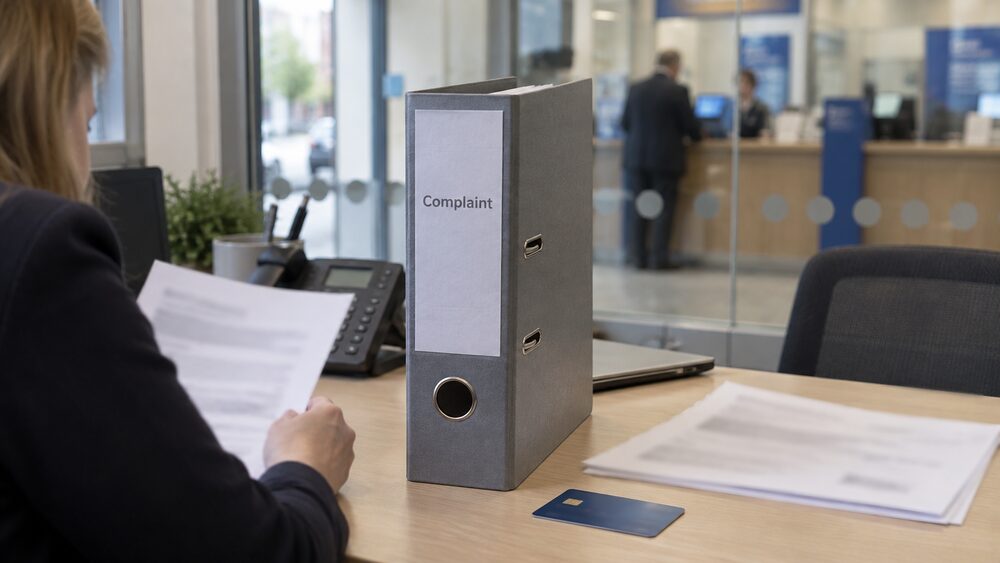
Every complaint route starts in the same place: the firm itself. The ombudsman's process is that a complaint is made first to the company involved, and only then brought to the ombudsman9. For most complaints, a business has up to eight weeks to consider it9. If the firm does not send a final response letter within eight weeks, or the response is not satisfactory, the complaint can be brought to the ombudsman4.
The eight-week rule is a maximum, not a target: many firms respond sooner, and a clear, dated written complaint is what starts the clock. The ombudsman's guidance on how to complain also covers practical points about preparing a complaint, including its position that where AI tools are used to help draft one, personal information that would not normally be shared, such as health or banking information, is best left out of the text entered into them, and that the resulting text needs careful checking9.
The complaint route has two clocks: eight weeks for the firm to respond, then six months from a final response to refer.
The detail of writing the complaint itself, and what to include, is covered in how to complain to a financial firm, and the eight-week rule in full in the eight-week rule: when you can go to the ombudsman.
Taking a complaint to the Financial Ombudsman Service
Once the firm has responded, or eight weeks have passed, the ombudsman can take over. You need to make a complaint to the ombudsman within six months from the date on your final response9. The service is free and easy to use26, and you do not need to pay anyone to represent you, for example a lawyer or claims management company9. Unlike a court, you generally do not need anyone to represent you, and the ombudsman can talk to a member of your family or someone else if you prefer2.
The ombudsman's reach is wide. Its banking and payments work covers current accounts, savings accounts, direct debits, money transfers, electronic payment platforms, cheques and banker's drafts, and it resolves complaints about issues such as account closures, disputed transactions, IT failures, and problems with switching services12. Other guidance covers complaints involving discrimination18, gambling-related harm26, unaffordable lending, logbook loans, and goods and services bought on credit4. The ombudsman makes its decision about what happened using evidence from you, the financial business and any relevant third parties9.
If the ombudsman thinks the business treated you unfairly, it will tell the business to put you back where you would have been if it had not made a mistake, and possibly to make an award for distress and inconvenience12. The process is a form of alternative dispute resolution, and the ombudsman notes that consumers can still go to court if they do not want to accept its decision8.
The full detail is in taking a complaint to the Financial Ombudsman Service, and the time limits in Financial Ombudsman time limits. If your dispute is not with a financial firm at all, which ombudsman? explains the other schemes, and alternative dispute resolution the general route.
What the ombudsman can award, and how compensation is worked out
The ombudsman's awards aim to restore your position, not to punish the firm. Its published approach to mis-sold payment protection insurance shows the arithmetic in real cases: total redress of £2,995 including interest of £555 in one example where a loan was sold on to a third party; £3,836.30 in another, made up of £3,189.97 plus £518.73 plus £127.60, where complete records existed; and £2,310.58, made up of £2,212.70 plus £97.88, where records were incomplete27. The common structure is a refund of what you paid, plus interest, plus any difference the mistake made to your position.
There is a ceiling on the "money award" the ombudsman can require a firm to pay. Its annual review for 2013 recorded compensation of up to £150,000, with £100,000 for complaints received before 1 January 201228. That figure is drawn from the ombudsman's own published material and reflects the position at that date; the current limit is set out on the ombudsman's own pages, and how much compensation the Financial Ombudsman can award covers it in detail.
Awards for distress and inconvenience sit alongside the money award, as the ombudsman's banking guidance makes clear12. In its response to a 2023 Treasury consultation on reforming the Consumer Credit Act 1974, the ombudsman noted that if a complainant accepts its decision, the decision and any redress awarded becomes binding on the firm29.
When a decision becomes binding, and your right to go to court
The ombudsman's final decision works on an acceptance basis. If you accept it, the decision is legally binding on the financial business, and the business cannot simply withdraw from the process2. This is the feature that gives the free service its teeth: a firm that loses must pay what the ombudsman has awarded.
Your own position is different. You are not bound unless you accept. The ombudsman states that consumers can still go to court if they do not want to accept its decision8. So the ombudsman route costs you nothing and carries no risk of a costs order against you for using it, but if you think your case is worth more than the ombudsman can award, court remains open. The trade-offs between the two routes, including costs and time, are set out in ombudsman or small claims court.
The court route differs by nation: small claims court in England and Wales, simple procedure in Scotland and small claims in Northern Ireland. If you disagree with an ombudsman decision after it is issued, what to do if you disagree with an ombudsman decision explains the options, which are narrow by design.
FSCS protection: up to £120,000 per person if a bank fails
The FSCS is the safety net for failure. If a bank or building society fails, the FSCS will automatically pay back customers' money within seven working days in most cases1. The protection limit is £120,000 per person, per firm30, and the FSCS states that from 1 December 2025 it will automatically compensate up to £120,000 per eligible person, per bank, building society or credit union5. Coverage includes deposits, current accounts and savings accounts30.
Several features of the limit matter in practice:
- Per firm, not per account. The £120,000 applies across all accounts you hold with one authorised firm, so two accounts at the same bank share one limit31.
- Per person. Each eligible person gets their own limit, which is what makes joint accounts and family savings work differently; see FSCS cover on joint accounts.
- Per authorised firm, not per brand. Several high street brands can share one banking licence, so money across them counts together; see FSCS protection when bank brands share a licence.
- Companies can claim too. In the case of deposits, large companies are also able to claim compensation, although some exclusions may apply24.
The FSCS is funded by the financial services industry and is free to use24. All the authorised firms whose customers are protected pay a levy to fund the cost of claims11. The scheme's own leaflet states that in most cases, for deposits, it aims to pay compensation within seven days of a bank, building society or credit union failing24, and its bank-specific guidance says money is returned within seven working days in most cases1. More complex cases, including some temporary high balance claims, take longer5.
Which?, writing about emergency funds in June 2026, puts the consumer point simply: the scheme protects up to £120,00032. Money above the limit with a failed firm is lost to the protection, which is why how to keep savings above the FSCS limit covered matters to anyone with a large balance, for example after a house sale. The full detail of the scheme is in the FSCS explained and FSCS compensation limits; what happens on the day a bank fails is in what happens if a bank fails.
What the FSCS covers beyond savings: pensions, insurance, investments and funeral plans
The FSCS covers a range of financial products if a UK-authorised financial firm fails, including deposits, insurance, investments, pensions, mortgage advice and certain other regulated services6. Its own summary lists seven different types of business: deposits, insurance policies, insurance broking, investment business, mortgage (home finance) advice or broking, debt management, and funeral plans24. Funeral plans have been covered since 29 July 202233.
The limits differ sharply by product, and this is where many people are caught out:
| Type of product | FSCS protection |
|---|---|
| Deposits (banks, building societies, credit unions) | Up to £120,000 per person, per firm5 |
| Investments | Up to £85,000 per eligible person, per firm6 |
| Debt management | Up to £85,000 per person, per firm24 |
| Most general insurance | 90% of the claim, with no upper limit34 |
| Whole of life assurance | 100% of the claim7 |
| Warranty claims | 90% of the claim7 |
The limits are not one number: deposits, investments and insurance are protected on different bases.
For debt management, the limit depends on when the firm failed: up to £85,000 per eligible person, per firm for firms that failed after 1 April 2019, and up to £50,000 per eligible person, per firm for firms that failed between 1 April 2018 and 31 March 201934. For funeral plans, if a provider fails and arrangements with a new regulated provider are not in place, the FSCS protects holders of an authorised funeral plan; a customer's nominated representative or next of kin will need to contact the named funeral director in the original funeral plan, then notify the FSCS by phone, post or live chat33. One further wrinkle for tax-wrapped products: if money is held in a child trust fund or junior ISA account, compensation will have to be paid into another ISA rather than being cashed31.
The FSCS also answers the question "does FSCS protect financial advice?" directly in its guide to investment protection, which walks through checking a provider's authorisation and what the activity covers23. The detail for pensions and platforms is in FSCS protection for pensions, platforms and funds, for funeral plans in are funeral plans protected by the FSCS, and for what is excluded in what the FSCS does not cover.
Chargeback for card purchases: the 120-day window
Chargeback is a card scheme process that reverses a payment back to the retailer's bank. It applies when goods or services you paid for by card do not arrive, are not as described, or the trader has gone bust. You usually have around 120 days to raise a chargeback about goods or services4, and MoneyHelper advises claiming as soon as you realise there is a problem, as you will usually need to claim within 120 days36.
Two features shape how chargeback fits with other protections. First, debit cards also offer chargeback protection on all purchases, but not Section 75, the statutory protection that applies to credit cards36. Second, chargeback is a scheme rule, not a law: it is discretionary and time-limited in a way statutory rights are not. The ombudsman can look at complaints involving goods and services bought on credit4, so if a bank refuses a chargeback and you think it was wrong to, the complaint route remains open.
The practical sequence is:
- Contact the trader first and ask for a refund or replacement.
- If that fails, ask your card provider to raise a chargeback, with evidence of what you paid and what went wrong.
- Keep within the window: usually around 120 days from when the problem arose4.
- If the bank refuses and you believe it handled the claim wrongly, complain to the bank, then to the ombudsman.
Your underlying statutory rights when goods, services or digital content are faulty are separate and longer-lived: see your statutory rights, refund, repair or replacement for faulty goods and your rights when digital content or an app is faulty. If the trader has gone bust rather than merely let you down, when a company goes bust explains where gift cards, deposits and orders stand.
Scams, unauthorised payments and where to report them
Scam protection splits by what happened. The ombudsman groups scams involving unauthorised payments, stolen details and identity theft into three categories, and handles complaints about the way a financial business has dealt with such a scam37. In other words, even where the scammer is beyond reach, your own bank's conduct, its fraud controls and its response to your report are all things the ombudsman can examine.
If you have been scammed, the ombudsman's immediate steps are:
- Contact your bank or payment services provider immediately.
- Contact the police on 101.
- Report the scam to Report Fraud.
- Keep records of all contact and correspondence between you and the scammer.37
The FSCS advises anyone who has been scammed to speak to their bank, building society or credit union, as they can protect and reimburse victims of certain types of fraud, and to report to Action Fraud at www.actionfraud.police.uk38. The Payment Systems Regulator has consulted on measures including extending customer protection across all banks and building societies at a minimum standard by changing payment system rules, and requiring banks and building societies to adopt a standardised approach to sharing data to help identify scams and stop them happening in the first place39.
The wider picture, including authorised push payment scams and how reimbursement works, is covered in scams and fraud: a complete guide, and safe online shopping habits in MoneyHelper's guidance on shopping safely online36. If a payment has simply gone wrong rather than been fraudulent, when a payment goes wrong: your bank's duties sets out what your bank must do.
Where protection stops
Every limit on this page has an edge, and knowing the edges is as useful as knowing the cover. The FSCS cannot protect e-money or payment services firms30, and there are some kinds of insurance that are not eligible for protection35. The FSCS only covers firms authorised by the FCA or PRA to do business in the UK24, so money with an unauthorised firm, or held offshore outside the scheme's scope, is unprotected; is cash in an offshore bond protected by the FSCS? and UK subsidiaries of overseas banks cover the boundary cases.
On the complaints side, the deadlines are hard edges: eight weeks for the firm to respond, then six months from the final response to refer9. The ombudsman's power is bounded by its money award limit28. And on the statutory side, the ombudsman noted in its 2023 response to the Treasury that it is not aware of any areas where consumer protection legislation, rules or guidance outside of the Consumer Credit Act mirrors or replicates the effects of the CCA's provisions29, which means consumers cannot assume the CCA's protections exist in duplicate elsewhere.
The ombudsman also handles complaints about firms it regulates through a specific lens: for example, its guidance on complaints involving gambling-related harm26 and on supporting customers in vulnerable situations40 shows where it expects firms to have gone further than the bare minimum. Where a firm has failed, the FSCS's own claims process sets out who is involved and what happens next35, and if you think the FSCS has decided your claim wrongly, how to challenge an FSCS decision explains the route.
Who provides free help
None of this costs the consumer anything at the point of use. The ombudsman is free for consumers8, and bringing a complaint to it is straightforward and will not cost you anything9. The FSCS is funded by the financial services industry and is free to use24. The FSCS contact number is 0800 678 1100, and its email address is communication@fscs.org.uk41.
Beyond the statutory bodies, MoneyHelper provides free guidance on everyday banking and shopping safely online36. Claims management companies can help you make certain types of claims against financial services providers for a fee, such as claiming for mis-sold payment protection insurance, but they are not required: the ombudsman states you do not need to pay anyone to represent you42. If you do use one, ask for a copy of their complaints procedure or check their website, contact the company with your complaint so they have a chance to put things right, and keep a record; complain to the FCA if you are unhappy with the conduct of a claims company42. What they charge and when they are worth considering is covered in claims management companies.
Banks themselves publish the FSCS position for their own customers: NatWest, for example, states on its own pages that the FSCS limit is £120,00043. The FSCS's online materials carry the same figure and the seven-day payout aim for deposits41. For a dispute rather than a failure, the choice between the two statutory routes is compared in FSCS vs Financial Ombudsman Service, and for a bank complaint specifically, complaining about a bank or building society walks through it step by step.
Sources43 cited
- Deposit protection: banks Financial Services Compensation Scheme, 2026-09-25
- How we make decisions Financial Ombudsman Service, 2026-09-27
- About the Consumer Duty Financial Conduct Authority, 2026-02-24
- Goods and services bought on credit Financial Ombudsman Service, 2026-09-25
- What we cover: banks, building societies and credit unions Financial Services Compensation Scheme, 2026-09-25
- What we cover Financial Services Compensation Scheme, 2026-09-25
- What we cover: insurance Financial Services Compensation Scheme, 2026-09-25
- Governance and funding: alternative dispute resolution Financial Ombudsman Service, 2026-09-27
- How to complain Financial Ombudsman Service, 2026-09-25
- Protect your money Financial Services Compensation Scheme, 2026-09-25
- What is the Financial Services Compensation Scheme? Bank of England, 2025-12-01
- Banking and payments complaints Financial Ombudsman Service, 2026-09-25
- FSCS beyond compensation: research findings Financial Services Compensation Scheme, 2022-11
- Save with a bank or borrow from a credit union Welsh Government, 2026
- PRIN 2A: The Consumer Duty FCA Handbook, 2026-06-26
- Treating customers fairly Welsh Government, 2026
- Our approach to consumers Financial Conduct Authority, 2025-05-02
- Complaints that involve discrimination Financial Ombudsman Service, 2026-09-26
- MCOB 11: responsible lending FCA Handbook, 2026-06-26
- BCOBS 5: banking conduct FCA Handbook, 2026-06-26
- COBS 6.15: platform services FCA Handbook, 2026-06-26
- The new Consumer Duty: setting a higher standard of care Financial Ombudsman Service, 2022-08-08
- Guide to investment protection Financial Services Compensation Scheme, 2026-09-25
- FSCS protected badge leaflet Financial Services Compensation Scheme, 2025-11-27
- Unaffordable lending complaints Financial Ombudsman Service, 2026-09-26
- Complaints that involve gambling-related harm Financial Ombudsman Service, 2026-09-26
- The ombudsman's approach to redress for mis-sold PPI Financial Ombudsman Service, 2026-09-27
- Annual review 2013 Financial Ombudsman Service, 2013-05
- Response to HM Treasury consultation on reforming the Consumer Credit Act 1974 Financial Ombudsman Service, 2023-03-17
- Check your money is protected Financial Services Compensation Scheme, 2026-09-25
- Deposit protection: credit unions Financial Services Compensation Scheme, 2026-09-25
- What to look out for when building an emergency fund Which?, 2026-06-26
- Funeral plans: protection for MPs' constituents Financial Services Compensation Scheme, 2026-09-25
- What we cover: debt management Financial Services Compensation Scheme, 2026-09-25
- The claims process: who's involved Financial Services Compensation Scheme, 2026-09-25
- Shop safely online MoneyHelper, 2026-09-25
- Scams involving unauthorised payments and identity theft Financial Ombudsman Service, 2026-09-26
- FSCS podcast episode 46 transcript Financial Services Compensation Scheme, 2025
- CP21/3: authorised push payment scams, call for views Payment Systems Regulator, 2026-09-26
- Supporting customers in vulnerable situations Financial Ombudsman Service, 2026-09-26
- FSCS protected website leaflet Financial Services Compensation Scheme, 2025-11
- Complain about a claims management company GOV.UK, 2026-09-26
- Financial Services Compensation Scheme NatWest, 2026-09-25




 Citizens AdviceFree advice on money, consumer and legal problems in England and Wales
 Financial Ombudsman ServiceFree, independent help when a complaint about a firm is not put right
 MoneyHelperFree, impartial money and pensions guidance, set up by government
 Citizens Advice ScotlandFree advice across Scotland