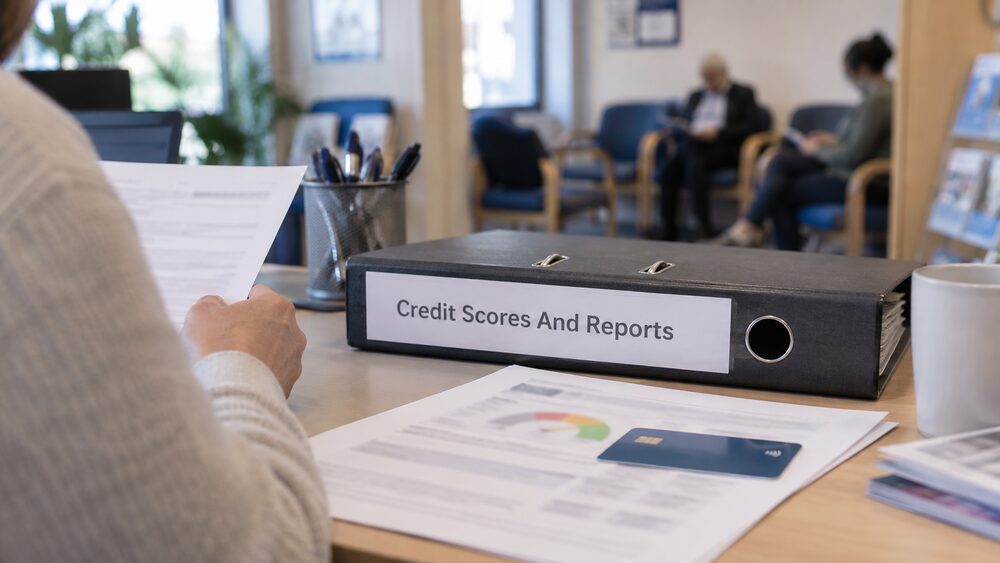
A credit score is a number a lender works out to estimate how likely you are to repay what you borrow. Citizens Advice describes it plainly: "Credit scoring is a system used by creditors to decide how much of a risk it is to lend to you"1. Each lender sets its own threshold, and if your score falls below it, the lender may refuse you credit or charge you more if it agrees to lend at all1. The score itself is built from your credit report, a record of your borrowing history held by credit reference agencies.
Three things follow from that, and they shape everything on this page. First, there is no single UK-wide credit score: the three main agencies, Experian, Equifax and TransUnion, each hold their own file on you and each can give you a different number2. Second, most information stays on your file for six years, so a missed payment today can still be visible to lenders years later1. Third, you have the right to see what is held about you, for free, and to challenge anything that is wrong3.
A credit score is a lender's guess at how likely you are to repay
When you apply for credit, whether a card, a loan, a mortgage or even a bank account, the lender checks your record with a credit reference agency before deciding. Citizens Advice explains that when you apply for a credit card, "the credit card provider will check your credit record with a credit reference agency, to see if you are credit worthy"7. The lender then scores what it finds, using its own rules and its own threshold. If your score is below that threshold, it may decide not to lend to you, or to charge you more if it does agree to lend1.
Two points are worth fixing in your mind early. The first is that the score a lender uses is its own, not the number you see on an app. The lender takes the raw information from your file, such as your payment history, how many accounts you have open and any court judgments, and applies its own scoring model to it. The second is that different lenders weigh things differently. One may care most about missed payments, another about how much of your available credit you are using. That is why the same person can be accepted by one lender and refused by another in the same week.
The stakes are highest with mortgages. Mainstream mortgage lenders will all expect you to have a good credit score8, and a poor file can narrow your options to specialist lenders and higher costs. But the same mechanics apply to smaller borrowing: every application involves a check, and every check leaves a trace. If you apply to lots of lenders in a short space, "this will leave a trail on your credit reference file", and lenders may read that trail as a sign you already have lots of borrowing or have been refused elsewhere1.
Age sets a floor for borrowing itself: you must be 18 to apply for a loan or a mortgage9. Below that, the question of a credit score does not arise, because lenders will not lend.
What is on your credit report, and what is not
Your credit report is a record of how you have borrowed and repaid, plus identifying information that helps lenders confirm you are who you say you are. The Information Commissioner's Office (ICO), the regulator for data protection, describes what the agencies hold: it includes details of your previous addresses and information from public sources such as the electoral roll, public records including county court judgments, and bankruptcy and insolvency data4.
In practice, a report covers:
- credit accounts you hold or have held, and your payment record on them
- missed payments, arrears and defaults
- court judgments and insolvency records, such as bankruptcy, IVAs and debt relief orders
- the electoral roll, used to confirm your name and address
- financial associations, meaning links to people with whom you share a joint product
- searches by lenders, which leave footprints other lenders can see
Some things people expect to find are not there. Credit reports do not include information about your balance, though they do show lenders how many accounts you have open10. The statutory credit report you can order free from each agency does not include your score at all11. Student loans for courses starting on or after September 1998 are not generally passed to credit reference agencies3. Council tax debts are not kept by credit reference agencies either5, although if arrears end in a court judgment, that judgment is a public record and can appear.
The information is not used only for lending. The ICO notes that the data held by the agencies is also used to verify the identity, age and residency of individuals, to identify and track fraud, to combat money laundering and to help recover payment of debts4. So a credit file check can be part of opening a bank account or a phone contract, not just a loan application.
One rule surprises many people: data protection law does not require lenders to report your information to all the agencies. As the ICO puts it, "As there is no requirement under data protection law for lenders to report such data to all the CRAs, it is up to the lender to decide which CRA they wish to use, if any"4. This is why your file can differ between agencies, and it is covered in more detail below. Equally, the agencies do not need your consent to process your data: data protection law does not require the CRAs, or any other organisation, to have your consent before they are allowed to process your personal data4.
The three credit reference agencies: Experian, Equifax and TransUnion
There are three main credit reference agencies in the UK: Experian, Equifax and TransUnion4. TransUnion was formerly known as Callcredit2. These are the agencies lenders mainly use when they check an application12, and they are the three biggest organisations for checking your credit report13.
Each agency is a separate business holding its own database. StepChange, the debt charity, explains that each CRA gets different information from lenders, which means your credit file may not look the same at each one14. National Debtline makes the same point: there are three credit reference agencies, and they may each hold different information about you15. Some lenders report to all three, some to one or two, and some to none16.
Because of that, debt charities' guidance is to check your file with all three agencies rather than one. StepChange puts it this way: "It is worth checking your credit file with all three credit reference agencies. They keep different records"17. The agencies operate UK-wide18, and you can contact them to find out who you owe money to and what is in your credit history18.
The agencies also generate some information themselves. The ICO states that the information generated by the CRAs, and for which they are responsible, includes financial links, linked addresses and alias information4. This matters when something is wrong: if the error is in a link or an address, the agency can fix it directly, but if it is in account data supplied by a lender, the agency cannot change it without that lender's permission, a distinction that comes up again in the section on errors.
The agencies have a special agreement in place which enables them to share information with each other about victims of fraud4. So a fraud marker recorded through one agency can be visible to the others, which is one reason identity theft can affect your file across the board.
Why you have more than one credit score
If you check your score with more than one agency, you will almost certainly get different numbers. This is normal, and it has three causes.
The first is the data. Because lenders choose which agency or agencies to report to4, each file can contain a different set of accounts. A card you have paid perfectly for years may show at Experian but not at Equifax, so the two scores are built from different evidence14.
The second is the scale. Each agency scores on its own range and attaches its own word grading. Advice NI for Northern Ireland notes that each credit score, regardless of the agency, will be a three digit number accompanied by a word grading2. One widely used scale runs from 0 to 1,00019. Equifax scores on a 0 to 1,000 scale with these bands20:
| Equifax band | Score range |
|---|---|
| Excellent | 811 to 1,000 |
| Very good | 671 to 810 |
| Good | 531 to 670 |
| Fair | 439 to 530 |
| Poor | 0 to 438 |
Experian and TransUnion use different scales, so a 700 at one agency does not mean the same thing as a 700 at another. TransUnion has also changed its score scale, so people who track a TransUnion score may see their number move for no other reason than the change itself12. Experian has likewise made changes to its score21. The practical rule is to compare your score only within one agency's own scale and bands, and to judge your position by the word grading rather than the raw number.
The third cause is the scoring model. Even with identical data, two agencies can weigh it differently. And the score a lender calculates for its own decision is its own model again, which is why the number on your app is a guide, not a verdict.
Checking your credit report for free
There is no cost to see your credit file. You can ask each credit reference agency for a free copy of your credit report under the Data Protection Act 20185. Business Debtline sets out how: to get a free copy, you need to contact the credit reference agencies and fill in an application form, and you can usually apply in writing, by phone or online22. Making this request is free of charge23. You can either ask the agencies to post a copy to you or view it online for free with adverts14. The service is free, though you may be asked for card details, as this helps the agency find your record17.
Beyond the statutory report, free services exist that show both your report and your score. Which? notes that with Experian, all you need to do is download the Experian app to see both your credit report and your credit score for free24. Similar free access exists for the other agencies' data through free checking services.
A few practical points:
- You can check your score as often as you like without doing any harm24.
- Your report should be sent to you within seven working days, unless the agency needs you to send proof of your identity and address3.
- The statutory report is free, but it does not include your score11; the score comes from the agencies' own free services or paid subscriptions.
- A fee of £2 has been cited for obtaining a statutory credit file from the CRAs25, but free routes exist under the Data Protection Act 20185, so check before paying anything.
Checking your file before a big application is worth the few minutes it takes. Shelter advises renters to check their credit score for free online before looking for a property to rent26, and the same logic applies before a mortgage or a loan: you can see what the lender will see, fix anything wrong, and avoid a failed application that itself leaves a mark.
What lowers a credit score
The clearest single answer: failed applications. StepChange warns that any failed application reduces your credit rating, and calls the pattern the "rejection spiral"27. One refusal makes the next application riskier, which makes another refusal more likely.
Around that spiral sit the things that damage a file in the first place:
- Missed and late payments. Not being on the electoral roll, or making a late payment, negatively affects your score regardless of the agency24.
- Lots of applications close together. A lot of checks in a short amount of time can reduce your score28. Multiple hard searches, particularly within a short period, can lower your credit score13. Making several mortgage applications very close together could significantly damage your credit score8. Applying for too many cards, or regularly switching cards, can affect your rating7.
- Defaults and court judgments. A default usually happens after you have missed between three and six months' payments3, and stays on your file for six years from the date of default3. Court judgments are kept on record for six years3.
- Financial associations. A joint account, loan, mortgage or credit card creates a financial link between your files. StepChange explains: "A 'financial association' links your credit files. This means your record of making reduced payments may affect the other person's credit file and their ability to get credit"29. Which? gives the same warning about joint savings accounts: a joint account can create a financial link which affects your own score30.
On that last point, the detail matters. A partner's poor credit does not always affect you, even if you are married or in a civil partnership, unless you have a joint account, loan or credit card with them31. Someone you live with can affect your score if they have a bad credit history, but only where a joint product exists31. Simply sharing an address does not link files.
How long information stays on your file: usually six years
Six years is the standard retention period, and it applies to most of what people worry about. Citizens Advice states that information about you is usually held on your file for six years1. StepChange lists what that covers: "Some information stays on your credit file for six years, like missed payments, defaults and court judgments"19. National Debtline agrees that information such as missed payments, default notices and court judgments will generally stay on your credit file for six years32.
The six-year clock starts at different points for different entries3:
| Entry | Deleted |
|---|---|
| Missed payments (arrears) | six years |
| Defaults | six years from the date of default |
| Settled accounts | six years from the date the account is settled or the last payment, unless a default was registered |
| County court judgments | six years from the date of the judgment, whether or not paid |
| High court judgments | six years from the date of the judgment, whether or not paid |
| Administration orders | six years from the date of the order |
| Bankruptcy orders | normally six years from the order, unless a bankruptcy restrictions order or undertaking lasts longer |
| Debt relief orders | normally deleted after six years, extendable by a restrictions order or undertaking |
| IVAs | normally six years from the date the IVA was set up, or until the IVA ends if it runs longer |
Two rules sit around the default itself. Lenders should notify consumers of their intention to register a default at least 28 days before doing so25. And a default is typically registered when the consumer is between three and six months in arrears25. So a default should not arrive as a surprise, and it should not arrive after a single missed payment.
Six years is the norm, not a law of nature. Mental Health and Money Advice cautions that most information stays on your credit report for six years, "but this is not always the case"33. Business Debtline notes the agencies will leave most information on your report for at least six years5, and National Debtline points out that if you have been in a debt management plan for longer than six years, your debts may have already dropped off your file16. The direction of travel matters too: entries are deleted on schedule whether or not the debt was paid, but a satisfied entry reads better to a lender than an unpaid one.
Hard and soft searches: which ones lenders can see
Not every check of your file is the same. A hard search is a full search of your credit report by a lender deciding an application. Hard checks "leave a 'footprint' on your credit file that's visible to other lenders for at least 12 months and can impact your credit report and score"24. A soft search is a lighter check that other lenders cannot see.
The distinction drives three everyday situations:
- Your own checks are soft. You can check your own credit score without hurting it28, and Experian confirms that checking your own score won't affect it34.
- Landlord checks are soft. Landlords and letting agents can only do a soft search26. This means they only see information that is already public, for example county court judgments, an IVA or bankruptcy35. A credit check by a landlord or agent does not affect your credit score35.
- Application checks are usually hard. Multiple hard searches, particularly within a short period, can lower your credit score13, which is why spacing out applications matters.
The practical consequence is that the checks you make yourself, and the checks landlords make, cost you nothing. The checks that count are the ones lenders make when you apply for credit, and those are the ones to ration. If you are comparison shopping, an eligibility checker that runs a soft search before you apply can tell you whether a full application is likely to succeed, without leaving the footprint a failed application would.
How to improve your credit score
Improvement is slow and unglamorous: it means fixing what is wrong, then demonstrating good repayment over time. StepChange lists the core actions27:
- Pay back any credit you have borrowed.
- Register on the electoral roll.
- Check your credit report to make sure it is correct.
- Make sure your credit file is not linked to somebody with a poor credit score.
Each of those maps to something on this page. Paying back what you owe stops new arrears being recorded, and arrears are the raw material of a damaged file. Being on the electoral roll matters because its absence is one of the few things that hurts your score at every agency24. Checking your report matters because errors are common enough that the correction process exists in law, and a wrong default or a stale financial association can hold a score down for years. Unlinking from a former partner's poor credit matters because the association itself, not your own conduct, is what the lender sees.
Experian's own guidance adds that checking your own score won't affect it, so there is no reason not to monitor progress as you go34. StepChange also notes that a lot of checks in a short amount of time can reduce your score28, so part of improving a score is simply not applying for much while it recovers.
There is no shortcut, and services that promise one deserve caution. The Financial Conduct Authority has issued guidance stating that misleading claims about removing negative but accurate credit file entries are likely to contravene its Principles, as is failing to explain that a credit reference agency will only respond to the customer36. Accurate negative information stays until its time is up; only inaccurate information can be removed through a dispute.
Errors on your credit report and how to correct them
Wrong information on a credit file is a recognised problem, and there is a set process for dealing with it. The starting point is the split of responsibility described earlier: the ICO says CRAs can't amend data on credit files provided by other companies without that company's permission37. So when you dispute an account entry, the agency must check with the lender that supplied it. The CRA should remove the information or explain why it won't within 28 days37.
The process in order:
- Check your report with each of the three agencies, because they hold different records17.
- Raise the wrong entry with the agency that holds it, online or in writing.
- The agency checks the entry with the lender that supplied it, since it cannot change lender data without permission37.
- The agency should remove the information or explain why it won't within 28 days37.
- If you are not satisfied, make a formal complaint to the agency, and if that fails, take it to the Financial Ombudsman Service.
Two limits are worth knowing. The CRAs won't remove adverse information if it's correct, although you may ask to submit a "notice of correction" note to explain the circumstances37. A notice of correction is free and can be up to 200 words33, and you can ask the agency to add one explaining why you got into debt or why you think information on your report is wrong5. It does not remove the entry, but future lenders read it alongside it.
The second limit concerns insolvency records. The Insolvency Service is not able to correct any information on your credit file; you must contact the credit reference agency to resolve any issues38. So a wrong bankruptcy or debt relief order entry on your file is fixed through the agency, not through the official body that administered the insolvency.
One more reason to check: being refused financial services, credit cards or a loan, despite having a good credit rating, is listed by the ICO as a warning sign of identity theft39. Entries you do not recognise on your report can mean someone has used your details to borrow, and the sooner that is disputed and flagged, the less damage follows.
Refused credit: what the lender must tell you
Refusal is not a dead end, and it is not a secret either. If a lender refuses you credit after checking your credit reference file, they must tell you why credit has been refused and give you the details of the credit reference agency they used1. The finance company should give you good reasons why they turned you down, including telling you if they have used a credit-scoring system22.
Lenders will not tell you what your score is, but if you ask them, they must tell you which credit reference agency they used to get the information about you1. That tells you which file to check first, which saves checking all three before you know where the problem sits.
The reasons for refusal vary. Your score may have fallen below that lender's threshold1. Something on the file, such as a default or a judgment, may have failed the lender's rules. Or the refusal may have nothing to do with your history: affordability, income and the lender's own appetite for lending all play a part. What you can do is get the reason, get the agency's name, order that report free5, and look at what it shows before applying anywhere else, since each failed application reduces your credit rating27.
If refusals keep coming despite a good rating, treat it as a possible sign of identity theft and check your file for entries you do not recognise39.
Where to complain about a credit reference agency
If an agency will not fix an error, or handles your dispute badly, you have a formal route. You have the right to complain to the Financial Ombudsman Service about how a credit reference agency has dealt with your credit file, but you must follow the agency's own complaints process first5. Advice NI sets out the same sequence: complain to the agency, and if that does not resolve your complaint, you then have the right to complain to the Financial Ombudsman Service2. StepChange agrees: if you feel your complaint has not been resolved fairly, you can escalate your complaint to the Financial Ombudsman Service19.
The order of steps:
- Raise the disputed entry with the agency and let its 28-day response period run37.
- If unsatisfied, make a formal complaint through the agency's own complaints process5.
- If the agency rejects the complaint or eight weeks pass, complain to the Financial Ombudsman Service5.
The Ombudsman's workload shows this is a used and live route: its quarterly complaints data for Q1 2026/27 records complaints across credit categories, including credit broking40. In Northern Ireland, Consumerline can also take complaints about credit and can refer them to the Trading Standards Service for investigation or the Financial Conduct Authority, which authorises lenders41.
Free, impartial help with the underlying debt is available alongside. StepChange, National Debtline and Business Debtline all publish guidance on credit files and will advise on debt problems behind a damaged file14, and Citizens Advice covers how lenders decide whether to give you credit1. If the problem is an abusive partner linked to your finances, Surviving Economic Abuse publishes specific guidance on credit reports and on separating your finances42.
Sources42 cited
- How lenders decide whether to give you credit Citizens Advice, 2026-09-25
- Credit reports and credit reference agencies Advice NI, 2026
- Credit reference agencies National Debtline, 2026-09-25
- Credit Information Commissioner's Office, 2026-09-25
- Credit reference agencies Business Debtline, 2026-09-26
- How to check your credit score for free Which?, 2025-10-24
- Choosing and applying for a credit card Citizens Advice, 2026-09-25
- Applying for a mortgage Which?, 2026-05-20
- Managing your own money Scope, 2025-08-18
- How to open a bank account online Which?, 2026-04-23
- Do you understand your credit score? Which?, 2025-05-10
- TransUnion credit score shake-up: what the changes mean for you Which?, 2026-09-06
- Bad credit mortgages Which?, 2025-10-08
- Finding who I owe money to StepChange, 2026-09-25
- Getting ready: advice National Debtline, 2026-09-25
- Can you get a mortgage with a debt management plan? National Debtline, 2026-09-25
- Work out what you owe StepChange, 2026-09-25
- Credit reference StepChange, 2026-09-25
- How does debt affect a credit file? StepChange, 2026-09-25
- How to check your credit score for free Which?, 2025-10-24
- New Experian credit score shake-up Which?, 2025-11-03
- Your non-priority debts Business Debtline, 2026-09-26
- Credit Information Commissioner's Office, 2026-09-25
- How to check your credit score for free Which?, 2025-10-24
- Payday lending report Financial Ombudsman Service, 2026-09-27
- Credit checks when renting Shelter England, 2026-05-01
- Credit cards, bad credit score StepChange, 2026-09-25
- Credit score StepChange, 2026-09-25
- DMP and credit score StepChange, 2026-09-25
- Should you open a joint savings account? Which?, 2026-02-09
- How to rent with a poor credit history Shelter England, 2026-05-01
- Getting credit card debt written off: your rights and options National Debtline, 2026-09-25
- Will I be blacklisted? Mental Health and Money Advice, 2025-09-08
- Improve your credit score Experian, 2026
- How landlords and letting agents check tenants Shelter England, 2026-05-01
- FCA Consumer Duty guidance on credit information services claims Financial Conduct Authority, 2026-06-26
- Credit reference agencies and credit files House of Commons Library, 2026-09-26
- Once you have a Debt Relief Order (DRO) GOV.UK, 2023-12-19
- Identity theft Information Commissioner's Office, 2026-09-25
- Quarterly complaints data Q1 2026/27 Financial Ombudsman Service, 2026
- Loans nidirect, 2025-09-30
- Your credit report Surviving Economic Abuse, 2025-02






 MoneyHelperFree, impartial money and pensions guidance, set up by government
 Financial Ombudsman ServiceFree, independent help when a complaint about a firm is not put right
 Citizens AdviceFree advice on money, consumer and legal problems in England and Wales
 StepChangeFree debt advice and solutions from a charity
 GOV.UKOfficial information on tax, benefits and government services