
Two figures shape most of what happens to household money in the UK: the Bank of England's Bank Rate and the official rate of inflation. Bank Rate is currently 3.75%, and on 17 September 2026 the Bank held it there for the sixth meeting in a row1. Inflation, measured by the Consumer Prices Index including owner occupiers' housing costs (CPIH), rose to 3.3% in the 12 months to August 2026, its second monthly rise in a row2. The Government's target for inflation is 2%, and adjusting Bank Rate is the Bank's main tool for trying to get there3.
This guide explains what each of these figures is, who sets and measures them, and how they reach mortgages, savings, rents and bills. It also sets out where the official numbers are published, how the different inflation measures differ, and what protection exists when rates and prices move against you.
What Bank Rate is and why it matters to you
Bank Rate is the rate of interest the Bank of England pays to commercial banks, building societies and other financial institutions that hold money with it3. It is the single most important interest rate in the UK: because it shapes what it costs banks to fund themselves, it feeds into the rates those banks then charge and pay across the whole economy. The Bank describes it as the core interest rate in the UK, and setting it is the Bank's job4.
For a borrower, the interest rate, or lending rate, is the amount charged for borrowing, shown as a percentage of the total loan. For a saver, the interest rate, or savings rate, tells you how much money will be paid into your account, as a percentage of your savings4. Bank Rate sits behind both, but it does not set them directly. Each bank sets its own rates for its own products, which is why two lenders can charge very different amounts for what looks like the same mortgage5.
The reach of Bank Rate is wide but uneven. The Bank of England says raising or lowering Bank Rate mainly affects people with variable mortgages, whose payments can move soon after a decision5. Savers see it in the rates paid on savings accounts, though not always to the same extent or at the same speed. Borrowers on fixed rates are insulated until their fix ends. Renters, whose rents are not set by interest rates at all, feel the effects indirectly, through what landlords pay on any borrowing and through the wider path of prices and wages.
Bank Rate: 3.75% and held for six meetings in a row
Bank Rate stands at 3.75%1. The Monetary Policy Committee held it there in July 2026, the fifth consecutive hold, and again on 17 September 2026, the sixth6. A hold is not a sign that nothing is happening: the Committee votes on the rate at every meeting, and the vote itself can reveal disagreement about the direction of travel. The next decision is due to be announced on Thursday 5 November 20261.
The reason a hold can matter as much as a change is that expectations do a lot of the work. When the Committee holds Bank Rate while inflation is rising, it is signalling that it expects the pressure on prices to ease without a further rise in rates. When it holds while inflation is near target, it is signalling that it sees no case for a cut yet. Borrowers and savers respond to those signals, and the rates on new fixed mortgages and savings accounts move on expectations of future Bank Rate, not only on the rate today.
For households, the practical reading of a hold is straightforward. Tracker mortgage rates stay where they are, because they follow Bank Rate exactly. Standard variable rates and discount rates usually stay put too, because lenders tend to leave them alone when Bank Rate is unchanged, though they are not bound to. Fixed rates on new deals continue to be priced on what lenders expect over the coming years, so they can move between decisions. Savings rates on variable accounts are typically left unchanged, though a provider can change them at any time for its own reasons.
The Committee's task at each meeting is judged against the 2% inflation target, and the background to the current holds is an inflation rate above that target and rising. How that tension is resolved, and how quickly, is what the November decision and those after it will turn on.
How the Monetary Policy Committee sets Bank Rate
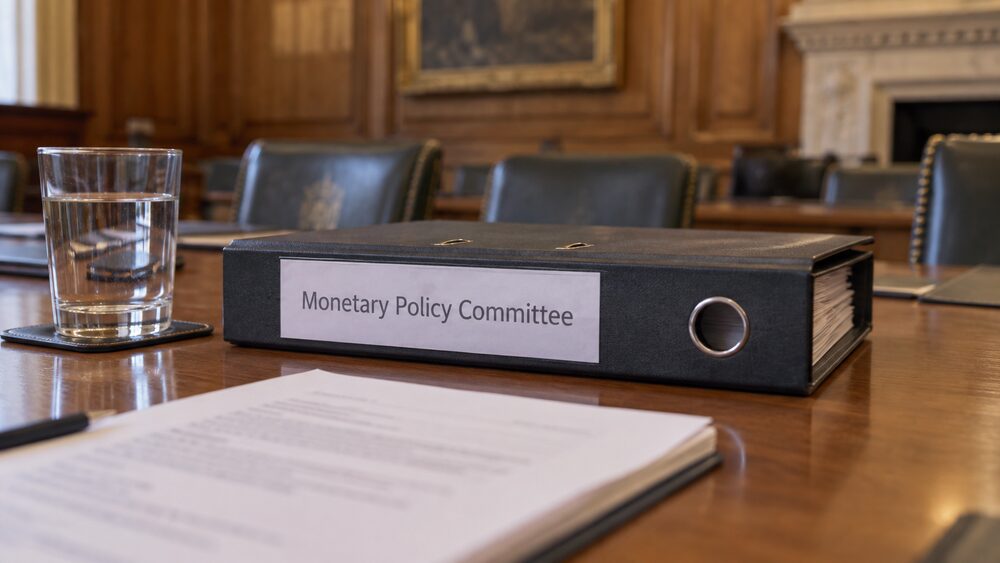
Bank Rate is set by the Monetary Policy Committee, usually shortened to MPC. It is a group of nine people with a variety of backgrounds, responsible for setting Bank Rate1. Five of the nine are internal members, already employees of the Bank. Four are external members, people from outside the Bank with relevant knowledge or experience, appointed by the Chancellor for a fixed term. The Governor appoints the Chief Economist after consultation with the Chancellor3.
The Committee meets to look at the evidence and make a decision about every six weeks, which works out at eight scheduled decisions a year1. The decision, with minutes of the meetings, is published at midday on the Thursday of decision week3. The membership structure is set out in the Bank of England Act 1998, and the arrangements for how the Committee reaches and publishes its decisions follow recommendations made by the 2014 Warsh Review, with the structure set out in the Bank of England and Financial Services Act 20163. Since 2015 the Committee's second and final meetings have been recorded, and transcripts are published after an eight-year delay3.
What the Committee looks at is the state of the UK economy. Nationwide, a major mortgage lender, summarises the decision basis as the financial state of the UK economy, including inflation, employment figures and consumer confidence7. The Committee is not targeting the interest rate itself: it adjusts Bank Rate as the instrument for meeting the inflation target the Government has set it. That is why a decision can look odd in isolation, holding rates while inflation is above target, for example, and only make sense as a judgement about where inflation is heading over the next year or two.
The fuller guide to the Monetary Policy Committee covers the membership, the calendar and how each vote is published.
The 2% inflation target and how inflation is measured
The Government sets the Bank of England a target of getting inflation to 2%3. The target is measured on the Consumer Prices Index, the CPI: when the target was framed, the Committee was instructed to target an inflation rate of 2% as measured by that index8. The Scottish Government's own cost of living analysis likewise refers to the Bank of England's target rate of 2%9. The Bank's statutory objective, set in law, is monetary (price) and financial stability3.
Inflation itself is the rate at which the general level of prices is rising. It is measured by the Office for National Statistics, which collects the prices of a large basket of goods and services and compares the total cost of that basket over time. The headline number is a 12-month rate: the percentage by which the price of the basket has risen over the past year.
How does moving Bank Rate bring inflation down? The Bank's own explanation is that higher interest rates reduce spending in the economy, because borrowing becomes more expensive and saving more attractive, and with less spending, price rises slow10. Two features of this mechanism matter for anyone trying to read the news. First, it works slowly: the Bank says it usually takes up to two years for a change in rates to work through to inflation10. Second, it has limits: higher interest rates cannot stop the impact of price shocks that have already happened, such as a jump in the price of imported energy, but they can slow the new causes of inflation that follow on from those shocks10.
The recent record shows the target being met and then missed. CPI inflation fell gradually from its October 2022 peak to reach the Bank of England's target rate of 2% by June 202411. The Bank's forecast published in December 2024 was for inflation to rise to 2.8% in 2025 before gradually easing back towards 2% in 202711. The dedicated pages on the 2% inflation target and what inflation is go deeper into both the target and the measurement.
CPI or CPIH: which inflation figure is which
Two consumer price measures appear in the headlines, and they are not interchangeable. The CPIH, the Consumer Prices Index including owner occupiers' housing costs, is the Office for National Statistics' lead measure of inflation, based on economic principles12. It is the most comprehensive measure because it includes owner occupiers' housing costs and Council Tax, which are excluded from the CPI12. The CPI, by contrast, is the measure used in policy: it is the official measure of inflation used in the UK, including to uprate things like benefits and pensions10.
The housing part of CPIH is measured in a particular way. The ONS uses an approach called rental equivalence, which works out housing costs from the rents that would be paid for equivalent properties, rather than from mortgage payments. Owner occupiers' housing costs currently account for 16.5% of the expenditure weight of CPIH12, and the ONS notes the component accounts for approximately 18% of the CPIH13. Both CPIH and CPI are accredited official statistics, and both cover the expenditure of all private households, institutional households and visitors to the UK12.
A third measure, the RPI, sits outside this pair. It is not an accredited official statistic, and its rates of change are calculated from rounded published indices, whereas CPIH and CPI rates are calculated from unrounded index levels12. Following a consultation in 2020, CPIH methods and data sources will be introduced into the RPI from 2030 at the earliest, and the RPI's supplementary and lower-level indices will be discontinued14. The RPI nonetheless still appears in some household products: Plan 1 student loans in England charge the lower of the RPI at the preceding March or 1% above the highest base rate of a nominated group of banks, and Plan 2 loans charge RPI plus 3% while studying15. Help to Buy equity loans also link their interest to the RPI, and that interest increases each year from year 6 even when inflation is 0% or less16.
The comparison pages on CPI and CPIH and CPI versus RPI set out the differences in full.
Inflation is rising again: 3.3% on CPIH
The CPIH rose by 3.3% in the 12 months to August 2026, up from 3.1% in July, the second consecutive monthly rise2. The CPI rose by 3.3%'s companion figure of 3.1% over the same 12 months, up from 2.9% the previous month14. On a monthly basis, CPIH rose by 0.5% in August 2026, compared with a rise of 0.3% in August 20252.
The detail behind the headline shows where the pressure is. The 12-month rate for housing and household services was 4.3% in August 2026, up from 4.1% in July2. The CPIH goods annual rate rose from 2.2% to 2.7%, while core CPIH, which excludes energy, food, alcohol and tobacco, stood at 2.9%2. Food and non-alcoholic beverage prices rose by 1.3% in the 12 months to August 2026, unchanged from July14. Transport prices rose by 1.5% on the month in August 2026, compared with a rise of 0.4% a year earlier, and transport, particularly motor fuels, was the largest upward contributor to the change in the annual rate14.
A month earlier the picture was similar but milder: in July 2026 the CPIH rose by 0.3% on the month, the CPIH services annual rate was unchanged at 3.6%, and housing and household services contributed most to the CPIH rate13. The direction of travel is what matters for the rate decisions ahead. The Bank of England is projecting inflation to peak at 3.2% in the fourth quarter of 20266, against a target of 2%.
For households, a rising inflation figure means different things depending on what is driving it. Housing and household services at 4.3% points to rents, mortgage interest and household bills as the pressure points, which hits renters and recent borrowers hardest. Food at 1.3% is comparatively subdued. The latest inflation figures page tracks each release and when the next one is published.
How Bank Rate changes flow through to mortgages and loans
When Bank Rate changes, the effect on borrowing depends entirely on the type of rate a household has. The Bank of England is blunt about this: raising or lowering Bank Rate mainly affects people with variable mortgages5. A variable rate can change at any point, typically reflecting a change in the Bank of England's base rate5.
The four main mortgage types respond in different ways:
- Tracker: the interest rate exactly follows the Bank of England base rate plus a specified percentage, so a Bank Rate change moves the payment, usually within a month17.
- Standard variable rate (SVR): follows the basic interest rate set by the lender, not Bank Rate itself, so the lender decides how much of any change to pass on, and when18.
- Discount: a set amount below the lender's standard variable rate, so it moves when the SVR moves, and the SVR can change by any amount and at any time19.
- Fixed: stays the same for the fixed period, whatever Bank Rate does, so a change reaches the household only when the fix ends and a new rate is chosen17.
Other borrowing behaves differently again. Credit card rates are high and tend not to move with base rate changes5, so a cut in Bank Rate rarely brings credit card interest down. Overdrafts and personal loans are priced at the point of borrowing, so existing balances are unaffected and only new borrowing reflects the change.
The Bank also has a hand in how risky this lending is allowed to get: it has created rules to limit the riskiest type of mortgage lending, and it tests whether the largest banks can cope with big losses from unsecured debt5. Those tests are about the stability of the system rather than any individual household, but they are part of why mortgage lending in the UK is constrained in ways credit card lending is not. The fuller guide to how a Bank Rate change affects mortgage payments works through each mortgage type in detail.
Why mortgage rates can rise while Bank Rate stays put
One of the most confusing sights of 2026 has been lenders raising mortgage rates while the Bank of England holds Bank Rate unchanged. It is not a contradiction. Fixed-rate mortgages are priced on what lenders expect interest rates to do over the whole fixed period, not on Bank Rate today. Lenders fund fixed mortgages in wholesale markets, and the cost of that funding moves with expectations of future rates, which can rise even when the official rate is on hold.
The same logic explains why a cut in Bank Rate does not automatically make new fixed deals cheaper. If markets read a cut as likely to be followed by rises, or as a sign that inflation will stay sticky, the pricing of fixed deals can move up even as Bank Rate moves down. Which? notes that while rates have been falling, they remain significantly higher than in the 2010s, which shapes what lenders can offer on new fixes19.
For households on variable rates, the picture is simpler but no longer guaranteed. A lender's standard variable rate is set by the lender, and while lenders often move SVRs in line with Bank Rate, they are not obliged to18. A discount mortgage tracks the lender's SVR, which can change by any amount and at any time, meaning monthly repayments might not be the same each month19. So even a household on a variable rate can see its rate change between Bank Rate decisions, if the lender decides to reprice its own standard rate.
The Bank's own account of how rate rises work also explains why the Committee tolerates holding while inflation rises. Higher interest rates cannot stop the impact of shocks that have already happened, but they can slow the new causes of inflation that follow from them10. A Committee that expects the current pressure to fade may hold rather than rise, and mortgage pricing will still move on what it expects next. The narrow page on gilt yields and fixed mortgages explains the funding link in full.
What Bank Rate means for your savings
For savers, the interest rate tells you how much money will be paid into your account, as a percentage of your savings4. Bank Rate influences what providers pay, but the link is loose in both directions. When Bank Rate rises, savings rates on variable accounts often rise by less, and when Bank Rate falls, providers can cut savings rates quickly. NS&I, the government-backed savings provider, states plainly that its Direct ISA rate is variable and can be changed up or down from time to time, for example when the Bank of England base rate changes or when rates in the general savings market change21. That wording is a fair description of variable savings accounts generally: the provider, not the Bank, sets the rate.
Two protections are worth knowing. First, every savings account must carry a summary box setting out the rate or rates of interest that apply, the circumstances in which different rates apply, where the rate tracks a reference interest rate, and the times at which interest payments are calculated and credited22. This is an FCA requirement, and it is where to look to find out whether an account's rate is linked to Bank Rate and what notice the provider must give before changing it.
Second, the trade-off between access and rate. Fixed-rate savings bonds usually pay a higher interest rate than instant access savings accounts, and the longer money is locked in, the higher the rate is likely to be23. The cost of that higher rate is access: money in a fixed bond is committed for the term. In a period when Bank Rate is expected to fall, fixing locks in today's rates; if rates rise instead, an instant access account would capture that, but at a lower starting rate.
Whether savings are keeping pace with inflation is a separate question from the rate itself. With CPIH at 3.3%2, an account paying less than that is losing purchasing power in real terms, even though the balance is growing. The page on real returns and savings works through this, and the savings section covers account types.
Bank Rate over time: from 0.1% to 5.25% and back
The recent history of Bank Rate is a full cycle in five years. The Bank of England interest rate rose from 0.1% in December 2021 to 5.25% in August 202324. That rise came in 14 consecutive increases from the end of 2021 to August 202311. In the longer sweep, between 1975 and 2007 Bank Rate was 3.5% at its lowest point and 17% at its highest1, a reminder that the levels of the 2010s were unusually low rather than normal.
The way down has been slower than the way up. The Bank reduced interest rates twice in 2024, in August and November, from 5.25% to 4.75%11. Scottish Government analysis published in November 2024 recorded Bank Rate at 5.25% from August 2023 and 5% from August 202425. By August 2025 the Committee had lowered rates three times that year, from 4.75% to 4%26. Bank Rate then fell to 3.75%, where it has been held since December 2025, through six consecutive decisions to September 20266.
Expectations along the way were repeatedly wrong in an instructive way. In May 2015 markets expected Bank Rate not to rise until July 20168, and guidance at the time suggested any rises would be gradual and leave the rate materially below the 5% averaged before the financial crisis8. In July 2023, market expectations were for Bank Rate to average around 5.5% over the next three years31; by December 2023 Bank Rate was 5.25%32 and it never reached 5.5%. The lesson for households is not to plan around any single forecast, but to know how their own mortgage, savings and borrowing would respond to a move in either direction.
The Financial Ombudsman Service's guidance on interest awards from January 2026 includes worked examples using Bank Rate at 4.75% between 15 January and 5 February 2025 and 4.50% between 6 February and 7 May 202533, which traces the path of the cuts in early 2025. The full record is on the Bank Rate history page.
Rent, living costs and the wider economy
Inflation is not the same for every household, and renters have been feeling a distinctly higher version of it. The Office for National Statistics produces Household Costs Indices, which measure inflation as it is experienced by different household groups. In the 12 months to December 2025, private renter households and social renter households each saw an annual inflation rate of 3.8%34. Over the past five years, social and other renters have seen cumulative inflation of 33.0%34. Earlier readings tell the same story: 4.3% for social and other renter households in the year to March 202435, and 29.8% cumulatively over five years as measured to March 202536.
Why renters' inflation runs high is no mystery. Rent is the largest single cost for most renter households, and it has been rising fast. Average rents in the 12 months to May 2026 increased to £1,442 (3.4%) in England, £836 (4.7%) in Wales, and £1,009 (1.0%) in Scotland37. Social rent increases are often set in line with inflation or up to an agreed maximum cap for the area38, which ties a large slice of social renters' costs to past inflation. Low-income households were more affected by social rent payments, which contributed 0.57 percentage points to their inflation rate in early 202536. Higher-income households, by contrast, felt restaurant and hotel prices more, contributing 0.26 percentage points to the gap between high- and low-income households' rates in early 202435.
Mortgaged households have their own pattern. In the year to September 2025, mortgagor and other owners saw annual inflation of 4.2%, while social and other renters saw 4.1%39. Mortgage interest is inside the CPIH housing component, so a period of high Bank Rate feeds directly into mortgagors' measured inflation.
The wider economy is measured with the same tools. The ONS adjusts its household wealth estimates to average prices using the CPIH40, so the official picture of how much richer or poorer the country is depends on which inflation measure is chosen. The pages on the Household Costs Index, private rents and the cost of living crisis take each of these strands further.
Bank of England scams: what it will never ask you to do
Because the Bank of England is a trusted name, scammers use it. The Bank publishes a clear list of what it will never do, and any message that crosses these lines is a scam:
- It will never ask you to move money "for safety" or to "release funds"41.
- It will never contact you from personal email addresses41.
- It will never offer savings accounts, investments, cryptoassets or "guaranteed returns"41.
- It will never provide investment advice or endorsements41.
- It will never verify your identity by requesting National Insurance numbers or bank statements, unless you are exchanging banknotes with the Bank41.
- It will never contact you about unclaimed estates, refunds, fines or warrants41.
The Bank states that it and its staff do not endorse, promote or advertise financial products41. This matters because a common scam format is a fake endorsement: a message claiming the Bank of England, or a governor past or present, backs a particular investment or savings scheme. None of these is real. The Bank is the UK's central bank and a publicly owned body; it does not deal with the public's personal accounts at all.
If a message claiming to be from the Bank of England asks for any of the above, it is not from the Bank. The general guidance on scams and fraud covers what to do next, including how to report a scam and where to get help.
Where protection comes in, and where it stops
The rules around rates and inflation are mostly about transparency rather than caps. No law fixes a maximum mortgage rate or a minimum savings rate. What the rules do is force the terms into the open. Savings accounts must carry the summary box described earlier, setting out the rates, when they apply and what they track22. Mortgage offers must set out the rate, how it can change and any early repayment charge. The Financial Ombudsman Service can award interest where a firm has wrongly deprived a customer of money, and its guidance on interest awards from January 2026 sets out how it calculates that interest, using Bank Rate as it stood in each period33.
Where a firm has treated a customer unfairly in connection with a mortgage, savings account or other product, the complaint route is the firm first and then the Financial Ombudsman Service, free to the consumer. For debt problems that moves in rates can create, free and impartial help is available from MoneyHelper, including on rent arrears and problems paying rent38, and from debt advice charities. The debt section sets out the options and the protections, including breathing space schemes.
Where protection stops is at the market itself. Bank Rate can rise again; the Committee can change it by as little or as much as it needs to, and while moves are usually 0.25%, they can be larger3. Inflation can stay above target for years: CPIH reached 9.6% in October 202242, and the CPIH series only began in January 200642, so the recent era of high measured inflation is short in statistical terms. No compensation exists for a fixed-rate mortgage that ends up above the market, or for savings that lag inflation. The protections are procedural: clear terms, a right to complain, and an ombudsman to enforce them. The numbers themselves are the household's to manage, and knowing how Bank Rate and inflation reach each account is where that starts.
Sources42 cited
- Current interest rate: Bank of England explainer Bank of England, 2026-09-17
- Consumer price inflation, August 2026 (PDF) Office for National Statistics, 2026-09-16
- Inflation and interest rates FAQ Bank of England, 2026-02-04
- What are interest rates? Bank of England, 2026-07-30
- What do I need to know about debt? Bank of England, 2025-08-19
- Scottish Economic Insights, September 2026 Scottish Government, 2026-09
- Bank of England base rate: what it means for your mortgage Nationwide, 2026
- Interest rates and inflation, Key Issues 2015 UK Parliament, 2015-05
- Understanding the cost of living crisis in Scotland Scottish Government, 2025-02-12
- How do higher interest rates help to lower inflation? Bank of England, 2023-05-11
- Understanding the cost of living crisis in Scotland (PDF) Scottish Government, 2025-02-12
- Consumer price inflation: CPIH, CPI and RPI QMI Office for National Statistics, 2026-03-25
- Consumer price inflation, July 2026 Office for National Statistics, 2026-08-19
- Consumer price inflation, August 2026 Office for National Statistics, 2026-09-16
- Student loans in England 2024 to 2025: interest rates GOV.UK, 2026-07-02
- Paying interest on your Help to Buy: Equity Loan GOV.UK, 2024-07-18
- Mortgage repayment options Shelter Cymru, 2026-08-28
- What is a tracker mortgage? HSBC UK, 2026
- Discount mortgages Which?, 2026-04-02
- Mortgage term ending StepChange, 2026-09-25
- NS&I Direct ISA NS&I, 2026-09-04
- FCA Handbook, BCOBS 2.6: summary box Financial Conduct Authority, 2016-12-01
- Fixed-rate savings bonds MoneyHelper, 2026-09-25
- Bank of England interest rate: Commons Library briefing SN04769 House of Commons Library, 2026-07-08
- Scottish Economic Bulletin, November 2024 Scottish Government, 2024-11
- Scottish Economic Insights, September 2025 Scottish Government, 2025-08
- Household Finance Review 2024 Q2 UK Finance, 2024-09
- Understanding the cost of living crisis in Scotland Scottish Government, 2025-02-12
- Bank of England base rate and your mortgage Which?, 2026-06-23
- What's happening to the base rate Which?, 2026-09
- Financial Stability Report, July 2023 Bank of England, 2023-07
- Financial Stability Report, December 2023 Bank of England, 2023-12-06
- FOS guidance on interest awards from January 2026 Financial Ombudsman Service, 2026-09-26
- Household Costs Indices for UK household groups, October to December 2025 Office for National Statistics, 2025-12
- Household Costs Indices for UK household groups, January to March 2024 Office for National Statistics, 2024
- Household Costs Indices for UK household groups, January to March 2025 Office for National Statistics, 2025-03
- Private rent and house prices, UK, June 2026 Office for National Statistics, 2026-05
- Rent arrears and problems paying your rent MoneyHelper, 2026-09-25
- Scottish Economic Bulletin, December 2025 Scottish Government, 2025-09
- Household total wealth in Great Britain: quality and methods guide Office for National Statistics, 2026-07-07
- Scams and fraud: how to spot a fake Bank of England message Bank of England, 2026-06-18
- FSCS consumer research: impact of the rising cost of living Financial Services Compensation Scheme, 2023-03





 MoneyHelperFree, impartial money and pensions guidance, set up by government
 Citizens AdviceFree advice on money, consumer and legal problems in England and Wales
 GOV.UKOfficial information on tax, benefits and government services
 StepChangeFree debt advice and solutions from a charity
 FSCSProtects your money if a bank, insurer or investment firm fails