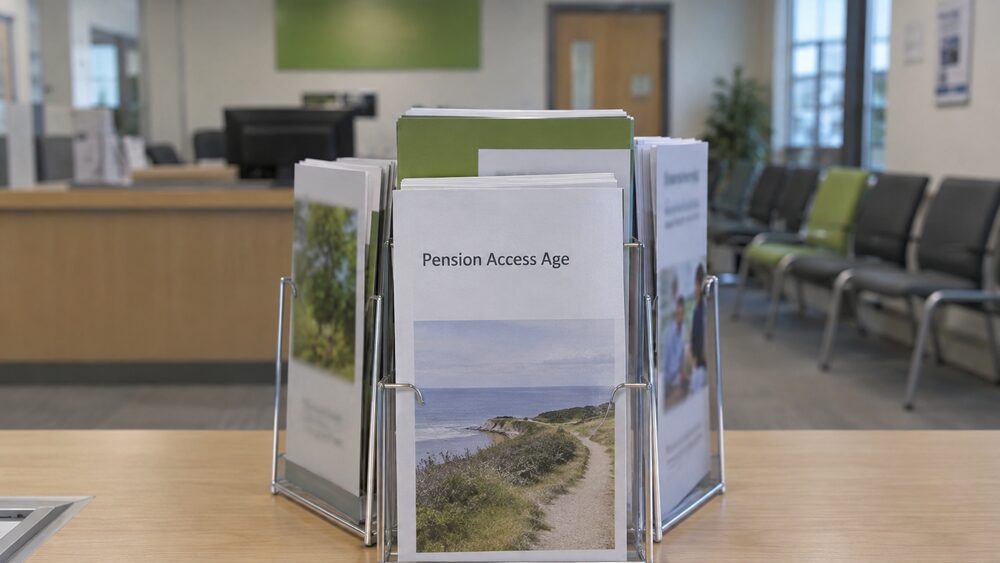
The earliest you can usually take money from a private or workplace pension is 55. You can take it at any point after that, not just on your birthday, and you do not have to stop working to do it. The exact age depends on your scheme rules, so it is worth checking with your provider before you make plans1.
That age is changing. The minimum age for taking a private pension rises from 55 to 57 on 6 April 2028, and from that date the age at which you can use pension freedoms increases to 57 or over3. If you reach 55 before 6 April 2028, you are not affected by the change and can still access your pension from 555.
The minimum age has moved before. Since April 2010, the age when you can take your workplace or personal pension has been 55 for most people, up from 506. The rules link the minimum pension age to the State Pension age, which is why it is rising again. This page sets out what the age is now, who the change affects, how it relates to your State Pension age, and what to do if someone offers to unlock your pension sooner.
The earliest age you can take your pension: 55 for now
For most people, the earliest age you can take a personal or workplace pension is 551. Pension Wise, the government's free guidance service, puts it plainly: you can currently take a private pension, including some workplace pensions, from age 55, increasing to age 57 from April 20284. The same age applies whether the pension is one you set up yourself or one your employer arranged8.
There are two things to keep apart. The first is the legal minimum, which is 55 for now. The second is your scheme's own rules, which can set a later age. As one official guide puts it, the exact age you can take your pension depends on the scheme rules9. A workplace scheme may therefore let you take money at 55, or it may not. Check the scheme's rules, not just the law.
The age applies to taking money, not to retiring. You can claim a personal or workplace pension while you are still working, as long as you have reached the age agreed with your pension provider10. Taking money from a pension does not require you to give up work, and it does not automatically stop you paying in.
There is one important exception. If you have a serious illness, you may be able to take your pension before 55. Scope notes that if you are over 55 you may be able to take a personal or workplace pension early, and Macmillan says you may be able to get your pension early if you retire due to cancer, depending on the rules of your scheme or employer11. These are scheme-specific routes, not a general right, so they depend on your provider's rules.
Minimum pension age rising from 55 to 57
The minimum age for taking a private pension rises from 55 to 57 on 6 April 20283. From that date, the age at which you can use pension freedoms increases to 57 or over4. The change was set out in legislation and confirmed by the financial regulator, which states that the normal minimum pension age increases to age 57 on 6 April 2028, from age 5513.
Who is affected depends on when you reach 55. If you turned 55 before 6 April 2026, you are not affected by the rule change: the earliest you can access your private pension is 555. If you turn 55 between 6 April 2026 and 5 April 2028, you will be able to access your pension once you turn 55, but your pension age could jump to 57 in April 2028, depending on your course of action5. In other words, there is a window where someone can take money at 55 and then find the age for everyone else has moved to 57.
The rise is not a change to when you can retire, and it is not a change to your State Pension. It is a change to the earliest age at which a private or workplace pension will pay out. If you had planned to take money at 55 and you turn 55 after the change takes effect, you will need to wait until 57 unless your scheme has a protected earlier age.
How the minimum age links to your State Pension age
The minimum pension age is not the same as your State Pension age, but the two are connected. The rule of thumb behind the 2028 rise is that the minimum pension age should stay ten years before the age at which you can claim the State Pension3. That is why it is moving from 55 to 57: State Pension ages have risen, and the minimum pension age is following.
Your State Pension age is the age at which you can claim the new State Pension, and it is set separately14. It is not the age at which you can take a private or workplace pension. The two can be many years apart, and for most people the private pension age comes first.
The link matters because it explains why the minimum age can change again. If State Pension ages rise further, the minimum pension age can be expected to follow, though no further increase beyond 57 has been announced. The changes to State Pension age are unlikely to affect when people can take their workplace or personal pensions, because that age is usually set by the employer or pension provider15.
There is a practical knock-on effect. If you take a private pension early and then claim benefits before you reach State Pension age, the pension income can reduce what you receive. Turn2us notes that you can claim income-related benefits even if you are over State Pension age as long as your income is low enough, and that pension income is taken into account16. New Style Jobseeker's Allowance is also affected: your earnings and any payment you are getting from a pension can affect the amount you may receive17.
Workplace and personal pensions: the same age rules
The minimum age applies to both workplace and personal pensions. Since April 2010, the minimum age when you can take your workplace or personal pension has been 55 for most people, up from 506. The same rules cover personal and stakeholder pensions, where the earliest age you can take the pension is usually 55, depending on your arrangements with the provider or trust2.
There are differences in how the two are run, not in the age. A workplace pension belongs to you, even if you leave your employer in the future18. When you change jobs, your pension belongs to you19. That means the age rules travel with the pot, not with the job.
Some employers offer personal pensions as workplace pensions20. If yours does, the age rules are the same as for any other personal pension. If you are self-employed and do not have access to a workplace pension, or you are not working but can afford to pay in, a personal pension may be suitable for you2.
One practical point: some providers might insist you change your pension to a personal pension to take the income drawdown option21. That is a change of product, not a change of age, but it is worth knowing before you ask your workplace scheme to pay you an income.
If you are thinking about how much you need, or how long a pot has to last, the age you start taking money is one of the biggest factors. Taking money earlier means it has to stretch further, and the Which? response to the Pensions Commission's call for views notes that 55 is the current age at which you can access a private pension22. For the options themselves, see your options for taking money from a pension.
Access before the minimum age and where to get help
There is no general right to take a private or workplace pension before 55. The exceptions are narrow: ill health, where the scheme's rules allow it, and a small number of protected cases. Everyone can access their pension from the age of 55, and not before, apart from those stated exceptions23.
That makes any offer to unlock a pension early a warning sign. The Pensions Ombudsman lists, among the common types of pension scam, those that offer access to a pension before the age of 5524. The Financial Services Compensation Scheme is blunter: an offer to release funds before age 55 is highly likely to be a scam25. Age UK warns that scammers may say they will help you access your pension pot before the age of 55 in exchange for a fee, but unless you are in one of the stated exceptions, that is not possible26.
If you are struggling with debt and thinking about your pension, there is free help. StepChange notes that you may be able to take money from personal savings or a workplace pension before retirement, but taking pension money early can reduce your income in the long term28. Free, impartial debt advice is available from StepChange, National Debtline and Business Debtline, and free pension guidance from Pension Wise. If you have lost track of a pension, the Pension Tracing Service can find the contact details for your own scheme, or for someone else's with their permission30.
If you think you have been targeted, report it. National Debtline and Business Debtline both have guides on dealing with fraud31. For the full picture on warning signs and transfers, see pension scams.
Pensions and inheritance tax: what is changing
Until April 2027, any money left in your pension will not be counted for inheritance tax purposes8. That is changing. As announced at Autumn Budget 2024, the government will bring most unused pension funds and death benefits into scope of inheritance tax from 6 April 20277. From that date, any unspent pensions will count towards the value of your estate when inheritance tax is calculated33.
The mechanics matter if you are naming beneficiaries. Pension scheme administrators will become liable for reporting and paying any inheritance tax due on pensions to HMRC34. Personal representatives will also be liable for reporting and payment of inheritance tax due on unused pension funds and death benefits35. Where inheritance tax is due, it will be applied to the pension first, and beneficiaries will then be eligible for a statutory deduction, meaning they will only pay income tax on the remaining amount after inheritance tax has been settled33.
There is a timing rule to be aware of. If personal representatives direct pension scheme administrators to withhold funds, beneficiaries will only be able to access 50% of the deceased's pension death benefits which may be subject to inheritance tax, for up to 15 months after the date of death36.
Separately, the income tax treatment of an inherited pension depends on when you die. If you die after age 75, your pension usually cannot be inherited tax-free, and the inherited amount is normally added to your beneficiary's other income to calculate how much income tax is due8. What happens to a workplace or private pension after you die depends on the type of pension you have, and beneficiaries could receive money in different ways, so it is worth checking with your provider what the rules and options are38. For more, see pensions and inheritance tax and what happens to your pension when you die.
Sources38 cited
- Personal pensions MoneyHelper, 2026-09-25
- Understanding personal pensions nidirect, 2025-10-24
- Retirement age Age UK, 2026-07-23
- State Pension Pension Wise, 2026-09-28
- Private pension age is rising to 57: will your retirement be affected? Which?, 2026-06-17
- Introduction to workplace, personal and stakeholder pensions nidirect, 2010
- Reforming Inheritance Tax: unused pension funds and death benefits GOV.UK, 2025-07-21
- Take your whole pot Pension Wise, 2026-09-28
- Workplace pensions: changes to personal circumstances nidirect, 2025-09-11
- Working, retirement and pension age GOV.UK, 2026-09-26
- Stopping work and ill health retirement Scope, 2025-12-31
- Money FAQs Macmillan Cancer Support, 2026-04
- Pension transfers: defined contribution Financial Conduct Authority, 2026-09-25
- The new State Pension GOV.UK, 2026-09-25
- Will this change affect my work or personal pension? Turn2us, 2026-08-04
- State Pension age and benefits Turn2us, 2026-08-04
- New Style Jobseeker's Allowance GOV.UK, 2016-12-06
- Enrolling in a pension at work nidirect, 2026-07-07
- Workplace pensions GOV.UK, 2026-09-26
- Personal pensions: your rights GOV.UK, 2026-09-26
- Pensions income drawdown Citizens Advice, 2026-09-26
- Which? response to the Pensions Commission's call for views Which?, 2026-07
- Financial jargon checker Age UK, 2026-08-26
- Common topics factsheet: pension scams The Pensions Ombudsman, 2022-02
- Protect yourself from pension scams Financial Services Compensation Scheme, 2018-08-20
- Pension scams Age UK, 2026-04-13
- Dealing with fraud National Debtline, 2026-09-25
- Retirement and debt StepChange, 2026-09-25
- Budgeting, saving and borrowing Business Debtline, 2026-09-26
- How to trace lost money Age UK, 2025-02-10
- Dealing with fraud Business Debtline, 2026-09-26
- Pension freedoms and debt National Debtline, 2026-09-26
- Will my pension be subject to inheritance tax? Which?, 2026-07-23
- Inheritance Tax on pensions: liability, reporting and payment GOV.UK, 2024-10-30
- Inheritance Tax on pensions: liability, reporting and payment: summary of responses GOV.UK, 2025-07-21
- Inheritance Tax: unused pension funds and death benefits GOV.UK, 2025-11-26
- Adjustable income Pension Wise, 2026-09-28
- What happens to your pension when you die Marie Curie, 2024-03-31



 Pension WiseFree guidance on your options for a defined contribution pension, from age 50
 FSCSProtects your money if a bank, insurer or investment firm fails
 GOV.UKOfficial information on tax, benefits and government services