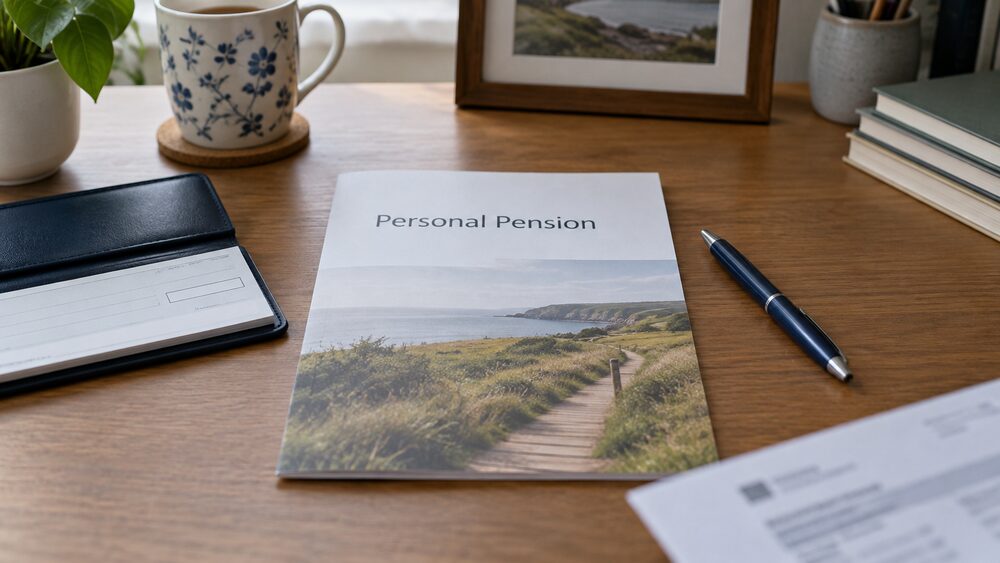
A personal pension is a pension you arrange yourself, rather than one your employer sets up for you. You choose the provider, you decide how much to pay in, and the provider invests the money on your behalf, usually in things like shares1. Personal pensions are sometimes called defined contribution or "money purchase" pensions, because what you end up with depends on how much was paid in, how the investments perform, and how you decide to take the money1.
The main draw is tax relief: if you pay tax at 20 per cent, every £80 you pay in becomes £100 in your pot3. The main constraint is that the money is locked away until you are at least 55, rising to 57 from April 20284. You can start most personal pensions from age 18, or open one on behalf of someone younger, and you usually cannot pay in after age 75 unless you are transferring a pension across4.
What a personal pension is and who it suits
A personal pension is one that you take out yourself, for example if you are self-employed, and you choose the provider and how your contributions are paid, sometimes through an independent financial adviser2. The provider invests what you pay in, and sends you annual statements telling you how much your fund is worth1. You will also receive a yearly forecast from your provider2.
All personal pensions are defined contribution schemes: the pot is based on what you or your employer paid in, and it can go up or down with the investments4. There is no promised income, unlike a defined benefit pension. Many schemes are designed to start paying from around age 65, but that is a design choice, not a rule: the earliest you can usually take the money is 554.
Official guidance says a personal pension may suit you if you are self-employed with no access to a workplace pension, if you are not working but can afford to save, if you want to save more for retirement on top of other pensions, or if your employer offers one as their workplace scheme2. Some employers do offer personal pensions as workplace pensions, so the two categories overlap1. You can pay in regular monthly amounts or lump sums, and other people, including family members, can pay in on your behalf1.
Saving into a personal pension will not affect your entitlement to the basic State Pension, which depends on your National Insurance record instead10. The State Pension and any workplace or personal pensions are separate sources of retirement income.
Types of personal pension: individual, stakeholder and SIPP
Personal pension schemes, including stakeholder pensions, are provided by insurance companies, banks and building societies11. Within that, three forms crop up again and again.
| Type | What it is | Key features |
|---|---|---|
| Standard personal pension | A pension you arrange yourself with a provider | Provider invests for you; charges usually a percentage of your fund2 |
| Stakeholder pension | A flexible personal pension meeting government standards | Capped charges, lower minimum payments, fee-free transfers4 |
| SIPP | A self-invested personal pension | You choose the investments yourself; covered in SIPPs explained |
A stakeholder pension is simply a personal pension that has to meet certain government standards designed to make it straightforward and decent value10. MoneyHelper describes them as having capped charges, lower minimum payments, fee-free transfers and usually a range of investment funds4. If you have moderate earnings and expect to stop and start payments or vary the amount, a stakeholder pension might be worth considering2.
A SIPP is a personal pension where you pick the investments yourself rather than the provider doing it for you. The Financial Ombudsman Service treats SIPPs, group personal pensions and annuities in payment as part of the same personal pension family when it looks at complaints about their administration12. The differences between a standard plan and a SIPP are covered in SIPP or standard personal plan.
Tax relief: how £80 becomes £100 in your pot
You usually get tax relief on money you pay into a pension1. The way it works for a basic rate taxpayer is simple: for every £80 you pay in, the government adds £20, so £100 lands in your pot3. MoneyHelper puts the same thing another way: a £100 contribution into your pension will cost you £804.
The government also pays into workplace pensions in the form of tax relief, and in most cases your employer adds money too14. Over a lifetime this top-up is a large part of the pot: an analysis of a £100,000 defined contribution pension found £4,000 of it came from tax relief16. How relief is applied, and how higher rate taxpayers claim their extra relief, is covered in pension tax relief and claiming higher-rate tax relief, with separate rules for Scottish taxpayers.
How much you can pay in: the annual allowance
You can save as much as you want into a personal pension, but tax relief only applies up to the annual allowance10. The maximum you can pay in each year while benefitting from tax relief is either £60,000 or your salary, if your salary is lower6. The documents in this area describe the earnings limit slightly differently, one saying relief is limited by your income and another by 100% of your earnings, but the effect is the same: if you earn less than £60,000, your earnings set your relief limit.
The full rules, including what happens if you go over the allowance and how carry forward of unused allowance from earlier years works, are covered in the pension annual allowance. People with no earnings at all can still get some relief, explained in tax relief with no earnings.
Charges: management fees, fund costs and switching
The pension provider may charge you for starting and running your pension, and usually they take a percentage from your pension fund2. On top of the provider's own charge come the costs of the funds your money is invested in: fund management charges tend to sit between 0.1% and 0.3% for passive funds, although actively managed investments can cost more17.
Charges matter because they are taken year after year from a pot that is meant to be growing for decades. Two pensions with the same investments but different charges can end up worth noticeably different amounts, which is one reason people transfer old pots into cheaper plans.
Switching itself can carry costs or risks. Complaints to the Financial Ombudsman about pension transfers often involve an adviser not having disclosed the higher charges a person would pay after redirecting their contributions, or the loss of guarantees such as guaranteed annuity rates, or market value adjustments on with-profits funds18. Before moving money, the charges of both the old and new scheme need checking, alongside any benefits that would be given up.
Stakeholder pensions: charges capped at 1.5%
Stakeholder pensions are the one type of personal pension with a legal charge cap. Managers can charge up to one and a half per cent of your pension fund each year for the first 10 years, and after that up to one per cent3. The legislation behind the cap sets the same limit: 1.5% for the first 10 years, then reducing to 1% of the fund a year19. On a fund value of £10,000, the first 10 years' cap would be £150 a year20.
Alongside the cap, stakeholder pensions must allow you to switch to a different pension provider without penalty charges3, and they have lower minimum payments than other personal pensions4. They are covered in more detail in stakeholder pensions explained and compared with standard plans in personal pension vs stakeholder pension.
For comparison, workplace pension fees are capped at 0.75%, a limit that includes both the fees charged by the pension providers and those charged by fund managers16. That cap applies to workplace schemes used for automatic enrolment, not to personal pensions you arrange yourself, which is covered in workplace pension charges and the charge cap.
How to set up a personal pension or transfer old pots
There are no comparison sites for personal pensions, so you will either need to search and compare options yourself or pay a financial adviser4. You can start most personal pensions from age 18, or open one on behalf of someone younger4. Once open, you pay regular monthly amounts or lump sums2.
If you have old pensions from previous jobs, you can transfer a UK pension pot to another registered UK pension scheme21. A transfer can mean moving money from one personal pension to another, or from a personal or workplace pension to a SIPP18. The usual steps are:
- Check your current scheme allows transfers out.
- Make sure you will not lose any benefits.
- Decide which scheme to transfer into.
- Check whether you need to pay for financial advice.
- Ask your current provider for a transfer value.
- Ask the new scheme to start the transfer.22
The "what could be lost" step is where most of the harm happens. The Financial Ombudsman regularly sees complaints where transfers lost guarantees, triggered higher charges, or moved someone out of valuable workplace benefits18. The risks are set out in what are the risks of transferring, and the rules on when regulated advice is required are in when advice is required to transfer. If you cannot find an old pot at all, the Pension Tracing Service and other routes can help locate it, though some tracing services charge a one-off fee if regulated advice is given or if they locate and transfer pensions on your behalf17.
When you can take your money: 55 now, rising to 57
The earliest you can take a personal pension is usually age 55, depending on your arrangements with the provider2. That age is rising: you can currently take a private pension from age 55, increasing to age 57 from April 20285. The rise keeps the access age 10 years before State Pension age23, and several sources confirm the same date, with some specifying 6 April 202824.
The money is locked away until then, which is the trade-off for the tax relief4. The one main exception is serious ill health: you cannot usually take money from a pension scheme before 55 unless you are seriously ill26, covered in taking your pension early because of ill health. The rules are explained in full in when can I access my private or workplace pension.
You do not need to be retired from work to get your pension benefits2. You can claim while working, as long as you have reached the age agreed with your pension provider27, and if you keep working past State Pension age you will stop paying National Insurance28.
Taking your pension: 25% tax-free and the rest as income
When you take money from your pension, 25% is usually paid tax-free, and the other 75% counts as earnings for Income Tax7. You can take up to 25% of your pot tax-free, to a maximum of £268,275 across all your pensions6. How the rest is taxed is covered in how pension income is taxed.
There are two common ways the 25% works. You can take 25% of your whole pot tax-free in one go, meaning any further withdrawals are all taxed as income29. Or you can take 25% of every cash withdrawal tax-free, with the remaining 75% of each withdrawal taxable as income29. Which suits a person depends on when they need the money and what other income they have.
The main ways to take the rest are:
- Leave it invested and take an income (drawdown)
- Take the whole pot in one payment (taking your whole pot)
- Take lump sums as and when needed (UFPLS)
- Buy a guaranteed income (annuities)
One detail worth knowing: if you set up your own pensions, you can use the small pot rules to take up to three of them in one go without triggering the money purchase annual allowance, which otherwise cuts how much you can pay in after taking flexible withdrawals7. The money purchase annual allowance is explained in what is the money purchase annual allowance. Free guidance on all these options is available from Pension Wise.
What happens to the pot on death is set by rules rather than your will: your provider will ask you to complete an expression of wish form telling them who should receive the pension, and it is worth keeping this updated4. If you die before age 75, money left in the pension can currently be inherited completely free of tax; if you die after 75, it is usually taxed in the same way as the beneficiary's income6. See what happens to your pension when you die.
Complaints and where to get help
Personal pensions generate a lot of complaints. They were the most complained-about pension product at the Financial Ombudsman Service in 2024/25, with 4,698 new complaints8. In Q1 2025/26, 1,122 complaints about personal pensions were opened and 51% were upheld30; a year later, in Q1 2026/27, 931 were opened and 42% were upheld28. Those upheld rates mean a substantial share of people who complain about a personal pension get something put right.
Where you complain depends on what the complaint is about:
| Complaint about | Who handles it |
|---|---|
| The administration of a personal pension, SIPP, group personal pension or annuity | Financial Ombudsman Service12 |
| How a personal or occupational pension scheme is run | The Pensions Ombudsman32 |
| Your State Pension | The Pension Service34 |
| A concern about how a workplace pension is being run | The Pensions Regulator29 |
The Pensions Ombudsman can look at complaints about the administration of personal and occupational pension schemes32, and during Pension Awareness Week it promoted member guidance covering how to complain about a pension problem, common complaint topics, who can complain and what it can and cannot do33. You can also complain to MoneyHelper or the Pensions Ombudsman about how a workplace pension is managed35. The full routes are set out in complaining about a pension provider and the Pensions Ombudsman.
Free, impartial help is available at every stage: MoneyHelper explains personal pensions and how they work4, Pension Wise offers free guidance on taking money7, and nidirect carries the same guidance for Northern Ireland2.
Sources35 cited
- Personal pensions: your rights GOV.UK
- Understanding personal pensions nidirect
- Stakeholder pensions nidirect
- Personal pensions MoneyHelper
- State Pension Pension Wise
- Should I take a lump sum from my pension? Which?
- Take your whole pot Pension Wise
- Annual complaints data insight 2024/25 Financial Ombudsman Service
- Personal pensions Financial Ombudsman Service
- Introduction to workplace, personal and stakeholder pensions nidirect
- Getting information and help with pensions nidirect
- Where to go for help with your pension complaint The Pensions Ombudsman
- Five ways to reduce your risk of pension poverty Which?, 2026-05-17
- Workplace pensions GOV.UK
- Enrolling in a pension at work nidirect
- Should you be more hands-on with your pension investments? Which?
- Lost pensions: the tracing services that could help you find them Which?
- Transfers from personal pension arrangements Financial Ombudsman Service
- Stakeholder pension schemes charge limit instrument FCA Handbook
- Stakeholder pension charge cap instrument FCA Handbook
- Transferring your pension nidirect
- Pension transfer: defined contribution FCA
- When can I retire? Which?
- How and when should you take your pension? Which?
- Options for cashing in your pension: overview Which?
- Workplace pensions: changes in personal circumstances nidirect
- Working after pension age GOV.UK
- Quarterly complaints data Q1 2026/27 Financial Ombudsman Service
- How are payments from flexible pensions taxed TaxAid
- Quarterly complaints data Q1 2025/26 Financial Ombudsman Service
- Pensions and annuities: complaints we can help with Financial Ombudsman Service
- Pensions Ombudsman promotes member guidance during Pension Awareness Week The Pensions Ombudsman
- Report concerns about your workplace pension The Pensions Regulator
- How your situation affects your workplace pension nidirect
- Safety of workplace pension schemes nidirect

 Pension WiseFree guidance on your options for a defined contribution pension, from age 50
 FSCSProtects your money if a bank, insurer or investment firm fails
 GOV.UKOfficial information on tax, benefits and government services