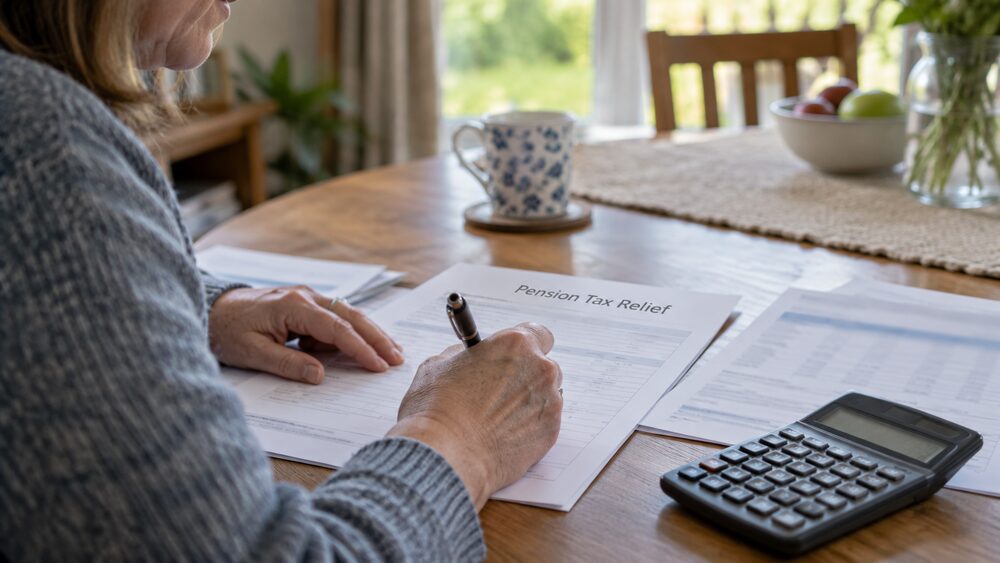
Pension contributions attract income tax relief at your marginal rate, so a higher-rate taxpayer gets 40% relief and an additional-rate taxpayer gets 45%1. The catch is that only the basic 20% is added to your pension automatically. Basic-rate (20%) tax relief is usually added to your pension contributions automatically, but the extra 20% for higher-rate payers, or 25% for additional-rate payers, has to be claimed by you3.
Pension contributions attract income tax relief at your marginal rate, so a higher-rate taxpayer gets 40% relief and an additional-rate taxpayer gets 45%1. The catch is that only the basic 20% is added to your pension automatically. Basic-rate (20%) tax relief is usually added to your pension contributions automatically, but the extra 20% for higher-rate payers, or 25% for additional-rate payers, has to be claimed by you3.
That claim is the whole subject of this page. It is not automatic, it does not always arrive as money in your pension pot, and the route you use depends on how your scheme is set up. For a 40% taxpayer, the effect is that a £100 pension contribution costs £60 once the extra relief is accounted for5.
Higher-rate relief is not added automatically: you claim the extra yourself
The pension system gives tax relief at your marginal rate, but the machinery only delivers the basic slice without your involvement. Most personal pension providers will claim tax relief automatically for you at a fixed rate of 20%5. Your provider claims the basic rate of 20% tax relief for you, and no more7.
If you pay higher or additional rate tax, you can claim extra relief through your tax return, which reduces your tax bill rather than adding to your pension8. That distinction matters. The basic 20% is paid into the pension and invested. The extra relief for higher-rate payers is normally given as a reduction in the tax you owe, so it reaches you as cash you would otherwise have paid to HMRC, not as a top-up to the pot8.
The arithmetic is straightforward once you see both halves. If you pay Income Tax at 40%, a £100 pension contribution will cost you £605. Another way of putting it: if you pay the higher rate of 40%, making a £60 pension contribution would actually boost your pot by £100, as you would get £40 in tax relief from the government10. Additional-rate taxpayers can claim 45% tax relief2.
If you are a higher-rate taxpayer, you will need to claim any additional tax relief yourself through your self-assessment tax return11. PensionBee, for example, claims the 25% basic rate tax top up automatically on personal contributions, but only the standard basic rate relief; higher and additional rate taxpayers must claim extra relief themselves through Self-Assessment12.
Relief at source or net pay: whether you need to claim depends on your scheme
There are two main ways a workplace or personal pension handles tax relief, and they behave very differently for a higher-rate taxpayer.
Under relief at source, your employer takes your pension contribution from your pay after deducting tax (and National Insurance contributions), and your pension scheme provider then claims the tax back from the government at the basic rate of 20 per cent13. You can tell it is relief at source if the pension provider has to claim the tax relief from HMRC14. If you have higher and additional rate taxpayers and your scheme uses relief at source, they will need to claim their full tax relief by completing a tax self-assessment14.
Under a net pay arrangement, your employer takes your pension contribution and the government's contribution as tax relief from your pay before deducting tax, and you pay tax on what is left13. Because the relief is applied at your marginal rate on the way in, higher-rate taxpayers in net pay schemes generally do not have a separate claim to make.
| Feature | Relief at source | Net pay |
|---|---|---|
| When tax is deducted | Contribution taken from pay after tax13 | Contribution taken before tax13 |
| Who claims basic relief | Provider claims 20% from government13 | Applied automatically through payroll13 |
| Higher-rate taxpayer action | Must claim the extra 20% or 25%14 | No separate claim needed |
| Non-taxpayers | Still get tax relief15 | No relief if you pay no tax |
The practical question is which one you are in. If your payslip shows pension contributions coming out of your take-home pay, you are likely in a relief at source scheme and may have a claim to make. If they come out before tax, you are likely in a net pay arrangement.
How to claim: self-assessment tax return or contacting HMRC
There are two routes, and which one applies depends on your circumstances.
The first is a self-assessment tax return. If you pay higher rates of tax, you will usually need to complete a self-assessment tax return to claim higher rate of tax relief, and the money will be paid to you personally and not into your pension9. You can submit a self-assessment tax return to HMRC either online or with a paper form16.
The second is contacting HMRC directly. To claim higher rate tax relief on your pension contributions, you have two options: an online Self-Assessment tax return, or contacting HMRC online or in writing12. Scottish taxpayers can claim this either on their Self Assessment tax return on GOV.UK or through their tax code for the money you put into a private pension17.
Whichever route you use, one condition comes first. Check with your provider that your pension scheme is registered with HM Revenue and Customs (HMRC); if it is not registered, you will not get tax relief18.
How long it takes for relief to arrive
Basic rate relief is handled by the provider and normally appears in your pension without you doing anything. The extra relief you claim from HMRC runs on HMRC's timetable, not the provider's.
One provider says it usually takes 6 to 11 weeks to receive the tax reclaim from HMRC6. A pension plan's key features document puts the process of reclaiming tax relief to your pension at normally between six and ten weeks19. The two figures are close but not identical, and they come from different documents, so treat the range as roughly six to eleven weeks rather than a promise.
If you claim through self-assessment, the timing is tied to the return. The relief is worked out as part of your tax calculation, so it lands when your tax position for the year is settled rather than when you make each contribution.
Relief is limited to what you earn in the tax year
Tax relief is not unlimited. You will only get tax relief on contributions up to the amount you have earned in any given tax year20. The official rule is that you can get tax relief on what you pay in, up to 100 per cent of your earnings, as long as you are under 7513. Each year you will receive tax relief on your pension contributions of up to 100 per cent of your UK earnings, meaning salary and other earned income15.
If your earnings are low, there is a floor. You can get tax relief on pension contributions up to 100% of your earnings, or £3,600 if your earnings are lower2.
There is a separate cap that is easy to confuse with this one. The Money Purchase Annual Allowance is £10,00021. If you have accessed a pension flexibly, the amount you can get tax relief on is limited to up to £4,000 each year22. Separately, you may be able to get tax relief on pension contributions up to £40,000 each year, depending on your level of earnings23.
Does the earnings limit apply to contributions my employer makes?
No. This limit does not apply if your employer is making the contribution on your behalf, though employers can still receive tax relief on what they pay20. Employer contributions are not limited by earnings but are still subject to the annual allowance24.
That means a company owner or anyone whose employer pays into their pension can have more paid in than they earn personally, within the annual allowance. The earnings limit bites on what you pay yourself, not on what your employer pays for you.
Self-employed people and non-taxpayers
Self-employed people are not covered by the workplace pension rules that enrol employees automatically25. If you are self-employed or do not have a workplace pension, you could open a personal pension and get tax relief on what you pay in26. You will get 20% tax relief from the government if you are a basic rate taxpayer, and you can claim up to 25% tax relief if you are a higher or additional rate taxpayer27.
For the self-employed, the claim route is the tax return. If you pay higher rates of tax, you will need to claim this back yourself in your self-assessment tax return28.
Non-taxpayers are not shut out. Non-taxpayers can also benefit from tax relief at the basic rate (20%) on pension contributions29. If you have little or no earnings and are in a relief at source scheme, you will still get tax relief15. Stakeholder pensions go further: if you do not pay tax, you can still get tax relief on your own or someone else's contributions up to a certain limit10.
If you pay tax at the 40 per cent or 50 per cent rate you can claim the extra tax back10. Basic and nil-rate taxpayers qualify for 20% tax relief30.
Where to get help
If you are unsure whether you have claimed correctly, or whether your scheme is relief at source or net pay, the first step is your pension provider. If you have a tax query, HMRC can check your position32. Free, impartial guidance on pension basics is available from MoneyHelper5.
If a dispute with a provider cannot be resolved, the Pensions Ombudsman handles complaints about pension schemes, and the Financial Ombudsman Service covers many pension and investment complaints. Both are free to use.
Sources32 cited
- Pension contributions and tax House of Commons Library, 2026-09-26
- 5 questions for pension savers filing their 2024-25 tax return Which?, 2026-01-22
- How to boost your pension Which?, 2026-08-10
- Private pensions Interactive Investor, 2026-03-06
- Personal pensions MoneyHelper, 2026-09-25
- Pensions and tax Interactive Investor, 2026-09-26
- High rate tax relief Interactive Investor, 2026-09-26
- Pension tax relief benefits Legal & General, 2026-09-26
- Tax relief Hargreaves Lansdown, 2026-09-26
- Stakeholder pensions nidirect, 2025-09-11
- What is a salary sacrifice pension PensionBee, 2026-05-12
- Pension tax relief PensionBee, 2026-05-12
- Workplace pensions and tax relief nidirect, 2026-07-07
- What to look for in a pension scheme The Pensions Regulator, 2026-09-26
- Introduction to workplace, personal and stakeholder pensions nidirect, 2026-09-25
- Self-assessment Advice NI, 2026
- Scottish Income Tax: allowances and reliefs mygov.scot, 2026-04-06
- Personal pensions: your rights GOV.UK, 2026-09-26
- Transact Personal Pension Plan key features document Transact, 2026-04
- Tax relief AJ Bell, 2026
- Pension freedoms and debt National Debtline, 2026-09-25
- Pension freedoms and debt Business Debtline, 2026-09-26
- Revisiting the State Pension age Resolution Foundation, 2025-11-01
- SIPP for the self-employed Hargreaves Lansdown, 2026-09-26
- How your situation affects your workplace pension nidirect, 2025-09-11
- Tax credit and pension contributions Entitledto, 2026-09-26
- Investing Scottish Widows, 2026-09-26
- What pension can you get if you're self-employed Which?, 2026-09-15
- Can I get pension tax relief without paying tax Which?, 2026-07-06
- Pensions tax relief House of Commons Library, 2026-07-08
- Debt and long-term sickness StepChange, 2026-09-25
- Occupational Maternity Pay Entitledto, 2026-09-26








 Pension WiseFree guidance on your options for a defined contribution pension, from age 50
 FSCSProtects your money if a bank, insurer or investment firm fails
 GOV.UKOfficial information on tax, benefits and government services