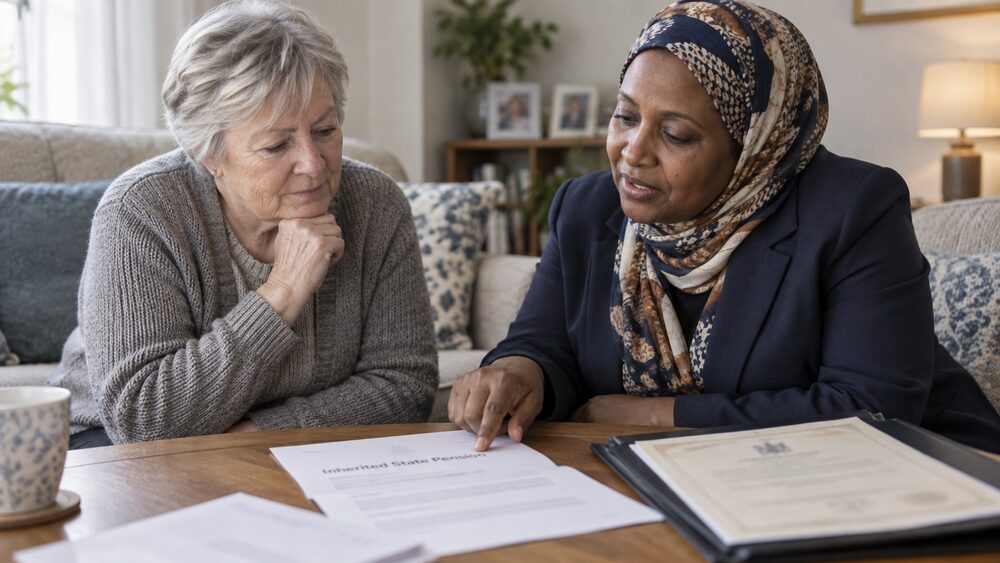
Your State Pension payments generally stop when you die, but a spouse or civil partner might be able to inherit some of it1. Nobody else can. A partner you lived with but did not marry or form a civil partnership with cannot inherit State Pension, however long you were together2.
What can be inherited is not the basic State Pension itself. It is the extra amounts built up on top: the Additional State Pension, SERPS, graduated retirement benefit, or a protected payment under the new State Pension. For Additional State Pension, the rate of inheritance is assumed to lie between 50% and 100%3. For a protected payment, 50% can pass to a surviving partner4.
The rules turn on dates. When you married or formed your civil partnership, when your partner reached State Pension age, and whether you have remarried all change what you can receive. This page sets out who can inherit, how much, and what happens in the situations where nothing passes on.
Only a spouse or civil partner can inherit State Pension
It is only possible for a spouse or civil partner to inherit a State Pension2. That is the starting point, and it rules out most people a reader might assume are covered. A partner you lived with for decades, a partner you had children with, a partner you shared a mortgage with: none of them can inherit State Pension unless you married or formed a civil partnership.
The one exception sits outside the State Pension. The War Widow's or Widower's Pension can be paid to someone who lived with a partner as husband and wife or as civil partners7. That is a separate benefit with its own rules, not an inheritance of State Pension.
For married couples and civil partners, what passes on is narrower than many expect. Your basic State Pension is paid only to you and cannot be passed on to someone else when you die8. What a surviving spouse or civil partner may inherit is the Additional State Pension, and only in the circumstances set out below.
There is also a route that is not inheritance at all. If you reached State Pension age before 6 April 2016, you may be able to use part of your former spouse or new partner's National Insurance record to count towards your State Pension9. That is a claim on someone else's contribution record while they are alive or after death, and it works differently from inheriting an amount they had built up.
If your partner reached State Pension age before the new State Pension began
The date your partner reached State Pension age is the single biggest factor. The new State Pension began on 6 April 2016, and the rules either side of that date are different.
If your partner reached State Pension age before 6 April 2016, you may be able to inherit some of their State Pension when they die10. For those who got the state pension before 6 April 2016, between 100% and 50% of any additional state pension, not basic state pension, can be inherited by spouses and civil partners11. The exact percentage depends on the deceased person's date of birth. For a deceased male born 6 October 1945 and after, and a deceased female born 6 July 1950 and after, the maximum inheritable share is 50%11.
If you are widowed, you may be able to inherit part of your partner's Additional State Pension that was already built up under the pre-2016 rules12. That distinction matters: it is the amount built up before the change that can pass on, not anything accrued afterwards.
There is also a top-up route. If your spouse or civil partner topped up their State Pension between 12 October 2015 and 5 April 2017, you may be able to inherit some or all of that top-up10.
If you reached State Pension age before 6 April 2016 yourself, you could be entitled to receive a higher basic state pension based on your spouse's National Insurance record5. When you die, your spouse or civil partner could be entitled to receive a higher basic state pension based on your National Insurance record, assuming they are receiving less than the full basic state pension13.
Additional State Pension: between 50% and 100% can pass on
The Additional State Pension is the earnings-related top-up that existed under the old system, also known as SERPS or the State Earnings-Related Pension Scheme. It is inheritable by the spouse, including a civil partner, on the individual's death14.
The rate is not a single figure. For Additional Pension the rate of inheritance is assumed to lie between 50% and 100%3. You can inherit up to 50% of your spouse or civil partner's state second pension15. For any Additional State Pension, generally 50% of it is inheritable by your husband or wife4.
The exact amount depends on individual circumstances. It will be greater if the late spouse was an employee rather than self-employed, and if the widow is not receiving a widow's pension from a company pension scheme11. The amount of National Insurance contributions you both made, and when you both reached or will reach State Pension age, also feed into it2.
There is a marriage date condition. You might be able to inherit part of their additional state pension if your marriage or civil partnership began before 6 April 20165. Your spouse or civil partner might also inherit part of your additional state pension if your marriage or civil partnership began before 6 April 201613.
Graduated retirement benefit, an older scheme that ran from 1961 to 1975, follows its own rules. The inherited amount is half of the weekly rate of the deceased spouse's or civil partner's graduated retirement benefit16. A person whose dead spouse or civil partner paid graduated contributions is entitled to a state pension if they have reached pensionable age, the spouse or civil partner died while they were married or civil partners, the marriage or civil partnership was formed before 6 April 2016, and they are entitled to an inherited amount17.
Do I get an inherited payment if I am on the new State Pension?
If your spouse or civil partner reached State Pension age after 6 April 2016 and receives the new State Pension, you may be entitled to an inherited payment18. Whether you can receive it depends on when your marriage or civil partnership began and when they died18.
The new State Pension changed what can pass on. Under these rules, you can no longer inherit additional state pension from a late spouse or civil partner13. In general you will not be able to claim on your spouse or civil partner's contributions at retirement, or if you are widowed or divorced12. You cannot receive any New State Pension based on your partner's national insurance contributions19.
What can still pass on under the new system is a protected payment, covered below, and any extra State Pension your partner had built up through deferral. If your partner was getting extra State Pension before they died, you will inherit it as extra weekly payments, paid with your own State Pension20. Any extra weekly payment you inherit will be added to your State Pension, or paid when you start your claim if you have not reached State Pension age yet20.
You can only receive any extra State Pension you have inherited once you have reached State Pension age20.
Deferral has its own timetable. If your partner deferred their State Pension by less than five weeks, their State Pension payments for those weeks will become part of their estate20. If they deferred by between five weeks and a year, you will inherit it as weekly payments, paid with your own State Pension20. If they deferred by a year or more, you can usually choose to inherit it as a lump sum or as weekly payments, and you will get a letter with the options you can choose from20.
One caution on deferral. While a spouse or civil partner may inherit some benefits in certain circumstances, the enhanced payments earned through deferral typically cannot be passed on21. The rules on deferred State Pension inheritance are set out separately, and the conditions include that your partner reached State Pension age before 6 April 2016, you were married to or in a civil partnership with them when they died, they had deferred their State Pension or were claiming it when they died, and you did not remarry or form a new civil partnership before you reached State Pension age20.
Protected payment: 50% can pass to a surviving partner
A protected payment is an extra payment you might get in addition to your full State Pension22. It usually arises where someone had built up more under the old system than the new State Pension would give them, and the difference is protected.
Half of this protected payment can be passed onto your husband or wife4. If you are both due to reach State Pension age after 6 April 2016, your partner will inherit 50% of any protected pension you have23. Allowance is made for inheritance of Protected Payments using official marital status projections3.
A protected payment can also be shared on divorce. If your state pension includes a protected payment, this could be shared24, and the Protected Payment element of the new State Pension can be shared with a court order25. That is a separate process from inheritance and runs through the courts as part of a financial settlement.
A surviving spouse or civil partner can inherit the extra amounts built up on top of the basic State Pension, not the basic amount itself.
Where inheritance does not apply
Several common assumptions do not hold. State Pension is based on someone's own National Insurance contributions, and in general you cannot claim on your spouse or civil partner's contributions26. Your basic State Pension is paid only to you and cannot be passed on to someone else when you die8. Your state pension cannot be inherited27.
If there is no spouse or civil partner, nothing passes on. State Pension payments stop when someone dies, and the only people who can inherit any part of it are a husband, wife or civil partner, depending on National Insurance contributions and State Pension age dates2.
Savings do not affect State Pension, so having money put by does not reduce it28. State Pension is not means-tested, so having a partner does not reduce it either26.
There is a wider point about what a spouse can inherit. Married couples and civil partners can inherit from one another tax-free, and this does not apply if you are unmarried29. Anything left to a surviving spouse or civil partner, including pensions, remains 100% exempt from inheritance tax30. A surviving spouse or civil partner never pays inheritance tax on anything you leave them, regardless of the amount, as long as you are both UK-domiciled31. That tax treatment is separate from whether the State Pension itself can be inherited, and it does not make State Pension inheritable.
How remarrying or a new civil partnership affects what you inherit
Remarrying or entering a new civil partnership may affect entitlement to inherited State Pension benefits18. The timing is what matters.
The process of remarrying or entering another civil partnership before you have reached State Pension age will disqualify you from any State Pension inheritance due6. Your spouse cannot inherit your Additional State Pension if they remarried or formed a civil partnership before they reach State Pension age4.
If you have already reached State Pension age, the position is different. Remarriage after State Pension age does not remove an inherited Additional State Pension.
There is a separate warning for anyone receiving a widow's or widower's pension from a workplace scheme. If you intend to re-marry or co-habit, contact the scheme, as this may affect your pension entitlement34. That is a workplace scheme rule, not a State Pension rule, and it can bite even where the State Pension position is settled.
Divorce and dissolution have their own rules. If you reached State Pension age before 6 April 2016, you may be able to use part of your former spouse or new partner's National Insurance record to count towards your State Pension9. You can also claim on your former partner's National Insurance record if you are divorced or your civil partnership has ended, where this gives you a higher rate of State Pension35. Under the new State Pension, you cannot usually claim extra pension based on the National Insurance contributions of your spouse or civil partner, or ex-spouse or ex-civil partner, although there are some exceptions35.
Getting help and checking what you are owed
Working out what you can inherit is not straightforward, because it depends on two people's contribution records and a set of dates. Pension Wise offers free guidance on State Pension and on your pension options1. The Pensions Ombudsman handles complaints about pension schemes, and there is a separate route for complaining about a pension provider36.
If you are under State Pension age and have a husband, wife or civil partner who has died in the last 21 months, Bereavement Support Payment may be available37. In Scotland, bereavement benefits are handled through mygov.scot38. If you are on a low income, Pension Credit rules treat couples in a particular way: a married or unmarried couple may agree between them which partner makes a claim for state pension credit, but in the absence of an agreement the Department decides which of them is to make the claim39.
For anyone who wants to check what they are entitled to inherit, there is a free tool built to help understand what state pension you are entitled to inherit11. The rules are complex enough that a free check is worth doing before assuming either that you are owed something or that you are not.
Sources39 cited
- State Pension Pension Wise, 2026-09-28
- What happens to your pension when you die Marie Curie, 2024-03-31
- Report by the Government Actuary on the draft Social Security Benefits Up-rating Order 2026 Government Actuary's Department, 2026-01-13
- What happens to my pension when I die Royal London, 2026-01-14
- Widow's pension and bereavement allowance Which?, 2026-04-06
- Pension accrued before marriage PensionBee, 2026-05-14
- War Widow's or Widower's Pension GOV.UK, 2026-09-27
- State Pension and benefits Scottish Widows, 2026-09-25
- Relationships and your money Independent Age, 2026-09-26
- Qualifying basic State Pension nidirect, 2026-09-09
- New State Pension error impacting widows Which?, 2024-08-14
- New State Pension Age UK, 2026-05-26
- What happens to my pension when I die Which?, 2026-09-17
- Class 3A voluntary National Insurance contributions Pensions Policy Institute, 2014-10-24
- State second pension and SERPS Which?, 2026-03-17
- The Social Security (Graduated Retirement Benefit) Regulations 2015 legislation.gov.uk, 2015-02-09
- The Social Security (Graduated Retirement Benefit) Regulations (Northern Ireland) 2016 legislation.gov.uk, 2016-02-22
- What happens to my pension when I die Legal & General, 2026-09-26
- What if I don't qualify Turn2us, 2026-03-05
- Claiming or inheriting deferred State Pension nidirect, 2026-06-26
- Should you wait to claim your State Pension Which?, 2026-02-06
- Pensions and divorce Aviva, 2025-04-29
- Workplace and State pensions Resolver, 2026-09-26
- Pensions in divorce Which?, 2026-03-11
- Pensions and divorce Advicenow, 2026-09
- Partnership rights Age UK, 2026-07-28
- How inheritance tax will apply to pensions Which?, 2026-07-24
- How savings affect means-tested benefits Scope, 2026-04-01
- Inheritance tax property changes Which?, 2026-04-06
- Inheritance tax on pensions: how the new rules will work in practice Which?, 2026-05-23
- 7 things to know about inheritance tax changes and your pension Which?, 2025-07-26
- Investigation into underpayments of State Pension National Audit Office, 2021-09-22
- Request information about underpaid State Pension for someone who has died GOV.UK, 2022-07-08
- Annual pension increase Scottish Public Pensions Agency, 2026
- Financial and legal tips before remarrying Age UK, 2024-05-28
- Complaining about a pension provider, platform or fund manager financial.org.uk
- Bereavement Support Payment mygov.scot, 2022-10-19
- Financial help for the bereaved nidirect, 2026-04-03
- The State Pension Credit Regulations (Northern Ireland) 2003 legislation.gov.uk, 2003-04-07


 Pension WiseFree guidance on your options for a defined contribution pension, from age 50
 FSCSProtects your money if a bank, insurer or investment firm fails
 GOV.UKOfficial information on tax, benefits and government services