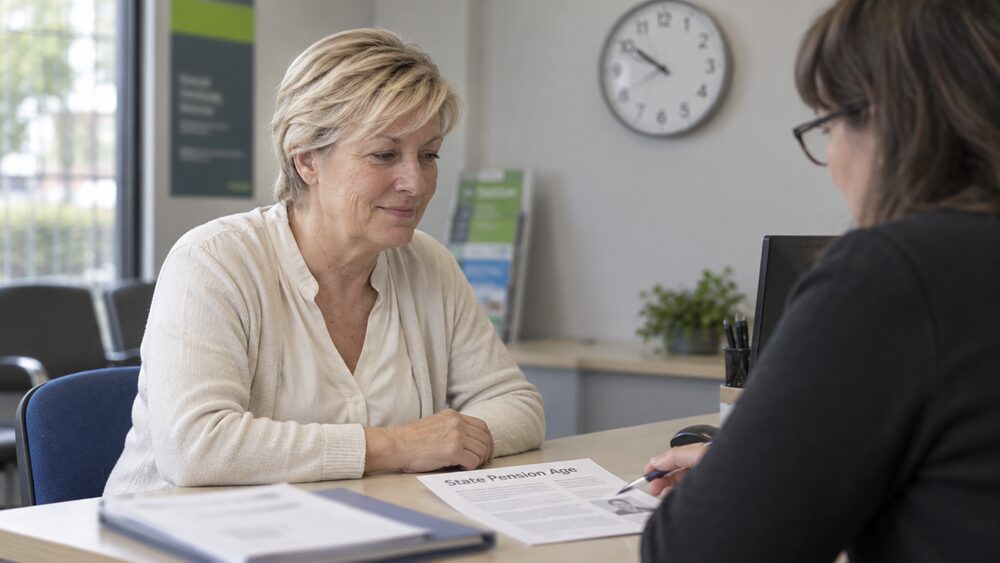
State Pension age is the earliest age at which you can start receiving your State Pension, and right now it is 66 for both men and women1. It is in the middle of a rise: between April 2026 and March 2028 the State Pension age is increasing from 66 to 67, so anyone born after 6 April 1960 will wait longer than their older colleagues did2. A further rise, to 68, is already in law for between 2044 and 2046, and reviews have proposed bringing that forward to as early as 20373.
Your exact State Pension age depends on your date of birth, and for people born in the 1960s and 1970s it often falls between two birthdays rather than on one. The government must give at least 10 years' notice of any change, so future rises should not arrive as a surprise, but the timetable is reviewed regularly and can be altered by Parliament2. This page sets out how to find your own State Pension age, how the age came to rise, what it means for women born in the 1950s, how much you can get and how to claim.
State Pension age is 66 now and rising to 67
State Pension age is the earliest age you can start receiving your State Pension1. It is currently 66 for both men and women, and it is increasing7. The rise to 67 is already under way: between April 2026 and March 2028, the State Pension age is rising from 66 to 672, with official statistics describing the change as a gradual increase from 66 to 67 years old between 6 April 2026 and 5 April 20288. The Work and Pensions Committee notes the age will reach 67 by April 20289.
The rise is being phased rather than applied on a single date, which is why people born only weeks apart can have different State Pension ages. For someone born in the early 1960s the age may be 66 years and a few months; for someone born in 1977 it is 67. The phasing is set out in law, under the Pensions Act 2014, which provides for the increase from 66 to 67 between 2026 and 202810.
The reason the age rises is longevity and cost: people are living longer in retirement, and the State Pension is paid for by those in work. The Department for Work and Pensions paid £290.8 billion in benefits including the State Pension in 2024-2511. Around 13 million people were receiving the State Pension in March 2026, an increase of 2.0% over the year12.
Your State Pension age by date of birth
Your State Pension age is worked out based on your gender and date of birth1. For most people alive today the answer falls into one of a small number of bands:
| Date of birth | State Pension age |
|---|---|
| 6 October 1954 to 5 April 1960 | Your 66th birthday |
| 6 April 1960 to 5 April 1977 | Between 66 and 67, a set date depending on your date of birth |
| 6 April 1977 to 5 April 1978 | Between 67 and 68, a set date depending on your date of birth |
| After 6 April 1978 | Your 68th birthday |
The bands come from official guidance on the State Pension5. People born between 6 April 1960 and 5 April 1977 are the group caught by the current rise: their State Pension age is somewhere between their 66th and 67th birthdays, on a date fixed by law for each date of birth. For people born after 5 April 1969 but before 6 April 1977, State Pension age is 67 under the Pensions Act 20071.
One quirk affects people born on the last day of a month. If you were born on the 31st of the month and the month in which you will reach State Pension age has only 30 days, you are considered to reach State Pension age on the 30th of that month2. This matters for people whose State Pension age falls between birthdays, because the exact date determines when payments can start.
The most reliable way to find your own date is the official State Pension age checker, which gives the exact date you reach State Pension age and your Pension Credit age. Because the age is regularly reviewed, the result of the calculator may change in the future1. You can also get a State Pension forecast showing what you are on track to receive, covered in how to check your State Pension forecast.
The rise from 66 to 67: who is affected and what it means
The people affected by the current rise are those born between 6 April 1960 and 5 April 19775. For them, the wait is longer than it was for people only a few years older, who received their State Pension at 66. The government is phasing the increase in from April 2026, to be complete within two years13.
The last time the pension age went up, from 65 to 66, it led to 100,000 more 65-year-olds in absolute income poverty compared with before, according to the Work and Pensions Committee, which has launched an inquiry into support for people in the income gap before pension age13. The Committee has also reported on proposals for a benefit boost for 66-year-olds amid the State Pension age rise9. In practical terms, the rise means anyone planning to retire at 66 needs to check their exact State Pension age first, and think about what bridges the gap if it is now later.
The rise also affects means-tested benefits. Universal Credit statistics record that State Pension age is currently being increased from 66 to 67 years old gradually between 6 April 2026 and 5 April 20288. Once you reach State Pension age, the benefits you can claim change: Pension Credit replaces working-age benefits, and the age at which you qualify rises in step with State Pension age. How pensions affect Pension Credit and other benefits is covered in a separate guide.
For people who plan to keep working, the rise changes little: you can work past State Pension age, and you can also claim the State Pension while you are still working, as long as you have reached State Pension age14. The rise is about when the pension starts, not when you must stop.
The planned rise to 68, and why it could come sooner
Under current law, State Pension age is due to rise for both men and women to 67 between 2026 and 2028, and to 68 between 2044 and 20463. The rise to 68 was scheduled in the Pensions Act 20072. People born after 6 April 1978 will reach State Pension age on their 68th birthday; those born between 6 April 1977 and 5 April 1978 reach it between their 67th and 68th birthdays5.
The 2044 to 2046 timetable is not necessarily the end of the story. The Office for Budget Responsibility notes that following a review, the increase to 68 was rescheduled to 2037-39 rather than 2044-4615. That earlier timetable has been proposed but not yet made law, so the legislated date remains 2044 to 2046, while the possibility of an earlier rise to as early as 2037 remains live2. Anyone born in the late 1970s or the 1980s should expect the age at which they get their State Pension to be 68, and should treat the exact year as something that could still move.
Whatever the final timetable, the government must give at least 10 years' notice of changes to the State Pension age, to allow people to plan for their retirement2. That rule is the protection for anyone whose retirement plans depend on the date: no rise can be sprung on people at short notice.
How State Pension age has changed for women
For most of its history, the State Pension had different ages for men and women. From the 1940s until April 2010, State Pension age was 60 for women and 65 for men3. Before 6 April 2010, women reached State Pension age at 6018.
That changed in two steps. First, the age for women was increased gradually over a ten-year period from 2010, so that women born on or after 6 April 1955 would not get a State Pension until 6519. The equalisation timetable was then accelerated: women's State Pension age reached 65 by November 2018 rather than April 202020. Official statistics describe the result as a gradual increase for women from 60 in April 2010 to 65 in November 2018, and then for both men and women to 66 by October 202016. The Office for Budget Responsibility summarises it as the State Pension age being raised for women to equalise it with that for men at 65 by 201815.
The effect fell on women born in the 1950s, some of whom received little notice that their pension would start years later than they had expected. The qualifying age for Pension Credit also rose gradually from 60 to 65 in line with women's State Pension age from April 201021. Since the equalisation was completed, State Pension age has been the same for men and women: statistics for recent years record the State Pension age for both men and women as 6622, and the same 66-year age is used for both sexes in official tax modelling23.
The specific position of women born in the 1950s, including the campaigns and the timetable they faced, is covered in the guide to State Pension age changes for women born in the 1950s.
State Pension age is not the same as the age you can take other pensions
State Pension age is only about the government pension. It is not the same as retirement age, and it is not the age at which you can take money from a workplace or personal pension. Official guidance notes that retirement age is not the same as State Pension age, which can be between 61 and 68 depending on when someone was born and their gender24.
Private and workplace pensions have their own minimum access age, which is lower than State Pension age: pension withdrawals can start from age 55, rising to 57 by 202825. So someone can take money from their workplace pension while still waiting for the State Pension, which is one way the gap created by rising State Pension ages can be bridged. The details are in when can I access my private or workplace pension?.
Working past State Pension age also changes your workplace pension rights. If you have reached State Pension age but are under 75 and earning more than £10,000 a year, your employer will not automatically enrol you in their workplace pension, but you have the right to join if you want, with both of you contributing and tax relief possible26. Automatic enrolment itself is explained in workplace pensions explained.
What you can get at State Pension age: up to £241.30 a week
Reaching State Pension age is one condition; your National Insurance record decides how much you get. Under the new State Pension, you need 10 qualifying years on your National Insurance record to get anything at all, and 35 qualifying years to get the full amount, currently £241.30 a week5. A qualifying year is a tax year in which you have enough earnings on which you have paid National Insurance contributions7. Each qualifying year between 10 and 35 is worth around £6.89 a week, so 20 years would give about £137.805. The law itself sets the entitlement: a person is entitled to a State Pension at the full rate if they have reached pensionable age and have 35 or more qualifying years10.
The maximum amount of State Pension is currently around £12,548 a year for most people5. In practice, many people get less than the full rate: the average weekly payment for people receiving a State Pension was £211.31 in March 2026, an increase of £8.69 over the year12.
Which system you are in depends on when you reached State Pension age. If you reached it before 6 April 2016, you claim the old State Pension, made up of the basic State Pension and an Additional State Pension, and it is calculated differently5. The full basic State Pension is £184.90 a week, and people who reached State Pension age before 6 April 2016 and are married or in a civil partnership might be able to get up to £110.75 a week as an increase based on their partner's record27. These systems are explained in the new State Pension explained and the basic State Pension, SERPS and Additional State Pension.
If you were contracted out of the Additional State Pension before April 2016, you might need more than 35 qualifying years to get the full State Pension5. How your record builds up, and how to fill gaps, is covered in your National Insurance record and the State Pension and paying voluntary National Insurance to fill gaps.
How to claim when you reach State Pension age
The State Pension does not start by itself: it has to be claimed. A letter with an invitation code is sent around four months before a person reaches their State Pension age5. A claim can be made up to four months before State Pension age28, and there is no time limit to apply, though payments only begin once the claim is made5.
How you claim depends on where you live:
- England, Scotland or Wales: online through Get your State Pension on GOV.UK, or by phone or post through the Pension Service5.
- Northern Ireland: online through nidirect, or by phone or post through the Northern Ireland Pension Centre5. The differences are covered in the State Pension in Northern Ireland.
- Outside the UK: by email or phone through the International Pension Centre, or by post using the International State Pension claim form5.
Once claimed, the State Pension is usually paid every four weeks rather than on the same date each month5. It is paid without tax taken off: your tax code is usually changed so that any tax due is collected from other income, such as wages or a workplace pension30. Tax is only due if your total taxable income, including the State Pension, is higher than your personal allowance30. How pension income is taxed generally is covered in how pension income is taxed.
Delaying your State Pension or carrying on working
You do not have to claim the State Pension the moment you reach State Pension age. If you do not want to claim yet, you can delay your State Pension, which is called deferring31. There are incentives to take your State Pension later, and you might be able to increase the amount you get if you delay29. Under the new State Pension, your State Pension will increase for every week you delay claiming, provided you defer for at least 9 weeks32.
Deferral is fairly uncommon: official projections assume 6% of people choose to defer receipt beyond State Pension age, and of those, half are assumed to defer for up to one year, with the rest deferring for one to two or two to three years33. The extra amount from deferring increases in line with CPI rather than the triple lock5.
The rules differ between the two pension systems. People who reached State Pension age before 6 April 2016 and deferred could choose between a one-off lump sum payment or increased regular payments, but cannot get both, unless they reached State Pension age and deferred before 200527. Deferring can also interact with benefits: you cannot get extra State Pension if you get certain benefits, and deferring can affect how much you can get in benefits27. The details are in deferring your State Pension for a higher payment.
Carrying on working is entirely separate. You can claim the State Pension while working, as long as you have reached State Pension age14, and you can keep working past it. If you delay taking your State Pension, you will get larger weekly payments when you do start14. Claiming while still working is covered in can I claim my State Pension while still working?.
When State Pension age does not mean payment
Reaching State Pension age opens the door to the pension, but a few situations change whether or how it is paid.
Living abroad. You can claim the State Pension abroad if you have paid enough UK National Insurance contributions to qualify34. You must be within four months of your State Pension age to claim, and you must choose which country you want your pension to be paid in: it cannot be paid in one country for part of the year and another for the rest35. The pension authority in the country you live in may be able to notify State Pension schemes in countries you have lived or worked in35. If you move abroad to work before you reach State Pension age, you might not gain qualifying years towards your State Pension, depending on circumstances such as whether you work for a UK or a foreign company36. These rules are covered in claiming your State Pension from abroad and your pensions if you move abroad.
Prison. You cannot claim the State Pension while you are in prison37.
Care homes. Moving into a residential or nursing home will not affect your State Pension itself, but it will be counted as income when your contribution to your fees is assessed38.
Tax. The State Pension rates usually change in April30. From April 2027, the maximum State Pension is expected to be higher than the standard Personal Allowance, but the government has announced that you will continue not to pay any Income Tax if the State Pension is your only income5.
Transgender people. Your State Pension might be affected if you were born between 24 December 1919 and 3 April 1945, claimed the State Pension before 4 April 2005, or can provide evidence that gender reassignment surgery took place before 4 April 2005. If you legally changed your gender and started claiming on or after 4 April 2005, you do not need to do anything34.
Where to get free help
Several free, official services can help you check your State Pension age and plan around it:
- Pension Wise, the government's free guidance service, explains the State Pension and your options at retirement, including deferral5. See Pension Wise: free guidance on your pension options.
- The official State Pension age checker on nidirect gives your exact State Pension age from your date of birth, and notes that the age is regularly reviewed so results may change1.
- GOV.UK and nidirect carry the claim pages for the Pension Service and, in Northern Ireland, the Northern Ireland Pension Centre5.
- The International Pension Centre handles claims from outside the UK5.
For wider retirement planning, how much do you need to retire? and planning your retirement income set out the pieces beyond the State Pension, including workplace pensions and personal pensions.
Sources38 cited
- How State Pension works HM Revenue and Customs, 2026
- The State Pension age is about to rise: when will you qualify? Which?, 2026-03-27
- State Pension age briefing CBP-10139 House of Commons Library, 2026-07-08
- Poverty and income inequality in Scotland 2022-25: pensioners Scottish Government, 2026-03-26
- State Pension Pension Wise, 2026-09-28
- New State Pension GOV.UK, 2026-09-25
- Early retirement: the effect on your pension nidirect, 2025-07-31
- Universal Credit quarterly statistics: 29 April 2013 to 14 May 2026 Department for Work and Pensions, 2026-08-18
- Report backs benefit boost for 66-year-olds amid State Pension age rise Work and Pensions Committee, 2026-07-11
- Pensions Act 2014 legislation.gov.uk, 2014-05-14
- Tackling benefit overpayments due to fraud and error National Audit Office, 2025-10-22
- Annual DWP benefits statistics compendium 2026 Department for Work and Pensions, 2026-09-15
- Inquiry launched on pre-pension income gap support Work and Pensions Committee, 2025-11-10
- Working, retirement and pensions GOV.UK, 2026-09-26
- Welfare spending: pensioner benefits Office for Budget Responsibility, 2024-01-19
- Benefit combinations official statistics to March 2026 Department for Work and Pensions, 2026-09-15
- State pension age calculator Which?, 2026-03-17
- Quality and Methodology Report, Family Resources and Pensioner Income series Northern Ireland Statistics and Research Agency, 2024-03-27
- Occupational pension schemes regulations instrument 2006 Financial Conduct Authority, 2006-04-27
- Welfare reform briefing Northern Ireland Assembly, 2011
- Welfare Reform Bill explanatory and financial memorandum Northern Ireland Assembly, 2010
- Family Resources Survey report 2024-25 Northern Ireland Statistics and Research Agency, 2024
- Income Tax liabilities statistics 2023-24 to 2026-27 HM Revenue and Customs, 2026-07-15
- Working past State Pension age nidirect, 2026-06-26
- With-profits pensions explained PensionBee, 2028-12
- How your situation affects your workplace pension nidirect, 2025-09-11
- Deferring State Pension and what you will get nidirect, 2026-06-26
- State Pension abroad: easy read Department for Work and Pensions, 2026
- Early retirement and pensions GOV.UK, 2026-09-26
- How your State Pension is taxed GOV.UK, 2026-07-07
- Get your State Pension GOV.UK, 2026-09-25
- Increase your retirement income GOV.UK, 2026-09-28
- Report by the Government Actuary on the draft up-rating orders 2026 Government Actuary's Department, 2026-01-13
- State Pension GOV.UK, 2026-09-25
- State Pension if you retire abroad GOV.UK, 2026-09-26
- Guidance on social security abroad NI38 GOV.UK, 2026-07-07
- Benefits and prison GOV.UK, 2026-09-26
- Residential care and nursing homes and benefits nidirect, 2026-08-05

 Pension WiseFree guidance on your options for a defined contribution pension, from age 50
 FSCSProtects your money if a bank, insurer or investment firm fails
 GOV.UKOfficial information on tax, benefits and government services