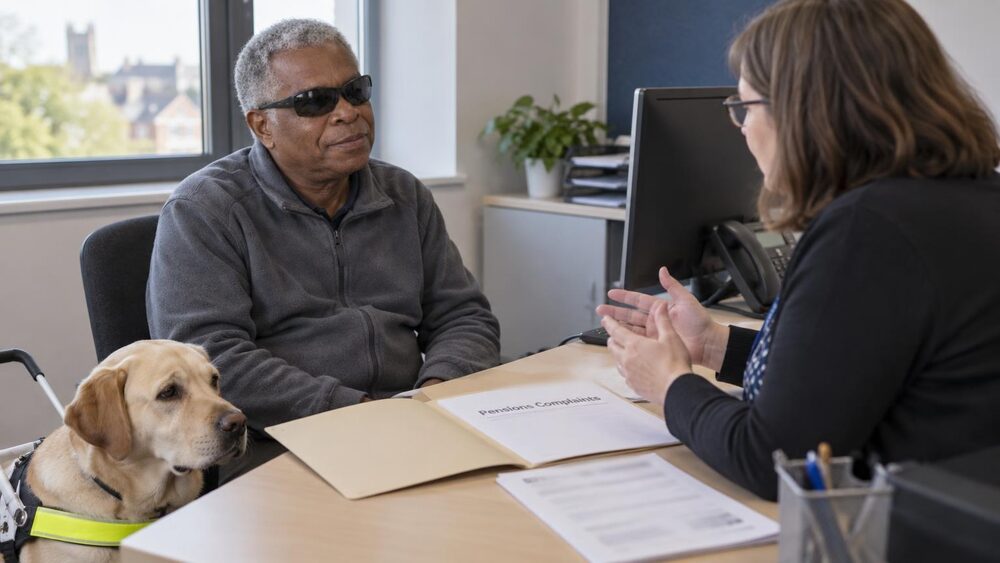
When something goes wrong with a pension, whether contributions that never arrived, a benefit calculated the wrong way, or a transfer that stalled for months, there is a free, independent body that can look at it and order it put right. The Pensions Ombudsman is an independent organisation set up by law, and its primary function is handling pension complaints and disputes1. It deals with some complaints about the administration of workplace pensions, and its remit extends to how personal and occupational pension schemes are run more generally2.
The service is free and impartial: it looks at the facts without taking sides3. In the year ending 31 March 2026 it resolved 10,793 pension complaints, a 14% increase on the previous year, and it now receives over ten thousand complaints every year4. The three most common topics of new complaints were contributions, retirement benefits and calculation of benefits4.
There is a second ombudsman in this area, the Financial Ombudsman Service, and which one you use depends on what your complaint is about. Broadly, The Pensions Ombudsman covers how schemes are run and administered, while the Financial Ombudsman Service covers the sale, marketing and advice side. This page explains the difference, what each can do, and the steps to take before either will look at your complaint.
What The Pensions Ombudsman does
The Pensions Ombudsman is an independent organisation set up by law1. Its primary function is handling pension complaints and disputes1, and it is set up by law to investigate complaints about how occupational or pension schemes are run, where the dispute cannot be resolved between the parties6. In practice that means it stands between a scheme member, beneficiary or potential beneficiary on one side, and the people running the pension on the other: the trustees, the scheme manager, the administrator or the employer.
It is not a court and it is not a regulator, but it has real teeth. It can investigate a complaint, make findings about what went wrong, and issue a determination that binds the organisation complained about. Where trustees or scheme managers did not comply with their legal obligations and this caused you loss, it may direct that they reinstate funds into the scheme for you or provide comparable benefits in another pension scheme1. It can also make an award for distress and inconvenience1.
The service is free and impartial3, and you have the right to refer your complaint to it free of charge7. It offers both a resolution service, which tries to settle complaints by agreement, and a formal adjudication service8. Most complaints never reach a formal decision: the majority are resolved informally7, which usually means the parties agree a fix without the Ombudsman having to order one.
It is worth being clear about scale. The Ombudsman now receives over ten thousand complaints every year9, and in 2025/26 it received 10,944 new pension complaints, a 14% increase compared with 2024/2510. For context, the Financial Ombudsman Service received 7,494 pensions complaints between 9 July 2024 and 8 July 20254, so the two bodies together deal with a substantial volume of pension disputes each year.
Complaints it can look at: contributions, benefits, charges and more
The Pensions Ombudsman can look at complaints about how personal and occupational pension schemes are run11. That is a wide brief, and the Ombudsman's own guidance lists the kinds of complaint it considers. The examples include:
- auto enrolment
- benefits: incorrect calculation, refusal, failure to pay, late payment, and pension increases
- charges and fees
- death benefits
- failure to provide information or act on instructions
- fund switches
- guaranteed annity rates
- ill health
- interpretation of scheme rules and policy terms
- misquotes and misinformation
- pension liberation
- transfers, in general
- winding up
- with-profits issues7
The same list appears in the Ombudsman's signposting guidance, which adds that these are examples rather than an exhaustive catalogue12. What links them is that each is a complaint about the running or administration of a scheme: something the trustees, manager, administrator or employer did or failed to do. The three most common topics of new pension complaints in 2025/26 were contributions, retirement benefits and calculation of benefits4, which reflects where problems most often arise in practice.
A few of these deserve a note. Pension liberation, where someone is persuaded to access their pension early, often through a scam, is covered both by the Ombudsman's complaint process and by its guidance on common scam topics, which notes that if you are unhappy with a scheme's reply, or it does not respond within eight weeks, you can submit a complaint1. If you are worried about a transfer in particular, the pages on transferring pensions, what to do if a transfer is delayed and pension scams cover the warning signs and the steps to take.
Complaints about death benefits, where a scheme has paid the wrong person or taken too long, are also within its remit7, and the page on what happens to your pension when you die explains how those decisions are normally made in the first place.
Where The Pensions Ombudsman cannot help
The limits matter as much as the remit. The Ombudsman is not a regulator: it cannot change the law, make wider changes to the pensions industry, or fine or punish organisations6. Its job is to sort out the individual dispute in front of it, not to police the market. That is the role of bodies such as The Pensions Regulator and the Financial Conduct Authority.
Some complaints belong elsewhere entirely:
- Mis-selling of pensions or advice. Complaints about the sale or marketing of pensions, or about financial advisers, need to go to the Financial Ombudsman Service6.
- The State Pension. Complaints about the State Pension should be directed to the Pension Service13. The Ombudsman's remit covers workplace and personal schemes, not the state scheme. The pages on the new State Pension and your National Insurance record explain how that side works.
- Firms not on the FCA Register. If the firm you want to complain about is not on the FCA Register, the complaint should be referred to The Pensions Ombudsman13, which is the mirror image of the Financial Ombudsman Service's own position.
- Complaints about the Ombudsman's own service. If you are unhappy with how The Pensions Ombudsman handled your complaint, you can take that complaint to the Parliamentary and Health Service Ombudsman, which can only look at complaints about process, not decisions3.
There is also a limit on who can bring a complaint after a death. The Ombudsman's governing legislation provides that only a personal representative can bring or continue a complaint on behalf of a deceased person's estate14. A relative who has not been appointed as the estate's personal representative cannot take the complaint forward, however close they were to the person who died. The page on what happens to pensions when someone dies explains how estates and death benefits are handled.
Personal pensions: Pensions Ombudsman or Financial Ombudsman Service
This is the point that confuses most people, because two ombudsmen can both look at pension complaints, and the dividing line depends on what the complaint is about rather than what kind of pension you have.
The Financial Ombudsman Service can consider most complaints about personal pension arrangements15. Its pensions jurisdiction covers matters which concern advice relating to the sale or marketing of individual pension arrangements16, and it states plainly that it is not able to investigate matters that concern the administration and management of personal and occupational pensions, or state pensions16. That is The Pensions Ombudsman's territory.
For the administration of a personal pension scheme, including self-invested personal pensions, group personal pensions and annuities in payment, either the Financial Ombudsman Service or The Pensions Ombudsman could help you12. So if your complaint is that a SIPP administrator failed to act on an instruction, or a group personal pension was run badly, you have a choice of bodies. If your complaint is that you were advised to transfer into a personal pension and that advice was wrong, that is a sale and advice complaint, and it goes to the Financial Ombudsman Service6.
If you are not sure which body your complaint belongs to, you do not have to work it out in advance. You can bring your complaint to the Financial Ombudsman Service and, if it thinks it should be dealt with by The Pensions Ombudsman, it will let you know2. The same logic applies in reverse, and the Ombudsman's signposting guidance is designed to route complaints correctly12.
The Financial Ombudsman Service also allows someone to bring a complaint on your behalf: a representative such as a friend, family member or support worker can talk to it for you, or you can bring the complaint directly yourself2. The pages on personal pensions and SIPPs explain how these arrangements work day to day.
Complain to your scheme first: the eight-week rule
Neither ombudsman is a first port of call. Before applying to The Pensions Ombudsman, you must first make a formal complaint directly to the relevant party, such as the trustees or manager of your pension scheme, the administrator or an employer3. The Ombudsman's guidance is equally direct: before you come to it, you must have completed the formal complaints process with the relevant party6.
The rule that follows is the eight-week rule. If you are unhappy with the scheme's reply, or it does not respond within eight weeks, you can submit a complaint to the Ombudsman1. Eight weeks is the point at which the scheme has had a fair opportunity to put things right itself, and the Ombudsman will expect to see what happened when you gave it that chance.
Workplace schemes operate a formal internal dispute resolution procedure, and the rules require that the notification at the end of it includes a statement referring the member to The Pensions Ombudsman and how the organisation may help them, with contact details provided17. Schemes must also provide information about the Money and Pensions Service and the Pensions Ombudsman to the complainant at certain stages of the dispute18. So if you have been through the process, the scheme's final letter should itself tell you about your right to escalate.
There is also a time limit on your side. You generally have three years to bring a complaint to the Ombudsman5, counted within three years of the event you are complaining about happening, or within three years of when you first knew about it, or should have known about it19. The same three-year rule appears in the Ombudsman's signposting guidance7. If you are close to the limit, it is better to apply than to wait, because the clock does not pause while a scheme considers its reply.
How to apply to The Pensions Ombudsman
By law, applications must be made in writing3. In practice, you can complete an application online, and you will need to include full details of your complaint together with the response, if any, from any party you believe to be at fault1. A PDF form can be printed and posted, and in exceptional circumstances the Ombudsman can take an application by phone. MoneyHelper can help you complete the application3.
What you send matters, because the Ombudsman will check first that the complaint is valid. The application needs:
- full details of your complaint
- the final response from any party or parties you believe to be at fault
- any relevant correspondence
- copies of the policies and scheme rules under which the decision was made, if you have them8
The requirement that catches most people out is evidence. You will have to provide evidence that you raised your complaint with the party or parties you believe to be at fault, and gave them an opportunity to respond19. A complaint that arrives without proof of the earlier formal complaint can be closed as invalid, so keep copies of what you sent, when you sent it, and anything that came back.
If you are complaining on behalf of someone who has died, remember the personal representative rule: only a personal representative can bring or continue a complaint on behalf of a deceased person's estate14. The application will need to show that you hold that role.
If your complaint is about missing payments into a workplace pension rather than administration in general, The Pensions Regulator is also relevant: it accepts reports from scheme members about missing payments, and its guidance notes that if you are unhappy with how your employer or workplace pension scheme dealt with your situation, you can make a complaint to The Pensions Ombudsman20. The page on automatic enrolment explains what your employer must pay in in the first place.
Review, informal resolution, investigation and determination
Once a complaint is accepted, it passes through four stages: Review, Informal Resolution, Formal Investigation and Determination3.
At the Review stage, the Ombudsman checks that the complaint is valid and within its remit: that it is the kind of complaint it can look at, that the formal complaints process has been completed, and that it is within time. There are several ways a complaint can be closed at this point, including invalid closure, jurisdiction closure, withdrawal, resolution, discontinuation and determination3.
At Informal Resolution, the Ombudsman tries to settle the complaint by agreement between the parties. This is where most complaints end, and it is often faster and less adversarial than a formal decision.
At Formal Investigation, the complaint moves to the formal Adjudication Service, which looks at the evidence from both sides4. Anyone involved can request an oral hearing, with the decision on whether to hold one resting with the Ombudsman, and oral hearings are open to the public3.
At Determination, the Ombudsman or a Deputy Pensions Ombudsman makes a formal decision. In the year ending 31 March 2026, a total of 377 pension complaints were closed by Determination, of which 72 were Expedited Determinations4.
The structure reflects a deliberate design. A government consultation on the Ombudsman's dispute resolution and jurisdiction sought views on measures to make new provisions for dispute resolution, in particular a function for early resolution of disputes before a determination21, and the consultation responses were broadly supportive of the proposals21. The aim is that disputes are settled at the earliest stage that produces a fair result.
Most complaints are resolved informally
The headline number surprises people who expect every complaint to end in a formal ruling. The majority of the Ombudsman's complaints are resolved informally7, and in the year ending 31 March 2026 it recorded an informal resolution rate of 87.4%, well above its 80% target4.
The formal route is the exception rather than the rule. In 2025/26 the Ombudsman closed 968 pension complaints through its formal Adjudication Service, a 2.9% decrease on 2024/25, and closed 377 complaints by Determination4. Set against 10,793 complaints resolved in total over the same year4, the formal decisions are a small fraction of the caseload.
Of the complaints that did reach a Determination, 45% were upheld or partly upheld4. That figure is worth reading both ways: a determination is not a formality for either side, and a substantial share of formally decided complaints end with the scheme or administrator being told to put things right.
For a consumer, the practical meaning is this. An informal resolution is still a resolution: the Ombudsman's involvement, and its power to determine the complaint if agreement fails, is usually what brings the parties to settle. A complaint does not need to be dramatic or legally complex to be worth making, and the fact that most are settled without a formal decision does not mean the complaint was not justified. The Ombudsman's own case studies include examples where a scheme did things right, published as part of its work explaining its decisions9.
What the Ombudsman can order, including awards for distress
If the Ombudsman finds in your favour, it has a range of powers to put things right. Where trustees or scheme managers did not comply with their legal obligations and this caused you loss, it may direct that they reinstate funds into the scheme for you, or provide comparable benefits in another pension scheme1. That is the remedy that matters most in serious cases, because it restores the pension position rather than simply paying cash compensation.
The Ombudsman may also make an award for any distress and inconvenience you have suffered1. Its guidance sets a threshold: it may make an award if it finds that poor administration caused you "significant" distress and inconvenience as defined in its guidance8. The word significant is doing real work there, and awards for distress are not automatic, but they are available where the impact of the maladministration went beyond the purely financial.
The equivalent powers at the Financial Ombudsman Service work in much the same way for the complaints it handles. If it thinks you lost money, or may lose retirement income, because you received the wrong pensions advice, it will tell the financial adviser or pensions provider to put things right, and it may also tell them to pay you compensation for any distress or inconvenience you have suffered22. In workplace pension cases it may tell the provider to pay compensation into your pension plan or straight to you2.
A determination by The Pensions Ombudsman is binding on the organisation complained about. If the organisation does not comply, enforcement routes exist, but the starting position is that a determination ends the dispute. If your complaint is about how the Ombudsman itself behaved in handling your case, that is a process complaint for the Parliamentary and Health Service Ombudsman, which cannot revisit the decision3.
Free help with a pension complaint
You do not have to work out your complaint alone, and none of the help costs anything. The Pensions Ombudsman publishes a member guidance hub covering how to complain about a pension problem, common pension complaint topics, who can complain to it, and what it can and cannot do10. Its signposting guidance sets out where to go for help with a pension complaint, including the routes for personal pension administration complaints12.
MoneyHelper, the government's money guidance service, can help you complete an application to the Ombudsman3, and official guidance confirms you can complain to MoneyHelper or the Pensions Ombudsman about how your workplace pension is managed23. For free guidance on your pension options more generally, Pension Wise covers what is available.
In Scotland, official guidance for people who were mis-sold a pension instead of being a member of the NHS or Teachers' Scheme sets out two routes: contacting the pension providers and asking them to contact the SPPA confirming what action they are willing to take, and referring the case to the Financial Ombudsman, which may be able to consider taking action on their behalf22. The page on public sector pension schemes explains how those schemes work.
If your concern is less a dispute and more a suspicion that something is wrong, The Pensions Regulator accepts reports from scheme members about their workplace pension, including reports that an employer is not complying with its workplace pension duties, and asks for the evidence you want to send20. It also notes that The Pensions Ombudsman can help if you have a complaint about your pension scheme24. For suspected scams, the page on pension scams sets out the warning signs and where to report them.
Sources24 cited
- Common topics factsheet: pension scams The Pensions Ombudsman, 2022-02
- Pensions organised through employers Financial Ombudsman Service, 2026-09-26
- How we handle complaints The Pensions Ombudsman, 2026
- A year of record productivity: continued transformation and growing demand at TPO The Pensions Ombudsman, 2026-03-31
- How to complain about a pension problem The Pensions Ombudsman, 2026
- What we can and cannot do The Pensions Ombudsman, 2026
- Signposting to The Pensions Ombudsman The Pensions Ombudsman, 2023
- Death benefit lump sum guidance The Pensions Ombudsman, 2026-06
- Ombudsman's desk: a case where the scheme did things right The Pensions Ombudsman, 2026-08-27
- Pensions Ombudsman promotes member guidance during Pension Awareness Week The Pensions Ombudsman, 2026-09-14
- Research briefing: pension complaints House of Commons Library, 2026-09-26
- Where to go for help with your pension complaint The Pensions Ombudsman, 2020-05-19
- Pensions and annuities: complaints we can help with Financial Ombudsman Service, 2026-09-26
- Complaining to TPO on behalf of a deceased's estate The Pensions Ombudsman, 2021-01
- Personal pensions: complaints we can consider Financial Ombudsman Service, 2026-09-26
- Consultation on pensions transfers Financial Ombudsman Service, 2015-10-21
- Pensions law tutorial 4: internal dispute resolution procedure The Pensions Regulator, 2026-06
- Dispute resolution procedures: code of practice The Pensions Regulator, 2026-09-26
- Complaining to the parties at fault The Pensions Ombudsman, 2021-03
- Report missing payments to your workplace pension The Pensions Regulator, 2026-09-26
- The Pensions Ombudsman: dispute resolution and jurisdiction consultation HM Government, 2018-12-19
- Mis-selling pensions pensions.gov.scot, 2026
- Safety of workplace pension schemes nidirect, 2025-12-03
- Report concerns about your workplace pension The Pensions Regulator, 2026-09-26



 Pension WiseFree guidance on your options for a defined contribution pension, from age 50
 FSCSProtects your money if a bank, insurer or investment firm fails
 GOV.UKOfficial information on tax, benefits and government services