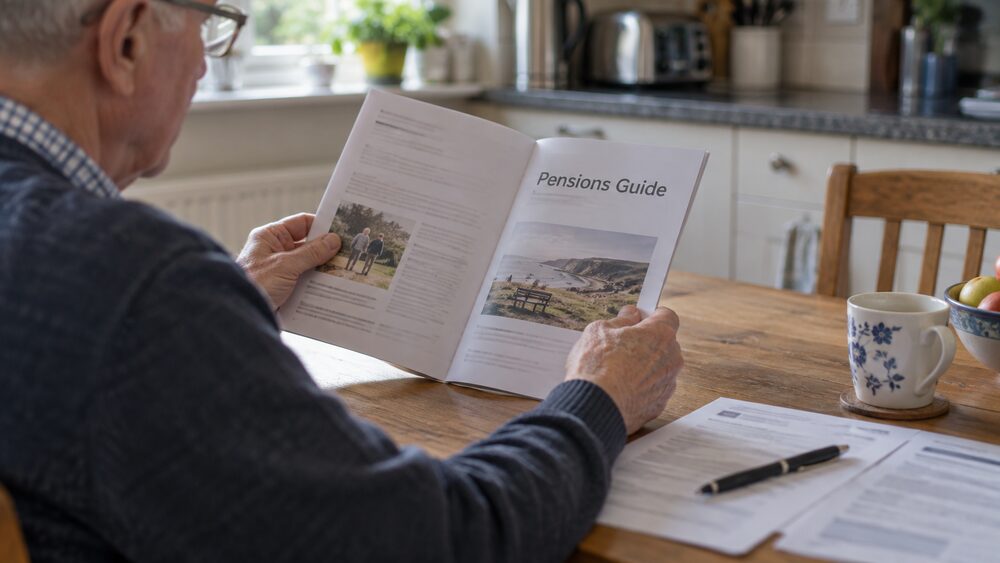
A workplace pension is a way of saving for retirement that is arranged by your employer, and in most cases your employer also adds money into the pension scheme for you, with the government adding tax relief on top1. A percentage of your pay goes into the scheme automatically every payday, so the saving happens without you having to do anything once it is set up1. Almost 10 million workers have been automatically enrolled into a workplace pension by their employer2.
The charges matter because they come out of your pot year after year. The main protection is a cap of 0.75% a year on the charges taken from members' savings in the default fund of a qualifying scheme, the fund most people are in unless they choose otherwise3. The cap does not cover everything: transaction costs and certain performance-based fees sit outside it, and it does not apply to funds you actively choose yourself.
How a workplace pension works
A workplace pension is arranged through your employer as a way to save for your retirement9. Some are called "occupational", "works", "company" or "work-based" pensions, but they all mean the same basic thing: a percentage of your pay is put into the pension scheme automatically every payday1. In most cases your employer also pays money in, and you may get tax relief from the government as well1.
In a defined contribution workplace pension scheme, which is the most common type used for automatic enrolment, your employer chooses a pension provider to invest your pension contributions10. The money is invested, and the size of your pot at retirement depends on how much has been paid in, how the investments perform, and how much has been taken out in charges. This is different from a defined benefit scheme, where your employer must make sure the scheme has enough money to pay employees' pensions and cannot spend the pension fund if it runs into financial problems10.
Charges are taken by the provider to run the scheme and manage the investments. Because these charges are deducted from your pot rather than billed to you, many people never notice them, but over a working lifetime they can make a significant difference to what you end up with. That is why the rules on charges, and the cap explained below, exist.
When your employer automatically enrols you, they must write to you with the date they added you to the scheme, the type of scheme and who runs it, how much they will contribute, how much you will pay in, and how you can leave8. Keep that letter: it is the reference point for everything the scheme owes you.
The wider picture is covered in workplace pensions explained, and the different types of scheme in defined contribution pensions explained and defined benefit pensions explained.
The 0.75% cap on default funds
The annual cap on charges in qualifying defined contribution workplace pension schemes is set at 0.75 per cent of funds under management, or an equivalent combination charge annual cap3. The Pensions Regulator puts the same rule in plainer terms for employers choosing a scheme: charges paid out of member savings in default investment arrangements must be no higher than 0.75% a year of the member's fund4.
The default investment arrangement, usually just called the default fund, is where your money goes if you do not make an active choice about how it is invested. Most members of workplace schemes are in the default fund, which is why the cap was aimed there. The government consulted on the design in 2013, asking whether a cap on charges in default funds of defined contribution qualifying schemes should be introduced11, and the cap that followed applies to those funds rather than to every fund a scheme offers.
The evidence at the time showed why it was needed. In the 2016 Pension Charges Survey, as many as 98 per cent of members of qualifying contract-based schemes and 99 per cent of members of qualifying trust-based schemes paid charges within the cap3. But in non-qualifying contract-based schemes, just 21 per cent of members paid charges within the cap3. In other words, the schemes the rules covered were mostly already under the limit, while many schemes outside the rules carried much higher charges.
The cap is a ceiling, not a target. Many default funds charge less than 0.75%, and a scheme that charges less today keeps the benefit of that lower charge. The cap's job is to stop members who do not make an active choice from paying charges that would erode their savings unnecessarily. How default funds work, and what happens if you pick your own investments, is covered in default funds in workplace schemes.
What the charge cap covers and what it leaves out
The cap is deliberately defined by what it leaves out as much as by what it includes. It applies to all ongoing charges, and therefore excludes transaction costs3. Transaction costs are the costs incurred when the fund buys and sells investments, such as dealing commissions and the spread between buying and selling prices. They still reduce the value of your pot, but they are not counted towards the 0.75% limit.
Performance-based fees are also outside the cap. Regulations in force since March 2024 exclude specified performance-based fees from the charge cap that limits the charges passed on to members of most occupational money purchase pension schemes12. The same regulations removed provisions that had allowed schemes to smooth or pro-rate the effects of performance-based fees for the purposes of the cap12. A performance-based fee is one that rises if a fund beats a target, so excluding it from the cap means a fund manager can, in principle, charge more than 0.75% in total in a year when performance is strong.
The government continues to monitor the market. The Pension Charges Survey 2020 was designed to measure average overall charge levels and the distribution of charges across pension pots, to measure the prevalence and level of different charge components within the cap, and to confirm that charge components now banned are no longer being levied13.
Older types of scheme have their own limits. Stakeholder pension managers can charge up to one and a half per cent of your pension fund each year for the first 10 years, and after that up to one per cent14. That is a different, older cap with a different structure, and it applies to stakeholder schemes rather than to the default funds of qualifying schemes.
One further protection sits alongside the cap. Under FCA rules in force since 31 March 2017, firms must not impose, or include provision for, an early exit charge on members who joined arrangements on or after that date15. The Pension Schemes Act 2017 went further, providing for regulations able to override certain contractual terms in occupational pension schemes to enable a cap on early exit charges and a ban on member-borne commission charges3. So a scheme cannot lock you in with a penalty for leaving, at least for newer arrangements.
Minimum contributions: your employer must pay at least 3%
Automatic enrolment comes with minimum contributions. Employers must make a minimum pension contribution of 3% of the employee's salary, as long as the employee does not opt out5. On top of the employer's payment, you pay a contribution from your own pay, and the government also pays into the pension in the form of tax relief16.
The full detail of how the minimums are worked out, including the qualifying earnings band they are measured against, is covered in auto-enrolment minimum contribution rates and automatic enrolment: who is enrolled and what must be paid in. In practice, the effect is that every pound paid into the pot comes from three sources: you, your employer, and the taxman.
Contributions are taken from your pay automatically, so you do not need to do anything to keep them going once you are enrolled1. If you want to pay in more than the minimum, you can usually do so, and some employers will match higher contributions, though that depends on the scheme. For advice about increasing your workplace or private pension, the official guidance is to speak to a financial adviser1.
How the tax relief side works, including the difference between relief at source and net pay arrangements, is covered in pension tax relief and relief at source or net pay. Some employers run their scheme through salary sacrifice, which changes how contributions and tax relief are applied.
Who is automatically enrolled
Your employer must automatically enrol you into a workplace pension scheme unless you are already in a suitable scheme9. The core test for automatic enrolment is age and earnings: if you earn more than £10,000 a year and are aged over 22 but under State Pension age, you will be automatically enrolled6. Employees who earn more than £10,000 are automatically enrolled into a workplace pension unless they opt out17.
Below that earnings trigger, the rules change in steps:
- Earning more than £10,000 a year, aged 16 to 21: your employer will not automatically enrol you, but you have the right to join if you want, with both you and your employer contributing and you getting tax relief6.
- Earning more than £6,240 up to £10,000 a year, aged over 16 but under 75: your employer will not automatically enrol you, but you have the right to join the pension, and you and your employer will both pay into it6.
- Earning £6,240 or less a year: your employer does not have to contribute, but can choose to do so7.
The official example makes the under-22 rule concrete: Raj is 20, earns £17,000 a year working for a building contractor, and his employer does not have to automatically enrol him because he is under 22. But Raj can ask to join the pension, and if he does, his employer has to enrol him and pay into it16.
Earnings are assessed on what you are actually paid. If you get additional earnings, for example paid overtime, that means your pay in a single pay packet will be more than the threshold, and your employer will automatically enrol you6. The earnings trigger is £10,000 a year, which is also expressed in the employer rules as £520 a month or £120 a week8.
The duty reaches beyond traditional employment. If you work through an umbrella company, your employer must automatically enrol you into a workplace pension scheme if you are eligible19. The Pensions Regulator has also said that employers in the gig economy should recognise and comply with their automatic enrolment responsibilities voluntarily and promptly20. And under the Pensions Act 2008, a worker without qualifying earnings, aged 16 to 75 and working in Great Britain, may by notice require their employer to arrange for them to become an active member of a pension scheme21. Self-employed people are the exception: they are not automatically enrolled, because automatic enrolment works through an employer22.
Staying in or opting out
You can choose to opt out of a workplace pension9. Your employer has to tell you the start and end dates of the one-month opt-out period when you are automatically enrolled7, and if you opt out within that month, your employer must refund the money you have paid8.
Opting out is a personal decision, and the rules protect your right to make it either way. Your employer cannot encourage or force you to opt out of the scheme, cannot unfairly dismiss or discriminate against you for staying in, cannot imply someone is more likely to get a job if they choose to opt out, and cannot close a workplace pension scheme without automatically enrolling all members into another one8.
Before opting out, it is worth weighing what you would give up. Staying in means your employer pays in at least 3% of your salary5, the government adds tax relief16, and the pot belongs to you even if you leave your employer later16. The official guidance also notes that if you are behind on your mortgage, rent, credit card or other debt payments, a pension might not be the right step at that moment7, and free debt help is available rather than paying for advice.
If you opt out, you are not out for good: your employer must re-enrol you periodically, and you can opt out again each time. How that cycle works is covered in how often you are re-enrolled after opting out, and the mechanics of leaving and getting a refund in how do I opt out of a workplace pension and get a refund.
When your employer does not pay in
There are situations where the employer's contributions stop or never start. The earnings threshold is one: if you earn £6,240 a year or less, your employer does not have to contribute, but can choose to do so7. If you earn more than £6,240 a year, even one penny more, and you are in a workplace pension, your employer has to contribute6.
Unpaid leave is another. If you are not getting paid during maternity leave, your employer does not have to make pension contributions unless your contract provides for this23. However, if you are not getting paid, your employer still has to make pension contributions in the first 26 weeks of your leave, and after that only if it is in your contract6. While you are getting paid during maternity leave, you and your employer continue to make contributions, with your contribution based on your actual pay and your employer's contributions based on the salary you would have received if you were not on leave23.
If contributions go missing altogether, there are routes to recover them. You can claim contributions that were deducted from your pay but not paid into the scheme during the 12 months before your employer became insolvent, and you may also receive unpaid contributions payable by the employer on its own account for the same 12 months24. The Department may also pay 10 per cent of the total pay of the employees concerned for the 12 months ending the day before insolvency24.
The Pensions Regulator treats missing payments as a reportable matter: a report can be made where pension contributions have not been paid into a scheme for 90 days or more25. Missing payments to a workplace pension and employer non-compliance with pension duties are reported using a different form from general concerns about a scheme26.
Where to complain or report a concern about your scheme
Where you take a problem depends on what the problem is. For complaints about how your workplace pension is managed, you can complain to MoneyHelper or the Pensions Ombudsman10. The Pensions Ombudsman deals with some complaints about the administration of workplace pensions27, and can look at complaints about the administration of personal and occupational pension schemes28.
There is a required first step. Before applying to the Pensions Ombudsman, you must first make a formal complaint directly with the relevant party, such as the trustees or manager of your pension scheme, the administrator, or an employer27. If you are unhappy with how your employer or workplace pension scheme dealt with your situation, you can then make a complaint to the Pensions Ombudsman25.
For wrongdoing rather than poor service, the route is The Pensions Regulator. It accepts reports of concerns that relate to a workplace pension, including dishonesty or fraud in the scheme, or significant concerns about how the scheme is being run26. A concern can be reported online, or the regulator can be contacted by phone, email or post where online reporting is not possible30. Reports can be made in confidence where a person thinks their employer or scheme is involved in wrongdoing in an area the regulator covers30.
Complaints about pensions are not rare. The Financial Ombudsman Service received 931 complaints about personal pensions in a single quarter of 2026/2731. Note the split of responsibilities: the Pensions Ombudsman handles complaints about workplace and occupational schemes, while the Financial Ombudsman Service handles complaints about personal pension providers, and complaints about the state pension go to the Pension Service instead32.
The full process, including time limits and what the ombudsman can award, is covered in the Pensions Ombudsman and complaining about a pension and complaining about a pension provider.
Sources32 cited
- Workplace pensions, GOV.UK GOV.UK, 2026-09-26
- Self Employed Savings Trials, deposited paper Parliament, 2018-12
- Pension charge cap briefing SN06209, House of Commons Library House of Commons Library, 2026-07-08
- What to look for in a pension scheme, The Pensions Regulator The Pensions Regulator, 2026-09-26
- Treasury Committee report on pension charges House of Commons Treasury Committee, 2025-06-30
- How your situation affects your workplace pension, nidirect nidirect, 2025-09-11
- Deciding if a workplace pension is right for you, nidirect nidirect, 2026-09-25
- Employers' workplace pension rules, GOV.UK GOV.UK, 2026-09-26
- Introduction to workplace, personal and stakeholder pensions, nidirect nidirect, 2026-09-25
- Safety of workplace pension schemes, nidirect nidirect, 2025-12-03
- Better workplace pensions: a consultation on charging, GOV.UK GOV.UK, 2013-10-30
- Occupational Pension Schemes (Charges and Governance) Regulations (Northern Ireland) 2015, as amended legislation.gov.uk, 2024-03-26
- Pension charges survey 2020, GOV.UK GOV.UK, 2021-01-13
- Stakeholder pensions, nidirect nidirect, 2025-09-11
- COBS 19.10, FCA Handbook FCA, 2017-03-31
- Enrolling in a pension at work, nidirect nidirect, 2026-07-07
- Automatic enrolment briefing CBP-9517, House of Commons Library House of Commons Library, 2026-07-08
- Making the most of your money after the summer boom Money and Pensions Service, 2025-08-04
- Working through an umbrella company, GOV.UK GOV.UK, 2021-04-29
- Automatic enrolment and the gig economy briefing CDP-2023-0027, House of Commons Library House of Commons Library, 2026-07-08
- Pensions Act 2008 legislation.gov.uk, 2008-11-26
- Pensions and the self-employed briefing CBP-7505, House of Commons Library House of Commons Library, 2026-07-08
- Workplace pensions: changes in personal circumstances, nidirect nidirect, 2025-09-11
- Insolvency payment claims, nidirect nidirect, 2025-12-22
- Report missing payments to your workplace pension, The Pensions Regulator The Pensions Regulator, 2026-09-26
- Report a concern relating to your workplace pension scheme, The Pensions Regulator The Pensions Regulator, 2026-09-26
- How we handle complaints, The Pensions Ombudsman The Pensions Ombudsman, 2026
- Quarterly complaints data Q1 2026/27, Financial Ombudsman Service Financial Ombudsman Service, 2026
- Pensions complaints briefing House of Commons Library, 2026-07-08
- Report concerns about your workplace pension, The Pensions Regulator The Pensions Regulator, 2026-09-26
- Pensions and annuities complaints, Financial Ombudsman Service Financial Ombudsman Service, 2026-09-26
- Taking your whole pot, Pension Wise Pension Wise, 2026-09-28





 Pension WiseFree guidance on your options for a defined contribution pension, from age 50
 FSCSProtects your money if a bank, insurer or investment firm fails
 GOV.UKOfficial information on tax, benefits and government services