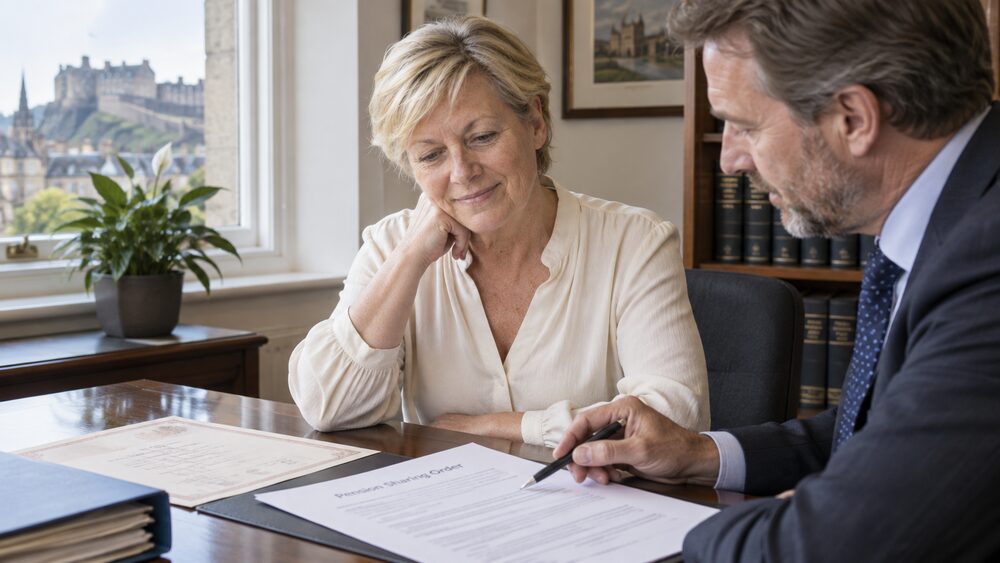
Pensions are often one of the largest assets in a marriage, yet they are frequently left out of the picture when a couple separates. Research for the UK Parliament notes that "pensions are often not considered during divorce"1, and a 2026 survey for the Money and Pensions Service found only 44% of men and 41% of women were aware that a pension can form part of a divorce settlement2. That gap can leave one partner, often the one with less pension of their own, materially worse off in retirement.
Scottish law treats pensions differently from the rest of the UK in one important way: only the pension built up during the marriage counts as matrimonial property. The value used is calculated from the date of the marriage or civil partnership to the date of separation, not from joining the scheme3. This page explains how that valuation works, how a pension sharing order splits a pension, what it costs, how long it takes and where it can go wrong.
In Scotland, only pension built up during the marriage counts
Under Scots law, a pension is matrimonial property only to the extent it was built up during the marriage. The rule is stated plainly in the guidance of the Scottish Public Pensions Agency (SPPA), which administers NHS and teachers' pensions in Scotland: "For divorces under Scots Law, only pension rights relating to the period of marriage will be used in calculating the Cash Equivalent Transfer Value"3. The SPPA's detailed guidance spells out the period as "date of marriage or civil partnership, i.e. date of marriage or civil partnership to date of separation"4.
This is the single biggest difference from the law south of the border. For divorces under the law of England and Wales, "membership relating to the whole period, from the date of joining the pension scheme to the date of the actual calculation" is taken into account4, and under English law "all pension rights will be taken into account"3. So the same pension can be worth a very different amount in a settlement depending on which side of the border the divorce happens in.
The same principle applies to other assets. MoneyHelper's guidance on dividing the family home explains that a home is matrimonial property if it was bought after the marriage or civil partnership, or bought before it specifically for use as a family home, and that if the home is transferred to one partner it "should be valued at the date you separated"5. The date of separation is therefore the pivot on which the whole Scottish settlement turns: pension value, house value and other matrimonial property are all measured against it.
The stakes are real. The Scottish Government notes that pensioner poverty is a growing issue in Scotland, with one in seven people over State Pension age living in poverty6, and the wealthiest quarter of Scottish households with private pension wealth held a median of £69,700 in private pension wealth in the period July 2012 to June 20147. A pension ignored at divorce is a retirement income lost decades later.
How the matrimonial share is valued: CETV from marriage to separation
The starting point is the Cash Equivalent Transfer Value, or CETV: the scheme's own calculation of what the pension rights are worth in cash terms today. For a Scottish divorce, the SPPA calculates the CETV only for the period of marriage, from the date of marriage or civil partnership to the date of separation4. Anything built up before the wedding, or after separation, stays outside the pot.
Getting the valuation takes time. The SPPA warns that because the calculation can depend on third parties such as employers and HMRC, "the process can therefore take up to three months to complete"4. That is before any court process begins, so it is worth requesting a valuation early.
Members of public service schemes affected by the McCloud remedy face an extra layer. For pension sharing arrangements on or after 1 October 2023, eligible active and deferred members going through divorce or dissolution will have two CETVs calculated: "One CETV based on legacy scheme benefits for the remedy period and the other based on reformed scheme benefits. The higher value CETV will be used as the basis for the arrangement"8. If one of you has an NHS, teachers', civil service, police, fire or local government pension, ask the scheme whether the remedy affects the valuation. The McCloud remedy for public sector pensions is explained in full on its own page.
The SPPA provides a pension valuation service for divorce or dissolution of a civil partnership, and help with implementing pension sharing arrangements3. Other schemes, including private and workplace pensions, provide valuations through their own administrators; the general rules on workplace pensions and personal pensions apply to how those pots are valued and run.
Pension sharing orders: how a pension is split
A pension sharing order is the court order that actually moves value from one partner's pension to the other. Once implemented, the receiving partner holds their share in their own right: it is no longer part of the member's pension and no longer depends on the member being alive, retiring or cooperating.
For the SPPA's schemes, implementing the order requires three things: a copy of the Extract Decree or Dissolution Order, the Pension Sharing Order itself including the information required by the Pensions on Divorce (Provision of Information) Regulations 2000 Section 5, and payment of the administration charges for implementing the order3. The Pensions on Divorce etc. (Charging) Regulations 2000, which underpin the charging regime, apply across England, Wales, Scotland and Northern Ireland9.
The SPPA strongly suggests a practical step: "submitting a draft copy of the Pension Sharing Orders or Qualifying Agreement before finalising the divorce can save considerable time and costs, as SPPA can review the document and ensure its terms are enforceable"3. Sending the draft before the divorce is finalised means errors are caught while they can still be fixed cheaply, rather than after the decree has been granted.
Once the order is implemented, the member's remaining pension is reduced accordingly. If the member later transfers their pension to a new provider, "pension benefits will be reduced to take account of the provisions of the Pension Sharing Order. A copy of the Order will be forwarded to the new pension provider to take account of any effect on HMRC's maximum benefit limits"3. The receiving partner's share is theirs to transfer or invest under the normal rules on transferring pensions between providers.
A fixed sum or a percentage: how Scottish orders set the share
A pension sharing order in Scotland can be expressed in one of two ways: a fixed sum, stated in pounds, or a percentage of the CETV. Both approaches draw on the same valuation, the CETV calculated for the period of marriage, but they behave differently if the pension's value moves between the valuation date and implementation.
A fixed sum gives certainty about the amount that moves, but if the underlying pension falls in value before the order is implemented, the percentage of the pot needed to fund that sum rises; in a falling market a large fixed sum can in principle consume more of the pot than expected. A percentage order instead moves a set proportion of the value, so both partners share the effect of any rise or fall between valuation and implementation. Which form to use is a matter for the settlement negotiation and legal advice; what the scheme needs is that the order is drafted in enforceable terms, which is exactly what the SPPA's draft review service is for3.
The choice also interacts with the wider settlement. MoneyHelper's guidance on dividing the family home shows how the date of separation fixes the value of the house as well as the pension5, so a couple weighing a fixed sum against a percentage is really deciding how each of them carries the risk of values moving after that date. The comparison page on sharing or offsetting on divorce sets out the alternative of leaving the pension with one partner in exchange for a larger share of other assets.
Which pensions can be shared, and which cannot
Most pension types can be subject to a sharing order: workplace pensions, personal pensions, and public service schemes such as the NHS and teachers' schemes the SPPA administers3. Within those schemes, the normal rules of the scheme continue to apply to what the share looks like.
- Defined benefit pensions, including public sector schemes, produce a share that is usually an internal credit in the same scheme. The NHS scheme, for example, pays a pension for life once a member has accrued two years' service, with a normal pension age of 60 in the 1995 section and the same as the State Pension age in the 2015 scheme10.
- Defined contribution pensions move cash value, which the receiving partner can hold or transfer. Only "sums or assets held for providing money purchase benefits may be designated as available for drawdown pension" under the relevant provisions of the Pensions Act 201511, so a shared pot follows the normal drawdown and access rules afterwards.
- Pensions in payment or in drawdown can still be valued and shared; the share is carved from what remains.
- Pension Protection Fund compensation has historically been harder to share. The Pensions Act 2008 and draft regulations were designed to "enable pension compensation provided by the Pension Protection Fund (PPF) to be shared when a person seeks a divorce, a dissolution of their civil partnership or an annulment"12. If a pension is in PPF compensation rather than a live scheme, check the current position with the PPF and take advice.
Transfers add a further condition. Under Part 4ZA of the Pension Schemes Act 1993 there is a statutory right to transfer, subject to conditions, for example that the member has not started to draw benefits13. The page on transferring out of a final salary pension covers when that is even possible.
Benefits and drawbacks of pension sharing
The case for sharing is straightforward: it converts a pension that exists only on paper for the non-member partner into an asset they own. Given that only 44% of men and 41% of women surveyed in 2026 were aware a pension can be part of a divorce settlement2, and that pensions are often not considered at all1, sharing is the mechanism that stops the lower-pension partner reaching retirement with nothing.
The benefits:
- The receiving partner gets a pension in their own name, independent of the member's survival, retirement date or future choices.
- It creates a clean break: once implemented, neither partner has a continuing claim on the other's pension.
- It works for pensions of all sizes, and the share can be transferred or invested under normal rules3.
The drawbacks and risks:
- It costs money: the SPPA's standard charge for implementing a pension sharing order is £3,600 plus £720 of VAT, a total of £4,320, from 1 April 20264, before legal fees.
- It takes time: up to three months for the valuation and up to four months for implementation4.
- The share is pension money, not cash. It cannot generally be drawn before the normal minimum age, and only money purchase funds can be designated for drawdown11. Someone expecting a lump sum on divorce may be disappointed.
- The member's remaining pension is permanently reduced, which affects their own retirement income and any death benefits.
Offsetting, leaving the pension untouched in exchange for a greater share of the house or savings, avoids the fees and delay but ties the lower-pension partner to assets that may be harder to live on in old age. The trade-offs are set out on the sharing or offsetting page.
How long it takes: up to four months once the scheme has everything
The process has two clocks. First, the valuation: the SPPA states the CETV calculation "can therefore take up to three months to complete" because it can depend on third parties such as employers and HMRC4. Second, the implementation: once the divorce or dissolution is granted, "the SPPA then has 4 months from that date to implement the order", counted from the date the documents and the administration charge are received4.
The practical way to shorten this is the draft review: sending the draft Pension Sharing Order or Qualifying Agreement to the scheme before the divorce is finalised "can save considerable time and costs" because the scheme can confirm the terms are enforceable3. A badly drafted order discovered after the decree means starting again.
If things go wrong at the scheme, there are set timescales too. Under The Pensions Regulator's dispute resolution rules, a scheme must decide a dispute within four months of receiving the application, or reach a first stage decision within four months in a two-stage procedure, and notify the applicant of the decision no later than 21 days from when it is made14. A person who no longer has an interest in the scheme generally has six months from the date their interest stopped to apply14. Separately, it can take up to three months for money to be paid into a pension15, which can extend the wait for a transfer-based share.
Costs, fees and provider acceptance of transfers
The scheme's own charge is only part of the cost. For the SPPA's schemes, from 1 April 2026 the standard charge for implementing a pension sharing order is £3,600 plus VAT of £720, a total of £4,3204. Other schemes set their own charges under the Pensions on Divorce etc. (Charging) Regulations 2000, which apply UK-wide9. On top of that come legal fees for the divorce and the order, and possibly actuarial or financial advice on the valuation.
Who pays the scheme's charge is part of the negotiation; the SPPA requires payment of the administration charges before it will implement the order3, so in practice the order cannot complete until someone has paid it.
If the receiving partner wants the share moved to a different provider, the normal transfer rules apply. The statutory right to transfer under Part 4ZA of the Pension Schemes Act 1993 is subject to conditions, including that the member has not started to draw benefits13. Transfers also carry scam risk: the government's consultation on pension scams, which applies to England, Scotland and Wales, is part of a framework designed to protect members from being persuaded to move their pension into fraudulent schemes16. The pension scams page covers the warning signs. The wider Pensions Investment Review, which also applies to England, Scotland and Wales, is part of the ongoing policy backdrop to transfers and scheme consolidation17.
Money that has been through a divorce settlement is no different from any other pension money when it comes to debt problems. If bankruptcy enters the picture, the fees and processes are different in Scotland18, and specialist debt advice is the place to start.
Where pension sharing can fail or leave claims open
The clearest failure is the one the statistics point to: pensions simply not being considered during divorce1. A settlement that divides the house and savings but leaves both pensions untouched has not settled the pension question, and the partner with the smaller pension carries that into retirement, where one in seven people over State Pension age in Scotland already live in poverty6.
Other failure points:
- Death before implementation. An Earmarking Order, an older alternative to sharing, "ceases to apply if the former spouse or civil partner dies before the member retires"4. A former partner relying on earmarking can lose everything they were owed. Sharing, once implemented, does not have this dependency.
- Unenforceable drafting. An order the scheme cannot implement wastes the whole process. The SPPA's draft review exists precisely to prevent this3.
- Missing the transfer window. In the Scottish police schemes, for example, a member must "apply for a transfer payment within six months of leaving Police employment or opting out of the Police scheme"19. Timing around a divorce can interact with scheme-specific deadlines like this.
- Valuation surprises. Members affected by the McCloud remedy get two CETVs, with the higher used as the basis8; a settlement negotiated on one figure can be unsettled by the other.
- Death benefits left out of the discussion. Scheme death benefits, such as those in the NHS scheme payable to a legal spouse, registered civil partner, qualifying partner and dependent children10, change meaning after divorce. Proposals in the Local Government Pension Scheme in Scotland have even addressed continuity of survivor pension entitlement where a member died on 30 September 202320, and the Police Pension Scheme (Scotland) Amendment Regulations 2025 came into force on 1 April 202521. Nomination of beneficiaries needs reviewing after any divorce; see how to nominate a beneficiary.
Estate planning also shifts. In Scotland, the spouse or civil partner exemption for inheritance tax must be calculated on the basis that any entitlement to legitim against the estate will be claimed in full22, and new regulations are being made to require pension providers and personal representatives to share information with each other, with beneficiaries and with HMRC about a deceased person's pension assets23. The pages on pensions and inheritance tax and what happens to pensions when someone dies cover this in detail.
Where to get help
Free, impartial support exists at every stage. MoneyHelper, the government-backed money guidance service, publishes guidance on dividing the family home and mortgage during divorce or dissolution5, and the Money and Pensions Service, which runs it, is the body behind the research showing how few people realise pensions can be shared2. Free guidance on pension options generally is available through Pension Wise.
If a dispute is with the scheme itself, the route is the scheme's internal dispute resolution procedure, governed by The Pensions Regulator's rules on timescales and notification14, and after that the Pensions Ombudsman. The general rules on workplace pensions and public sector schemes explain who administers which kind of scheme, and the NHS Scotland scheme has its own page at NHS Scotland Pension Scheme.
For the legal process itself, a solicitor practising Scottish family law is essential: the rules on the relevant date, matrimonial property and the form of the order are Scots law, and they differ from England and Wales as described above. The wider site guide to pensions and the page on pensions on divorce or dissolution cover the UK-wide picture, and the money in Scotland section explains where Scottish rules differ across personal finance.
Sources23 cited
- Pensions and divorce research briefing UK Parliament House of Commons Library, 2026
- Just four in ten aware that pensions can be part of a divorce settlement Money and Pensions Service, 2026
- Pensions on divorce, SPPA NHS and teachers' guidance Scottish Public Pensions Agency, 2026
- SPPA Pensions on Divorce, NHS and Teachers, 1 April 2026 (PDF) Scottish Public Pensions Agency, 2026
- Dividing the family home and mortgage during divorce or dissolution MoneyHelper, 2026
- Pension Age Winter Heating Payment fairer Scotland duty assessment Scottish Government, 2024
- Wealth in Great Britain Wave 4, private pension wealth chapter (PDF) Office for National Statistics, 2012 to 2014
- Scottish Teachers' Pension Scheme consultation on the 2015 Remedy Scottish Public Pensions Agency, 2023
- The Pensions on Divorce etc. (Charging) Regulations 2000 legislation.gov.uk, 2000
- How your NHS pension works Scottish Public Pensions Agency, 2026
- Pensions Act 2015, drawdown designation provisions legislation.gov.uk, 2015
- Pension Protection Fund pension compensation sharing on divorce consultation HM Government, 2010
- Occupational and Personal Pension Schemes (Conditions for Transfers) Regulations 2021 impact assessment HM Government, 2021
- Dispute resolution procedures, code of practice The Pensions Regulator, 2026
- Report missing payments to your workplace pension The Pensions Regulator, 2026
- Pension scams: empowering trustees and protecting members consultation HM Government, 2021
- Pensions investment review: unlocking the UK pensions market for growth HM Government, 2024
- How bankruptcy affects me StepChange Debt Charity, 2026
- Leaving the Scottish police pension scheme Scottish Public Pensions Agency, 2026
- LGPS Amendment Regulations 2026 consultation Scottish Public Pensions Agency, 2025
- Police Pension Scheme (Scotland) Amendment Regulations consultation Scottish Public Pensions Agency, 2025
- IHT400 notes, inheritance tax accounts HM Revenue and Customs, 2026
- Inheritance tax on pensions information sharing regulations consultation HM Government, 2026




 Pension WiseFree guidance on your options for a defined contribution pension, from age 50
 FSCSProtects your money if a bank, insurer or investment firm fails
 GOV.UKOfficial information on tax, benefits and government services