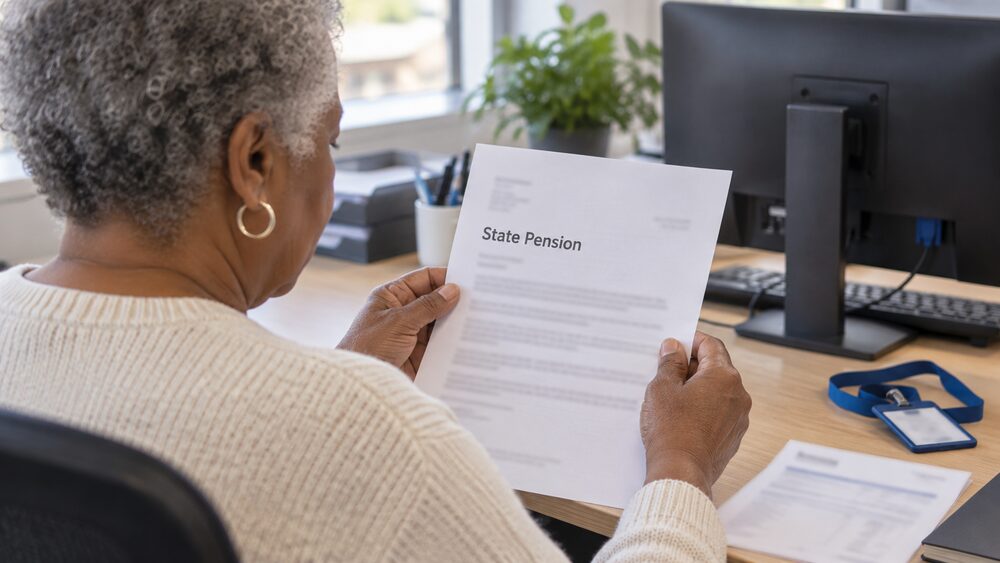
Yes. Working does not stop you claiming your State Pension. The only condition that decides when you can claim is reaching State Pension age, and you can claim while employed, self-employed or not working at all. State Pension age is currently 66 and is increasing gradually over the next two years until it reaches 671.
What you earn does not reduce your State Pension. It is based on your National Insurance record, not on your salary at the time you claim. You can get the new State Pension even if you are working or have other income, as long as you satisfy the National Insurance conditions2. You normally need at least 10 qualifying years on your National Insurance record to get any new State Pension3.
Two things do change once you reach State Pension age and keep working. You stop paying National Insurance on your earnings, and your State Pension is paid without tax taken off, with your tax code adjusted instead so any tax due comes out of your wages or other pensions4.
Working does not stop you claiming your State Pension
The rule is simple and it is set out in official guidance: you can claim your State Pension while working as long as you have reached State Pension age1. There is no earnings test, no tapering and no requirement to reduce your hours. Anyone can continue working past State Pension age, and you do not have to stop working when you reach it8.
That is different from the way many private and workplace pensions work, where the scheme's own rules decide when you can draw. For the State Pension, the trigger is age alone.
Three options are open to you at State Pension age, and they sit side by side9:
- Stop working and claim your State Pension.
- Carry on working and claim your State Pension at the same time.
- Carry on working and put off claiming, which may mean extra State Pension or a lump sum later.
If you are still working, you are also still entitled to the National Minimum Wage for any paid work you do after you reach State Pension age8. Reaching State Pension age is not a reason for an employer to change your pay rate.
One practical point: the Department for Work and Pensions will not pay you automatically. You have to tell them you want to claim10. If you do nothing, your pension is treated as deferred, which is a different outcome from simply not being paid yet.
The condition that matters: reaching State Pension age
Your State Pension age is the earliest age you can start receiving your State Pension11. It is not the same as retirement, and it is not the same as the age at which you can take a private pension.
State Pension age is currently 66 and is increasing gradually over the next two years until it reaches 671. It is under review and may change in the future12. For people born between 6 April 1977 and 5 April 1978, it falls between age 67 and 68 on a set date depending on date of birth13.
If you retire before you reach State Pension age, you will have to wait to claim it14. There is no early access route on grounds of simply having stopped work. The earliest you can get your State Pension is when you reach State Pension age14.
Which State Pension you get depends on when you reach that age, not on when you were born or how long you worked:
| Your situation | Which State Pension applies |
|---|---|
| You reach State Pension age on or after 6 April 2016 | The new State Pension14 |
| You reached State Pension age before 6 April 2016 | Basic State Pension and Additional State Pension14 |
You can claim up to 4 months before you reach State Pension age, so the payments can start as soon as you are eligible6. If you want to check what you are likely to get before then, a State Pension forecast is available, though you cannot use the online forecast service if you are already getting your State Pension or have deferred claiming it12.
National Insurance conditions for the new State Pension
Working does not just fail to reduce your State Pension. It is usually how you build the record that qualifies you for one. You need at least 10 qualifying years on your National Insurance record to get any new State Pension3.
If you have gaps, there are routes to fill them. If you are not working and receive child benefit, you automatically qualify for National Insurance credits, and the same applies if you receive Carer's Allowance. You also receive credits while unemployed if you are actively seeking work and claiming benefits such as Jobseeker's Allowance or Universal Credit15. Carer's Credit protects your right to a State Pension even if you are not working or claiming benefits16.
Once you reach State Pension age, the contributions stop. You do not pay National Insurance after you reach State Pension age, unless you are self-employed and pay Class 4 contributions5. If you are employed, you stop paying on your earnings, and your employer stops paying secondary contributions too17.
There is one protection worth knowing about if you built up contributions before 6 April 2016. If you paid National Insurance contributions before that date and would have been better off claiming the old Basic State Pension, you could receive an additional amount so that you are not any worse off claiming the new State Pension19.
Deferring your State Pension while you keep working
If you do not want to claim yet, you can delay your State Pension20. This is called deferring, and it is a common choice for people who carry on working past State Pension age21.
You do not have to do anything to defer. Your pension is automatically deferred until you claim it22. You can defer for as long as you like23. There are incentives for taking your State Pension later instead of at State Pension age8, and you may get more money when you do claim24.
The choice at the point of claiming is usually between a higher weekly payment and a lump sum. You can postpone claiming and get a higher pension or a lump sum when you do claim25.
Two limits matter. You cannot build up the extra State Pension if you get certain benefits, and deferring can also affect how much you can get in benefits26. If you have already started receiving the State Pension, it is still possible to defer it, but this can only be done once23.
There is also a rule about late claims. If you start your claim over 12 months after you reach State Pension age, you will be treated as having deferred your pension27. So a long delay is not neutral: it is treated as a deferral whether or not that was your intention.
Pension Credit if you are still working
Pension Credit is the main income-related benefit for people over State Pension age, and having a job does not rule it out. You may be able to claim it if you are over State Pension age and on a low income28. You can get it even if you have other income, savings or own your own home29.
Earnings from employment and self-employment count as income when Pension Credit is worked out, alongside your State Pension, other pensions and most social security benefits such as Carer's Allowance30. So a salary does not disqualify you, but it does reduce what you get.
If your income is higher, you might still be eligible if you have a disability, you care for someone, you have savings or you have housing costs30. You can apply up to four months before you reach State Pension age, and any time after7.
Deferring interacts with Pension Credit in a way that catches people out. If you claim Pension Credit or Universal Credit while you are deferring your State Pension, they will be calculated as if you were getting your State Pension entitlement, allowing a grace period32. Pension Credit treats you as having State Pension income even if you defer10. Deferring to increase your State Pension therefore does not increase your Pension Credit in the meantime.
Money you earn after State Pension age may also affect income-related benefits such as Pension Credit and Housing Benefit8. If you are claiming New Style Jobseeker's Allowance, your earnings and any pension payment can affect the amount you receive33.
How claiming while working differs from private pension access
The State Pension and a private or workplace pension are governed by different rules, and the ages rarely line up.
For a personal or workplace pension, you can claim while working as long as you have reached the age agreed with your pension provider1. That age is set by the scheme, not by the state. You may be able to draw all or some of your lump sum and pension while still working full or part-time for the same employer, depending on the scheme's rules34.
The minimum age for taking most private pensions is changing. The normal minimum pension age rises from 55 to 57 on 6 April 2028, unless a protected pension age applies23. That is a separate date from State Pension age and can fall earlier or later depending on when you were born.
There are also circumstances where a private pension can be accessed before 55, for example if you are unable to work due to ill-health34. No equivalent exists for the State Pension: the earliest you can get it is State Pension age14.
A few other differences are worth knowing:
- If you stop paying into a workplace scheme, you will still get that pension when you reach the pension scheme's age35.
- If you are self-employed, Class 2 National Insurance contributions entitle you to the basic State Pension, but not the additional State Pension34.
- If you work and get your State Pension or a workplace pension, you can still get Statutory Sick Pay36.
- You cannot claim State Pension while you are in prison37.
- Moving into a care home will not affect your State Pension, but it will be counted as income when your contribution to your fees is assessed38.
If you move or retire abroad, you can claim State Pension abroad if you have paid enough National Insurance contributions to qualify, and the amount might be affected by retiring or moving abroad39.
Where to get help
The State Pension is administered by the Department for Work and Pensions, and claims are made through the Get your State Pension service20. In Northern Ireland, the equivalent service is run through nidirect40.
Free, impartial guidance on the State Pension and your options at retirement is available from Pension Wise, the government's guidance service13. MoneyHelper offers free guidance on benefits, including what you can claim as a carer16. If you are over State Pension age and on a low income, Independent Age and Turn2us both publish free guidance on Pension Credit and working later in life28.
If you are unsure whether deferring, claiming or a mix suits your circumstances, that is a decision about your own income and tax position, and free guidance services can explain the rules without recommending a course of action.
Sources40 cited
- Working past State Pension age GOV.UK, 2026
- Can I get New State Pension Turn2us, 2026
- The new State Pension GOV.UK, 2026
- How your State Pension is taxed GOV.UK, 2026
- National Insurance and after State Pension age nidirect, 2026
- New State Pension Age UK, 2026
- Pension Credit Independent Age, 2026
- Working past State Pension age nidirect, 2026
- What is State Pension age Turn2us, 2026
- Pensions and disability benefits Scope, 2026
- Check your State Pension age nidirect, 2026
- Check your State Pension forecast nidirect, 2026
- State Pension Pension Wise, 2026
- Early retirement and your pension GOV.UK, 2026
- The high cost of pausing your pension contributions Which?, 2026
- Planning ahead: pension help Carers UK, 2026
- National Insurance Advice NI, 2026
- How your situation affects your workplace pension nidirect, 2025
- How much new State Pension will I get Turn2us, 2026
- Get your State Pension GOV.UK, 2026
- Preparing your finances for retirement Citizens Advice, 2026
- Deferring State Pension and what you will get nidirect, 2026
- Deferring your State Pension Which?, 2026
- Working later life Independent Age, 2026
- Basic State Pension Age UK, 2026
- Increase your retirement income GOV.UK, 2026
- How do I claim new State Pension Turn2us, 2026
- Making the most of your money Business Debtline, 2026
- Pension Credit GOV.UK, 2026
- Income, benefits and Pension Credit nidirect, 2026
- Benefits and tax credits you can claim as a carer MoneyHelper, 2026
- The new State Pension Entitledto, 2026
- New Style Jobseeker's Allowance GOV.UK, 2016
- Introduction to workplace, personal and stakeholder pensions nidirect, 2026
- Workplace pensions: changes in personal circumstances nidirect, 2025
- Check if you can get sick pay Citizens Advice, 2022
- Benefits and prison GOV.UK, 2026
- Residential care and nursing homes and benefits nidirect, 2026
- Moving, living or retiring abroad GOV.UK, 2025
- Get your State Pension nidirect, 2026

 Pension WiseFree guidance on your options for a defined contribution pension, from age 50
 FSCSProtects your money if a bank, insurer or investment firm fails
 GOV.UKOfficial information on tax, benefits and government services