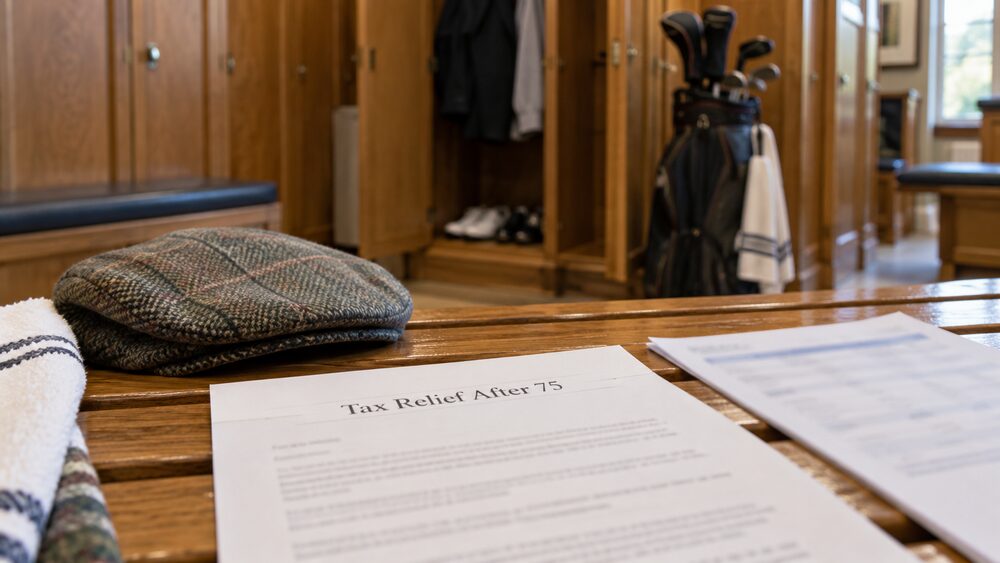
You can keep paying into a pension after your 75th birthday, but the government stops adding tax relief to your contributions once you reach 75. Providers state the rule plainly: tax relief on contributions stops at age 751. Contributions to a pension continue to qualify for tax relief until age 752.
Before 75, the picture is different. If you are under 75, you can continue to save into a pension and get tax relief, even if you have already started taking money from your retirement savings1. You can get tax relief on what you pay in, up to 100 per cent of your earnings, as long as you are under 753.
The age limit matters because it changes what a contribution actually costs you. Before 75, every £80 you pay into a personal pension can become £100 in your pot once basic-rate relief is added. After 75, that top-up stops, so the same contribution buys less retirement income.
Tax relief on pension contributions stops at 75
The rule is simple and it is the same across the UK. You can pay money into your pension until you are 75 and still get tax relief9. Personal contributions paid before age 75 generally receive tax relief10. To get tax relief on your contributions, you must be under age 7511.
What happens at 75 is not that contributions become illegal or that your provider closes your account. It is that HMRC stops adding relief. Money you pay in after 75 comes from income that has already been taxed, and it is not topped up. The provider will still accept the payment if the scheme rules allow it, but the government contribution stops.
There is a separate age that governs when you can take money out, and it is not 75. Pension savings can usually be accessed from age 55, set to rise to 57 by 202812. The two ages do different jobs: 55 (rising to 57) is the earliest you can normally draw on a defined contribution pot, while 75 is the last birthday at which contributions attract relief.
The relief itself is the reason pensions are different from other savings. What sets pensions apart from other savings or investment accounts is that you get tax relief on your contributions13. That relief is worth most to people who pay the most tax, which is why the rate you get depends on your income tax band.
Who gets tax relief before 75: UK residents, even non-taxpayers
Two conditions do most of the work. If you are a resident in the UK for tax purposes and under the age of 75, you can get tax relief on pension contributions4. If you are a UK resident under 75 you can get tax relief, even if you do not pay tax14.
That second point surprises people. Non-taxpayers can also benefit from tax relief at the basic rate of 20% on pension contributions15. If you do not pay tax, you can still get tax relief on your own or someone else's contributions up to a certain limit16. You usually get tax relief on money you pay into a pension17.
There is a limit on how much relief you can get when your earnings are low or nil. You can get tax relief on pension contributions up to 100% of your earnings, or £3,600 if your earnings are lower4. So a non-taxpayer with no earnings can still pay in and receive relief on up to £3,600 a year.
If you live abroad, the position depends on your tax status. To get UK relief, you must have been a UK individual for tax purposes for the tax year in question18. You can get relief on your contributions up to the value of your earnings that are subject to UK Income Tax19.
How much you can pay in: up to 100% of your earnings
The core rule is that relief is capped at what you earn. You can get tax relief on private pension contributions worth up to 100% of your annual earnings21. Each year you will receive tax relief on your pension contributions of up to 100 per cent of your UK earnings, meaning salary and other earned income22. Tax relief is available on contributions up to 100% of your annual earnings23.
On top of that sits the annual allowance, which caps the total paid in across all your pensions in a tax year. You can contribute up to £60,000 a year, or your total earnings if lower, and still receive tax relief5. For each tax year you can get tax relief on pension contributions up to 100% of your annual earnings, up to a maximum of the annual allowance gross contribution including the HMRC top-up24.
The two limits work together. To get relief, you need to meet both conditions: you do not pay in more than you earn, and all payments in are less than the annual allowance6. If you breach the annual allowance, the excess does not attract relief and may trigger a tax charge.
| Limit | What it caps | Figure |
|---|---|---|
| Earnings limit | Relief on what you personally pay in | 100% of your earnings, or £3,600 if lower4 |
| Annual allowance | Total paid into all your pensions in a tax year | £60,000, or your total earnings if lower5 |
| Age limit | When relief stops | Under 751 |
If you have unused allowance from earlier years, carry forward rules may let you pay in more than the annual allowance in a single year. That is a separate subject with its own conditions, covered in pension carry forward.
Tax relief rates: 20% to 48%
The rate of relief you get is set by the highest rate of income tax you pay. Tax relief is based on the highest rate of income tax you pay, and boosts your pension contributions by at least 20%7. If you are a higher-rate taxpayer, you qualify for pension tax relief at 40%, or 45% for additional-rate taxpayers7.
Scotland has its own income tax bands, and the relief rates follow them. If you are a higher, advanced or top rate taxpayer in Scotland, you qualify for pension tax relief at 42%, 45% or 48% respectively7. That makes the top Scottish rate of relief 48%, higher than anywhere else in the UK.
Most personal pension providers will claim tax relief automatically for you at a fixed rate of 20%6. Any personal contributions paid into your pension receive immediate tax relief at the basic rate, which is currently 20%25. When you invest into a pension, you automatically receive an extra 20% in your pot through tax relief26.
The higher rates are not automatic for everyone. If you pay Income Tax at a higher rate than 20%, you will need to claim the extra tax relief yourself6. Higher-rate (40%) and additional-rate (45%) taxpayers may have to claim the additional tax relief on their Self Assessment tax return, unless their employer does this automatically through a net pay arrangement27.
| Your tax position | Relief rate | How it reaches you |
|---|---|---|
| Basic rate | 20% | Added automatically by your provider6 |
| Higher rate | 40% | 20% automatic, 20% claimed27 |
| Additional rate | 45% | 20% automatic, 25% claimed28 |
| Scottish higher, advanced, top | 42%, 45%, 48% | Claimed according to your band7 |
Is the 20% relief added automatically or do I have to claim it?
For personal pensions, the basic rate is handled for you. Your pension provider claims back the basic rate of 20% tax relief for you from HMRC, and it happens automatically25. Basic-rate (20%) tax relief is usually added to your pension contributions automatically29.
The extra relief for higher earners is where you have to act. The first 20% is usually claimed automatically by your provider, and you can then claim the additional 20% via your Self Assessment tax return27. Your provider still claims 20%, but you can claim back the other 20% through your Self Assessment tax return5. You will have to claim the remainder, 20% for higher rate or 25% for additional rate, by filing a Self Assessment tax return28.
Self-employed people face the same process. If you are a higher or additional rate self-employed taxpayer, you will need to claim this back yourself in your Self Assessment tax return30.
A worked example shows what the relief is worth. Say you earn £60,000 a year, putting you into the higher-rate band. By contributing £10,000 to your pension, you will get 20% (£2,000) relief automatically, and you can claim another 20% in your tax return. As a result, the total cost to you will be just £6,00031.
What happens to contributions made after 75
After 75, the tax relief stops but the pension does not. You can continue paying into a pension if you have already retired, provided you are under 7533. Once you pass 75, any further payment is made from taxed income and receives no government top-up.
This is worth planning around. If you have earnings and want to make a large one-off contribution, doing it before your 75th birthday means it attracts relief; doing it after means it does not. The same applies to regular payments that would otherwise run past that date.
Taking money out does not close the door on relief before 75. If you are under 75, you can continue to save into a pension and benefit from tax relief, even if you have already started taking money from it34. You would still get tax relief, but you would not benefit from extra employer contributions as you would if you were increasing your workplace payments35.
There is a separate consideration if you have flexibly accessed a defined contribution pension. The money purchase annual allowance can reduce how much you can pay in while still getting relief, and it applies well before 75. That rule is set out in what is the money purchase annual allowance?.
If you are still working and paying into a workplace scheme, the mechanics of relief depend on the scheme type. Workplace pensions explained covers how employer and employee contributions are treated, and pension tax relief: how it works and how to claim it covers the claim process in full.
How your age at death changes the tax on your pension
The age of 75 does a second job in pensions: it sets the tax treatment of money left in a pot when someone dies. If someone dies before their 75th birthday, most lump sums paid from their pension are tax-free up to a limit8. If someone dies after their 75th birthday, the person receiving a lump sum pays income tax like they would on other income8.
The same split applies to drawdown. If you die before the age of 75 and leave money in pension drawdown, your beneficiaries do not have to pay income tax on the money they withdraw36. If you die aged 75 or over, your beneficiaries will normally pay income tax when they withdraw money from your pension36.
The rate they pay is their own. If you live beyond 75, they will only pay tax on the money they take at their normal rate of income tax37. If you die after the age of 75, your beneficiaries pay income tax on any withdrawals from your pension38.
| Your age at death | Lump sum treatment | Drawdown withdrawals |
|---|---|---|
| Before 75 | Most lump sums tax-free up to a limit8 | No income tax for beneficiaries36 |
| 75 or over | Recipient pays income tax like other income8 | Beneficiaries pay at their usual rate37 |
There is usually no tax to pay if you die before your 75th birthday37. If you die before the age of 75, any unused pension funds left to a beneficiary are usually paid tax-free39. If a person dies before the age of 75, their pensions can be inherited free of income tax40. If you die before age 75 with all or some of your pension fund still invested, it will pass to your beneficiaries tax-free41.
Inheritance tax is a separate question from income tax, and the rules on pensions are changing. If the individual dies before age 75, death benefits including lump sums and inherited drawdown pensions are typically taken free of Income Tax42. The treatment of pensions for inheritance tax is covered in pensions and inheritance tax, and the wider rules on what happens to a pot are in what happens to your pension when you die.
Where to get free help
Pension decisions around age 75 involve tax, death benefits and withdrawal rules at once, and the sums involved are often large. Free, impartial guidance is available. Pension Wise offers guidance on taking a whole pot43 and on adjustable income44. MoneyHelper covers personal pensions and how relief works6.
If something has gone wrong with a provider or an adviser, there are formal routes. Complaints about a pension provider, platform or fund manager are handled first by the firm and then by the Financial Ombudsman Service, as set out in complaining about a pension provider, platform or fund manager. The Pensions Ombudsman deals with complaints about pension schemes, covered in the Pensions Ombudsman and complaining about a pension.
For anyone weighing up whether to pay in before 75 or take money out, the starting point is the full picture of what a pension is and how it works, in how a pension works, and the options for taking money, in your options for taking money from a pension.
Sources44 cited
- Working in retirement Which?, 2026-03-17
- Transact LISA key features document Transact, 2026-04
- Workplace pensions and tax relief nidirect, 2026-07-07
- 5 questions for pension savers filing their 2024-25 tax return Which?, 2026-01-22
- 6 ways to save for retirement without a workplace pension Which?, 2025-08-09
- Personal pensions MoneyHelper, 2026-09-25
- Lifetime ISA vs pension Which?, 2026-03-23
- Pensions and inheritance tax House of Commons Library, 2026-07-08
- What is a private pension? Legal & General, 2026-07-16
- Aegon Financial Planning investments Aegon, 2026
- Share Exchange Service SIPP Hargreaves Lansdown, 2026-09-26
- Revisiting the State Pension age Resolution Foundation, 2025-11-01
- How pensions work Which?, 2026-04-07
- Guide to pension tax relief Hargreaves Lansdown, 2026-09-26
- Can I get pension tax relief without paying tax? Which?, 2026-07-06
- Stakeholder pensions nidirect, 2025-09-11
- Personal pensions: your rights GOV.UK, 2026-09-26
- Living abroad after Brexit: is your UK pension secure? Which?, 2020-11-28
- Overseas pensions: tax relief on your contributions GOV.UK, 2016-12-05
- How your situation affects your workplace pension nidirect, 2025-09-11
- Scottish Income Tax: allowances and reliefs mygov.scot, 2026-04-06
- Introduction to workplace, personal and stakeholder pensions nidirect, 2026-09-25
- Tax reliefs Which?, 2026-04-06
- Pension tax guide PensionBee, 2026-05-12
- Pension tax relief benefits Legal & General, 2026-09-26
- Pension planning Skipton Building Society, 2026-09-26
- Pensions tax Interactive Investor, 2026-09-26
- What to do if you move into a higher tax bracket Which?, 2024-07-25
- How to boost your pension Which?, 2026-08-10
- What pension can you get if you're self-employed? Which?, 2026-09-15
- 4 mistakes to avoid when trying to lower your tax bill Which?, 2026-06-26
- Questions for pension savers filing their 2022-23 tax return Which?, 2024-01-19
- One million more people set to pay income tax Which?, 2026-07-31
- Options for cashing in your pension overview Which?, 2026-07-09
- Why can't I add more to my pension? Which?, 2025-07-14
- What happens to my pension when I die Which?, 2026-09-17
- Things to consider before taking cash from your pension Fidelity Pensions, 2026-09-26
- How inheritance tax will apply to pensions Which?, 2026-07-24
- 7 things to know about inheritance tax changes and your pension Which?, 2025-07-26
- Will my pension be subject to inheritance tax and income tax? Which?, 2026-08-24
- Pensions income drawdown Citizens Advice, 2026-09-26
- Inheritance tax on pensions: summary of responses GOV.UK, 2025-07-21
- Take your whole pot Pension Wise, 2026-09-28
- Adjustable income Pension Wise, 2026-09-28



 Pension WiseFree guidance on your options for a defined contribution pension, from age 50
 FSCSProtects your money if a bank, insurer or investment firm fails
 GOV.UKOfficial information on tax, benefits and government services