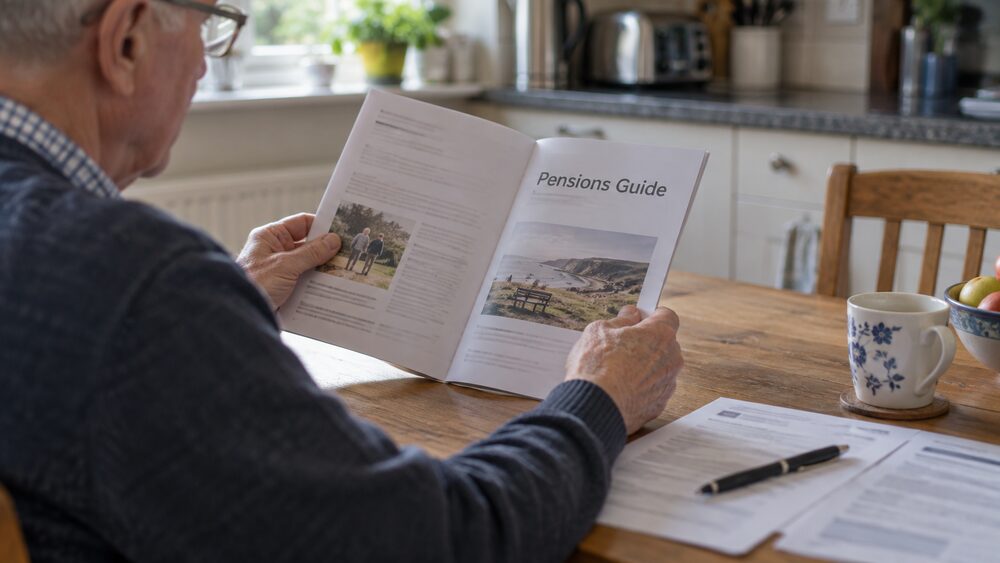
The State Pension works in Northern Ireland much as it does in England, Scotland and Wales, but it is run separately. Northern Ireland has its own pensions legislation, passed by the Northern Ireland Assembly, and its own claim service on nidirect, with claims and enquiries handled by the Northern Ireland Pension Centre rather than by the Department for Work and Pensions1. At May 2026 there were 335,540 State Pension claimants in Northern Ireland, an increase of 7,030 (2%) on a year earlier2.
The amounts are the same as in Great Britain. The full weekly rate of the new State Pension is £241.30, and each qualifying year on your National Insurance record after 6 April 2016 adds to your pension up to that full rate3. You need 35 qualifying years for the full amount and at least 10 to get any State Pension at all. The State Pension age is rising from 66 to 67 between April 2026 and March 2028, so when you can claim depends on your date of birth4.
Who runs the State Pension in Northern Ireland
Social security and pensions in Northern Ireland are a devolved matter, run under Northern Ireland's own legislation. The Pensions Act (Northern Ireland) 2015 is the local equivalent of the Westminster Act that created the new State Pension, and it sets out the rules on qualifying years, the full rate, deferral and inheritance in the same terms as the GB legislation8. In practice the two systems are kept in step: an Assembly memorandum on delegated legislation notes that maintaining parity of timing and substance is essential to the operation of a single system of social security, pensions and child support across the UK9.
The day-to-day difference for a pensioner is who you deal with. Claims, questions and changes of circumstances go to the Northern Ireland Pension Centre, and the online claim service sits on nidirect rather than gov.uk1. The Pension Centre provides information on the State Pension and on other benefits you may be eligible for on retirement10. Behind the scenes, the Department for Work and Pensions processes Northern Ireland survey data on behalf of the Department for Communities as part of the UK-wide dataset11, and the two departments work closely on areas such as occupational pensions, which are devolved to Northern Ireland12.
The rules on amounts, qualifying years and State Pension age are the same as in Great Britain. What differs is the legislation that gives them force, the body that administers them and the routes for claiming, disputing decisions and reporting changes.
Qualifying years: up to 10 for any pension, 35 or more for the full rate
Your State Pension is built from qualifying years on your National Insurance record. You need 35 qualifying years to get the full new State Pension, and at least 10 to get any new State Pension at all5. The minimum number of qualifying years for a pension payable at the reduced rate is set in regulations, and the legislation caps that minimum at no more than 106.
One group may need more than 35 years. If you were contracted out of the Additional State Pension before April 2016, for example through a workplace pension, you might need more than 35 years of qualifying National Insurance contributions to get the full State Pension5. This is because years in which you paid a lower rate of National Insurance count for less under the new system. The rules on contracting out and the Guaranteed Minimum Pension explain how those years are treated.
Northern Ireland's own Act defines the qualifying years that count towards the new State Pension, including pre-commencement qualifying years, which are qualifying years beginning on or after 6 April 1978 and ending before 6 April 20168. If you want to check whether you qualify with fewer years, or to fill gaps in your record, contact the Northern Ireland Pension Centre13. The guide to your National Insurance record covers how gaps arise and what credits and voluntary contributions can do.
How your amount is worked out if you have older National Insurance years
The amount you get depends on your National Insurance record and when you reach State Pension age14. People who reached State Pension age before 6 April 2016 come under the old system, the basic State Pension and any Additional State Pension they built up, and Northern Ireland legislation confirms that a person who reaches pensionable age before that date is not entitled to benefits under the new State Pension rules8. The basic State Pension, SERPS and Additional State Pension are covered in their own guide.
For those under the new system, National Insurance contributions are paid from age 16 until State Pension age15. Since 6 April 2016, all National Insurance contributions are at the standard rate, which ended the lower contracted-out rates16. Each qualifying year after 6 April 2016 increases your State Pension amount, up to the full rate of £241.30 a week3.
If you have a Guaranteed Minimum Pension from being contracted out in the past, the Northern Ireland Pension Centre can help with information about it, and you can contact the Centre if you are over State Pension age and want details of your record17. To see what you are on track to get, use the Check your State Pension forecast service if you are under State Pension age, or contact the Northern Ireland Pension Centre if you are over it18.
State Pension age: rising from 66 to 67 between 2026 and 2028
Between April 2026 and March 2028, the State Pension age is rising from 66 to 674. Under the Pensions Act 2014, State Pension age will gradually increase from 66 to 67 over this period, and the same timetable applies in Northern Ireland through the Pensions Act (Northern Ireland) 201519. The Northern Ireland Act sets the detailed timetable by date of birth: for example, a person born on 31 January 1961 is taken to attain pensionable age at 66 years and 10 months, and those born between 6 February 1961 and 5 March 1961 reach it at 66 years and 11 months8.
Under current law, State Pension age is then due to rise from 67 to 68 between 2044 and 2046, though this timetable has been reviewed before and could be changed. The guide to what your State Pension age is explains how to find your exact date.
Reaching State Pension age also changes other entitlements. Winter Fuel Payment in Northern Ireland goes to people over State Pension age, with a single person living alone receiving £200 if aged between State Pension age and 79, or £300 if aged 80 or over20. Separate Northern Ireland regulations govern Housing Benefit for people who have reached the qualifying age for State Pension Credit, covered below.
How to claim the State Pension in Northern Ireland
There is a different claim process if you live in Northern Ireland21. A letter with an invitation code is sent around four months before State Pension age is reached5. The claim can then be made online using that code through the nidirect Get your State Pension service, or by phone or by post through the Northern Ireland Pension Centre1. Where the letter has not arrived and State Pension age is within the next 3 months, an invitation code can be requested21.
Claiming by post will take more time than claiming online or calling the Northern Ireland Pension Centre1. There is no time limit to apply5, and you may get more State Pension if you put off claiming1. If you are claiming a deferred State Pension and you live outside Northern Ireland, the process is different and is explained on gov.uk22.
A few points worth knowing once you are receiving it:
- If you move abroad, you must tell the Northern Ireland Pension Centre before you go, and again when you return to Northern Ireland23.
- You must report changes in circumstances, such as a change of address or family situation, by telephone to the Northern Ireland Pension Centre24.
- Personal information you send when using the online claim service is handled by the Department for Communities under its pension service privacy notice1.
Deferring your State Pension: extra weekly increments
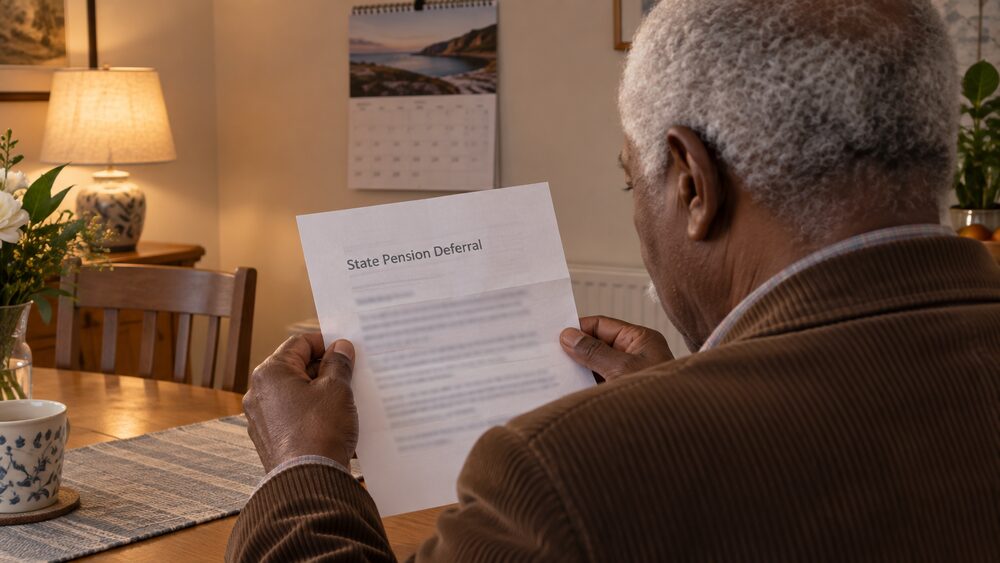
You do not have to claim your State Pension as soon as you reach State Pension age, and putting off claiming can increase what you get1. You might be able to increase the amount you get if you delay your pension14. For people reaching State Pension age on or after 6 April 2016, the rules work like this: you must defer for at least 9 weeks before you can claim increased regular payments, and for every 9 weeks you defer you get 1% added to your regular weekly pension payment for life7.
The official examples show what this means in cash. Defer for 52 weeks and you get an extra £13.94 a week (5.8% of £241.30) according to the nidirect guidance, while the gov.uk page for the same period gives £13.99 a week (5.8% of £241.30): the two documents disagree by a few pence on the same percentage7. For 104 weeks (two years), the figures are £27.88 a week (11.6%) on nidirect and £27.99 a week (11.6%) on gov.uk7. Deferring an additional 26 weeks beyond 52 weeks adds £6.97 a week (2.89% of £241.30)25.
People who reached State Pension age before 6 April 2016, claiming the basic State Pension, build deferral increases faster: one per cent is added for every five weeks deferred, just under 10.4% for every 52 weeks, and deferring for 52 weeks gives an extra £19.23 a week (10.4% of £184.90)7. Payment options for deferral under the new system include a one-off arrears payment of up to 52 weeks, increased regular payments, or both7.
What you can inherit from a spouse or civil partner
Your State Pension payments will generally stop when you die, but a spouse or civil partner might be able to inherit some of your State Pension5. What can be inherited depends on which system you and your partner fall under.
If you reached State Pension age before 6 April 2016, you may be able to inherit some of your spouse's or civil partner's State Pension when they die13. If your partner topped up their State Pension between 12 October 2015 and 5 April 2017, you may be able to inherit some or all of that top-up13. From 6 April 2010, a married man's or civil partner's basic State Pension can be based partly or wholly on his wife's or civil partner's National Insurance record26.
To inherit a partner's extra State Pension from deferral, all of the following must apply: your partner reached State Pension age before 6 April 2016, you were married to or in a civil partnership with your partner when they died, your partner had deferred their State Pension or was claiming their deferred State Pension when they died, and you did not remarry or form a new civil partnership before you reached State Pension age22. Northern Ireland legislation provides that an inherited pension of this kind is payable at a weekly rate equal to the inherited amount8.
There is also an underpayment exercise to be aware of. Official guidance explains that a person may have been underpaid State Pension if they did not inherit some of their husband's, wife's or civil partner's State Pension, in cases where the person who died was widowed and reached State Pension age before 6 April 201627. On inheritance tax, legislation provides that where value transferred on death is attributable to notional pension property, it is treated as also attributable to property the spouse or civil partner receives under the scheme, and the recipient's estate is treated as increased by that value28. The guides on inheriting a partner's State Pension and what happens to your pension when you die go further.
When your State Pension can be lower than the full rate
The full rate of the State Pension is defined in Northern Ireland legislation as the weekly rate for the time being specified in regulations8. Your own pension can be lower than that full rate for several reasons.
- Fewer than 35 qualifying years. The pension builds year by year, so a shorter record means a smaller pension, and below 10 qualifying years there is no entitlement at all5.
- Contracted-out years. If you were contracted out before April 2016, you may need more than 35 qualifying years to reach the full amount5.
- The old system. People who reached State Pension age before 6 April 2016 receive the basic State Pension instead. Official guidance gives the full basic State Pension rate as £176.45, with a lower figure of £125.95 also appearing in the same guidance for a different category: the two figures sit side by side and the document does not reconcile them27.
- Reduced rate elections. A woman who paid the reduced rate of National Insurance can still qualify: the legislation provides that the minimum qualifying years rule at the transitional rate does not apply to a woman if a reduced rate election was in force for her at the beginning of the relevant 35-year period8.
- Benefit sanctions. Jobseeker's allowance sanctions in Northern Ireland can reduce payments for a period not exceeding 18 months in relation to any failure sanctionable under the relevant Article29.
Other rules can affect pension income around the edges. In bankruptcy, a trustee cannot usually claim a pension as an asset if the bankruptcy petition was presented on or after 29 May 2000, as long as the pension scheme has been approved by the Inland Revenue30. A welfare supplementary payment must cease to be paid from the end of the week in which the conditions for State Pension Credit cease to be met31. And for pension-age Housing Benefit, the two child limit was abolished in 2024: the applicable amount no longer includes a maximum of two amounts for children or young persons in the household32, under regulations that have governed pension-age Housing Benefit in Northern Ireland since November 200633.
If you think a decision about your pension or Pension Credit is wrong, ask the Northern Ireland Pension Centre to look at the decision again; if you are still unhappy, you can appeal to an independent Appeal Tribunal34.
Transferring a private or workplace pension: scam checks to expect
The State Pension cannot be transferred, but many people arriving at State Pension age also hold private or workplace pensions, and moving those pots is where the scam risk sits. The warning from Pension Wise is blunt:
"Do not withdraw or transfer your pension because of a cold call, visit, email or text. It's likely a scam designed to steal your money."36
In England, Northern Ireland and Wales, fraud or concerns about a potential scam are reported to Report Fraud37. The Pensions Regulator's strategy document records that, despite concerns from industry that 5% of pension transfers could have features of a scam, action to combat pension scams continues38. The Regulator runs a pledge scheme to combat pension scams that pension providers and administrators can sign up to37.
Transfers themselves are regulated. The Occupational and Personal Pension Schemes (Conditions for Transfers) Regulations, which the government consulted on amending in 2026, set conditions that schemes must check before allowing a transfer, and occupational pensions are a devolved matter for Northern Ireland, with the Department for Communities working closely with Westminster counterparts on the rules12. The guides on pension scams, transferring pensions and the risks of transferring cover what to check before moving a pot.
Who gets the State Pension in Northern Ireland
At May 2026 there were 335,540 State Pension claimants in Northern Ireland, an increase of 7,030 (2%) on a year earlier2. The November 2025 statistics showed 333,620 claimants in receipt of State Pension, an increase of 3% (8,270) on a year earlier, so the number has been growing steadily as the population ages39. Across the UK as a whole, at March 2026 there were 5.4 million people receiving the new State Pension, an increase of 780,000 compared with February 202519.
Other benefits sit alongside the State Pension in the official counts. At May 2026 there were 60,030 Pension Credit claimants and 68,900 beneficiaries in Northern Ireland, a decrease of 180 claimants (0.3%) on a year earlier, and 55,700 claimants of Employment and Support Allowance2. The Family Resources Survey for Northern Ireland gives a picture of pensioner circumstances: 46% of adults over State Pension age report a disability, and 9% of State Pension age adults are informal carers40.
Where to get help
The Northern Ireland Pension Centre is the main point of contact for the State Pension and related benefits. It provides information on the State Pension and other benefits you may be eligible for on retirement10, handles claims by phone and post1, takes reports of changes in circumstances24, and deals with Pension Credit applications and disputes34. If you are over State Pension age you can contact the Centre about your record; if you are under State Pension age, use the forecast service18.
Specific questions have specific routes:
- Pension Credit: call the Northern Ireland Pension Centre, calls are free, or use the online calculator to check eligibility and get an estimate; postal applications go to the Pension Centre35.
- Disputes: ask the Northern Ireland Pension Centre to look at the decision again, then appeal to an independent Appeal Tribunal if still unhappy34.
- Underpayments after a death: official guidance covers requesting information about underpaid State Pension for someone who has died27.
- Moving abroad: tell the Northern Ireland Pension Centre before you leave, and again when you return23.
For wider pension questions, Pension Wise offers free guidance, and the pensions section of this site explains workplace and personal pensions, the triple lock that governs how the State Pension rises each year, and the options for taking money from a pension.
Sources40 cited
- Get your State Pension nidirect, 2026-08-18
- Benefits statistics summary May 2026 NISRA, 2026
- Increase your retirement income GOV.UK, 2026-09-28
- How the State Pension works HMRC Tax Confident campaign, 2026
- State Pension Pension Wise, 2026-09-28
- Pensions Act 2014 legislation.gov.uk, 2014-05-14
- Deferring State Pension and what you will get nidirect, 2026-06-26
- Pensions Act (Northern Ireland) 2015 legislation.gov.uk, 2015-06-23
- Draft explanatory memorandum, Child Support (Miscellaneous Amendments) Regulations 2026 Northern Ireland Assembly, 2026
- Getting information and help about pensions nidirect, 2026-06-26
- Personal Incomes Injuries Quality and Methodology Report 2024/25 NISRA, 2026-03-26
- Protecting Pension Savers: proposals to amend the Occupational and Personal Pension Schemes (Conditions for Transfers) Regulations 2021 GOV.UK, 2026-06-09
- Qualifying for the basic State Pension nidirect, 2026-09-09
- Early retirement and pensions GOV.UK, 2026-09-26
- National Insurance and after State Pension age nidirect, 2026-04-28
- Contracted out pension schemes GOV.UK, 2016
- Guaranteed Minimum Pension nidirect, 2026-06-26
- Check your State Pension forecast nidirect, 2026-09-01
- Annual DWP Benefits Statistics Compendium 2026 GOV.UK, 2026-09-15
- Winter Fuel Payment Regulations (Northern Ireland) 2025 explanatory memorandum legislation.gov.uk, 2025
- Get State Pension GOV.UK, 2026-09-25
- Claiming or inheriting a deferred State Pension nidirect, 2026-06-26
- Living or working overseas and the State Pension nidirect, 2026-09-10
- State Pension: report a change of circumstances nidirect, 2026-09-01
- Deferring State Pension if you reach State Pension age on or after 6 April 2016 GOV.UK, 2026-09-28
- Guidance on Social Security Abroad (NI38) GOV.UK, 2026-07-07
- Request information about underpaid State Pension for someone who has died GOV.UK, 2022-07-08
- Pensions Act 2026, pension interests legislation.gov.uk, 2026
- Jobseeker's Allowance Regulations (Northern Ireland) 2015 legislation.gov.uk, 2015-12-09
- Effect of bankruptcy Department for the Economy, 2000-05-29
- Welfare Reform (Northern Ireland) Regulations 2016 legislation.gov.uk, 2016-06-29
- Social Security (State Pension Age Claimants: Closure of Tax Credits) (Amendment) Regulations (Northern Ireland) 2024 legislation.gov.uk, 2024-06-08
- Housing Benefit (Persons who have attained the qualifying age for state pension credit) Regulations (Northern Ireland) 2006 legislation.gov.uk, 2006
- Income, benefits and Pension Credit nidirect, 2026-06-26
- Applying for Pension Credit nidirect, 2026-07-06
- Take your whole pot Pension Wise, 2026-09-28
- Pledge to combat pension scams The Pensions Regulator, 2026-09-28
- Our strategy to combat pension scams The Pensions Regulator, 2026-09-26
- Benefits statistics summary November 2025 NISRA, 2025-11-30
- Family Resources Survey Northern Ireland report 2024/25 NISRA, 2024

 Pension WiseFree guidance on your options for a defined contribution pension, from age 50
 FSCSProtects your money if a bank, insurer or investment firm fails
 GOV.UKOfficial information on tax, benefits and government services