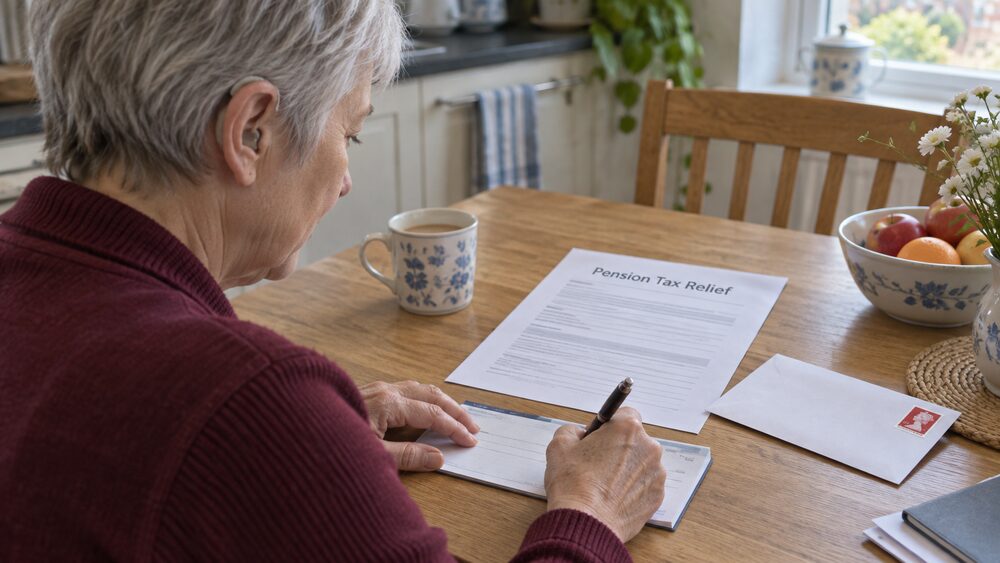
Yes. You can get tax relief on pension contributions even if you have no earnings at all. The rule is that you can pay in £2,880 a year, and the government adds £720 in basic-rate relief, so £3,600 goes into your pension. That is the figure most people mean when they talk about the £3,600 limit for non-earners1.
The relief is not a refund of tax you have paid. It is a top-up the government adds to your contribution, at the basic rate of 20%, whether or not you have ever paid income tax. Non-taxpayers can benefit from relief at the basic rate on pension contributions2. You must be under 75 to get it3.
This page explains how the limit works, what counts as earnings for the higher limit, when relief is not available, and how someone else can pay in for you.
The £3,600 limit for people with no earnings
If you have no earnings, the annual cap is £3,6007. That is the gross figure, the amount that ends up in the pension after relief is added. You pay in £2,880 and the government adds £7204. The same £3,600 gross limit applies if you earn less than £3,600, and it applies only if you are paying into a pension that gets tax relief at source7.
The limit is per person, per tax year. It is not a lifetime cap and it does not carry over. If you have already used part of your allowance in the tax year, you can only pay in the remaining amount before the tax year ends on 5 April. One worked example from the 2025-26 tax year put the remaining allowance at £2,380 for someone who had already used part of it2.
The £3,600 figure is sometimes described as the higher of minimum relevant earnings and your actual earnings. HMRC's own notes for the 2025-26 tax year give the minimum relevant earnings figure as £3,6008. In practice this means that even with no earnings, the relief system treats you as if you had £3,600 of relevant earnings, and gives relief on contributions up to that amount.
Relief limits: 100% of earnings or £3,600, whichever applies
For someone who is working, the limit is different. You can get tax relief on pension contributions up to 100% of your earnings, or £3,600 if your earnings are lower5. The official wording is that you can get tax relief on what you pay in, up to 100 per cent of your earnings, as long as you are under 753. Each year you receive tax relief on your pension contributions of up to 100 per cent of your UK earnings, meaning salary and other earned income9.
So the £3,600 figure is not a separate allowance that sits alongside your earnings. It is a floor. If you earn £20,000, your relief limit is £20,000. If your earnings are below £3,600, your limit is £3,600, because that is higher than your earnings. If you earn nothing, your limit is still £3,600.
There is a second, much larger cap on top of this: the annual allowance. All pension contributions, including those made through salary sacrifice, remain exempt from income tax, subject to the annual allowance of £60,00010. For most non-earners the £3,600 limit bites long before the annual allowance becomes relevant, but it matters if you have a year with high earnings and want to use carry forward from earlier years.
Do you have to pay tax to get pension tax relief?
No. The relief is available to non-taxpayers. Non-taxpayers can benefit from tax relief at the basic rate of 20% on pension contributions2. If you do not pay income tax because you are on a low income, you automatically get tax relief11. And if you have received relief you were not entitled to, you do not have to pay it back2.
This matters because many people assume relief is only for people who pay income tax. The system works differently depending on how your pension scheme is set up. In a relief at source scheme, contributions are paid after you have paid income tax, and the pension scheme sends a request to HMRC, which pays 20% tax relief into your pension. This applies to all personal pensions and some workplace pensions12. If you have little or no earnings and are in a relief at source scheme, you will still get tax relief9.
The State Pension itself is paid without tax taken off, but it counts towards your tax-free Personal Allowance13. If your only income is your State Pension and it is less than the Personal Allowance, you will not need to pay tax14. That does not stop you getting relief on pension contributions.
When non-taxpayers may not get tax relief
There is one important exception, and it depends on the type of workplace scheme you are in. Under a net pay arrangement, contributions are deducted from your salary before income tax is paid on them, and the scheme automatically claims back relief at your highest rate12. The catch is that under this arrangement, if you do not pay tax, you do not get tax relief, for example because you earn less than the tax threshold11. The Pensions Regulator puts it plainly: staff who do not pay income tax will not get tax relief whichever tax relief method your scheme uses10.
If you are in a net pay scheme and earn too little to pay tax, you can still open a separate personal pension and pay into that instead. You would still get tax relief, but you would not benefit from extra employer contributions as you would if you were increasing your workplace contributions15.
There are also types of income that do not count as earnings for relief purposes. You do not have to pay tax on pensions administered under the War Pensions Scheme and Armed Forces Compensation Scheme, lottery or Premium Bond wins, industrial injuries benefits, Individual Savings Accounts, or some National Savings and Investments products15. Income that does count includes earnings from employment or self-employment, pensions including the State Pension and annuities, interest from savings accounts, dividends from shares, income from lettings, some benefits such as Carer's Allowance and Statutory Sick Pay, and income from a trust15.
Paying into a pension for someone who does not work
Someone else can pay into your pension and you still get the relief. If your partner is under 75 and does not work, you can pay up to £2,880 each tax year and they will receive 20% in basic-rate relief18. If one partner is not working or has a low income, the other can still contribute up to £2,880 a year into their pension, with government tax relief boosting it to £3,60018.
The relief belongs to the person whose pension it is, not the person paying. So the £3,600 limit applies to the non-earner's pension, and it is used up by contributions from any source. If you pay in £2,880 for your partner and they also pay in something themselves, the combined gross total cannot exceed £3,600 in the tax year.
Even if you have no form of paid employment, you can set up a stakeholder pension1. Stakeholder pensions are one option for non-earners because they must accept contributions within set limits. If you do not pay tax, you can still get tax relief on your own or someone else's contributions up to a certain limit1. You get tax relief on contributions of up to 100 per cent of your earnings each year, depending on an annual allowance1.
Does the £3,600 limit apply to workplace pensions?
It depends on the scheme. In a relief at source workplace pension, you will still get tax relief if you have little or no earnings9. In a net pay arrangement, you will not get relief if you do not pay tax11.
There is a separate question about whether you can join a workplace scheme at all. If you earn less than £6,240, you can ask your employer to let you join the pension scheme. They have to say yes, but they do not have to pay towards it19. That means you could contribute, get relief if the scheme is relief at source, but receive no employer contribution.
If you are not automatically enrolled because you earn £6,240 or less, or between £6,240 and £10,000, or you are over State Pension age, you might still get some tax relief from the government, and it is worth checking with whoever runs your pension scheme20.
Can you get pension tax relief after age 75?
No. You must be under age 75 to get tax relief3. If you are a resident in the UK for tax purposes and under the age of 75, you can get tax relief on pension contributions11. If you are under 75, you can continue to save into a pension and get tax relief, even if you have already started taking money from your retirement savings6.
Once you reach 75, you can still pay into a pension in some circumstances, but no relief is added. The age limit is separate from the annual allowance and from the £3,600 non-earner limit. It applies to everyone.
When can you take money out of a pension you pay into without earnings?
The earliest age is usually 55, rising to 57 from 6 April 20286. When you take a lump sum from your pension, 25% is usually paid tax-free, as long as the total amount of tax-free cash taken stays within the limit21. You can usually take up to 25% of the amount built up in your pension without needing to pay tax on it22. The rest counts as earnings for Income Tax21. Usually, any income you withdraw from your pension is subject to tax21.
If you die before the age of 75, your pension can usually be inherited tax-free as long as certain conditions are met23. If a person dies before the age of 75, their pensions can be inherited free of income tax24. If someone dies before the age of 75, any unused pension funds left to a beneficiary are usually paid tax-free23. In all other cases, including if you die after age 75, your pension usually cannot be inherited tax-free23.
Until April 2027, any money left in your pension will not be counted for Inheritance Tax purposes23. A surviving spouse or civil partner never pays inheritance tax on anything you leave them, regardless of the amount, and this continues for pensions after April 202724. If part of your pension is used to pay the inheritance tax directly, this would not be subject to income tax24.
Where to get help
Free, impartial guidance on pensions is available from Pension Wise, which covers your options for taking money from a pension25. MoneyHelper explains how personal pensions work, including contributions and relief7. If you are on a low income or have no earnings and want to understand what you can pay in, the starting point is the £2,880 figure and the £3,600 gross limit.
For anyone who has already started taking money from a pension and wants to keep contributing, the under-75 rule is the one to check first6. For anyone whose partner is not working, the £2,880 annual figure is the one to remember18.
Sources25 cited
- Stakeholder pensions nidirect, 2025-09-11
- Can I get pension tax relief without paying tax? Which?, 2026-07-06
- Pension tax relief Hargreaves Lansdown, 2026-09-26
- Pension calculator Bank of Scotland, 2026-09-27
- How much could the State Pension pay in 2025? Which?, 2024-10-18
- Working in retirement Which?, 2026-03-17
- Personal pensions MoneyHelper, 2026-09-25
- SA110 Notes 2026 HMRC, 2025-26
- Introduction to workplace, personal and stakeholder pensions nidirect, 2026-09-25
- What to look for in a pension scheme The Pensions Regulator, 2026-09-28
- Workplace pensions and tax relief nidirect, 2026-07-07
- Tax reliefs Which?, 2026-04-06
- Tax Independent Age, 2026-09-26
- Questions for pension savers filing their 2022-23 tax return Which?, 2024-01-19
- What is PAYE? Which?, 2026-04-06
- Tax on UK income if you live abroad GOV.UK, 2026-09-28
- Residence, domicile and the remittance basis GOV.UK, 2026-09-28
- 6 ways couples can cut taxes and maximise their savings Which?, 2026-09-28
- 6 ways to save for retirement without a workplace pension Which?, 2025-08-09
- How your situation affects your workplace pension nidirect, 2025-09-11
- Should I take a lump sum from my pension? Which?, 2026-09-28
- Financial help at end of life Macmillan Cancer Support, 2022-09-01
- What happens to my pension when I die? Which?, 2026-09-28
- 7 things to know about inheritance tax changes and your pension Which?, 2025-07-26
- Adjustable income Pension Wise, 2026-09-28

 Pension WiseFree guidance on your options for a defined contribution pension, from age 50
 FSCSProtects your money if a bank, insurer or investment firm fails
 GOV.UKOfficial information on tax, benefits and government services