Yes, pension income is taxable. When you get money from a pension, you pay tax on any income above your tax-free Personal Allowance, which is £12,570 for the 2026/27 tax year1. That single rule covers the State Pension, workplace pensions, personal pensions, annuity payments and drawdown income alike: all of them count towards your taxable income for the year, and the tax is worked out on the total3.
In practice, whether tax is actually taken off each payment, and how, depends on where the income comes from. The State Pension is paid without any tax deducted, so HMRC collects what you owe through your tax code on other income, or by sending you a bill after the tax year ends5. Payments from a private or workplace pension are different: the provider deducts any tax due before paying you3. This page explains each route, how the Personal Allowance works, what happens when income passes £100,000, and what to do if you have paid too much or too little.
Pension income is taxable, but the Personal Allowance comes first
The starting point for all pension tax is the Personal Allowance. You pay income tax if your total annual income, including any pensions, adds up to more than that allowance3. Below it, you pay nothing; above it, only the excess is taxed. So a pensioner whose only income is a small workplace pension of, say, £8,000 a year pays no income tax at all, because the whole amount falls inside the allowance.
The legal basis for this is straightforward: the Income Tax (Earnings and Pensions) Act 2003 imposes charges to income tax on employment income, pension income and social security income9, and income tax on pension income is charged under Part 9 of that Act10. In other words, pension payments sit in the tax system alongside wages and state benefits rather than being treated as a separate, privileged category.
What counts as income for the test is broad. Alongside the State Pension and any private pension payments, income from part-time work in retirement counts as taxable income11, as do most taxable state benefits, savings interest outside an ISA and income from investments12. HMRC, which is responsible for collecting, paying, administering and enforcing taxes1, adds all of these together and compares the total with your allowance.
One point of mechanics is worth knowing for the future. The government has announced that the income tax ordering rules will change from April 2027 so that the Personal Allowance is deducted against employment, trading or pension income first13. That change affects how the allowance is applied when someone has several types of income, not whether pension income is taxable.
If you live abroad, the same principle applies to your UK income: if you are eligible for a Personal Allowance, you pay income tax on your income above that amount, and otherwise you pay tax on all of your income14.
Personal Allowance: £12,570 tax-free
The standard Personal Allowance is £12,570 for the 2026/27 tax year5, and the same figure applies for 2026 to 2027 in Scotland15 and applied to Welsh taxpayers in 2024 to 202516. Most people in the UK get this allowance of tax-free income4. It is not a special pension allowance: it is the same allowance that applies to wages, and pension income simply uses its share of it.
Because the allowance is annual, the timing of pension payments matters less than their total. A pension paid monthly and one paid quarterly are taxed the same way over the year, provided the payments are spread evenly. Problems tend to arise when a large amount arrives in one go, which is why lump sums and first withdrawals are where people most often see tax taken off that they later reclaim.
The allowance is also the reason many pensioners pay no income tax at all. The maximum State Pension is currently around £12,548 a year for most people5, which sits just under the £12,570 allowance. Someone whose only income is the full State Pension therefore has no taxable income left after the allowance. The government has announced that from April 2027, the maximum State Pension is expected to be higher than the standard Personal Allowance, but that if the State Pension is your only income, you will continue not to pay any income tax5.
The State Pension is taxable but paid without tax taken off
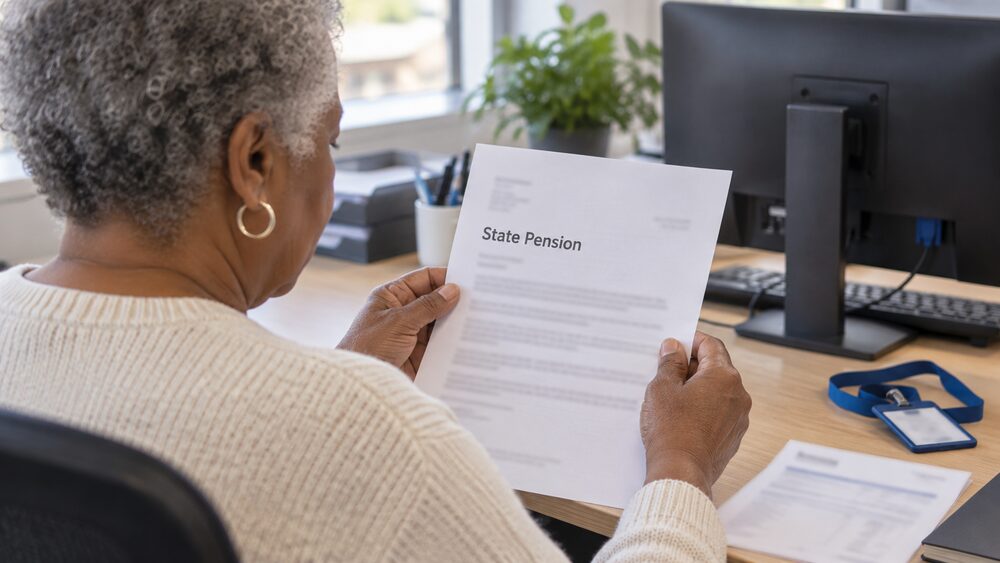
The State Pension is treated as taxable income, but it is handled differently from every other income source: it is paid to you without tax taken off5. No tax comes out of the payment itself, however much your State Pension is worth. Instead, your tax code will usually be changed so that you pay the extra tax on your other income5.
This arrangement exists because there is no PAYE mechanism on the State Pension payment itself. HMRC knows your State Pension amount, adds it to your other income, and adjusts the tax code applied to your wages or private pension so that the total tax collected across the year covers the State Pension as well17.
The practical consequence is that people whose State Pension pushes them over the allowance pay the tax indirectly: their take-home pay or private pension payments are reduced by more than the tax on those payments alone. That can be confusing, especially in the first year, when the adjustment may be backdated or spread over fewer remaining paydays. If there is no other income to collect from, HMRC falls back on a bill after the year ends, covered in the next section.
The State Pension is usually paid every four weeks rather than on the same date each month5. The full amount is £241.30 a week with 35 qualifying years of contributions, and 10 qualifying years are needed to get anything at all, currently around £68.90 a week5. You can claim it from State Pension age, and you can claim while still working, as long as you have reached State Pension age18. If you retire before that age, you will have to wait to claim19.
How HMRC collects tax on your State Pension
For people with other income from employment or pensions, HMRC will usually change your tax code so the tax due on your State Pension is collected from your wages or other pension17. The State Pension itself keeps arriving in full; the tax is taken from the other source instead.
If HMRC is unable to collect the tax due through your tax code, it may send you a Simple Assessment tax calculation after the end of the tax year17. A Simple Assessment is a bill: HMRC works out what you owe and tells you, rather than waiting for you to file anything. You are eligible for this route if you need to pay tax on your State Pension2.
The same code-based collection applies to other small amounts of tax. Tax on savings interest above your allowances is usually collected through your tax code if you are employed or get a pension20. So a pensioner with a private pension, a State Pension and some savings interest may find all three handled through one adjusted code on the private pension payments.
Working out your taxable State Pension for the tax year
One detail of the State Pension catches people out: HMRC works out your taxable State Pension using the amounts you were entitled to get over the tax year, rather than the payments you actually received17. Because the State Pension is usually paid every four weeks5, some tax years contain more payment dates than others. The entitlement basis smooths this out, so your taxable amount reflects what the year's State Pension was worth, not the accident of when the payments landed.
For most people this makes little difference, but it matters at the edges of a tax year: if you started claiming part-way through, or if a payment due on 5 April slips into the next tax year, the entitlement basis is what counts. The same broad definition of income applies here as elsewhere: state pension, private pension, self-employment, employment, taxable state benefits, non-ISA savings interest and investments all count12, as does income from part-time work in retirement11.
Where the tax cannot be collected through a tax code, the Simple Assessment route has its own limits. HMRC's guidance gives an example in which £750 of tax is paid through a private pension during the tax year, described as 50% of the private pension income, which is the maximum collectable through a tax code2. Anything above that has to be settled another way, which is when a Simple Assessment bill is issued.
Tax on workplace and personal pension payments
Payments from private and workplace pensions are taxed at source: your provider will deduct any tax due before making payments to you3. This is the ordinary PAYE system, the same one that applies to wages, so most people never have to do anything to pay the right tax on a regular pension income.
The tax treatment is the same whatever form the pension income takes. All pensions, whether scheme pensions, annuities or drawdown, are taxable in the hands of the individual as pension income at their marginal rate21. Parliament's own explanation of the pension tax rules states the principle plainly:
"People pay tax on payments from pensions like other income. People can access up to 25% of their pension savings tax-free"22
That 25% is the reason many people pay less tax in retirement than they expect. When you take a lump sum from your pension, 25% is usually paid tax-free, and the other 75% counts as earnings for Income Tax6. Regular drawdown income is treated similarly: all pension drawdown income is counted when calculating Income Tax each tax year, which runs from 6 April to 5 April, apart from the upfront lump sum worth up to 25% and 25% of other lump sums within limits23.
Workplace pensions come with their own tax advantages on the way in, which reduce the tax on the way out. Being part of a workplace pension may mean you benefit from an employer contribution as well as tax relief on your income tax24, and you usually get tax relief on money you pay into a pension25. One check is worth making with your provider: that your pension scheme is registered with HMRC, because if it is not registered, you will not get tax relief25.
Pension income is a large part of retirement income overall. In 2010-11, workplace and personal pensions made up 30 per cent of the retirement incomes across pensioner households, and seven in ten pensioner households received income from workplace and personal pensions, averaging £188 a week26.
Two further points on the edges of this area. From 6 April 2027, authorised payments of surplus assets from defined benefit schemes to individual members will be taxed as pension income, provided conditions are met, including the member being above the normal minimum pension age27. And if you are thinking of taking tax-free cash and recycling it into another pension scheme, be aware that the pension recycling rules can apply, under which you usually have to pay tax worth 55% of the tax-free lump sum you received23.
Income over £100,000: how the Personal Allowance shrinks
The Personal Allowance is withdrawn at high incomes. Those earning more than £100,000 see their Personal Allowance reduced by £1 for every £2 earned over £100,0007. The reduction applies irrespective of date of birth30, and the same taper applies in Scotland31 and was confirmed for Welsh income tax purposes in the 2024 to 2025 rates32.
The arithmetic is unforgiving. Because the allowance is £12,570 and it goes down by £1 for every £2 of income above £100,000, it disappears entirely at £125,140: you do not get a Personal Allowance if you earn over £125,14015. Someone with income in this range, which can happen when a large pension lump sum is taken in a single year, loses tax-free allowance at the same time as the lump sum is taxed, which is one reason lump sums can produce unexpectedly large tax bills.
The £100,000 threshold is measured after certain allowable deductions, such as pension and gift aid contributions33. Paying into a pension can therefore reduce the income used for the taper test, which is a legitimate effect of the rules rather than a loophole. The pages on pension tax relief and the annual allowance cover the limits on contributions.
Pension tax in Scotland, Wales and Northern Ireland
Where you live changes which income tax rates apply to your pension, though not the Personal Allowance. Scottish Income Tax applies to your wages, pension and most other taxable income15. The Scottish Government sets its own rates and bands, which differ from those in the rest of the UK, and publishes them for each tax year, including 2026 to 202715. The standard Personal Allowance of £12,570 is the same as in the rest of the UK15.
Scottish taxpayers also claim pension tax relief through routes that reflect the separate system: you can claim additional relief either on your Self Assessment tax return or through your tax code for the money you put into a private pension34. The page on pension tax relief for Scottish taxpayers covers this in detail.
Wales has the power to set Welsh rates of income tax, but in 2024 to 2025 the rates matched those in England and Northern Ireland, and the Personal Allowance was £12,57016. Northern Ireland has no separate income tax powers: income tax there, including tax on pensions, follows the UK-wide rules, and nidirect guidance confirms that when you get money from a pension you pay tax on any income above your tax-free Personal Allowance1.
Self Assessment and checking your tax code
Most pensioners never file a tax return, because PAYE and Simple Assessment handle their tax. But Self Assessment still touches some people with pension income, and the system is changing. Under reforms announced in 2026, where possible HMRC will update your tax code, which will determine how much Self Assessment tax is collected through your PAYE income alongside your existing tax on your employment or pension35. From April 2029, Self Assessment taxpayers with PAYE income, such as from employment or a pension, will need to pay towards their Self Assessment tax bill through their PAYE income, where they have enough income to do so35.
If you do file a return, the software you use can retrieve your PAYE details, such as your income from employment and private pensions, directly36. And if you want to check what you actually paid, HMRC's service for checking last year's Income Tax has one firm limit: you cannot use it if you paid any part of your Income Tax last year through Self Assessment37.
For everyone else, the tax code is the thing to check. Your code determines how much tax is taken from your private pension or wages, including the extra collected for your State Pension. HMRC's guidance on common letters explains what a P800 or Simple Assessment means and what to do next8, and the check your Income Tax service on GOV.UK shows the code HMRC is using and the income it believes you have.
If you have paid too much or too little tax
If you have paid too much or too little tax by the end of the tax year on 5 April, HMRC will send you either a tax calculation letter, known as a P800, or a Simple Assessment letter38. Which one you get depends on how the correction can be collected.
A P800 is sent if HMRC finds a difference between what you paid and what you owed at the end of the tax year8. P800s are usually sent out between June and March, after the tax year ends8. If you have overpaid, the letter explains how to claim a refund; if you have underpaid, it sets out how the money will be collected, often through your tax code in the following year.
A Simple Assessment letter, formally a PA302, is different: HMRC sends it if you did not pay enough tax and could not collect it through your tax code2. You will get one if you owe more than £3,000, or if your State Pension is your only income and it is more than your Personal Allowance8. HMRC's guidance also lists the wider triggers: you may be sent a Simple Assessment bill if you go over your Personal Allowance and have tax to pay on your State Pension, owe Income Tax that cannot be automatically deducted, or owe £3,000 or more3.
If you use a tax refund company to reclaim overpaid pension tax, expect it to take a share of the refund. Claiming from HMRC directly is free, and the refund is paid to you in full. The page on emergency tax on pension withdrawals explains why first withdrawals are so often overtaxed and how to get the money back.
Help if you owe HMRC tax you cannot pay
Owing tax you cannot pay is common among pensioners whose State Pension or lump sum pushed them over the allowance without them realising. The rule is to act early. Contact HMRC as soon as possible if you cannot pay your tax bill: you may be able to pay what you owe in instalments, depending on your circumstances and affordability40.
HMRC publishes guidance on what financial help it can offer, including time to pay arrangements40. Do not ignore a Simple Assessment or P800 that shows underpaid tax, because the debt does not go away and collection through your tax code will begin automatically in many cases.
Working past State Pension age does not exempt you from tax: you could pay tax, and it depends on the size of your total income18. Income from part-time work in retirement counts as taxable income alongside your State Pension11, so someone who keeps working while claiming may owe more than their code allows for. The page on claiming the State Pension while working covers the interaction.
Finally, if you are dealing with tax on a pension after someone has died, the position is more complex. From 6 April 2027, personal representatives will be liable for reporting and payment of Inheritance Tax due on unused pension funds and death benefits41. Where a beneficiary does not direct the pension scheme administrator to pay the Inheritance Tax, the beneficiary will need to contact HMRC to request a refund of Income Tax, and HMRC will publish further guidance on how this will operate41. The pages on what happens to your pension when you die and pensions and inheritance tax go into this in depth.
Sources41 cited
- Tax and allowances in retirement nidirect, 2026-03-30
- Understand Simple Assessment GOV.UK, 2026-09-25
- Understanding tax and your pension GOV.UK, 2025-03-27
- Income Tax GOV.UK, 2026-09-26
- State Pension Pension Wise, 2026-09-28
- Take your whole pot in one payment Pension Wise, 2026-09-28
- Scottish Income Tax rates and bands 2026 to 2027 Scottish Government, 2026-01-14
- Common letters from HMRC HMRC Tax Confident campaign, 2026-09-28
- Income Tax (Earnings and Pensions) Act 2003, section 1 legislation.gov.uk, 2003
- Income Tax Act 2007, section 3 legislation.gov.uk, 2007
- Working past State Pension age nidirect, 2026-06-26
- Pension Age Winter Heating Payment factsheet Social Security Scotland, 2026-08
- Changes to tax rates for property, savings and dividend income GOV.UK, 2025-11-26
- Tax on UK income if you live abroad GOV.UK, 2026-09-26
- Scottish Income Tax GOV.UK, 2026-09-25
- Welsh Income Tax outturn statistics 2024 to 2025 GOV.UK, 2024
- How your State Pension is taxed GOV.UK, 2026-07-07
- Working, retirement and State Pension age GOV.UK, 2026-09-26
- Early retirement and pensions GOV.UK, 2026-09-26
- How you pay tax on savings interest GOV.UK, 2026-09-28
- Finance Act 2014 explanatory notes, pension income legislation.gov.uk, 2014
- Pension taxation briefing House of Commons Library, 2026-09-26
- Adjustable income (drawdown) Pension Wise, 2026-09-28
- Making the most of your money after the summer boom Money and Pensions Service, 2025-08-04
- Personal pensions and your rights GOV.UK, 2026-09-26
- Government interventions to support retirement incomes National Audit Office, 2013
- Defined benefit pension scheme surplus payments to members GOV.UK, 2026-07-13
- Budget 2025 overview of tax legislation and rates GOV.UK, 2025
- Scottish Income Tax technical factsheet Scottish Government, 2026-01-13
- Autumn Budget 2024 rates and allowances GOV.UK, 2024-11-11
- Scottish Budget 2025 to 2026 Scottish Government, 2024-12-04
- Scottish Income Tax rates and bands 2024 to 2025 Scottish Government, 2024
- Tax-free savings explained NS&I, 2026-09-03
- Scottish Income Tax allowances and reliefs mygov.scot, 2026-04-06
- Timely payments in Income Tax Self Assessment factsheet GOV.UK, 2026-06-23
- Use software to help complete your Self Assessment tax return GOV.UK, 2019-05-01
- Check your Income Tax for the last tax year GOV.UK, 2026-09-26
- Tax overpayments and underpayments GOV.UK, 2026-09-25
- Check if a text message you have received from HMRC is genuine GOV.UK, 2026-09-18
- Check what financial help you can get from HMRC GOV.UK, 2022-04-05
- Inheritance Tax on pensions: liability, reporting and payment, summary of responses GOV.UK, 2025-07-21
 Pension WiseFree guidance on your options for a defined contribution pension, from age 50
 FSCSProtects your money if a bank, insurer or investment firm fails
 GOV.UKOfficial information on tax, benefits and government services