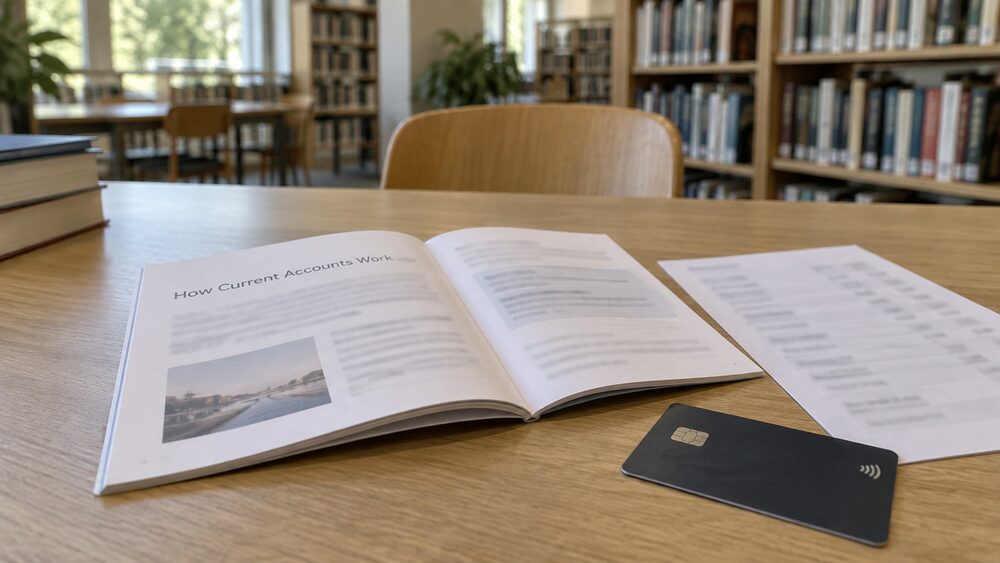
A current account is the account most people use for everyday money: wages and benefits are paid into it, bills go out of it, and a debit card attached to it pays for shopping in person and online. MoneyHelper describes it as an account that lets you receive your benefits and wages, spend in shops, withdraw cash at a cash machine, manage your money online or by mobile app, and set up Direct Debits and standing orders1. Citizens Advice puts it more simply: it is an account for managing money day to day, including paying bills, receiving money such as salary or benefits, and keeping track of spending2.
Under the regulator's own definition, a personal current account is a payment account within the meaning of the Payment Accounts Regulations, other than a current account mortgage2. In practice that means it is an account whose whole purpose is moving money: in, out, and between people. This page explains how each of those parts works, what it costs, and what can go wrong.
What a current account lets you do
The core functions are the same across the market. A current account receives money, holds it, and sends it where you tell it to. MoneyHelper's summary of what a bank or current account usually lets you do covers the essentials: receive benefits and wages, spend in shops, withdraw cash at a cash machine, manage your money online or by mobile app, and set up Direct Debits and standing orders1. Most accounts also come with a cheque book, though cheques are used far less than they were8.
Not every account offers everything. Some accounts require you to pay in a minimum amount each month, earn a certain salary, pay a monthly fee, have a good credit history, or own a smartphone7. The bank will usually run a credit check when you apply, to see your credit history including whether you have had problems paying money back7. Where an account is refused, a basic bank account is the fallback designed to be opened without a credit check.
There are variations on the standard account. A joint bank account allows two or more people to receive payments, pay by debit card, transfer money and manage the account, depending on the bank9. Some credit unions offer current accounts, usually with no credit check or overdraft1. And a small but growing group of people hold their day-to-day account with a payment services institution or e-money provider rather than a bank: the FCA's Financial Lives survey found 12% of adults did so in 2024, up 5 percentage points since 202210. Where you hold the account matters for protection, which is covered in FSCS protection.
For most people the practical question is not whether to have a current account but which type. The types of current account are covered elsewhere on the site, including student bank accounts, graduate accounts, children's accounts and packaged accounts that bundle insurance for a fee.
Getting paid in: wages, benefits and cleared funds
Money arrives in a current account in two main ways: your employer pays your wages by transfer, and the government pays benefits and tax credits the same way. Benefits can be paid into a standard bank or building society account, for example a current account, or into a basic bank account, sometimes called an introductory account11. The legislation behind this is explicit: a payment on account of benefit may be paid by direct credit transfer into a bank account or other account nominated by the claimant or a person acting on their behalf12. MoneyHelper's guidance for Universal Credit makes the same point: a bank or building society account, also called a current account, is the easiest way to access your payments13.
If you do not have an account when a benefit payment is due, the payment can build up until one is opened. That is one reason the Post Office card account existed, and its closure is covered on the Post Office card account page.
Once money is paid in, it is not all instantly spendable. A payment that has arrived but is still being processed shows as uncleared funds: it counts towards your balance but not yet towards the money you can spend. This matters most with cheques, which take days to clear, and it is why your available balance can be lower than your total balance. If you spend against money that has not cleared and the account goes overdrawn, or a payment is refused because there are not enough funds, the bank can charge a fee, usually called an unpaid transaction fee7. How long each type of payment takes is covered in bank transfers: Faster Payments, Bacs and CHAPS and cheque clearing times.
Some accounts pay interest on the money sitting in them. How that interest works and how it is taxed is covered in interest on current accounts and how it is taxed.
Paying out: cards, Direct Debits and standing orders
Money leaves a current account in several ways, and they behave differently.
- Debit card: pays for goods in shops, online and contactless, and withdraws cash at machines. Every basic bank account includes one, and most allow contactless14.
- Direct Debit: a payment the company you are paying pulls from your account, with the amount and date able to vary. Used for energy, phone and insurance bills. Protected by the Direct Debit Guarantee, which allows immediate refunds for wrong amounts15.
- Standing order: a payment you set up yourself, for a fixed amount to the same person or company, such as rent or a regular transfer to savings. You control it and can change or cancel it15.
- Bank transfer: a one-off payment to someone, using their sort code and account number, now checked by Confirmation of Payee.
The distinction between Direct Debits and standing orders trips many people up, and it matters when things go wrong, because the refund routes differ. The full comparison is in Direct Debits and standing orders.
The rules also set a floor on what even the most basic account must do. A payment account with basic features must allow direct debits, payment transactions through a payment card including online payments, and credit transfers including standing orders16. That is why a basic bank account, which is fee-free at the largest banks, still lets you set up Direct Debits and standing orders, use a debit card, have income paid in, and check your balance at a bank, cash machine or online14. In Northern Ireland the same applies: basic accounts there allow you to set up, amend and cancel Direct Debits and standing orders, use a debit card with a contactless facility, withdraw money from an ATM, have income or benefits paid in, and check your balance in a branch, at an ATM or online17.
Some people keep a second account purely for bills. Business Debtline's budgeting guidance notes that it can be easier to cope with paying bills if you open a separate bank account, paying regular amounts into it to plan ahead, with Direct Debits or standing orders taking the regular payments automatically18. Whether you can have more than one current account is covered in having two accounts.
Recurring card payments and how to stop them
A recurring card payment, sometimes called a continuous payment authority, is different from both a Direct Debit and a standing order. It is set up with your debit or credit card details rather than your account details, and the business takes payments when they fall due. The FCA notes they are often used to pay for things like subscriptions, memberships and short-term loan repayments5.
Because the payment runs on your card, it can behave in ways people do not expect. If you get a new payment card, your recurring payments may continue, but this is not always the case, and you can contact your card issuer to check5. A cancelled card does not automatically cancel the payments attached to it.
Stopping one is straightforward in principle. The Financial Ombudsman states that to cancel a recurring payment, you need to contact either the business or your card provider19. The FCA says the same: you can cancel a recurring card payment by contacting the business taking the payment and asking them to stop, or by asking your card issuer to cancel the payment5. Debt charities advise putting the request to your card issuer in writing20.
One point catches people out: cancelling the payment does not cancel what you owe. As the FCA puts it:
"Cancelling a recurring card payment does not necessarily end your contract with a business. It will still be your responsibility to pay any money that you owe under a contract."5
So cancelling a gym payment stops the gym taking money, but if you are still in a contract with the gym, the debt remains. If a payment is taken after you cancelled it, you have refund rights, covered in the Direct Debit Guarantee and cancelling recurring card payments. If you spot a payment you never agreed to, Which? advises contacting your card provider and asking them to stop all future payments21.
Digital wallets such as Apple Pay and Google Pay
A digital wallet is a way of paying with your phone instead of the plastic card itself. Apple Pay, along with Google Wallet and Samsung Pay, lets you upload your card details to a digital wallet on your mobile phone or tablet, then tap your phone on a card reader to pay in shops, and pay on some websites and apps22. The card behind it is still your current account's debit card; the wallet is just the front end.
There is a security benefit to paying this way. Which? notes that using a digital wallet such as Apple Pay, Google Pay, PayPal or Samsung Pay ensures your card details stay private, because the shop never receives your actual card number23. That also means a scam that fakes a wallet suspension is a common trick, and any message saying your Apple Pay has been suspended should be treated with suspicion22.
When you send money to a person rather than a shop, a different check applies. Confirmation of Payee works by checking the account name and account details to make sure there is a match, with alerts notifying the payer whether there has been a match before the payment is made24. It is designed to stop payments going to the wrong account and to disrupt some impersonation scams. How it works in practice is covered in Confirmation of Payee explained, and how much you can spend by phone in phone payment limits.
Overdrafts: arranged borrowing that costs more than it looks
An overdraft is a type of credit linked to a bank account8. With an arranged overdraft, the bank agrees in advance that you can spend more than your balance, up to a limit, and charges interest for using it8. An unarranged overdraft, also known as an unplanned or unauthorised overdraft, happens when you spend more than you have without agreeing it in advance, including going over the limit of an authorised overdraft25.
The cost is the part to understand. MoneyHelper states that with an overdraft you will normally pay daily interest of up to 40%3. The Bank of England groups overdrafts with credit card revolving credit and payday loans as types of borrowing that charge higher interest26, and StepChange describes overdrafts as a very expensive way to borrow money due to high interest rates8. Fees can also apply if you spend more than you have, including where there is not enough to cover a Direct Debit or standing order13.
Since April 2020 the charging structure has been simpler than it once was, but the headline rate is higher. FCA rules state that the rate of interest that applies to any given balance of arranged overdraft relating to a personal current account must either be zero or the same as the rate that applies to any other balance of arranged overdraft on that account4. The same uniformity rule applies to unarranged overdraft rates4. In plain terms: a bank can no longer charge one rate for part of an overdraft balance and a steeper rate beyond it. The old fee system that preceded this is covered in the 2020 overdraft changes.
Where an account allows you to go overdrawn without an arranged overdraft, the charges that would apply to overrunning must be included in the account opening information27. Banks must also tell you when you are using the overdraft repeatedly: a rule that took effect on 18 December 2019 requires firms to communicate with customers showing a pattern of repeat overdraft use without signs of financial difficulty28. That is covered in overdraft repeat use: the FCA rules and overdraft text alerts.
Going into an unarranged overdraft has consequences beyond interest. nidirect, the Northern Ireland government service, warns that you may have to pay a penalty charge and a high rate of interest, that your bank may also charge for sending a reminder letter and for Direct Debits or cheques put through the account, and that the bank may freeze the account until the overdraft is paid off29. The full picture is in arranged vs unarranged overdrafts and how overdraft interest and charges work.
Getting cash: cashpoints, branches and other access
Cash still matters to many account holders, and access to it is now protected by policy. The government's Cash Access Policy Statement covers access to cash deposit and withdrawal services for relevant personal and business current accounts across the UK6. The FCA's rules that followed it cover access to both notes and coins, and access that is free of charge for consumers with personal current accounts30.
In practice, cash comes from three places:
- Cash machines: every current account's debit card withdraws cash at ATMs, and basic accounts are no exception14. Whether machines are free to use is covered in are cash machines free to use?
- Branches: fewer than there were, and closures follow a notice process, covered in bank branch closures and what replaces them
- The Post Office: most banks let you use it as if it were their counter
The Post Office route is the one many people do not know about. Some banks will let you cash a current account personal cheque or use your cash card at the Post Office, free of charge2. The details are in banking at the Post Office.
One thing to watch: an account left alone can be treated as gone. Current accounts can be marked as inactive after just a year31, and Which? has reported on billions of pounds sitting in lost accounts31. If you keep an account only for occasional use, check its terms on dormancy.
Letting someone else manage your account
There are times when someone else needs to run an account: illness, loss of capacity, or simply help with day to day banking. The formal route is a power of attorney. With a registered enduring or lasting power of attorney, the bank will allow the attorney and the account holder with capacity to operate the account independently of each other, unless the account holder with capacity objects, in which case the bank will usually only allow the account to operate on a both-to-sign basis32.
Not everyone can act as an attorney. You may not act or be appointed as the lasting power of attorney for a donor's property and affairs if you are an undischarged bankrupt33. The process for setting this up, and the other ways someone can access an account, are covered in power of attorney and third party access to bank accounts.
It is not a rare arrangement. The FCA's Financial Lives 2024 survey found that 1% of adults with a day-to-day account had used a branch to add a third party or a power of attorney to an account in the previous 12 months10. Banks are required to have processes for it, and accessible banking support is covered in accessible banking and extra support.
When a bank closes your account
Banks can close accounts, and they do, sometimes without giving a reason. What they must do is follow rules about notice and about returning your money. If you are using your overdraft when you close an account, you have to pay it back before the account can be closed, and you will lose access to statements, so it is worth getting copies first7.
A joint account is different again. If the bank freezes a joint account, it may close it and refund half the money to the other person, or remove one person's name from the account34. When that happens because of a separation, the options are in freezing a joint account after a separation.
If your bank closes your account and you disagree, or you are left out of pocket, you can complain to the bank and then to the Financial Ombudsman. The full picture, including closures over immigration status and the notice banks must give, is in when your bank closes your account.
If you are struggling with overdraft debt
Overdraft debt is different from other debt in one important way: the money you need to live on can be swallowed by the account that owes it. If you have an overdraft or other debts on your current account and you open a basic bank account at a bank in the same banking group, the bank may use money in the new basic account to pay off debts on your old account35. Citizens Advice in Scotland gives the same warning, and advises considering opening the basic account at a different bank if you get benefits, tax credit or state pension2.
That is the logic behind a "safe" or jam-jar account: keep your income in a bank you owe nothing to. Debt charities publish guides on exactly this, for England and Wales and for Scotland14.
Switching while overdrawn is possible. You can switch using the Current Account Switch Service even if you are overdrawn, provided your new bank agrees to let you have an overdraft of the same size or bigger. If this covers what you owe, the funds will be sent to your old bank and you will owe the overdraft balance on the new account instead. If the new overdraft is a lower amount, or you cannot get one, you will need to arrange to pay off the remainder separately before you can switch or close your old account7. This is covered in switching while overdrawn.
Free help exists and does not cost anything. StepChange, National Debtline and Business Debtline all publish guidance on overdraft debt and safe accounts8, and the options for dealing with the debt itself, including repayment plans and formal debt solutions, are in struggling to repay an overdraft and the site's debt section. MoneyHelper also offers free, impartial debt advice.
Sources36 cited
- Choosing a bank account for your Universal Credit payment MoneyHelper, 2026-09-25
- Getting a bank account Citizens Advice Scotland, 2026-09-26
- Current accounts MoneyHelper, 2026-09-25
- Overdraft price uniformity rules, CONC 5C.2 FCA Handbook, 2020
- Recurring card payments Financial Conduct Authority, 2025-06-23
- Cash Access Policy Statement HM Government, 2023-08-18
- How to open, switch or close your bank account MoneyHelper, 2026-09-25
- Overdraft debt StepChange, 2026-09-25
- Joint accounts MoneyHelper, 2026-09-25
- Financial Lives 2024: retail banking findings Financial Conduct Authority, 2025-05
- Payment of benefits and tax credits Citizens Advice, 2019-09-27
- The Social Fund (Recovery of Debts) Regulations 2013 legislation.gov.uk, 2013-02-25
- What to do now your Post Office card account is closing MoneyHelper, 2026-09-25
- Safe bank accounts National Debtline, 2026-09-25
- Safe bank accounts National Debtline, 2026-09-26
- Payment Accounts Regulations 2015, Regulation 19 legislation.gov.uk, 2015
- Basic bank accounts Advice NI, 2026-09-26
- Your business and household budget Business Debtline, 2026-09-26
- Regular payments Financial Ombudsman Service, 2026-09-26
- Making the most of your money Business Debtline, 2026-09-26
- Scamscriptions: how to stop a dodgy recurring payment Which?, 2025-04-09
- Scamwatch: has my Apple Pay been suspended? Which?, 2026-08-25
- How to spot an online shopping scam Which?, 2026-08-03
- Consultation on general directions for the implementation of Confirmation of Payee Payment Systems Regulator, 2026-09-26
- Overdrafts explained MoneyHelper, 2026-09-25
- What do I need to know about debt? Bank of England, 2025-08-19
- Overdraft charges disclosure regulations legislation.gov.uk, 2010
- CONC 5D.3 repeat overdraft use communication rule FCA Handbook, 2019-12-18
- Overdrafts and other bank debts nidirect, 2025-11-07
- Access to cash rules, PS24/8 Financial Conduct Authority, 2024-07
- £4.5bn sat in lost accounts: could some of the money belong to you? Which?, 2023-03-17
- Deputy and attorney guidance: dealing with banks Office of the Public Guardian, 2023-05-02
- Restrictions following a bankruptcy order HM Government, 2022-05-03
- Bank accounts after bankruptcy StepChange, 2026-09-25
- Getting a bank account Citizens Advice, 2026-09-25
- Banking and borrowing StepChange, 2026-09-25



 MoneyHelperFree, impartial money and pensions guidance, set up by government
 FSCSProtects your money if a bank, insurer or investment firm fails
 Financial Ombudsman ServiceFree, independent help when a complaint about a firm is not put right
 Citizens AdviceFree advice on money, consumer and legal problems in England and Wales