
Most people with a UK current account can do their everyday banking at a Post Office counter: pay in cash and cheques, take money out and check their balance. The Post Office states that its everyday banking service works with most UK personal and business bank accounts1, and according to UK Finance, 99% of retail banking customers can carry out basic banking at the more than 11,500 Post Offices across the UK2. That arrangement exists because banks and the Post Office have a formal agreement, which a Parliament report describes as meaning "consumers of 30 UK banks and building societies can continue to access cash and basic banking facilities via the Post Office until 2026"3.
The service matters because bank branches have been closing across the country, and the Post Office network is now the main place where many people can still deal with their money face to face. Consumer Scotland notes that Post Office branches make up more than 65% of all branch-based cash access points in the UK4. For someone whose local bank branch has shut, the Post Office is often the nearest counter where cash can be paid in or withdrawn.
What the Post Office cannot do is everything a full bank branch does. It cannot open accounts, arrange mortgages or give financial advice, and some services, such as paying a tax bill to HMRC, can no longer be done there at all5. This page explains which accounts work, what the limits are, when your money arrives, and where to complain if something goes wrong.
Which bank accounts work at the Post Office
The Post Office's everyday banking service is not a bank account of its own. It is a counter service that acts on behalf of your bank, and whether you can use it depends on whether your bank has signed up to the banking framework agreement. The Post Office says the service "works with most UK personal and business bank accounts"1, and the figures behind that are large: a Parliament report on access to cash states the framework means "consumers of 30 UK banks and building societies can continue to access cash and basic banking facilities via the Post Office until 2026"3. An earlier consultation document put the number at 28 banks in November 20199, so the list has grown slightly over time.
For personal customers, the coverage is close to universal. UK Finance figures reported by Which? show that 99% of retail banking customers can carry out basic banking at Post Offices2, and a House of Lords committee report from 2017 recorded the same 99% figure for current account customers being able to access some banking services over a post office counter10. Business customers are slightly less well served: the framework allows 99% of personal banking customers but 95% of business customers to deposit cheques, check their balance and carry out other basic tasks11.
There are exceptions worth knowing about:
- Basic bank accounts. Citizens Advice warns that "not all basic bank accounts can be accessed at the Post Office"12. Research on basic accounts has also found that some allow cash withdrawals at a Post Office but not deposits13. If you have a basic bank account, check with your provider before relying on it.
- Credit union accounts. Credit union current accounts can be used at a local Post Office for both withdrawals and deposits, according to the Building Societies Association14.
- The Post Office's own current account. The Post Office previously offered its own current account, which was operated through the Bank of Ireland15. That account is no longer part of the picture for new customers.
- Accounts without a card. To bank at the counter you normally need your debit card, or a paying-in slip for some accounts. Accounts that offer neither may not work at the Post Office.
If you are unsure whether your account is covered, the quickest check is with your bank, since it is your bank, not the Post Office, that decides. The general guide to current accounts explains the types of account available, and the comparison page on Post Office banking versus banking hubs sets out how the two services differ.
More than 11,500 branches, and what they mean for access to cash
The size of the network is what makes Post Office banking useful. The Payment Systems Regulator notes that "the Post Office is committed to investing in their network and maintaining around 11,500 branches with no further substantive reductions and continued accessibility for all at the national level"6. A Parliament report puts the same commitment slightly differently: the Post Office is accountable to the UK Government and "must maintain at least 11,500 branches"3. The FCA's cash access data counted 11,692 Post Office branches in its dataset for the second quarter of 202316, a figure consistent with the 11,500 commitment.
Those branches sit within a wider cash network. A PSR study drawing on a combined dataset had information on approximately 19,000 branches of banks, building societies and post offices17. Within that network, Post Office branches are the dominant presence: Consumer Scotland notes they make up more than 65% of all branch-based cash access points in the UK4. The practical effect is that in many towns the Post Office is the only counter left where cash can be paid in or taken out, a point that has become more important as bank branch closures have continued.
Banks themselves rely on the network heavily. Lloyds Banking Group told a Parliament committee that "about 21% of our current account customers use the Post Office on a regular basis", and that in 2021 there were "almost 35 million transactions by Lloyds Banking Group through the Post Office"3. Lloyds has also long allowed its basic bank account customers to access their money at around 12,000 Post Offices throughout the UK18.
The Post Office also runs the newer banking hubs. The House of Commons Library explains that "banking hubs provide face-to-face banking services and are operated by the Post Office"19. Hubs differ from ordinary Post Office branches because banks take turns to staff a counter there, so you can speak to your own bank as well as using the generic services. The page on access to cash covers cash machines, hubs and deposit services in more detail.
Paying in cash: your bank sets the limit
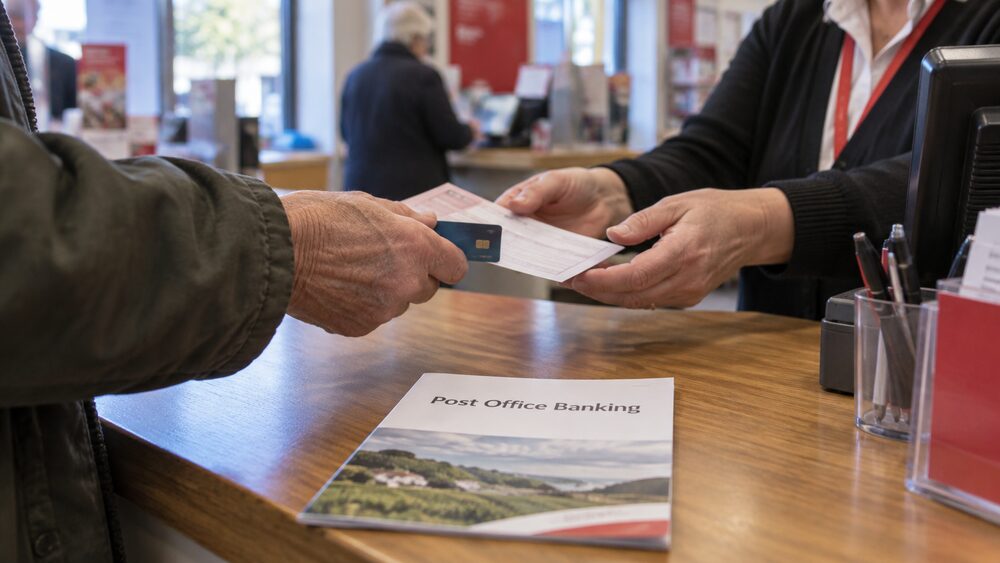
Paying cash in at a Post Office counter is straightforward in principle: you hand over the money, the counter staff process it against your account, and it appears in your balance. The Post Office says you can "deposit cash or cheques safely" and that the service offers "fee-free cash withdrawals and deposits" at selected banks, with restrictions applying1. Cash paid in using your debit card normally shows in your account the same day, though this depends on your bank's own processing.
The limit on how much you can deposit is not set by the Post Office. NS&I, speaking about payments into its accounts, makes the general point plainly: "Most banks have a daily limit on how much you can pay, please check with your bank, particularly if you want to make a" large payment7. The same principle applies to Post Office deposits, because the counter is acting as your bank's agent.
One bank has recently made its limits explicit. From 21 September 2026, HSBC UK limits cash deposits to £3,000 per day and £15,000 per calendar year across Post Offices, banking hubs, deposit machines and multi-bank ATMs, with larger deposits requiring an HSBC branch with counter service22. Other banks may introduce or change their own limits, so the figure to trust is the one your bank publishes on the day you deposit.
A few practical points finish the picture:
- Coins. There is no Post Office-wide rule on coins, but large volumes of loose coin are usually easier bagged in standard amounts. Arranging in advance with the branch is sensible for a large deposit, and some branches ask for this.
- Business takings. The Post Office says business customers can "pay in your takings in a secure environment" and withdraw cash or get change with some accounts1.
- Same-day timing. If the timing matters, for example because a Direct Debit is due, ask your bank when a counter deposit will clear, since the cut-off is set by the bank rather than the Post Office.
The guide to paying in cash and cheques covers the same task at bank branches and machines.
Cheques take longer than cash
Cheques deposited at a Post Office take longer than cash, and the delay starts at the counter. The Post Office's own guidance for CAF Bank customers states that "the cheque will take an additional working day to clear" when deposited at a Post Office using a paying-in slip1. That extra day is on top of the normal cheque clearing process, so a cheque paid in at a Post Office can be expected to take longer than the same cheque paid in at your bank's own branch.
The underlying clearing times give a sense of the scale. Which ? notes that paying by Bacs or by cheque in the post can take around three days23, and its guidance on self-assessment tax bills adds that "cheques could take much longer to arrive if the" post is delayed24. StepChange Debt Charity, describing how it pays creditors, allows up to five working days where a creditor has asked to be paid by cheque25. These figures are not all about Post Office deposits specifically, but they show that cheque processing is measured in days, not hours.
For someone managing a tight budget, the difference matters. Cash paid in by card normally arrives the same day; a cheque paid in at a Post Office counter may not clear for several working days, and the funds may not be available to spend even once the cheque shows in your balance. Macmillan's guidance for people managing money during cancer treatment lists the Post Office among places offering withdrawing money, paying in cash and cheques, and checking your balance26, and the same patience with cheque times applies whoever you bank with.
The narrow guide to cheque clearing times explains the 2-4-6 rules that govern when cheque money earns interest, can be withdrawn and is guaranteed.
Withdrawing cash and checking your balance with your card
Withdrawing money and checking your balance are the two services almost every covered account supports. The Post Office says you can "take out cash at our counters and ATMs" and "check your account balance"1. You normally use your debit card and PIN, just as at a cash machine, but with a member of staff processing the transaction. TSB personal banking customers can also use an ATM-only card to withdraw cash and check their balance over the Post Office counter1, which matters for customers who have a card that works in machines but not in shops.
How much you can withdraw is, like deposits, a matter for your bank. Lloyds' own support pages give two different figures for daily withdrawals at the Post Office, £300 a day in one document and £800 in another, both dated the same day1. Neither figure can be treated as settled, so the limit for a particular account is one to confirm with Lloyds directly before a large withdrawal. Other banks set their own limits, and the page on daily payment and cash withdrawal limits explains how these work.
A few related services sit alongside ordinary withdrawals:
- Cash delivery. For some customers who cannot easily reach a branch, a cash delivery service has been available. Which ? reported that if a request is approved, "you can receive up to £2,500 and the payment will be delivered to you via the Royal Mail Special Delivery"27. However, this was tied to specific payment arrangements: "If you receive your payment into another bank account, you will still be able to withdraw cash from any Post Office branch, but the delivery service won't be available to you"27.
- Payment Exception Service. If you cannot get a bank or building society account at all, MoneyHelper explains that "you can collect your benefit or State Pension payment in cash by visiting a Post Office" through the Payment Exception Service28. The separate Post Office card account page explains what happened when that older scheme closed.
- Credit unions. Members of credit unions without a current account can still get their money by "cashing a cheque at a local Post Office", among other routes14.
Some banks also let you cash a personal cheque or use your cash card at the Post Office free of charge, Citizens Advice notes, though this varies by bank12. The Consumer Council for Northern Ireland summarises the position: Post Offices "offer simple banking facilities, such as withdrawing and depositing cash and cheques for customers of nearly all banks"29.
Appointments, ID and opening an account
Everyday counter banking at the Post Office needs no appointment. You walk in during opening hours with your card and PIN, and the transaction is processed at the counter. Appointments come into play at bank branches rather than Post Offices: the Consumer Council for Northern Ireland notes that branch banking offers a wide range of face-to-face and automated services, and "to access certain services you may need to make an appointment (for example a mortgage application)"29. Nothing in the Post Office banking service requires booking ahead, though a branch may ask you to arrange large or unusual transactions in advance.
The Post Office cannot open a bank account for you. To open an account, Citizens Advice explains, "you usually have to fill in an application form" in a branch, online, or sometimes over the phone12. MoneyHelper adds that "most banks will ask for a driving licence or passport to prove your identity", or a photo if applying online, often along with a selfie30. Banks usually ask for ID documents such as a passport or driving licence, and where someone has no photo ID, the bank might accept a letter from a college, hostel or refuge confirming who they are31. The bank then checks identity against records, including a Home Office list where immigration status is relevant31.
A question people sometimes ask is whether the Post Office can certify copies of ID documents. It does not do this as part of everyday banking. Where certified copies are needed, the organisation asking sets the rules: a Court Funds Office application, for example, requires the copy to have "I believe this to be a true copy of the original" written on it and to be signed and dated by you and your witness on the same day32. The Post Office does accept ID for its own services, such as buying travel money, where a valid passport, full UK or EEA photocard driving licence or EEA identity card is accepted when paying by card in branch33.
If you are opening an account specifically so you can bank at the Post Office, the guides on how to open a current account and what ID you need cover the process, and the page on basic bank account eligibility explains who qualifies for the fee-free accounts that must, by rule, offer the same access as other current accounts. As one guidance document puts it, basic account holders "can also deposit money and withdraw cash over the counter at any Post Office or bank branch, on the same terms as other personal current account customers"34.
Fees and charges for personal and business customers
For most personal customers, everyday banking at the Post Office is free. The Post Office describes the service as offering "fee-free cash withdrawals and deposits" at selected banks, with restrictions applying1. The Post Office's own current account, where it still exists, carries no monthly fee34. The counter itself takes no charge for processing a standard deposit or withdrawal.
The caveat is that your bank, not the Post Office, decides what to charge. The Post Office says plainly: "Some banks may charge for selected services, so please speak to your bank for details if you're unsure"1. This matters for services beyond the ordinary deposit and withdrawal, and for accounts where the bank's own tariff applies to counter activity. The guide to current account fees and charges explains how bank charging structures work.
| Customer type | What the Post Office says | What to check |
|---|---|---|
| Personal, standard services | Fee-free cash withdrawals and deposits at selected banks1 | Whether your bank is in the fee-free group |
| Personal, selected services | Some banks may charge for selected services1 | Your bank's tariff for the specific service |
| Business | Pay in takings securely; withdraw cash or get change with some accounts1 | Whether your business account supports Post Office transactions |
| Basic bank account holders | Same terms as other personal current account customers34 | That your particular basic account is covered at all12 |
Two boundaries are worth knowing. First, the Post Office is not a place to pay bills that used to be handled there. Which ? notes of self-assessment tax bills: "You can no longer pay HMRC at the Post Office or via credit card"24. Second, the fee-free position covers the banking service only. Other Post Office counter products, such as travel money, have their own terms and ID requirements33.
For business customers, the framework covers 95% of business customers for deposits, balance checks and related services11, and a Parliament committee was told that "95% of business banking needs" can be done through the Post Office network3. But business account tariffs vary widely, and a bank may treat a Post Office transaction differently from one at its own counter, so the bank's own price list is the authority.
Who to complain to when something goes wrong
When a Post Office banking transaction goes wrong, a mistake by the counter, a deposit that never arrives, a withdrawal charged wrongly, your complaint goes to your bank, not to the Post Office. The counter acts on your bank's behalf, and the Financial Conduct Authority's guidance is that "if your complaint is about something your bank has done (for example, if it refused to refund an unauthorised payment)", you contact the bank35. The same rule applies to a transaction the bank carried out through the Post Office.
The process follows a fixed sequence. MoneyHelper advises bank customers to "make a formal complaint", noting that "they have eight weeks to investigate and give a final response"36. If the bank takes longer than eight weeks, or sends a letter of deadlock saying it will not move, you can go to the Financial Ombudsman Service37. The Payment Systems Regulator confirms the route: contact your bank first, and "you can also contact the Financial Ombudsman Service if you are still unhappy"38.
The ombudsman's coverage is broad. It handles complaints about "current accounts, savings accounts, direct debits, money transfers, electronic payment platforms, cheques and banker's drafts"8, which includes the services carried out at Post Office counters. The service is free to use.
Two situations have their own urgency. If money has gone out of your account without permission, you can claim it back from the bank, and if you are not happy with how the bank deals with your claim, you can complain to it and then to the ombudsman39. Independent Age gives the same sequence for scam victims: contact the bank straight away, then escalate to the Financial Ombudsman if the bank's response is unsatisfactory40.
If your card is retained by a machine or a counter, the PSR encourages you to "contact your card issuer (bank) to inform them of the situation", and to complain to the Financial Ombudsman Service if the matter is not resolved41. And if the problem is with the Post Office itself rather than the banking transaction, for example a staff member's conduct, the Post Office has its own complaints process, but anything involving your money still runs through your bank, because the bank is the firm responsible for your account.
Free, independent help is available at every stage: MoneyHelper for general banking questions, and the Financial Ombudsman Service for complaints that the bank has not resolved. The section page on consumer protection explains the wider framework of rights in UK financial services.
Sources41 cited
- Post Office everyday banking Post Office, 2026
- Bank branch closures: is your local bank closing? Which?, 2026
- Access to cash and banking services: Parliament report UK Parliament, 2022
- Consumer Scotland response to the FCA consultation on access to cash Consumer Scotland, 2024
- Self-employed VAT return Which?, 2026
- The UK's ATM network Payment Systems Regulator, 2026
- Pay by bank account NS&I, 2025
- Banking and payments complaints Financial Ombudsman Service, 2026
- Everyday finances call for insight Which?, 2019
- Financial exclusion report House of Lords, 2017
- Closure of high street banks: impact on local communities Lords Library, 2024
- Getting a bank account Citizens Advice, 2026
- Basic bank accounts research University of Bristol, 2011
- Credit unions factsheet Building Societies Association, 2026
- Two million facing new state pension payment headache Which?, 2017
- Access to cash coverage UK 2023 Q2 Financial Conduct Authority, 2023
- Access to cash during Covid-19 Payment Systems Regulator, 2026
- Banking reform: basic bank accounts UK Parliament, 2012
- Access to banking services and cash Commons Library, 2026
- Cash deposit guide Post Office, 2026-06-24
- Everyday banking help and support Post Office, 2026
- HSBC banking at the Post Office HSBC UK, 2026
- Self-employed tax deadline: how to avoid interest charges Which?, 2024
- Should you pay your tax bill early? Which?, 2025
- Ways to pay your StepChange plan StepChange Debt Charity, 2026
- Bank and building society accounts Macmillan Cancer Support, 2022
- Banking post lockdown Which?, 2020
- What to do now your Post Office card account is closing MoneyHelper, 2026
- Ways to bank Consumer Council for Northern Ireland, 2026
- How to open, switch or close your bank account MoneyHelper, 2026
- How to open a bank account Shelter England, 2024
- Get court funds money when you turn 18 GOV.UK, 2026
- Post Office travel money Post Office, 2026
- Bank accounts after bankruptcy StepChange Debt Charity, 2026
- Account information and payment initiation services Financial Conduct Authority, 2017
- Joint accounts MoneyHelper, 2026
- Packaged bank account mis-selling claims Which?, 2025
- When you make a payment Payment Systems Regulator, 2026
- Check if you can get your money back after a scam Citizens Advice, 2019
- Banking security and fraud Citizens Advice Scotland, 2021
- Access to cash FAQs Payment Systems Regulator, 2026
 MoneyHelperFree, impartial money and pensions guidance, set up by government
 FSCSProtects your money if a bank, insurer or investment firm fails
 Financial Ombudsman ServiceFree, independent help when a complaint about a firm is not put right
 Citizens AdviceFree advice on money, consumer and legal problems in England and Wales