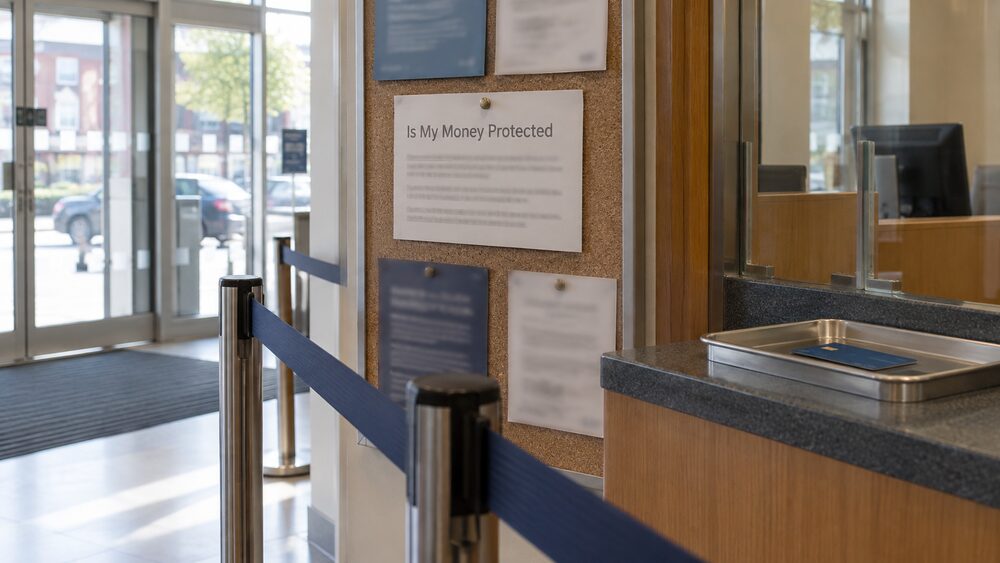
If your bank, building society or credit union fails, the Financial Services Compensation Scheme (FSCS) protects your money up to £120,000 per person, per authorised firm, for all banks, building societies and credit unions authorised by the Prudential Regulation Authority and FCA1. If a bank or building society fails, the FSCS will automatically pay back customers' money within seven working days in most cases2. But not every account that looks and works like a bank account is a bank account: the FSCS cannot protect e-money or payment services firms3, and money held with those firms follows a different set of rules called safeguarding.
The distinction matters more than it used to. App-based accounts, prepaid cards and payment wallets are common ways to hold and spend money, and some of them are banks with full FSCS protection while others are e-money firms whose customers must claim from an administrator if the firm fails. The limit has also changed recently: the FSCS now protects eligible deposits from the first pound up to £120,000 per person, per authorised firm, an increase from the previous £85,0004. This page explains what is protected, what is not, and how to check the firm you use.
FSCS protection: up to £120,000 per person, per firm
The headline rule is simple: the FSCS protects up to £120,000 per person or company, per authorised firm7. That means the limit applies to the total of your eligible deposits with one firm, not to each account separately. If you have a current account, a savings account and a fixed-term deposit with the same bank, the £120,000 covers all of them together.
The limit rose from £85,000 to £120,000, and independent guidance notes that before 1 December 2025 it was £85,000 per individual, per financial institution8. The FSCS announced the new level in March 2026, stating that it now protects eligible deposits from the first pound up to £120,000 per person, per authorised firm4. The government acted to support depositors during the change to the new coverage level9.
Two details catch people out. The first is shared banking licences. If you have money in multiple accounts with multiple banks that are part of the same banking group and share a banking licence, they are treated as one bank, with the £120,000 limit applying across all the accounts10. So two brands that look like separate banks may in fact share one limit. The FSCS gives a worked example: if a current account and a savings account share one firm reference number or authorisation number, they are classed as a single firm and the £120,000 limit is shared across both11.
The second detail is joint accounts. Joint accounts are eligible for FSCS protection up to the same limit of £120,000 per eligible person5, so a couple with a joint account each has their own £120,000 allowance for that money. But if you have an individual account and a joint account within the same banking group, the £120,000 compensation limit applies across all these accounts, not to each separate account12.
Business customers are covered too. If your business is a separate legal entity, such as a limited company or LLP, you could claim up to £120,000 for each account, meaning the business's claim is separate from your personal one with the same bank10. Credit unions work the same way as banks: the FSCS protects up to £120,000 in total across all accounts you hold with the credit union13.
What counts as a protected deposit
FSCS deposit protection covers money in current, saving and fixed-term deposit accounts14. The FSCS describes 'deposits' as including things like current and cash savings accounts15, and its coverage includes deposits, current accounts and savings accounts3. In practice, if you can pay money in, withdraw it, and the firm holds it as a bank holds a customer's money, it is likely a deposit.
The FSCS covers a range of financial products if a UK-authorised financial firm fails, including deposits, insurance, investments, pensions and mortgage advice16. Deposit protection is the part that applies to current accounts, and it is the strongest form of protection: it pays out automatically, quickly and up to a fixed limit.
What a deposit is not is equally important. Money you pay to a firm that is not a bank, building society or credit union, such as an e-money firm or a payment services firm, is not a deposit, and the FSCS cannot protect you if such a firm fails17. The next sections explain what happens to that money instead.
Deposits held with a firm that has withdrawn from the market but not failed remain protected. When Masthaven Bank announced it would withdraw from the savings and mortgage market, its customers were told their savings were safe and still covered by the FSCS18. A bank closing to new business is not the same as a bank failing.
E-money accounts are safeguarded, not FSCS protected
Many accounts that look like bank accounts are not bank accounts. MoneyHelper explains the distinction: if an account is not a bank account, it is likely to be a virtual current account covered by e-money rules, which means your money is kept safe at a different bank, but you would need to make a claim to the administrator if your provider failed19. The FSCS is blunt about its own limits: it cannot protect e-money or payment services firms3.
This is not a fringe issue. When the FCA announced that Premier Payment Solutions Ltd had entered liquidation, it confirmed that the FSCS only applies to certain types of activity and does not cover payment services20. Customers of e-money firms are told their money is safeguarded, but firms must make clear that FSCS protection does not apply21. The FSCS itself notes that e-money may not be protected by it, because e-money firms are not actual banks15.
Some well-known names sit on the e-money side of the line. Guidance on opening a bank account online notes that with Monese, you do not have access to the FSCS if the firm goes bust22. Others have moved over time from e-money licences to full banking licences, which is why the question "is my app account protected?" cannot be answered by looking at the app alone: it depends on the firm's current authorisation.
The practical difference is this. With a bank account, a failure triggers automatic FSCS compensation up to £120,000. With an e-money account, a failure triggers an insolvency process in which you claim your safeguarded money back from an administrator. Both systems are designed so customers do not lose their money, but the speed, the certainty and the ceiling are different, as the next section explains.
How safeguarding works if an e-money firm fails
Safeguarding means your money is held separately from the e-money firm's own money, typically at a different bank19. The firm cannot use your money as its own working capital. If the firm fails, an insolvency practitioner is appointed, the safeguarded money is identified, and customers make claims to the administrator to get their money back19.
Two features of this process matter to a customer. First, you have to make a claim, unlike a bank failure where the FSCS pays automatically. Second, the process runs through insolvency, so it can take longer than an FSCS payout, and the costs of the insolvency practitioner may be deducted before money is returned19. Safeguarding is a genuine protection, but it is not the same as the FSCS's guaranteed, automatic, capped compensation.
When FSCS can cover safeguarded money
There is one route by which safeguarded money can still end up protected by the FSCS. The FSCS states that it may protect safeguarded funds held by e-money providers if the bank holding the safeguarded funds were to fail15. In other words, if the e-money firm is solvent but the bank where it keeps customers' money collapses, the FSCS's deposit protection may apply to those funds.
A similar principle applies to savings platforms and aggregators. The FSCS says that if an aggregator deposited your money with a regulated bank that then fails, it is likely that the FSCS will protect it3. So with a savings marketplace or cash platform, the protection often depends on which regulated bank ends up holding your deposit, not on the platform itself.
For savings apps, the position depends on the app's arrangements. Independent reporting on where savings are really held found that a provider's partner banks should be covered by FSCS protection, but the compensation scheme noted that protection depends on the app's contractual arrangements24. The practical step is to ask the app which bank holds your money, and then check that bank's protection directly.
Prepaid cards, PayPal and virtual accounts
Prepaid cards are not covered by the FSCS should the provider go bust25. This includes pocket-money cards for children, where the money added to accounts such as a Starling Kite or Monzo under-16s account counts towards the parent's own FSCS protection limit, which was £85,000 when reported in April 2025 before the limit rose to £120,00025. Prepaid foreign currency cards are in the same position: funds are not protected by the FSCS if the card provider goes out of business26. A Klarna debit card launch was reported in October 2025 with the note that FSCS protection covers up to £85,000 if the provider fails, which was the limit at that date27.
PayPal balances are not FSCS protected, because PayPal is not a bank and its balances are not deposits28. What PayPal does offer is Buyer Protection: eligible purchases made online using the PayPal debit card or credit card, a bank account or the PayPal balance are protected, though in-store purchases are not29. That is purchase protection, a different thing from deposit protection, and it does not cover the balance itself if the firm fails.
If you have paid for something with a credit card, you might have more protection for that purchase, independently of anything happening to your account provider30. That protection sits with the payment method, not with where your money is held.
| Account or card type | FSCS protected? | What protects your money |
|---|---|---|
| Bank or building society current account | Yes, up to £120,000 per person, per firm1 | Automatic FSCS compensation |
| Credit union account | Yes, up to £120,000 across all accounts13 | Automatic FSCS compensation |
| E-money or virtual current account | No3 | Safeguarding; claim to an administrator if the firm fails19 |
| Prepaid card | No25 | Safeguarding; claim to an administrator if the firm fails |
| PayPal balance | No28 | Safeguarding; Buyer Protection covers eligible online purchases only29 |
| NS&I account | No, but 100% protected by Treasury backing6 | Government guarantee |
NS&I and credit unions: how their protection differs
National Savings and Investments (NS&I) is the odd one out. It is backed by HM Treasury, the government's economic and finance ministry31, and is therefore not covered by the FSCS6. Instead, money in NS&I accounts is 100% protected, regardless of FSCS limits, up to the maximum you can save in the accounts32. NS&I's own guidance puts it plainly: if your bank goes bust then you will automatically get your money back, and NS&I's protection comes from that Treasury backing rather than from the compensation scheme23.
For a saver, the NS&I position is in one sense stronger than FSCS protection, because there is no £120,000 ceiling, only the product's own maximum. In another sense it is a different kind of promise: it rests on the government's backing rather than on a statutory compensation scheme with fixed payout timescales.
Credit unions are on the FSCS side of the line. Loans and savings with credit unions are protected by the Financial Services Compensation Scheme33, and the FSCS protects up to £120,000 in total across all accounts you hold with the credit union13. Credit unions are authorised deposit takers in the same way banks are, so a current-style account or savings account with a credit union carries the same protection as one with a bank.
Getting money back when a bank fails
The FSCS process for a failed bank, building society or credit union is designed to be automatic. You do not need to make a claim: the FSCS will return your money automatically, up to its compensation limit27. You will get your money within seven working days of a bank, building society or credit union failing12, and the FSCS aims to pay compensation within seven days in most cases33. Independent guidance notes that deposit failures are most commonly paid in two or three days8.
More complex cases, including temporary high balance claims, take longer10. A temporary high balance arises when a deposit is briefly above the limit, for example after a house sale, and the rules for those claims are more involved than for a standard balance. The FSCS also covers customers of firms that failed after particular dates for particular activities, for example debt management companies that failed after 1 April 201811, but deposit failures are the straightforward case: automatic, capped at £120,000, and usually paid within days.
Where to check a firm and get help
The FSCS has a protection checker on its website that lets you check whether your money is protected3. FSCS protection applies at firm level and may be shared across brands under the same authorisation3, so the checker is the reliable way to find out whether two brands you use share one licence and one £120,000 limit. If you cannot find your firm, the FSCS has a dedicated page for firms that are not listed17.
You can also search the Financial Conduct Authority (FCA) register using the provider's firm reference number (FRN); if the status shows 'authorised', the FSCS may compensate if the firm fails1. The register distinguishes between firms with full authorisation and those with narrower permissions, which is the underlying difference between a bank deposit and an e-money balance.
Free, impartial help is available. MoneyHelper, the government-backed money guidance service, explains how to choose the right bank account, including the difference between bank accounts and virtual current accounts19, and covers how to open, switch or close a bank account31. National Debtline describes the FSCS as set up to protect you if your bank, building society or credit union runs into financial difficulty32. If a firm has failed and you need to claim, the FSCS's making a claim pages set out the process27.
For the wider picture of how current accounts work and how to switch, see the guides to how a current account works, opening a bank account and the Current Account Switch Service, and for deposit accounts more broadly, savings accounts.
Sources33 cited
- FSCS: can't find your firm FSCS, 2026
- Deposit protection for banks FSCS, 2026
- Check your money is protected FSCS, 2026
- FSCS protected leaflet FSCS, 2025
- Millions receiving large sums now have greater protection FSCS, 2026
- What to do if your bank goes out of business Which?, 2025
- Deposit protection for credit unions FSCS, 2026
- Government acts to support depositors during change to a new coverage level GOV.UK, 2015
- What we cover FSCS, 2026
- What if my bank just exists online? FSCS, 2020
- How to choose the right bank account MoneyHelper, 2026
- Is your money safe with Revolut? Which?, 2024
- Premier Payment Solutions Ltd enters liquidation FCA, 2026
- How to open a bank account online Which?, 2026
- Do you know where your savings are really held? Which?, 2025
- Children's bank accounts: what options are there in 2025 Which?, 2025
- I can't get my money out of my prepaid foreign currency card Which?, 2021
- FCA Consumer Panel report on payments and banking FCA Consumer Panel, 2024
- PayPal launches debit and credit card with cashback Which?, 2025
- What to do if you've been a victim of a scam Independent Age, 2026
- Klarna launches debit card Which?, 2025
- NS&I Guaranteed Growth Bonds key features NS&I, 2025
- UK personal terms and conditions Monese, 12 February 2026
- NS&I: protect your money NS&I, 2025
- Are the proceeds of my house sale safe in a bank account? Which?, 2026
- Save with a bank or borrow from a credit union Welsh Government, 2026
- Making a claim FSCS, 2026
- FSCS protected badge leaflet FSCS, 2025
- Masthaven Bank to withdraw from the savings and mortgage market Which?, 2022
- FSCS flood insurance cover FSCS, 2026
- How to open, switch or close your bank account MoneyHelper, 2026
- Saving money National Debtline, 2026
- Banks, building societies and credit unions Financial Services Compensation Scheme





 MoneyHelperFree, impartial money and pensions guidance, set up by government
 FSCSProtects your money if a bank, insurer or investment firm fails
 Financial Ombudsman ServiceFree, independent help when a complaint about a firm is not put right
 Citizens AdviceFree advice on money, consumer and legal problems in England and Wales