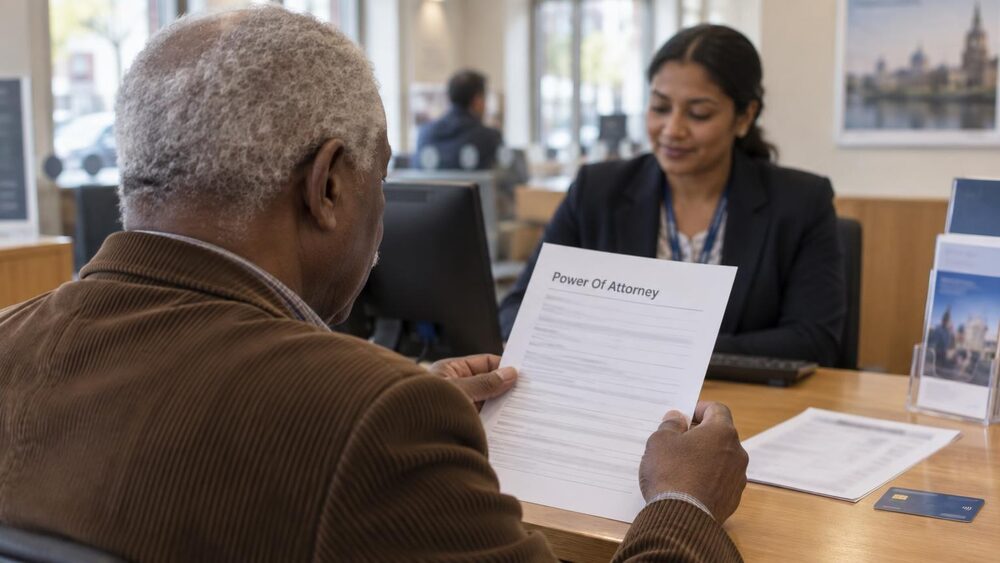
A power of attorney is a legal document that gives a third party the authority to make financial decisions for someone else1. There are several ways to let another person deal with your bank account, and they work quite differently: a third party mandate or an ordinary power of attorney covers day-to-day help while you still have capacity, while a lasting power of attorney keeps working if you later lose the ability to manage your own money2. You can only set up a power of attorney while you have what is known as mental capacity5.
The right choice depends on what the help is for. Someone who needs a hand with shopping and withdrawals while they are in hospital needs something much simpler than a family arranging care for a relative with dementia. This page explains each option, what it costs, how to register it with a bank, and what happens if capacity has already been lost and nothing was arranged.
Ways to let someone else manage your bank account
Broadly, there are four routes, and they suit different situations. A third party mandate is the simplest: it gives someone else access to your bank account, and you can specify how much access to give3. Most banks, building societies and other account providers allow it, for example with a second card4. An ordinary power of attorney goes further, letting a chosen person handle financial tasks such as selling a property, looking after a bank account, or withdrawing and managing a pension12. Both of these depend on you keeping mental capacity.
A lasting power of attorney (LPA) is the document most people need when planning ahead for illness or old age, because it keeps working after capacity is lost. And where nothing was arranged in time, the Court of Protection can appoint a deputy to manage someone's finances for them. You can also give someone else the right to access the money in your bank or building society account by asking for a third party mandate13.
Which route fits depends on the reason for the help. Someone going into hospital for a few weeks may just need a mandate or an ordinary power of attorney13. Someone with a progressive condition needs a lasting power of attorney, or its equivalents in Scotland and Northern Ireland, put in place while they can still understand and sign it5. And a family facing an emergency where nothing was arranged will be dealing with the Court of Protection. The sections below take each in turn.
Third party mandates: help with day-to-day banking while you still have capacity
A third party mandate is an instruction you give your bank naming another person who may use your account. You can specify how much access to give, so it can be limited to particular tasks rather than the whole account3. All banks should offer this10. It is often used when someone is in hospital, housebound, or finds getting to a branch difficult, and it can be quicker and cheaper than a power of attorney because there is no registration process or fee.
There are two important limits. First, a third party mandate does not give the other person the legal right to make decisions about your finances more widely: it is access to that account, nothing more10. Second, you need permission from the account holder to set one up, so it cannot be arranged for someone who has already lost capacity10. It also cannot be moved: you cannot transfer a third party mandate to another account or bank, so a fresh mandate is needed if the account moves10.
The account stays legally yours throughout. That means you are responsible for what the third party does: as Zempler Bank's guidance puts it, "your third party will have access to your bank account, so you'll be responsible for any withdrawals they make"14. Choose someone you trust, and remember the mandate can be cancelled.
Despite how useful they are, mandates are little used. The FCA's Financial Lives survey found that just 1% of adults with a day-to-day account had used a branch to add a third party or a power of attorney to an account in the previous 12 months, as at 202415.
Lasting power of attorney: property and financial affairs or health and welfare
In England and Wales there are two types of lasting power of attorney: one covering property and financial affairs, and one covering health and welfare9. A property and financial affairs LPA gives the attorney power over money and property: managing bank or building society accounts, paying bills, collecting a pension or benefits, and if necessary selling your home17. A health and welfare LPA covers decisions about care and medical treatment, and it is only this type that has nothing to do with the bank account.
For banking purposes, it is the property and financial affairs LPA that matters. Metro Bank, for example, states that for it to accept an authority, the power of attorney must be one that covers property and financial affairs18. Virgin Money likewise confirms its registration covers both health and welfare, and property and financial affairs19.
An LPA is the most common form of power of attorney in England and Wales17, and it can be made at any age: it is not only for older people. A diagnosis of dementia does not rule one out either. The Alzheimer's Society, as reported by Which?, explains that you can still set one up provided you have the mental capacity to understand the document, your choice of attorneys and the consequences of the decision9. You can appoint as many attorneys as you like, and replacement attorneys to step in if the first choices cannot act16.
There are some restrictions on who can be an attorney. You may not act or be appointed as an attorney for someone's property and affairs if you are an undischarged bankrupt16. A power of attorney for property and financial affairs is used to help someone deal with debts, mortgaged property and investments20, so the role carries real responsibility.
Enduring power of attorney: older documents that may still be valid
Before lasting powers of attorney existed, the equivalent document in England and Wales was the enduring power of attorney, or EPA. LPAs have now replaced EPAs, so you cannot make a new EPA16. But an EPA made before October 2007 remains valid21: specifically, one that was signed, dated and witnessed by all parties on or before 30 September 2007 can still be used, whether or not it has been registered22.
If you hold an old EPA, you can either continue to use it, or cancel it and set up a property and financial affairs LPA instead8. While the donor still has mental capacity, the attorney can use the EPA even if it is not registered23. The crucial difference from an ordinary power of attorney is what happens on loss of capacity: the attorney must then register the EPA with the Office of the Public Guardian before they can make any decisions on the donor's behalf16. Registration at that point costs £9223.
To use an EPA with a bank, you or your attorney will need to show signed copies of the document to banks and financial providers so the attorney can manage the accounts8. If you are thinking of cancelling an unregistered EPA, you may need to provide evidence that you still have mental capacity8.
Scotland and Northern Ireland: different rules and documents
England and Wales, Scotland and Northern Ireland all have different legal systems for power of attorney9, so the document you need depends on where the person making it lives.
In Scotland, a power of attorney can include continuing powers covering financial matters, welfare powers covering personal and healthcare matters, or both in a single document9. The financial type is known as a continuing power of attorney. One quirk of history: powers of attorney executed in Scotland before 2 April 2001 do not need to be registered with the Office of the Public Guardian Scotland, and continue even if capacity is lost, unless the document states it will lapse22.
In Northern Ireland, the equivalent document is an enduring power of attorney, which covers financial matters only, not health and welfare9. It must be set up while the donor has capacity, and registered with the Office of Care and Protection if the donor becomes incapable3. Once the donor lacks capacity, the attorney assumes full authority and must register the EPA with the Office of Care and Protection22.
Registration fees differ too: £92 per LPA in England and Wales, £99 in Scotland and £189 in Northern Ireland17. Terminology also varies for court appointments: the Court of Protection appoints a deputy, previously known as a receiver; in Northern Ireland the role is called a controller, and in Scotland a guardian is granted a guardianship order22.
Registering a lasting power of attorney: £92 fee, with reductions and exemptions
Before a lasting power of attorney can be used, it must be registered with the Office of the Public Guardian. The fee is £92 per LPA in England and Wales from 17 November 20256. Some guidance still quotes the previous fee of £827, so if you are applying, check the current figure on GOV.UK. Because most people register two LPAs, one financial and one covering health and care, the cost is £92 for each, so £184 in total16.
Reductions and exemptions can cut the cost substantially. If you receive certain benefits, you are eligible for a fee exemption and will not have to pay anything to register an LPA in England and Wales6. If you are on a low annual income, under £12,000, you might be eligible for a 50% discount16. The reduced fee is £46, having risen from £41 on 17 November 20256. If an application is rejected, you have three months to apply again and pay a repeat application fee of £466.
Forms and an information pack are available from the Office of the Public Guardian: you can download them, order them by calling 0300 456 0300, or use the online service on GOV.UK16.
In England and Wales it currently takes 8 to 10 weeks to process and register LPA applications, including a statutory 4-week waiting period5. Registering with a particular provider can take longer still: NS&I says a lasting power of attorney must be registered with the Office of the Public Guardian before it can be used with it, and that setting it up with NS&I can take up to 20 weeks22. Planning ahead matters, because an LPA cannot be made once capacity is gone.
Single, joint or jointly and severally: how multiple attorneys act
You can appoint as many attorneys as you like16, and the power of attorney document itself states whether the attorneys must make decisions together, known as acting jointly, or whether each can act independently, known as jointly and severally26. This choice has practical consequences at the bank.
Where attorneys must act jointly, everything has to be done together. Nationwide, for example, states that attorneys acting jointly must all be present together in branch to give instructions or carry out transactions, and that they cannot use its internet bank or have a debit card27. Attorneys acting jointly and severally have more flexibility: at Nationwide they can visit a branch, have a debit card and, if eligible, access the donor's accounts through Internet Bank27.
Jointly and severally is usually the more workable arrangement for day-to-day banking, since one attorney can act if another is ill or away. But it also means any single attorney can act alone, so the choice of people matters more, not less. A related question is whether an attorney should instead simply open a joint account with the donor. Which? does not recommend opening a joint bank account with someone for whom you also hold a lasting power of attorney or its equivalents in Scotland and Northern Ireland28. A joint account makes the attorney a co-owner of the money, and LPA powers end when the donor dies, with the personal representative or executor taking control, so a joint account can complicate the estate28. A basic bank account can be opened with someone you trust if you both qualify29, and joint accounts normally allow two or more people to receive payments, pay by debit card, transfer money and manage the account30. The dedicated page on joint bank accounts explains how ownership works.
Using a power of attorney with a bank: documents and checks
Once registered, the attorney takes the document to each bank or provider. What the bank needs is broadly the same everywhere: the original document, a certified copy, or digital access via a code or certificate, plus proof of each attorney's identity, such as a passport or driving licence, and proof of address such as a recent utility bill26. Some providers now issue a secure access code instead of holding paper copies: NS&I's unique code lasts for 30 days22.
What the attorney can then do depends on the terms of the document. Nationwide, for example, lists what an attorney may do if eligible and the power of attorney allows it: manage money and accounts, speak to the bank directly about the accounts, choose how to access them, choose where letters and statements are sent, make cash withdrawals in branch, and pay off existing debts and mortgage payments27.
Banks also react when capacity is lost. Depending on the terms of the power of attorney document, Nationwide says it may be able to cancel the donor's debit cards, chequebooks and online banking access, and can arrange for statements to be sent to the attorney instead of the donor27. That protects the donor from spending they may not understand, and keeps the attorney informed.
Access is not always what an attorney expects. In one Financial Ombudsman Service case study, a bank told a daughter she could access her mother's accounts online in her own right, but only through the desktop banking platform, not the mobile app31. The lesson is to ask the provider exactly what access the document gives before relying on it. If a bank refuses to accept a valid power of attorney or handles it badly, the attorney can complain to the Financial Ombudsman Service1.
When someone has lost capacity without a power of attorney
If someone has already lost the ability to manage their money and no power of attorney exists, there is no simple family workaround. A third party mandate cannot be set up without the account holder's permission10, and an ordinary power of attorney automatically becomes invalid once the donor has lost capacity12. Being a next of kin gives no right to operate the account.
The route then is the Court of Protection, which appoints an individual, individuals or a corporate body, known as a deputy, previously called a receiver, to manage the person's finances22. In Northern Ireland the equivalent role is called a controller, and in Scotland a guardian is granted a guardianship order22. The court order should be sealed or bear the blue office copy stamp when it is presented to a bank22. This process takes longer and costs more than registering an LPA, which is the main argument for making a power of attorney in advance.
There are some narrower options for particular situations. For collecting benefits or a pension, a person can nominate someone to collect these for them32. And where the problem is debt rather than capacity, a power of attorney for property and financial affairs is used to help someone deal with debts, mortgaged property and investments20. Free, impartial help is available: MoneyHelper can explain the options, and a debt advice charity such as StepChange can help an attorney or carer work out what to do about a borrower's debts2.
Cancelling a power of attorney, and when it ends
While the donor has mental capacity, most arrangements can be undone. The account owner can cancel a power of attorney at any time18, and a general power of attorney can be removed from the account at any time by letting the bank know in writing19. A lasting power of attorney can be cancelled at any time while the donor has capacity, by sending the original LPA document and a deed of revocation to the Office of the Public Guardian16.
The process for an enduring power of attorney depends on whether it is registered. To cancel an unregistered EPA before losing mental capacity, make a deed of revocation stating that you are cancelling it, keep it with the EPA form, and have both yourself and a witness sign the deed. You must let your attorneys and any relevant banks and financial providers know you are cancelling it8. To cancel a registered EPA, you must apply to the Court of Protection8.
Powers of attorney also end automatically in some situations. A lasting or enduring power of attorney automatically ends when the donor dies11, and the Financial Ombudsman Service confirms a power of attorney is no longer valid after the donor has passed away1. At that point the personal representative or executor takes control28, and the bank may temporarily stop access to the account, though it might still release money for funeral costs11. The page on bank accounts when someone dies covers what happens next.
Bankruptcy also ends the role: any power of attorney you have for another person is cancelled if you are made bankrupt33. And an attorney who becomes bankrupt may not continue to act for a donor's property and affairs16.
Sources33 cited
- Power of attorney complaints Financial Ombudsman Service, 2026-09-26
- Debt and long-term sickness StepChange Debt Charity, 2026-09-25
- Dementia and managing money nidirect, 2026-09-03
- Nominate someone to collect your State Pension GOV.UK, 2026-09-26
- Helping a relative with their bank account Which?, 2026-04-11
- Power of attorney fees rise this month Which?, 2025-11-05
- Power of attorney service Which? Wills, 2026
- Use or cancel an enduring power of attorney GOV.UK, 2026-09-26
- Managing money after a dementia diagnosis Which?, 2026-09-20
- Managing money for someone else Scope, 2025-11-27
- What to do when someone dies Age UK, 2026-02-16
- Ordinary power of attorney Age UK, 2026-03-23
- Managing money during a hospital stay Mental Health and Money Advice, 2026-09-26
- Third party authority Zempler Bank, 2026-09-26
- Financial Lives Survey 2024: retail banking Financial Conduct Authority, 2024
- Power of attorney Age UK, 2026-01-09
- What is power of attorney Which?, 2026-02-26
- Third party access Metro Bank, 2026-09-25
- Power of attorney service Virgin Money, 2026
- Power of attorney and debt StepChange Debt Charity, 2026-09-25
- Legal and regulatory matters: equity release FAQs Equity Release Council, 2026-09-26
- Managing savings for an adult NS&I, 2026-04-02
- Enduring power of attorney Age UK, 2026-01-09
- What is lasting power of attorney Mental Health and Money Advice, 2025-03-10
- 7 things you need to know about power of attorney Which?, 2023-03-21
- Setting up power of attorney Which?, 2026-02-26
- Using a power of attorney Nationwide, 2026
- Can a joint bank account help me manage a loved one's finances Which?, 2026-01-19
- Basic bank accounts MoneyHelper, 2026-09-25
- Joint accounts MoneyHelper, 2026-09-25
- Case study: power of attorney didn't entitle Joanne to use mum's login Financial Ombudsman Service, 2026-09-26
- Help to collect your benefits or pension nidirect, 2026-06-26
- Restrictions during bankruptcy StepChange Debt Charity, 2026-09-25






 MoneyHelperFree, impartial money and pensions guidance, set up by government
 FSCSProtects your money if a bank, insurer or investment firm fails
 Financial Ombudsman ServiceFree, independent help when a complaint about a firm is not put right
 Citizens AdviceFree advice on money, consumer and legal problems in England and Wales