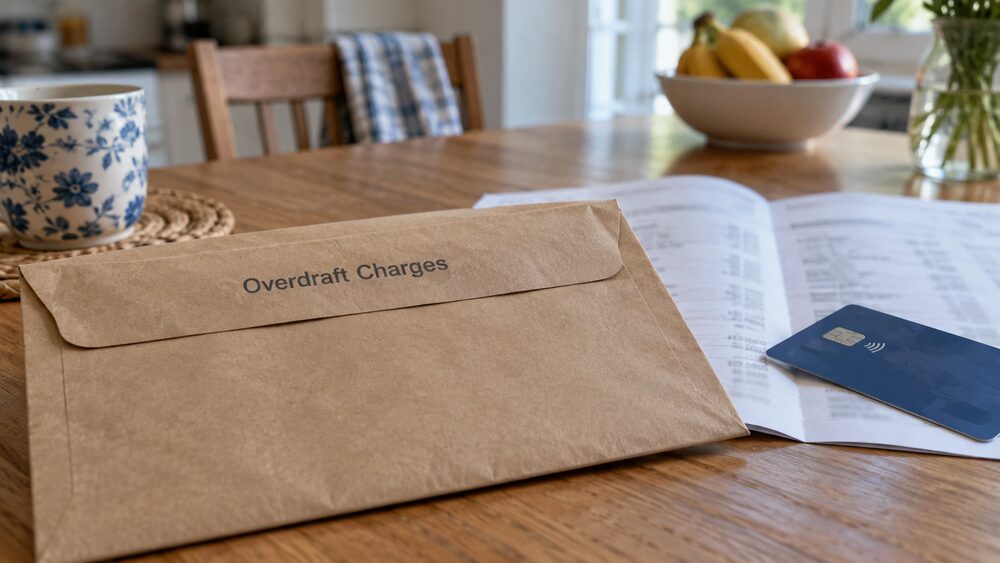
In April 2020 the rules on overdrafts changed. Banks and building societies had to stop charging fixed daily and monthly fees for going overdrawn and price every overdraft as a single annual interest rate instead. Rates must now be calculated as a percentage of the amount borrowed, and fixed fees and charges were banned1.
In April 2020 the rules on overdrafts changed. Banks and building societies had to stop charging fixed daily and monthly fees for going overdrawn and price every overdraft as a single annual interest rate instead. Rates must now be calculated as a percentage of the amount borrowed, and fixed fees and charges were banned1.
The effect was that many banks set a rate of approximately 40% on their overdrafts, replacing the old daily fees, monthly fees and set-up charges1. MoneyHelper's current guidance says you will normally pay daily interest of up to 40% on an overdraft, and that rates from banks and building societies range from 19% to 40% or more2. The Bank of England's official statistics put the effective rate on interest-charging overdrafts at 21.79% in April 2026, up 13 basis points4.
If you are still on an old-style deal, or you were left worse off when the changes came in, the sections below set out what changed, what the old fees were, and what you can do.
What changed: one interest rate, no fixed overdraft fees
Before April 2020, overdrafts were priced in a mix of ways. Banks charged a monthly fee, a setting-up fee, and separate daily or monthly charges for going over an arranged limit. The Competition and Markets Authority review that led to the changes set out the aim plainly: "Ensuring the price for each overdraft will be a simple, single interest rate – no fixed daily or monthly charges"6.
The rules that took effect on 6 April 2020 changed that structure. Rates must now be calculated as a percentage of the amount borrowed, and fixed fees and charges were banned1. The FCA's own handbook rules on overdraft pricing, CONC 5C.2, came into force on 06/04/20207.
The practical effect is that an overdraft is now a straightforward interest-bearing debt. You only pay interest on the overdraft money you use, not on your whole limit5. Interest is charged at a single annual rate, which makes it easier to compare charges between accounts3.
Some accounts still sit outside the standard model. Halifax's Ultimate Reward account, for example, states it has no unarranged overdraft interest, fees or charges8. Basic bank accounts have no overdraft facility at all, so no interest is charged on the account9. Credit union current accounts offer borrowing with daily interest up to 42.6%10.
Overdraft interest now: typically around 40%
The headline figure most people remember from 2020 is the 40% rate. Nearly every mainstream bank subsequently decided to charge an interest rate of approximately 40%1. MoneyHelper's current account guidance says you will normally pay daily interest up to 40% when you borrow with an overdraft2, and its switching guidance describes overdrafts as often up to 40% APR until paid back11.
That is not the whole picture. MoneyHelper's overdraft guidance says interest rates from banks and building societies on their overdrafts range from 19% to 40% or more3. Credit union current accounts normally carry daily interest up to 42.6%10.
The official average is lower than the headline rate, because it covers all interest-charging overdrafts including those priced below 40%. The Bank of England reported that the effective interest rate on interest-charging overdrafts increased by 13 basis points, to 21.79% in April 20264. That is the figure to use if you want to know what borrowers actually pay on average, rather than the rate advertised on a particular account.
The FCA took an interest in how the 40% figure was reached. It wrote to the banks to seek clarification about how they determined the new interest rate1.
| Measure | Figure | Date |
|---|---|---|
| Typical advertised rate | up to 40% daily interest2 | 2026 |
| Range across banks and building societies | 19% to 40% or more3 | 2026 |
| Credit union current accounts | up to 42.6% daily interest10 | 2026 |
| Effective rate on interest-charging overdrafts | 21.79%4 | April 2026 |
The old fees: monthly, set-up and unarranged overdraft charges
The fees that disappeared in 2020 were the reason the rules changed. Banks used to charge a monthly fee and a setting-up fee for an overdraft, which made it an expensive way to borrow5. On top of that sat the unarranged overdraft regime: if you spent more than you had without agreeing it in advance, including going over the limit of an arranged overdraft, you could face a penalty charge and a high rate of interest, charges for reminder letters, and charges for direct debits or cheques put through the account5.
The old pricing was also hard to compare. The FCA's BCOBS 7 rules required firms to publish annual interest rates for arranged and unarranged overdrafts and refused payment fees as at a stated date, and to show advertised APRs during the quarter for a three-month period12. That structure existed because there was no single rate to quote.
The regulator's own research had already flagged the problem. A 2014 FCA study found that overdraft limits were quickly raised by banks, so that a £200 overdraft facility could quickly become a £1,000 overdraft facility13. StepChange describes the old regime bluntly: your overdraft has high interest and charges14, and using an unauthorised overdraft meant paying very high charges as a result15.
If you were worse off after the changes
The 2020 changes helped many people, because unarranged overdraft charges were capped and fixed fees disappeared. For personal current accounts, banks and building societies can no longer charge more for an unauthorised overdraft than for an authorised one15. But some customers ended up paying more, particularly those who used a small overdraft for a long time and previously paid a modest monthly fee.
If you are in that position, the first step is to contact your bank. Banks might reduce or waive interest, offer a continuation of overdraft borrowing at the current rate of interest, or agree on a repayment programme possibly including a personal loan3. Lenders could agree to reduce the overdraft limit over time or stop interest and charges for a while14.
There is also a wider picture to weigh. The Resolution Foundation found that the combined car loans, personal loans and overdrafts of the poorest third of families sank by over 20 per cent17. If your circumstances have changed, other things can shift too: a mortgage porting application may fail because "if your circumstances have changed, you might not qualify"18, and a change in circumstances when claiming benefits can mean you are entitled to more benefit, less benefit, or no longer entitled at all19.
If you cannot afford a deduction from your wages, you can apply to get the amount changed20. If you have an informal arrangement with creditors and your situation worsens, for example if you lose your job, you can try to negotiate another arrangement; if your circumstances improve, your creditors may expect you to increase your repayments21.
When a bank can reduce or remove your overdraft
A bank can decide to cancel or lower your overdraft limit at any time, but it must warn you22. This may be more likely if you keep going over your limit. Halifax's own guidance puts it the same way: your bank or building society could change or cancel your overdraft at any time and it may be repayable on demand23.
Some overdrafts are designed to shrink from the start. On a graduate account, the overdraft limit goes down every 12 months24. That is a scheduled reduction rather than a withdrawal, but the effect on your monthly budget is similar.
If your overdraft is reduced or removed and you cannot repay it in one go, the options are to ask the bank to reduce or remove the overdraft on your terms, or to switch to a basic bank account with no overdraft14. A basic bank account has no overdraft facility, so you will not be charged interest on the account9. You can read more about how these work in our guide to basic bank accounts, and about the rules banks follow in Can my bank reduce or remove my overdraft?.
Complaints and the Financial Ombudsman
If you think your bank treated you unfairly over an overdraft, complain to the bank first. If you are not satisfied with its response, you can take the complaint to the Financial Ombudsman Service, which is free to consumers.
The ombudsman can award compensation, and the limits depend on when the complaint was referred and when the act complained about happened. For complaints referred on or after 1 April 2024 about acts or omissions by firms on or after 1 April 2019, the limit is £430,00025. For complaints referred between 1 April 2020 and 31 March 2022 about acts or omissions by firms on or after 1 April 2019, it is £355,00025. For complaints referred between 1 April 2019 and 31 March 2020 about acts or omissions by firms on or after 1 April 2019, it is £350,00025. For complaints referred on or after 1 April 2026 about acts or omissions that occurred before 1 April 2019, it is £205,00025.
For an overdraft complaint, the ombudsman will typically want to see current account statements for all accounts before the application to present, and the dates any reviews were, or at least should have been, carried out26. Overdraft complaints do reach the ombudsman: in the first quarter of 2026/27 it opened 55 complaints about business overdrafts27.
If you are struggling with an overdraft and want free, impartial help, StepChange and MoneyHelper both offer guidance, and you can read our guide to struggling to repay an overdraft.
Sources27 cited
- Overdraft rules and the 2020 changes House of Commons Library, 2026
- Current account MoneyHelper, 2026
- Overdrafts explained MoneyHelper, 2026
- Money and credit, April 2026 Bank of England, April 2026
- Overdrafts and other bank debts nidirect, 2025
- High-cost credit review final rules and buy now pay later Finance & Leasing Association, 2018
- CONC 5C.2 Financial Conduct Authority Handbook, 2020
- Ultimate Reward Current Account Halifax, 2026
- Basic bank accounts Advice NI, 2026
- Credit union current accounts MoneyHelper, 2026
- How to open, switch or close your bank account MoneyHelper, 2026
- BCOBS 7.8 Financial Conduct Authority Handbook, 2026
- Jigsaw research: consumer credit, overdrafts and credit cards Financial Conduct Authority, 2014
- How can I stop living in my overdraft? StepChange, 2026
- Overdraft debt StepChange, 2026
- Coronavirus: what it means for mortgages, savings, borrowing and benefits Which?, 2020
- Money on my mind Resolution Foundation, 2025
- Porting a mortgage Which?, 2026
- Change in circumstances Turn2us, 2026
- Debt payments from your wages GOV.UK, 2026
- Informal arrangements nidirect, 2025
- What is an overdraft? Experian, 2026
- Loan or credit card or overdraft Halifax, 2026
- Graduate overdrafts StepChange, 2026
- Compensation Financial Ombudsman Service, 2026
- Unaffordable lending Financial Ombudsman Service, 2026
- Quarterly complaints data Q1 2026/27 Financial Ombudsman Service, 2026






 MoneyHelperFree, impartial money and pensions guidance, set up by government
 FSCSProtects your money if a bank, insurer or investment firm fails
 Financial Ombudsman ServiceFree, independent help when a complaint about a firm is not put right
 Citizens AdviceFree advice on money, consumer and legal problems in England and Wales