
A graduate bank account is a current account aimed at people who have recently finished a university course. Its defining feature is an arranged overdraft that charges no interest for a limited period after graduation, usually alongside a monthly fee of nothing. TSB's Banking Charges Guide, for example, lists its graduate account with no fee and an interest-free overdraft of up to £2,000 for those who have successfully applied for an arranged overdraft1.
The account exists because most student accounts come with a large interest-free overdraft, and graduates would face sudden interest charges the moment their course ended. Instead, banks step the interest-free limit down over a number of years. StepChange, the debt charity, explains that student accounts often become graduate accounts automatically, and that the overdraft limit goes down every 12 months2. TSB describes its graduate account as running for up to 3 years after you have finished studying3.
What a graduate account is: no monthly fee and an interest-free overdraft
A graduate account is a current account, so it does the everyday job: paying in, Direct Debits, standing orders, a debit card and usually an app. What marks it out is the borrowing attached to it. The bank makes available an arranged overdraft, agreed in advance, and charges no interest on it during the graduate period. TSB's Banking Charges Guide lists the graduate account with no monthly fee and an interest-free overdraft of up to £2,000, available to customers who have successfully applied for an arranged overdraft1.
The interest-free overdraft is the reason most people keep the account. A standard current account overdraft charges interest, often at high rates, from the first borrowed pound. MoneyHelper, the free government-backed money service, describes an overdraft as a type of loan that often has interest6. The graduate account suspends that cost for a fixed window, which gives a new graduate time to reduce the borrowing built up as a student before charges begin.
The account is not a right. The overdraft is subject to application and approval, and the bank can set a lower limit than the advertised maximum. TSB states plainly that overdrafts are subject to application and approval and are repayable on demand3. The account itself usually carries no monthly fee, but other charges, for things like using the overdraft beyond its limit or foreign transactions, still apply under the bank's standard tariff1.
Graduate accounts sit within the wider family of current accounts, and the interest-free overdraft is a form of arranged overdraft: one the bank has agreed in advance, as distinct from an unarranged overdraft, which is what happens when you go overdrawn without an agreed facility or beyond its limit.
The interest-free overdraft: how much you can borrow
The headline amounts vary by bank, and the advertised maximum is not a promise. TSB's Banking Charges Guide lists up to £2,000 interest-free for its graduate account1. Royal Bank advertises an interest-free overdraft of up to £3,250 for the first year after graduation4. Bank of Scotland tiers its limit: up to £2,000 in the first year after graduation, £1,500 in the second year and £1,000 in the third, subject to application and approval7.
The common pattern is a step-down. StepChange explains that the overdraft limit goes down every 12 months, so the interest-free borrowing shrinks as the graduate period runs2. National Debtline makes the same point when advising students on choosing accounts: look at the amount of interest-free overdraft, the charges and interest on authorised and unauthorised overdrafts, and how long you can keep using the account after graduation8.
Two things follow from the step-down. First, the limit is a ceiling, not a target: borrowing less than the maximum costs nothing either way, and the aim for most graduates is to owe less each year so the falling limit never bites. Second, once your balance exceeds the current interest-free limit, the excess is charged at the bank's ordinary overdraft rate, which StepChange describes as a very expensive way to borrow money due to high interest rates9. The details of how overdraft interest is calculated are covered in how overdraft interest and charges work.
The maximum is also personal. "Up to £3,250" means the bank decides, based on your circumstances and credit history, how much of that to grant. If you are granted £1,000 and need more later, you can ask the bank to review the limit, but it can refuse.
Moving from a student account to a graduate account
For most people the move happens by itself. Bank of Scotland states that once you finish your course, your Student Account will automatically convert to a Graduate Account7. StepChange confirms this is the normal pattern: student accounts often become graduate accounts automatically2. You do not usually need to apply, though you may need to confirm your graduation date with the bank.
Banks give notice of the changes. Royal Bank tells student account holders that their account will automatically be changed to a graduate account, with 60 days' notice, based on the graduation date it holds, and that they will remain on the graduate account for 3 years until they are automatically moved to the bank's Select account, again with 60 days' notice10. Royal Bank adds a warning worth noting: after one year on the graduate account, you may start to pay interest on your overdraft if your graduation date changes and is not confirmed10. Keeping the bank's record of your graduation date accurate matters.
Not everyone follows the automatic route. Bank of Scotland states that if you do not meet the requirements for a Graduate Account, for example if you leave full-time study before graduating, it will convert your account to a Classic or appropriate standard account instead7. That means the interest-free overdraft ends earlier than planned, and any balance starts to attract ordinary overdraft charges. If you are in that position, the sections on managing the overdraft and on free help below are the ones to read.
Switching banks when you graduate
You do not have to stay with the bank you used as a student. StepChange states this directly: you do not need to stay with the same bank when you finish your course2. Some graduates switch because another bank offers a larger or longer interest-free overdraft, or because they want a different app, branch network or fee structure.
Switching is done through the Current Account Switch Service: you apply for an account with the new bank or building society, and it moves your balance and all your incoming and outgoing payments for you. MoneyHelper describes asking your new provider to transfer your balance and all your incoming and outgoing payments11. The Consumer Council makes the same point: it is very easy to switch accounts by applying for an account with a new bank or building society who will move your accounts and payments for you12.
The catch is the overdraft. MoneyHelper explains that if the new bank will let you move your overdraft, the funds will be sent to your old bank and you will owe the overdraft balance on the new account instead. If the new bank offers a lower amount, or will not take the overdraft at all, you will need to arrange to pay off the remainder separately before you can switch or close your old account13. This is covered in more detail in switching while overdrawn.
If money is paid into your account regularly, timing matters. Student Finance England requires 4 working days' notice to change your bank details so that a payment is made to your new bank account14. Anyone receiving benefits or other scheduled payments should tell the paying organisation before switching, so payments do not go to a closed account.
How to apply and how long it takes
If your student account converts automatically, there is nothing to apply for. If you are opening a graduate account fresh, or switching to a new bank's graduate account, the process is like opening any current account, with one extra document: proof that you graduated.
HSBC asks applicants to have graduated from university within the last 2 years, and to apply in branch, bringing proof of graduation, including the date you graduated, and a most recent bank statement15. Other banks set their own windows and channels. TSB says you can apply for a Graduate account online in as little as 10 minutes3, and Royal Bank says applying for a graduate arranged overdraft through Digital Banking takes around 5 minutes, with an instant decision if you already bank online with it4.
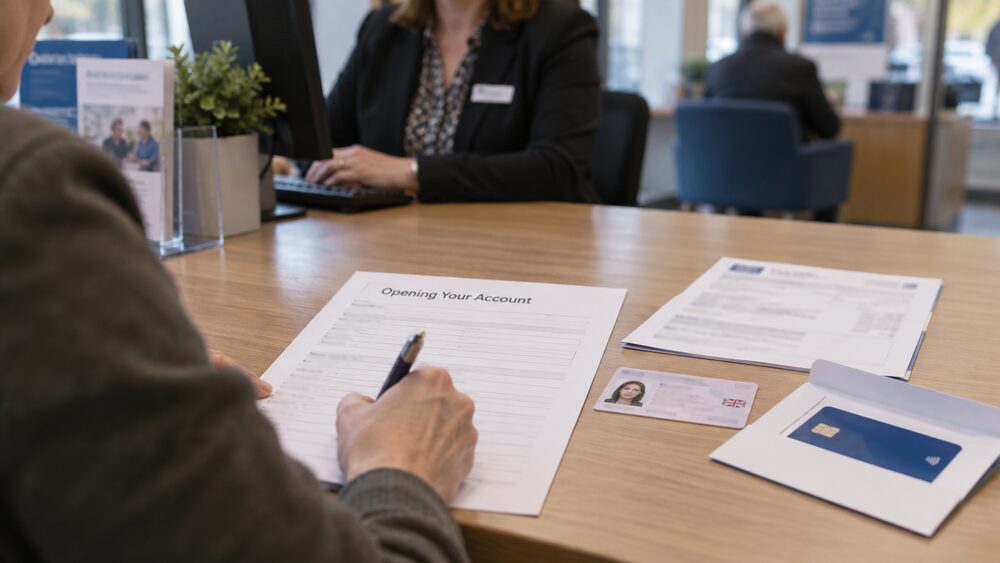
Alongside proof of graduation, you will need standard identification. Citizens Advice explains that you usually have to show the bank two separate documents that prove who you are, for example a passport, and where you live, for example a recent bill. If you do not have the right documents, the bank may accept a letter from a responsible person such as a GP, teacher, social worker or probation officer16. Citizens Advice Scotland gives the same guidance17. More detail is in what ID you need to open a bank account.
How long the whole thing takes varies. Online applications for an overdraft decision can be near-instant4, but the account itself is not always opened on the spot. Under the regulations governing payment accounts, where the account is one with basic features, the bank must open or refuse to open the account no later than 10 business days from receipt of the completed application18. For context, a student account is different again: Prospects notes that to be accepted for a student bank account, you need to have your university place confirmed19, which is why student accounts are opened before the course starts and graduate accounts after it ends.
Joint accounts and graduate overdrafts
Graduate accounts are normally sole accounts, but the question of joint borrowing matters if you are thinking of adding an overdraft to any shared account, or if a partner's overdraft affects your finances. The rule is simple and unforgiving: both of you are responsible for the whole debt.
MoneyHelper states that everyone named on a joint account is equally responsible, and that you are both responsible for any overdraft on the account20. StepChange puts the same point in practical terms: you are both responsible if the account is overdrawn, and the bank could ask you to repay overdraft borrowing made by the other person21. Macmillan, the cancer support charity, gives the same warning to people sorting out joint finances during illness: you and the other person will both be responsible for any overdraft on the account22.
Because both holders are liable for the whole amount, a bank assessing an overdraft application on a joint account will look at both people's circumstances, and one person's poor credit history can affect the outcome for both. The account can be closed at any time, but any overdraft must be repaid first, and some banks need permission from all account holders to close it20.
There are situations where joint liability outlives the relationship. If a joint account holder goes bankrupt, half of any credit balance is paid to the official receiver23. In Scotland, if joint account holders are not married or in a civil partnership and one dies, the bank will stop transactions on the joint account if the balance is overdrawn, and part of the debt becomes a claim on the estate24. The dedicated pages on joint bank accounts and how to close a joint bank account cover these rules in full.
Managing the overdraft: increasing, reducing or removing it
The interest-free limit falls on a schedule, but the actual borrowing is under your control, and there are three directions it can move.
Increasing. If your balance is at the limit and you need more, you can ask the bank for a higher arranged overdraft. The bank will reassess your circumstances and may refuse. Be aware that the bank holds the reverse power too: StepChange warns that your bank can withdraw or reduce your overdraft at any time, without notice25. The page on whether a bank can reduce or remove your overdraft covers this in detail.
Reducing. The aim for most graduates is to owe less each year, so the falling interest-free limit never catches up with the balance. StepChange suggests practical steps: reduce your overdraft, or ask your bank to help26. Because the limit goes down every 12 months2, a balance that stands still becomes steadily more expensive: the portion above the current limit is charged interest from the day the limit falls.
Removing. Some people want the temptation gone entirely. You can ask the bank to remove the overdraft facility, or switch to an account without one. StepChange notes that banks may be able to separate any overdrafts from your existing account and set up a new, clean basic bank account, helping you reduce your overdraft at a rate you can afford27. A basic bank account has no overdraft facility at all, which removes both the cost and the risk.
If you are struggling to bring the balance down, the free help listed in the final section is the place to start, and struggling to repay an overdraft sets out the options.
An overdraft is debt that is repayable on demand
The interest-free period can make an overdraft feel like an extension of your own money. Legally, it is not. StepChange defines an overdraft as a type of credit that is linked to a bank account, and states that overdrafts are payable on demand: the bank can ask for the money back in full, at any time9. National DebtLine puts it the same way: overdrafts are repayable on demand, so a bank can ask you to pay the whole amount back in one go if it chooses28. TSB's own graduate account terms repeat the phrase: overdrafts are subject to application and approval and are repayable on demand3.
The regulatory definitions sit behind this. The FCA's rulebook defines an unarranged overdraft as a regulated credit agreement that arises when a personal current account becomes overdrawn without an arranged overdraft, or when the firm makes available funds which exceed the limit of an arranged overdraft29. The underlying legislation defines "overrunning" as a tacitly accepted overdraft, where a payment provider makes available to a consumer funds which exceed the current balance or any agreed facility30. In other words, both the agreed overdraft and the accidental one are credit, and both create a debt.
In practice, banks rarely call in an overdraft without reason, but the power exists, and it shapes what an overdraft is: a debt with no fixed term, whose cost and availability the bank controls. MoneyHelper's reminder is worth keeping in view: an overdraft is a type of loan that often has interest6. The interest-free graduate period suspends the cost, not the nature of the borrowing.
This also matters for protection. National DebtLine warns that because an overdraft is repayable on demand, money in the account would no longer be safe in certain debt situations, which is why its guidance on "safe" bank accounts recommends keeping your money in an account without an overdraft if your bank is also a creditor31. The page on the bank's right of set-off explains when a bank can take money from your account to cover a debt.
What happens when the graduate period ends
The graduate account does not last forever. TSB runs its graduate account for up to 3 years after you have finished studying3. Royal Bank states that after 3 years on the graduate account, your account will automatically be changed to a Select account, with 60 days' notice4. At that point the interest-free overdraft ends, and any remaining balance is charged at the standard account's ordinary overdraft rate.
Notice of the change comes from the bank. Royal Bank gives 60 days' notice of the move from graduate account to Select account4. More generally, banks must provide at least 90 days' notice before terminating an account, for accounts opened on or after 28 April 2026, and give a clear reason for the action32. The page on the notice banks must give before changes covers what your bank has to tell you and when.
If money is still owed when the account converts, the debt does not vanish. MoneyHelper explains that if an overdraft is in use, it has to be paid back before the account can be closed, and access to statements is lost at that point, so copies can be kept in advance if they are needed13. One Family, in guidance on priority and non-priority debts, warns that a fee may be charged for going into a bank account overdraft, and that if the overdraft cannot be repaid there could be further consequences33.
The options at that point are the same as at any other time: switching to another bank if it will take the overdraft, asking the bank for time to pay, or taking debt advice. If a switch is made, a new bank will only move the overdraft if it is willing to lend the amount; otherwise the remainder has to be paid off separately before the old account can be switched or closed13. Direct Debits continue under the Direct Debit Guarantee, which requires the payer to be notified 10 working days in advance of the account being debited if amounts or dates change34, and Which? notes that customers are usually notified 10 days in advance of changes to amounts or payment dates35.
Where to get free help
If the overdraft is not shrinking as the interest-free limit falls, free help is available, and it is worth taking before charges start rather than after.
- StepChange Debt Charity explains graduate overdrafts specifically, including how the limit steps down and what to do if you cannot repay, and offers free debt advice online2.
- National DebtLine provides free guidance on overdrafts, banking and borrowing, including how to stop living in your overdraft28.
- MoneyHelper offers free, government-backed guidance on overdrafts, switching and closing accounts6.
- Citizens Advice can help with bank account problems and wider debt issues16.
A common piece of advice from these services is to separate your money from your overdraft: StepChange suggests banks may be able to separate any overdrafts from your existing account and set up a new, clean basic bank account, helping you reduce the overdraft at a rate you can afford27. The pages on basic bank accounts, overdrafts explained and the wider debt guide set out the options in full.
Sources35 cited
- TSB Banking Charges Guide TSB, September 2025
- Graduate overdrafts StepChange Debt Charity, 25 September 2026
- TSB Graduate bank account TSB, 2026
- Royal Bank Graduate bank account Royal Bank of Scotland, 26 September 2026
- Overdrafts are repayable on demand Business Debtline, 26 September 2026
- Overdrafts explained MoneyHelper, 25 September 2026
- Bank of Scotland Student Account Bank of Scotland, 27 September 2026
- Student money and debt National Debtline, 25 September 2026
- Overdraft debt StepChange Debt Charity, 25 September 2026
- Royal Bank Student account Royal Bank of Scotland, 26 September 2026
- Choosing a bank account for your Universal Credit payment MoneyHelper, 25 September 2026
- Manage and maximise your money Consumer Council, 2026
- How to open, switch or close your bank account MoneyHelper, 25 September 2026
- Student Finance England: how to guide GOV.UK, 24 June 2022
- HSBC Graduate Bank Account HSBC, 2026
- Getting a bank account Citizens Advice, 25 September 2026
- Getting a bank account in Scotland Citizens Advice Scotland, 26 September 2026
- Payment Accounts Regulations 2015 legislation.gov.uk, 15 December 2015
- Student loans and finance Prospects, 26 September 2026
- Joint accounts MoneyHelper, 25 September 2026
- How joint debts affect me StepChange Debt Charity, 25 September 2026
- Bank and building society accounts Macmillan Cancer Support, 1 November 2022
- Bank accounts after bankruptcy StepChange Debt Charity, 25 September 2026
- After death: dealing with an estate Citizens Advice Scotland, 26 September 2026
- Overdrafts: things to consider StepChange Debt Charity, 25 September 2026
- How can I stop living in my overdraft? StepChange Debt Charity, 25 September 2026
- Banking and borrowing StepChange Debt Charity, 25 September 2026
- Debt consolidation guide National Debtline, 25 September 2026
- FCA Handbook CONC 5C Financial Conduct Authority, 13 March 2025
- Payment Accounts Regulations 2015, amended data legislation.gov.uk, 6 April 2020
- Safe bank accounts National Debtline, 25 September 2026
- Bank branch and account closure rules House of Commons Library, 26 September 2026
- Priority and non-priority debts One Parent Families Scotland, 22 January 2026
- Guidance on social security abroad NI38 GOV.UK, 7 July 2026
- Credit card bills due on bank holidays Which?, 22 January 2022




 MoneyHelperFree, impartial money and pensions guidance, set up by government
 FSCSProtects your money if a bank, insurer or investment firm fails
 Financial Ombudsman ServiceFree, independent help when a complaint about a firm is not put right
 Citizens AdviceFree advice on money, consumer and legal problems in England and Wales