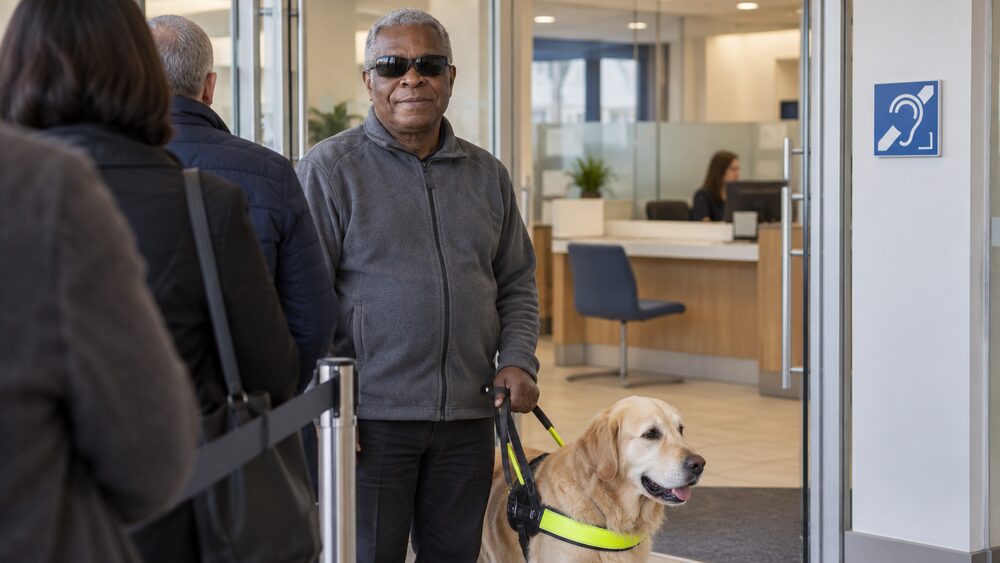
Banks and building societies have to make their information and services as accessible as possible for their disabled customers1. That is not a favour or a goodwill gesture: it is a duty, and it covers practical things like chip and signature cards for customers who are unable to memorise a PIN, statements in braille, hearing loops and talking cashpoints2. It also covers the way a bank treats you when you are ill, struggling with your mental health, or going through something like bereavement or a sudden change in circumstances.
This page explains what accessible banking means in practice, what the law entitles you to, how to tell your bank once and have the need recorded on your account, and where to find free support when money worries and mental health feed into each other. It applies to current accounts with banks and building societies across the UK.
What accessible banking means in practice
Accessible banking means being able to open, use and understand your account on the same terms as anyone else, whatever your disability, health condition or circumstances. MoneyHelper, the government-backed money guidance service, puts it plainly: banks have to make their information and services as accessible as possible for their disabled customers1. That duty reaches into the everyday mechanics of banking. A customer who cannot memorise a PIN can ask for a chip and signature card instead1. A blind or partially sighted customer can ask for statements and other documents in braille, or for large-print versions. Banks can provide hearing loops in branches and talking cashpoints at machines2.
Scope, the disability equality charity, lists the kinds of adjustments banks should make: communicating in an accessible way, having a quiet meeting space, providing bank accounts without an overdraft, and offering appointments so you can avoid queues7. Some of these help people whose disability is not visible. A quiet room and a pre-booked appointment can make the difference between being able to visit a branch at all and not. An account without an overdraft, meanwhile, is a recognised option for people who want the barrier of not being able to drift into debt, and the basic bank account is the product most often used for this8.
Accessibility also covers how the bank behaves when things go wrong in your life. Scope's guidance on managing money notes that banks should help if you suspect financial abuse, and that the bank should let a verified third party monitor a disabled person's account7. Some banks have a specific page for disabled customers and specialist teams that support people with access needs, and Scope suggests using other banks' pages as a guide to what you could ask your own bank for2. If your bank does not offer something another does, that is a reasonable thing to raise with it.
Equal access under the Equality Act 2010
The Equality Act 2010 is the legal foundation for all of this. Under it, your bank must provide you with equal access to all its products and services as a disabled customer2. The Act also protects people with mental health conditions: guidance from Business Debtline notes that people with mental health conditions are offered protection by the Equality Act 2010, which says creditors must make reasonable adjustments to help you9. So the duty is not limited to physical disability, and it applies to lenders and creditors as well as banks.
The Financial Ombudsman Service, which settles disputes between customers and financial businesses, handles complaints that involve discrimination, and its starting point is that if you have a disability, financial businesses must make reasonable adjustments so that you can use their services3. The Ombudsman's own duties are themselves anchored in the Act: its policy on interest on compensation awards cites section 149 of the Equality Act 2010 as its legal basis10. In practice, that means a complaint about a refused adjustment can be tested against the same law the bank is bound by.
Two limits are worth knowing. First, the Act's protection is against discrimination based on protected characteristics, and while banks are generally free to close customer accounts, they must not discriminate against customers based on those characteristics11. Second, there is a specific exception in Great Britain that allows age discrimination in the provision of financial service products12, which is why some products can have age limits. Neither of these waters down the core duty: equal access and reasonable adjustments for disabled customers, including those with mental health conditions.
What banks and building societies must offer
Beyond the Equality Act, banks have signed up to standards and are subject to rules that shape what they must offer. The Access to Banking Standard, overseen by the Lending Standards Board, is designed to ensure customers are better informed about a branch closure and the reasons behind it, requiring banks to make customers aware of the options they have locally to continue accessing banking services, and to provide specialist help for those who need it13. So when a branch closes near you, the bank should be telling you what replaces it and giving extra help to those who need it, not just posting a notice.
Access to cash is now regulated directly. The FCA's rules require banks and building societies designated by the Government to assess and fill gaps in cash access14. In practice, this means the 14 largest banks and building societies in the UK must conduct cash access assessments in response to trigger events, such as the closure of a branch or cash machine11. For someone who relies on cash because a card or app is hard to use, this is the rule that keeps a way to pay within reach. The wider picture of what replaces branches is covered in bank branch closures and what replaces them.
The FCA's rulebook also sets out how banks must treat you when they change things. Where a firm makes a change to a term or condition, a charge, or a material change to an interest rate that applies to a retail banking service and that will be to your disadvantage, it should provide reasonable notice to the banking customer on paper or in another durable medium before the change takes effect15. That matters for anyone who finds sudden changes hard to track, and it is the rule behind notice banks must give before changes.
On refusing customers, there are limits to when a bank can say no. A basic bank account can be refused only for reasons such as not agreeing to a credit check, failing the ID check, suspected unlawful or fraudulent use, or being threatening, abusive or violent towards staff, and the reason is given unless the bank suspects fraud or money laundering8. A parliamentary committee has gone further, recommending it should be a right for customers to open a basic bank account irrespective of their financial circumstances16. Where a refusal happens, what to do if you're refused a basic bank account sets out the options.
Telling your bank once, and having it recorded
The single most practical step is to tell your bank what you need and ask for it to be recorded. The reason is visible in the Ombudsman's case files. In one case, a customer named Sunita complained that her bank had not supported her through a period of ill health, and the bank responded by explaining it had no knowledge of her health problems prior to her complaint, with no notes or special instructions on the account regarding additional support4. The bank cannot act on what it has never been told. In another, a customer named Jamal had physical and mental health conditions which meant he relied on a third party for support, and the dispute turned on how the bank handled that reliance17.
Telling the bank once, and having the need noted on the account, means the support follows you: to the branch, to the phone line, to the collections process. Scope's guidance is that banks should make adjustments to help meet a disabled person's needs, and that all banks should offer third party mandate arrangements7. Some banks have specialist teams for customers with access needs, and asking to be passed to one is a reasonable request2.
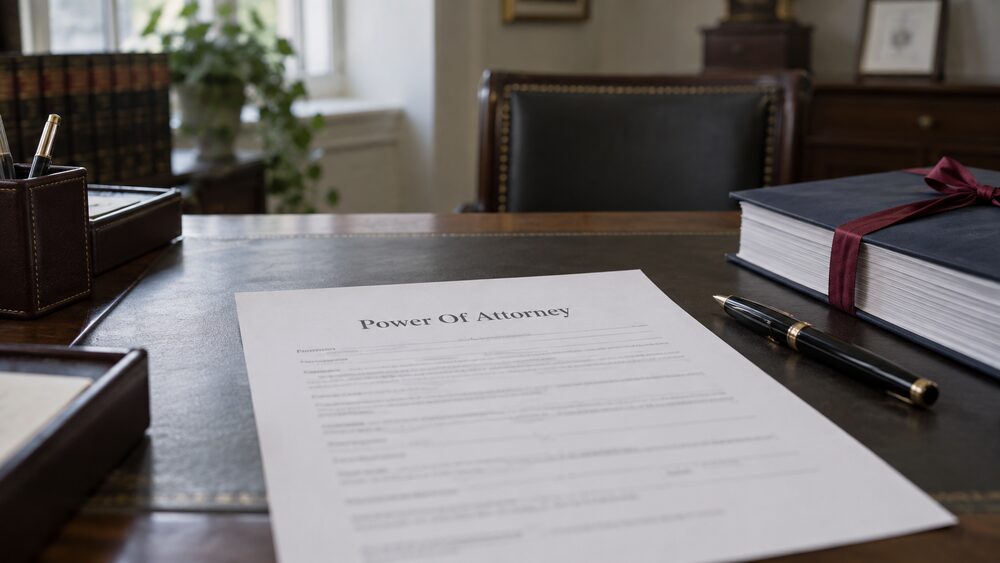
If someone else needs to be able to act for an account holder, there are established routes. Most banks, building societies and other account providers allow a third party access to the account, for example with a second card5. Most account providers also allow a customer to permanently or temporarily name a helper to access the account on their behalf, and each provider sets out its own instructions for arranging this5. A named helper can monitor the account once they verify their identity7. One caution from an Ombudsman case: a power of attorney did not entitle a daughter to use her mother's own login, because the bank's desktop platform was designed for customers, including those with accessibility needs, to access their own account20. Formal access has to be set up with the bank, not improvised. The full picture is in power of attorney and third party access to bank accounts.
How money worries and mental health connect
Money and mental health affect each other in both directions. The Mental Health and Money Advice service, run by Mental Health UK, exists to help people understand, manage and improve problems with mental health and money, and its guidance explains the connections between mental health and money, who is affected and what the effects can be21. Struggling financially can worsen a mental health problem, and a mental health problem can make money harder to manage, whether through reduced income, difficulty opening post or taking calls, or spending during periods of poor health.
The Financial Services Compensation Scheme, which protects deposits when banks fail, also points people towards mental health support resources if they are struggling with money worries, listing Mind, MoneyHelper and the Mental Health and Money Advice service22. Debt charities make the same link from the other side: Business Debtline's guidance on debt and mental health notes that people with mental health conditions are protected by the Equality Act 2010, which requires creditors to make reasonable adjustments to help you9. That means telling a lender about a mental health condition can change how it is allowed to treat you, for example in how and when it contacts you.
The Ombudsman's cases show what this looks like in practice. In one, a customer who had run up credit card debt during a period of ill health was put in touch with both debt and mental health charities to help him improve his situation23. In another, a customer whose payday loan from five years ago had come to cost everything he had was supported towards both debt and mental health help23. The pattern is consistent: the resolution combined financial help with mental health support, because the two problems were one problem.
Talking about it is hard, and the numbers bear that out. A Money and Pensions Service survey in September 2025 found that just four in ten adults feel comfortable talking to friends about money24. The survey covered the whole UK, with boosts in Scotland, Wales and Northern Ireland to make sure each nation's findings could be reported24. Knowing that discomfort is common, and that free, confidential services exist outside the friendship circle, is often the first step.
Free support for money and mental health
Several free services exist specifically for people dealing with money and mental health together, and all of them operate across the UK.
- Mental Health and Money Advice, from Mental Health UK, offers practical advice and support for mental health and money issues, helping people understand, manage and improve them21. Mental Health UK also helped write guides on talking to loved ones about debt and mental health26.
- National Debtline is a free-to-use advice and support service with advisers trained to help those with mental health problems6.
- StepChange Debt Charity provides debt and mental health support, and its resources include the guides Mental Health UK helped write26.
- The Money and Mental Health Policy Institute publishes signposting to help, including Martin Lewis's free guide for everyone struggling with their finances and a mental health problem, which is downloadable6.
- MoneyHelper and Mind are both listed as mental health support resources for people struggling with money worries22.
None of these charges for the help described. National Debtline is explicitly free to use6, and the guides and downloads listed alongside it are free to access6. The Money and Pensions Service underpins much of the national picture: its UK Strategy for Financial Wellbeing is a ten-year framework, developed over 12 months of listening to stakeholders, with five priority goals to be met by 203027. It works through partners across the four nations, with dedicated partnership managers in Northern Ireland, Scotland and Wales and regions across England28.
Looking after your wellbeing while dealing with money
The Money and Pensions Service defines financial wellbeing through five key areas: receiving a meaningful financial education, saving regularly, using credit for everyday essentials, accessing debt advice, and planning for and in later life28. Those five areas are a useful checklist when money and mental health are pulling in different directions. Two of them, using credit for essentials and accessing debt advice, are exactly the points at which people in difficulty tend to arrive, and both have free help attached, as the section above sets out.
For older people, or people supporting someone older, Age UK publishes a looking after your money information guide covering getting help with managing money, shopping and banking safely, sorting your legal affairs, spotting financial abuse and what to do if you think someone's taking advantage of you, and useful organisations for more specialised help29. It is a single free document that gathers together several of the threads on this page: third party help, safe banking, and protection from exploitation.
Practical steps also sit within the banking system itself. A basic bank account with no overdraft removes one route into difficulty8. A gambling block can be switched on where spending during periods of poor health is a risk. Naming a helper, permanently or temporarily, means someone trusted can pick up the post and calls when you cannot5. None of these is a substitute for the free advice services, but each reduces the number of things that can go wrong at once.
Where to get help if your bank lets you down
Banks do not always get this right. In one Ombudsman case, a bank upgraded a customer's account without permission and then denied it had done anything wrong, saying the customer had agreed to the upgrade, and sent a final response letter confirming it would not offer any refunds30. In another, a bank told a customer he should have noticed payments were still being made, and refused a full refund after it failed to cancel a direct debit31. In the cases above, banks have also claimed no knowledge of a customer's health because nothing was recorded4. When the bank's answer is no, there is a set route.
The first step is always to complain to the bank itself, setting out what you needed, what you asked for and what went wrong. The bank should investigate and reply, and if it will not help, it issues a final response letter setting out its position30. Once you have that, or once eight weeks have passed since you complained, the Financial Ombudsman Service can look at the case. The Ombudsman handles complaints involving discrimination, and its starting point on adjustments is that if you have a disability, financial businesses must make reasonable adjustments so that you can use their services3. Its service is free.
Alongside the complaint route, free advice is available whatever the outcome. Debt charities such as StepChange and National Debtline support people whose money problems are tangled with their health6, and the debt section of this site sets out the full range of options. If the problem is discrimination rather than debt, the Ombudsman's discrimination complaints route is the one to use3. And if the underlying problem is that the account itself no longer suits your needs, switching is covered in the Current Account Switch Service, and closing an account in how to close a bank account.
Sources32 cited
- Make your money easier to manage by yourself MoneyHelper, 2026-09-25
- Accessible banking and financial services Scope, 2026-08-17
- Complaints that involve discrimination Financial Ombudsman Service, 2026-09-26
- Case study: consumer asked for help after running up credit card debt during ill health Financial Ombudsman Service, 2026-09-26
- Nominate someone to collect your State Pension GOV.UK, 2026-09-26
- Get help with money and mental health Money and Mental Health Policy Institute, 2026-07-13
- Managing money for someone else Scope, 2025-11-27
- Basic bank accounts MoneyHelper, 2026-09-25
- Debt and mental health Business Debtline, 2026-09-26
- Policy statement on interest on compensation awards Financial Ombudsman Service, 2026-09-26
- Bank branch closures and access to cash House of Commons Library, 2026-09-26
- Age discrimination exceptions in financial services House of Commons Library, 2026-07-08
- Access to Banking Standard summary report Lending Standards Board, 2026-09-25
- PS24/8: Access to cash Financial Conduct Authority, 2024-07-24
- BCOBS 4.1: notice of changes FCA Handbook, 2026-09-26
- Report on consumers' access to basic bank accounts Parliament.uk, 2026-09-26
- Case study: consumer brings complaint after bank refuses refund of lost money Financial Ombudsman Service, 2026-09-26
- Support with living costs Carers UK, 2026-09-26
- Help to collect your benefits or pension NI Direct, 2026-06-26
- Case study: power of attorney did not entitle Joanne to use mum's login Financial Ombudsman Service, 2026-09-26
- How are mental health and money worries linked? Mental Health and Money Advice, 2026
- Mental health support if you're struggling with money worries FSCS, 2026-09-25
- Case study: payday loan from five years ago now costs everything Financial Ombudsman Service, 2026-09-27
- Just four in ten adults feel comfortable talking to friends about money Money and Pensions Service, 2025-09
- Debt and mental health support StepChange Debt Charity, 2026-09-25
- Adult Disability Payment: payments mygov.scot, 2025-03-24
- UK Strategy for Financial Wellbeing Money and Pensions Service, 2026-09-27
- What is financial wellbeing? Money and Pensions Service, 2026-09-27
- Looking after your money information guide Age UK, 2026-08-26
- Case study: consumer complains bank upgraded account without permission Financial Ombudsman Service, 2026-09-26
- Case study: customer complains bank failing to cancel direct debit Financial Ombudsman Service, 2026-09-26
- Complaints about banks and building societies Citizens Advice, 2026-09-25



 MoneyHelperFree, impartial money and pensions guidance, set up by government
 FSCSProtects your money if a bank, insurer or investment firm fails
 Financial Ombudsman ServiceFree, independent help when a complaint about a firm is not put right
 Citizens AdviceFree advice on money, consumer and legal problems in England and Wales