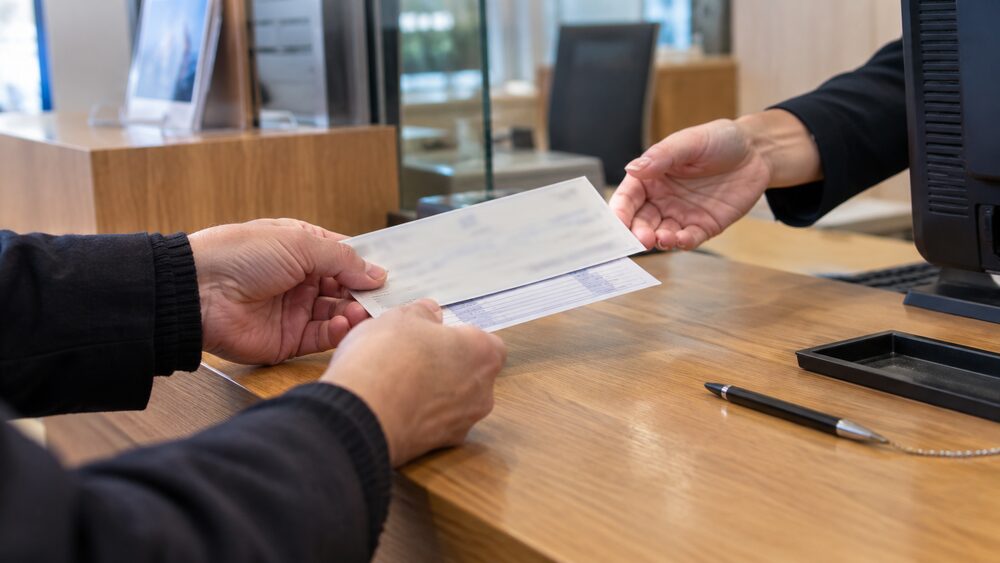
Most UK cheques clear by the next working day. Ulster Bank, for example, says that "in most cases, a cheque clears one working day after the day you pay it in"1. Barclays says cheques paid into a current account through its app usually clear the next working day2, and Lloyds Bank says the money is normally in your account and ready to use by the end of the next working day3.
Most UK cheques clear by the next working day. Ulster Bank, for example, says that "in most cases, a cheque clears one working day after the day you pay it in"1. Barclays says cheques paid into a current account through its app usually clear the next working day2, and Lloyds Bank says the money is normally in your account and ready to use by the end of the next working day3.
That is the headline. The complication is that not every bank works to the same timetable, and the gap between the fastest and slowest is wide. Some banks still quote 4 working days, some 7, and a few allow up to 15. Cheques from abroad are a different process altogether and can take weeks.
The reason the numbers differ is that clearing a cheque involves more than one bank. Your bank takes the cheque, presents it to the bank it is drawn on, and waits to see whether it is paid or returned. The money can appear in your account before that process has finished, which is why a balance that includes a cheque is not the same as money you can safely spend.
Most UK cheques clear by the next working day
The standard UK cheque clearing cycle runs on working days, and the money is normally available the day after you pay the cheque in. Ulster Bank states the one working day figure plainly1. Lloyds Bank puts it as the end of the next working day3, and Barclays gives the same answer for cheques deposited through its app2.
Two details change the timing. The first is the cut-off time. Ulster Bank says that if you pay a cheque in after 3:30pm on a working day, or at the weekend, the clearing cycle starts on the next working day1. A cheque paid in on a Saturday afternoon therefore begins its clock on Monday, and the money is available on Tuesday.
The second is how the cheque is processed. HSBC explains that before cheque imaging, a cheque paid into your account would show as pending until it had cleared, and that this could take 2 to 6 days9. Cheque imaging, where a picture of the cheque is used instead of the paper itself, is what allows the faster times now quoted by most banks.
Even so, the one working day figure is a norm rather than a guarantee. The bank can take longer if it has reason to doubt the cheque, and the money is not finally yours until the clearing period your bank sets has passed.
Why some banks say 4 to 7 working days
A bank that quotes 4 to 7 working days is not necessarily slower at moving the money. It is often quoting the point at which the cheque is finally settled, rather than the point at which the funds first appear.
Metro Bank says cheques normally take 4 working days to process4. Mansfield Building Society says that if you open a new account with a cheque, it can take up to 7 working days for the cheque to clear in the account5. RCI Bank says a cheque will be cleared after a maximum of seven business days after receipt, with interest starting from the second business day after receipt6. Virgin Money's Cybersave account describes the older 2-4-6 cycle, under which funds from a UK sterling cheque normally take three business days to clear and are not available for use until the fourth business day after the cheque is paid in10.
The range across the market is real, and it is worth knowing which figure your own bank uses before you rely on a cheque.
| Provider | Stated clearing time for a UK cheque |
|---|---|
| Ulster Bank | One working day after the day you pay it in, in most cases1 |
| Lloyds Bank | End of the next working day3 |
| Barclays (app deposit) | Usually the next working day2 |
| Bank of Scotland (app deposit) | Within 3 working days once cleared11 |
| Arab Bank Europe | Up to 3 business days under the image clearing process12 |
| Metro Bank | 4 working days4 |
| Mansfield Building Society | Up to 7 working days5 |
| RCI Bank | Maximum of seven business days after receipt6 |
| Virgin Money Cybersave | Three business days to clear, available on the fourth business day10 |
| National Bank of Kuwait (International) | Usually two working days after the recipient pays it in13 |
| SBI UK | 6 working days, excluding holidays, Saturdays and Sundays14 |
The pattern is that banks quoting longer periods are usually describing when the cheque is fully settled and the money cannot be clawed back, not when it first shows up. That distinction matters most when a cheque is large or comes from someone you do not know well.
A balance that includes a cheque is not spendable money
The single most useful thing to understand about cheque clearing is that the number on your banking app is not the same as money you can spend. A cheque can be returned unpaid after it has appeared in your account, and if that happens the bank can take the money back out.
This is why the clearing period your bank states matters. Until it has passed, the cheque is still capable of bouncing. Spending against it in the meantime means that if the cheque is returned, you owe the money back, and you may also face charges on your account.
The same principle applies to cheques you write. If you write a cheque and the recipient pays it in, the money leaves your account on the clearing timetable, not instantly. Keeping enough in the account until the cheque has cleared avoids the risk of it bouncing.
Cheques from abroad: 4 to 12 weeks to clear
Cheques drawn on a bank outside the UK are not part of the UK image clearing process, and the timescales are measured in weeks rather than days. Ulster Bank says foreign cheques are not part of the scheme and can take up to 20 weeks to clear1. Its own guidance on foreign cheques says the process can take up to 12 weeks8.
Cater Allen says cheques cleared by collection usually take between 4 and 8 weeks to clear, but can sometimes take longer7. Santander says a foreign-currency cheque sent for collection usually takes 2 to 8 weeks15.
The reason is that a foreign cheque has to travel through the banking system of the country it is drawn on, often by post, and be converted into sterling. Each stage adds time, and there is no equivalent of the UK's next-day clearing cycle.
If you are expecting a cheque from abroad, the practical point is that it can take a long time to arrive. A foreign-currency cheque sent for collection usually takes 2 to 8 weeks to clear13, and cheque collection can take up to 12 weeks16. Foreign cheques are not part of the cheque clearing scheme and can take up to 20 weeks to clear2. A bank transfer, where one is possible, is usually faster, though that depends on the sending bank and the country.
How long a cheque paid in by post takes to clear
Posting a cheque adds a stage before clearing even begins. The cheque has to reach the provider's processing centre first, and only then does the clearing clock start.
The Post Office says cheque deposits sent by post take two days to clear once the cheque has been received17. first direct says cheques sent in the post will show in your account within 2 working days of reaching its processing centre16. One credit union current account allows up to 15 working days for cheques deposited at a Post Office for clearance18.
The lesson is that the clearing time you are quoted usually excludes postage. If a provider says a cheque clears in two days, that is two days from receipt, not two days from the moment you put it in the post.
How long a cheque sent to pay a credit card bill takes to reach the account
Paying a credit card bill by cheque is one of the slowest ways to pay, because post and clearing both count against you.
Tesco Bank says to allow 5 to 7 days for a cheque payment to reach it by post, and then another 1 to 2 business days before the cheque funds clear19. Vanquis says to allow 7 working days for a cheque payment to clear on its Credit Builder, Travel and Purchase credit cards20.
Canada Life Home Finance says a payment by cheque will be credited to your account on the day it clears, which could take up to 6 working days23. StepChange Debt Charity, which pays some creditors by cheque, allows up to five working days for those payments24.
The risk with a credit card cheque payment is that it can arrive after the payment due date even if you posted it well before. If you are paying close to a deadline, a bank transfer or a debit card payment will reach the account faster.
What protects you if a cheque goes wrong
Cheque clearing is covered by rules, and there is a route to complain if a bank handles a cheque badly.
If you have a problem with a cheque, complain to your bank first. It has eight weeks to investigate and give a final response. If you are still unhappy, or the eight weeks pass, you can take the complaint free of charge to the Financial Ombudsman Service25. MoneyHelper offers free, impartial guidance on banking problems25.
The Financial Ombudsman Service publishes data on the complaints it receives. In the first quarter of 2026/27 it recorded 8,945 complaints about current accounts26. In the third quarter of 2025/26 it recorded 8,542 current account complaints with a 27% uphold rate27. In 2025/26, fraud and scams accounted for 18,900 of the cases it handled28, and in 2024/25 the most complained about issue in relation to current accounts was fraud and scams29.
Those figures are about current accounts generally rather than cheques specifically, but they show that complaints about accounts are common and that a significant share are upheld. If a cheque is lost, delayed or returned in circumstances you think are unfair, the ombudsman is the free route to a decision.
Sources29 cited
- How long does it take for a cheque to clear in my account? Ulster Bank, 2026-09-25
- Mobile banking app features Barclays, 2026
- Payment timescales Lloyds Bank, 2026-09-27
- Safe deposit box questions Metro Bank, 2026-09-25
- How to open a savings account Mansfield Building Society, 2026-07-28
- Managing your account RCI Bank, 2026-02-23
- A guide to your account Cater Allen, 2026-04
- How long does it take for foreign cheques to clear? Ulster Bank, 2026-09-25
- Cheque imaging HSBC UK, 2026
- Cybersave account terms Virgin Money, 2026
- Cheque deposits Bank of Scotland, 2026-09-27
- Private banking terms and conditions for personal accounts Arab Bank Europe, 2026
- Tariff of charges and FSCS deposit protection National Bank of Kuwait (International), 2026
- Paying by UK debit card SBI UK, 2026-09-25
- Making international payments Santander, 2026
- Paying in a cheque using the app first direct, 2026
- Instant Saver Post Office, 2026
- Current account terms and conditions Credit Union, 2025-08
- Help and FAQs Tesco Bank, 2026-09-26
- Credit Builder credit card summary Vanquis, 2026-09-21
- Travel credit card summary Vanquis, 2026
- Purchase credit card summary Vanquis, 2026
- Your mortgage guide Canada Life Home Finance, 2026
- Ways to pay your plan StepChange Debt Charity, 2026-09-26
- How to open, switch or close your bank account MoneyHelper, 2026-09-25
- Quarterly complaints data Q1 2026/27 Financial Ombudsman Service, 2026
- Quarterly complaints data Q3 2025/26 Financial Ombudsman Service, 2025
- Annual complaints data and insight 2025/26 Financial Ombudsman Service, 2025
- Annual complaints data and insight 2024/25 Financial Ombudsman Service, 2024




 MoneyHelperFree, impartial money and pensions guidance, set up by government
 FSCSProtects your money if a bank, insurer or investment firm fails
 Financial Ombudsman ServiceFree, independent help when a complaint about a firm is not put right
 Citizens AdviceFree advice on money, consumer and legal problems in England and Wales