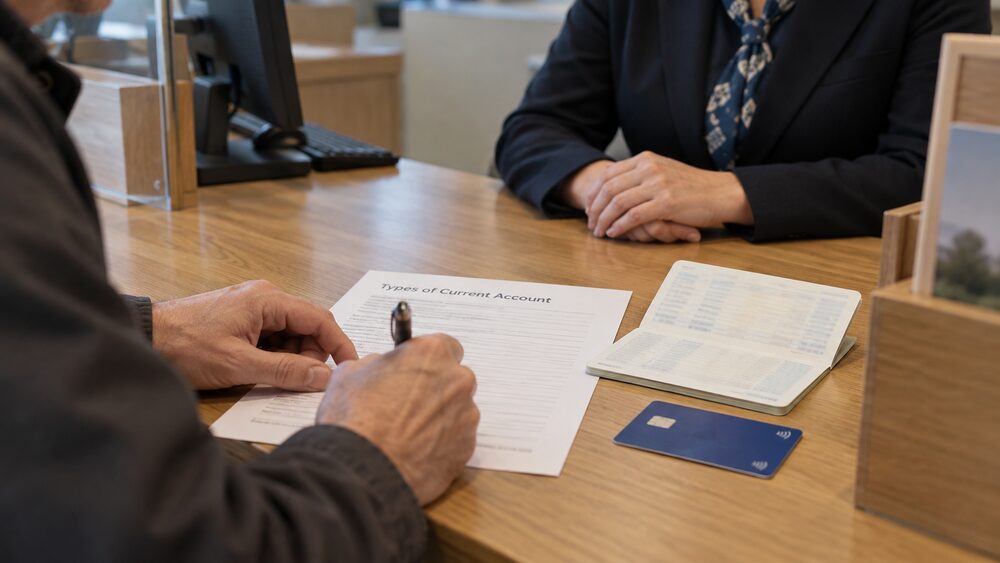
A current account is the account you use for everyday money: receiving your salary, pension or benefits, paying bills, spending with a debit card and withdrawing cash. In the regulator's terms, a personal current account is a payment account, other than a current account mortgage, within the meaning of the Payment Accounts Regulations1. In practice it is the account your income lands in and your bills go out of, and most people can use it to receive benefits and wages, spend in shops, withdraw cash, manage money online or by mobile app, and set up Direct Debits and standing orders2.
Current accounts are different from savings accounts, which are for putting money away for the future, for emergencies or for expensive purchases3. A current account usually comes with a debit card for shops and cash machines, possibly an overdraft and other credit, and the ability to make regular payments automatically3. Money held in current, saving and fixed-term deposit accounts with a licensed bank or building society is protected by the FSCS deposit protection scheme4.
What a current account is for
The core job of a current account is managing money day to day: paying bills, receiving money such as salary or benefits, and keeping track of spending3. Everything else a bank offers is built around that. A current account normally comes with a cheque book to take money out, possibly a debit card for shops and cash machines, possibly an overdraft and other credit, and Direct Debits and standing orders for regular payments3.
The FCA's rulebook gives the term a precise edge. A personal current account means an account, other than a current account mortgage, which is a payment account within the meaning of the Payment Accounts Regulations1. The definition matters because it decides which rules a bank must follow for that account, from how it communicates with you to how it handles complaints. The same definition appears across the FCA's conduct rules for banks7.
A current account is not the same as a savings account. Savings accounts are for money you would like to save for the future, for emergencies or to buy expensive things3, and credit union savings accounts either pay interest or a share of any profits8. Many people hold both: the current account for the flow of daily money, and a savings account for the money that should stay put. Legislation also recognises the category, defining a "relevant account" as a personal account operating as a current account, savings account or investment account, including one operating by reference to electronic money9.
If you receive Universal Credit, a bank or building society account, also called a current account, is described as the easiest way to access your payments2. The same account can receive wages, a pension and benefits, which is why most people organise their money around one. For a fuller picture of how the account works day to day, see how a current account works, and for the difference in detail, current account vs savings account.
Standard, basic, joint and sole accounts
Most current accounts fall into a few broad types, and the differences between them change what you can do with the account.
A standard account is the ordinary current account a bank or building society offers: income in, bills out, debit card, and usually an overdraft facility subject to a credit check. Providers offer these in single or joint form10.
A basic bank account is a simplified form of current account7. Basic bank accounts let you pay wages, salary, benefits and tax credits directly into the account, pay in cheques and cash, pay bills by Direct Debit and withdraw money from cash machines3. They are designed for people who might not qualify for a standard account, for example because of a poor credit history, and one route in can be applying for the bank's other accounts first, such as their standard current account11. As an example of what they include, Barclays' Basic Current Account allows customers to pay in income, make payments, withdraw cash and set up regular payments such as Direct Debits and standing orders, managed through the app, online, in branch or by phone; it does not include an overdraft or cheque book, but customers can receive text alerts and regular statements12. Alternatives to a basic bank account include a credit union current account, run by not-for-profit organisations, though you might pay a monthly fee for one, and a prepaid card account, which usually does not require ID but generally cannot set up payments11. See basic bank accounts explained and basic vs standard bank accounts.
A joint account is opened jointly with other people, for example to manage household bills or with a spouse or civil partner3. A joint account normally allows two or more people to receive payments, pay by debit card, transfer money and manage the account, depending on the bank13. The Current Account Switch Service works for joint accounts, provided you are switching to another joint account and all account holders agree; you can also switch a sole account to a joint account elsewhere13. Joint accounts carry particular risks if a relationship breaks down, covered in freezing a joint account after a separation.
A sole account is simply one held in your own name only. Most people hold a sole account for their own money and, if they share household costs, a joint account alongside it. There is more on the comparison in joint vs sole bank accounts.
| Account type | Who holds it | Typical features |
|---|---|---|
| Standard | One person, or two or more jointly10 | Full current account features, overdraft subject to credit check |
| Basic | One person who may not qualify for a standard account | Pay in income, Direct Debits, cash withdrawals, no overdraft3 |
| Joint | Two or more people | Shared payments and management, depending on the bank13 |
| Sole | One person | Everyday account in your own name |
More than one account, and who can open one
Provided you meet the eligibility criteria, there is no limit to the number of current accounts you can open5. People commonly hold two or more: one for bills, one for spending, or a separate account for a specific purpose. The things to watch are the eligibility rules each provider sets, and the effect on your credit file, covered in how current accounts affect your credit file and can you have more than one current account?.
Who can open one depends on the provider's checks, and on your immigration status. You can usually open a bank account if you have leave to remain or a valid visa14. Some online banks offer a current account where you do not need proof of address, which matters if you have recently arrived in the UK or have no fixed address14. Banks have also joined a scheme to help homeless people open bank accounts, which is one route in for people without a stable address12. If you are struggling to open an account, see opening a bank account with no fixed address and what ID you need to open a bank account.
Not every account that receives regular payments is a current account. Pension legislation, for example, defines its own categories of pension account, including an active member's pension account, a deferred member's pension account, a retirement pension account and a pension credit account, among others15. These are not current accounts and do not work like them. Separately, around two million people have faced a state pension payment headache because of how their payments are handled, which is a reminder that where a recurring payment lands is a practical choice worth getting right16.
Where you can open a current account
Current accounts are offered by banks, building societies and credit unions. Credit unions offer current accounts alongside savings accounts and loans, and a credit union current account can be a genuine alternative to a bank account, though it may carry a monthly fee8. See credit unions: a complete guide and banks and building societies: a complete guide.
Depending on the account you have chosen, you can usually apply online, using an app, over the phone or in person17. To open a bank account you normally fill in an application form in a branch, online, or sometimes over the phone, and provide proof of identity including your full name, date of birth and address3. For basic bank accounts, you can usually apply online, by phone or in a branch, though you will often need to apply for one of the bank's other accounts first, such as their standard current account11. The step-by-step process is covered in how to open a current account.
The Post Office is a special case. It announced its intention to enter the personal current account market and subsequently launched three types of account: a "free in credit" standard account, a packaged account and a control account18. The Post Office's own account is operated through the Bank of Ireland16. Separately from offering its own accounts, the Post Office acts as a counter for other banks: some banks will let you cash a current account personal cheque or use your cash card at the Post Office, free of charge, so ask your local branch3. All basic bank accounts offer the facility to withdraw cash at a local Post Office20, and credit union current accounts can be used at a local Post Office for both withdrawals and deposits20. The old Post Office card account, used for benefits and pensions, has closed, and holders needed to move to a bank, building society or credit union account21. See banking at the Post Office and Post Office banking vs banking hubs.
Account alerts and what banks send you
Banks send several kinds of alert, and they are worth turning on because they are one of the quickest ways to spot a payment you did not make. Bank mobile apps typically let you opt in to alerts for card spending and bank transfers, and you can check the app settings for these options22. Text alerts are also common: Barclays' Basic Current Account, for instance, includes text alerts and regular statements12. Regular statements themselves are part of the service, and checking transactions and reporting any you do not recognise quickly matters, because you will usually get a refund if it is fraud17.
Alerts sit alongside other routine information a bank sends. Guidance on avoiding scams covers what a scam is, the different types of scams, ways to avoid being scammed, what to do if you have been scammed and useful contact information23. For overdrafts specifically, there are rules on when your bank must alert you, covered in when your bank must alert you about overdrafts.
What alerts cannot do is stop you making a payment you have chosen to make. They tell you what has happened; the protections around payments you are tricked into making are separate, and are covered in the rest of this page. For the mechanics of app and online banking, see mobile banking apps and online banking.
Scam protection on current accounts
Current accounts are the main target for scams, because that is where the money is. The protections come in layers, and it helps to know which layer does what.
The first layer is what you control. Guidance from the Take Five campaign advises turning on 2-step verification to add an extra layer of security to any accounts that hold your personal or financial information24. Its app guide sets out the protections available for payments from personal bank accounts, including those made by micro-enterprises and certain charities25. Checking transactions regularly and reporting anything unfamiliar quickly means you will usually get a refund where it is fraud17.
The second layer is what the payment system does. Confirmation of Payee is a name-checking service that applies to accounts which allow consumers to transfer funds in and out, such as current accounts and e-money accounts; mortgage and credit card accounts are excluded26. It is designed to catch payments sent to the wrong, or a suspiciously different, name. See Confirmation of Payee explained.
The third layer is knowing the tricks. A common scam involves a fraudster pretending to be from your bank, phoning to say you have been a victim of fraud, and asking for personal and financial information or asking you to transfer funds into a "safe account"27. No genuine bank asks you to move money to a safe account. For people who are concerned about being scammed, there are options such as prepaid debit cards that can help, according to the learning disability charity Mencap28. If something has already gone wrong, the Financial Ombudsman Service can look at complaints about banking and payment services, including current accounts, savings accounts, Direct Debits, money transfers, electronic payment platforms, cheques and banker's drafts29. See scams and fraud: a complete guide and unauthorised payments from your bank account.
APP scam refunds: what the reimbursement rules cover
An authorised push payment (APP) scam happens when you send money to a fraudster from your bank account, either through trickery, because they are posing as someone else, or for goods or services that never arrive30. Since 7 October 2024 there has been a mandatory reimbursement requirement for these scams, and it is the strongest protection a current account holder has against being tricked into paying.
The Payment Systems Regulator's consolidated policy statement, PS25/5, brings together its previous publications on the reimbursement requirement into a single point of reference, including summaries of the most frequently asked questions and the requirements for reimbursement of APP fraud committed over the CHAPS payment system6. The requirement applies to APP scam payments executed by individuals, micro-enterprises and charities6.
The checks that decide whether a scammed payment must be reimbursed.
The rules require reimbursement in all but exceptional cases, so more victims get their money back34. All types of APP fraud are covered, such as impersonation or romance scams35.
Who is covered, and what is not:
- Covered: payments from personal bank accounts, and payments made by micro-enterprises and certain charities25; bank transfers to UK accounts35; payments made using Faster Payments25.
- Not covered: payments made using cash, a cheque, or a credit, debit or prepaid card; payments across other payment systems, for example card payments or cryptocurrency transfers; civil disputes; fraudulent claimants; payments to another account you control; unlawful payments; and payments to and from credit union, municipal bank or national savings bank accounts25.
A bank could refuse a refund in certain circumstances, such as where you ignored warnings about scams when setting up and amending payees or before making a payment, did not take care to establish that the person you were sending money to was legitimate, were grossly negligent, or acted dishonestly when you reported the scam30. Before the mandatory rules, a voluntary code applied, under which banks signed up to refund victims in these situations30. If you have been scammed, the practical steps are in how to get your money back after a scam and what to do if you are the victim of a bank transfer APP scam.
Faster Payments and CHAPS: both are covered
The reimbursement rules were built for Faster Payments, the system behind most instant bank transfers in the UK, and were extended to CHAPS, the system used for large-value payments such as house purchases. Everyone making a payment via Faster Payments or CHAPS from one UK bank account to another is covered37. The rules apply to payment service providers that offer Faster Payments, which is most UK banks, building societies and e-money firms, and also to firms making CHAPS payments36.
The eligibility conditions are specific. You must have made a transfer as part of a scam on or after 7 October 2024, made the transfer to another UK account, and told the bank or payment service provider no more than 13 months after the last payment32. The rules cover most transfers between UK bank and other accounts32. Relevant accounts are accounts held in the UK which can send or receive payments using the Faster Payments Scheme, but they exclude accounts provided by credit unions, municipal banks and national savings banks38. The requirement applies to all payment service providers participating in the Faster Payments Scheme and CHAPS, whether directly or indirectly, that offer relevant accounts6.
For how the payment systems themselves work, see bank transfers: Faster Payments, Bacs and CHAPS.
Sources38 cited
- BCOBS 8: Information, advice and services to be provided to persons holding accounts FCA Handbook
- Choosing a bank account for your Universal Credit payment MoneyHelper
- Getting a bank account Citizens Advice Scotland
- Check your money is protected FSCS
- Current accounts MoneyHelper
- PS25/5: APP scams reimbursement requirement, consolidated policy statement Payment Systems Regulator, 2025-05
- Excluding households from financial services House of Lords Select Committee on Financial Exclusion
- Credit union current accounts MoneyHelper
- Banking Act 2025, Schedule 3, Part 1 legislation.gov.uk
- FidBank UK current account FidBank
- Basic bank accounts MoneyHelper
- Banks join scheme to help homeless people open bank accounts Which?, 2025-11-14
- Joint accounts MoneyHelper
- How to open a bank account Shelter
- The Personal and Occupational Pension Schemes (Automatic Enrolment) (Scotland) Regulations 2018 legislation.gov.uk
- Two million facing new state pension payment headache Which?
- How to open, switch or close your bank account MoneyHelper
- Personal current account banking services Parliamentary Commission on Banking Standards
- Getting a bank account Citizens Advice
- Credit union current accounts and basic bank accounts research University of Bristol Personal Finance Research Centre
- What to do now your Post Office card account is closing MoneyHelper
- 4 fraud-proofing tips you can do right now Which?, 2024-04-24
- Scams guide Age UK, 2026-08-26
- Online scams Take Five to Stop Fraud
- App guide Take Five to Stop Fraud
- PS22/3: Extending Confirmation of Payee coverage Payment Systems Regulator, 2022-10
- Phone scams and cold calls nidirect, 2021-07-02
- How to save money Mencap, 2023-04-21
- Banking and payments complaints Financial Ombudsman Service
- Bank transfer scam victims to get refunds from May 2019 Which?, 2019-02-28
- PS25/5: APP scams reimbursement requirement Payment Systems Regulator
- Scams you've been tricked into making a payment Financial Ombudsman Service
- CP22/4 APP scams: requiring reimbursement Payment Systems Regulator
- PS23/3: Fighting authorised push payment fraud, a new reimbursement requirement Payment Systems Regulator
- How to get your money back after a scam Which?
- What to do if you're the victim of a bank transfer APP scam Which?, 2026-05-12
- APP scams Payment Systems Regulator
- PS23/4: APP scams policy statement Payment Systems Regulator, 2023-12

 MoneyHelperFree, impartial money and pensions guidance, set up by government
 FSCSProtects your money if a bank, insurer or investment firm fails
 Financial Ombudsman ServiceFree, independent help when a complaint about a firm is not put right
 Citizens AdviceFree advice on money, consumer and legal problems in England and Wales