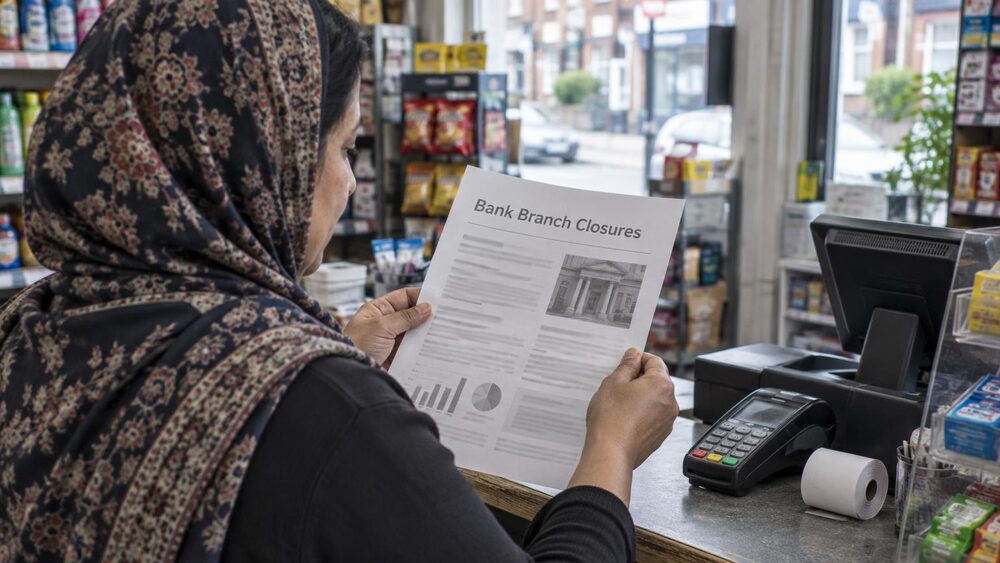
Branch closures have become a routine feature of UK banking. Which? reports that 314 branches were already scheduled for closure in 2026, including 116 from Lloyds, 88 from Halifax and 40 from Santander, with a further 19 scheduled for 20271. The number of branches and cash machines has been falling over the past decade as consumers increasingly use online banking and digital payments2.
A closure does not mean your account closes. Your account, sort code, account number, cards and payments all continue, and the money in your account stays protected exactly as before. What changes is where you go for the services the branch used to provide: paying in cash and cheques, withdrawing money, and talking to someone face to face. This page explains what your bank must tell you before a closure, what replaces the branch, and where to go if the alternatives do not work for you.
What happens when a bank branch closes
When a bank closes a branch, the branch stops providing services but the bank keeps serving you through its other channels: the app, online banking, telephone banking, cash machines, the Post Office and, increasingly, a shared banking hub in the town. The FCA's guidance on branch and ATM closures applies to what it calls "long-term" closures, defined as those lasting 6 months or more4. Temporary closures, such as a branch shutting for repairs, sit outside that guidance, though the bank still has to tell you what is happening.
The scale of change is large. There were 410 closures in 2024 alone, including 90 from Barclays, 83 from Lloyds, 76 from Halifax and 68 from NatWest6. Branch use has also shifted: Which? notes that average daily visits have fallen from 140 per day in 20126. Banks point to this fall as the reason for closures, and the Access to Banking Standard requires them to explain the reasons behind a decision to close and to make customers aware of the options they have locally to continue accessing banking services7.
A closure can also trigger a formal assessment of whether the local area still has adequate access to cash. Under the FCA's access to cash rules, a closure is one of the events that requires firms to carry out a cash access assessment, which can result in new facilities such as additional cash machines or a banking hub8. So a branch shutting often sets off a process, not just a door closing.
Notice before a closure: at least 12 weeks
You are not supposed to find out about a closure by turning up to a locked door. Under the FCA's policy statement PS24/8, firms should communicate branch and ATM closures to customers at least 12 weeks before they take effect3. The Access to Banking Standard adds that customers must be better informed about a closure and the reasons behind the decision, and that banks must provide specialist help for those who need it7.
The 12-week rule covers branch and ATM closures. Separate rules apply when a bank closes an account itself rather than a branch. For accounts opened on or after 28 April 2026, banks must provide at least 90 days' notice before terminating an account and give a clear reason; for accounts opened before that date, the requirement is at least 2 months' notice, with no obligation to give a reason9. For basic bank accounts, the government amended the payment account regulations in 2025 to require firms to give a sufficiently detailed and specific reason for closing a basic bank account10, and MoneyHelper notes that a bank closing a basic account for breaking the terms must give at least two months' notice11.
FCA rules also require reasonable notice, on paper or in another durable medium, before any change to a term, charge or interest rate that would be to your disadvantage12. The dedicated pages on branch closure notice and notices of changes to your account cover these rules in more detail.
Your account stays open when the branch shuts
The most important thing to understand is that a branch closure is not an account closure. Your current account continues, along with its sort code, account number, debit card, Direct Debits and standing orders. If you want to check what a sort code actually identifies, see sort codes and account numbers. Nothing about your day-to-day payments changes because a building has shut.
Where things can get harder is with services the branch uniquely provided. A Financial Ombudsman case study illustrates the friction: a customer, Dan, arrived at his branch to make a transfer and found it closed due to a water leak. The bank pointed out that Dan could have gone to the branch in the next town, two miles away, or made the transfer using telephone or online banking, both of which he was registered for. The ombudsman did not award compensation, but noted the bank's apology and considered it enough in the circumstances13. The lesson is practical: after a closure, some tasks need a different channel, and registering for online or telephone banking before you need it saves trouble.
Some account closures do happen for reasons unconnected to branches, and it helps to know the difference. A bank may close or freeze an account if you owe money to the bank, are bankrupt or have a debt relief order, or have not used the account for a long time14. If a bankruptcy order is made, accounts are usually frozen immediately15, and after a debt relief order is approved your bank may stop letting you use your current account16. These are account-level decisions by the bank, not consequences of a branch shutting. If your account is closed and you need a new one, a basic bank account is an option, and if you are leaving a relationship where financial control is a concern, an untraceable sort code cannot be used to find the location of a branch, which may help keep your location secure17.
If you decide to move banks after a closure, the Current Account Switch Service is free and switches your account automatically. If you are overdrawn, the position is more complicated: if your new arranged overdraft covers what you owe, the funds are sent to your old bank and you owe the overdraft balance on the new account instead; if it is lower, or you cannot get one, you need to arrange to pay off the remainder separately before you can switch or close the old account18. See switching while overdrawn for the detail.
Banking hubs: shared counters run by several banks
A banking hub is a shared branch: one premises on the high street where several banks take turns to serve their own customers. Hubs provide face-to-face banking services and are operated by the Post Office2. Counter services are run by Post Office staff, where personal and business customers of any bank signed up to the service can do everyday banking1. In addition, each participating bank sends its own community banker to the hub on a rotating schedule for services that need someone from your own bank.
The network has grown quickly. As of January 2024 there were 31 banking hubs in operation across the UK, 21 of them in England19. By 19 August 2025, 178 banking hubs had been opened across the UK1. LINK, the industry body responsible for cash access assessments, has recommended 77 further hubs, and there are now over 70 temporary hubs open, ensuring cash access provision remains continuous while permanent hubs are built20.
Which banks you can use at a hub depends on which banks have signed up in that town. For example, the Brixham banking hub is shared by Barclays, Lloyds, NatWest, Nationwide and Santander1. The counter is open to customers of any participating bank for standard transactions, but for anything account-specific, such as opening a product or resolving a dispute, you wait for your own bank's community banker day.
Everyday banking at the Post Office
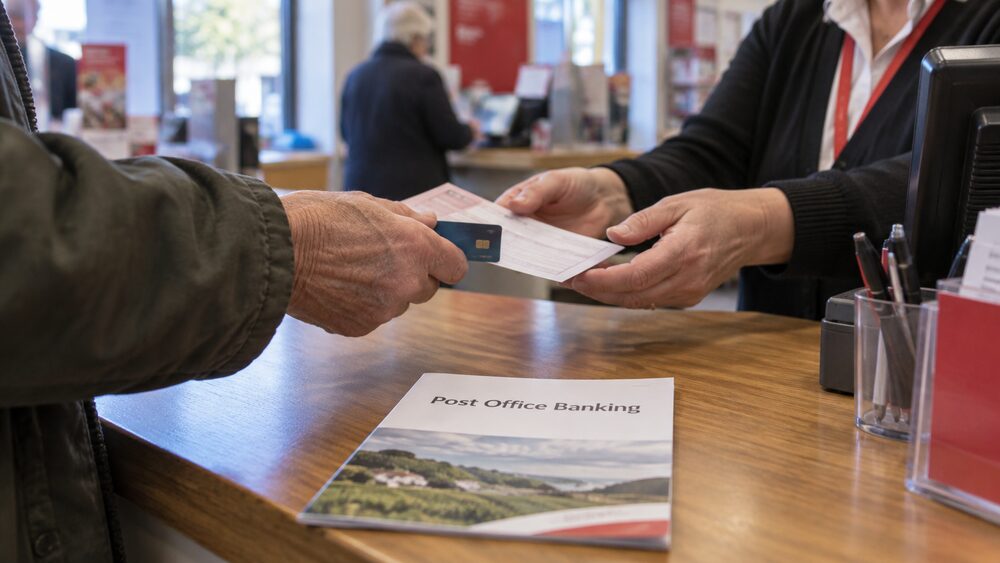
For most people, the Post Office is the immediate replacement for a closed branch. Post Offices offer simple banking facilities, such as withdrawing and depositing cash and cheques, for customers of nearly all banks21. A framework agreement means consumers of 30 UK banks and building societies can continue to access cash and basic banking facilities via the Post Office5. Some banks let you cash a current account personal cheque or use your cash card at the Post Office free of charge, and Citizens Advice suggests asking your local Post Office what your bank allows22.
The network is large and its opening hours have been extending. Official statistics show a trend of Post Office branches opening progressively later in the afternoons, Monday to Saturday, with an increase of 1.2% of branches open at 7pm in one quarter and 0.6% in the next24. That matters because a Post Office is often open at times a bank branch never was, including Saturdays.
There are limits to what the Post Office does. It handles everyday transactions: cash withdrawals, cash and cheque deposits, balance checks. It does not replace your bank for things like applying for products, resolving complaints or anything that needs a decision from your bank. Not all accounts can be used at the Post Office either: not all basic bank accounts can be accessed there23. The comparison page on Post Office banking versus banking hubs sets out which does what.
Getting and depositing cash without a branch
Cash access after a closure is protected by a specific regime. The FCA's rules mean cash access assessments are carried out in response to closures of, or material reductions or changes to, cash access services at an existing facility, and in response to cash access requests26. Changes to services, such as a branch, cash machine or Post Office closing or changing its opening hours, can trigger a review8. The aim is that a community still has a reasonable way to get cash, and reviews can result in new ATMs or banking hubs2.
In practice your options are:
- Cash machines: withdraw with your debit card; see free cash machines for how fee-free access works.
- The Post Office: withdraw and deposit cash over the counter with your card21.
- Cashback: some shops give cashback with a purchase.
- Banking hubs: shared counters as described above.
For people who cannot get a bank or building society account at all, there is a specific route: the Payment Exception Service lets you get vouchers that you can swap for cash at a Post Office or PayPoint outlet, often found in a corner shop, loaded onto a payment card or sent by email or text message27. It exists for people who cannot get a bank account, so they can collect benefits or the State Pension in cash28. The old Post Office card account, which was free but could not be used for wages or other income, has been replaced by these arrangements29. Getting paid into a bank account in the first place saves trips to the bank and is safer than carrying cash30.
Geography affects what is available. In the FCA's cash access coverage data for 2025 H2, there are no mobile bank branches or mobile/outreach Post Office branches in London31. During the access to cash "cold spots" analysis covering April to June 2020, fewer than 12% of all UK branch locations closed and fewer than 12% of ATM sites closed32. The full picture of machines, hubs and deposit services is on the access to cash page.
Banking by app, online and phone
Most banks now have their own smartphone and tablet apps, so once you have set up online banking you can download your bank's app from the Google Play Store for Android devices or the App Store for Apple devices33. Through an app or online banking you can typically check your balance, send payments, pay bills and manage standing orders without visiting a branch or cash machine21. Telephone banking lets you pay bills or transfer funds by landline or mobile phone, though call charges may apply21.
If you manage money for someone else, note one limitation: most banks give telephone and online access to a person with power of attorney, but only a small number of banks give access to the mobile app34. If app access matters to you or the person you help, check with the bank before assuming it is available. The pages on mobile and online banking and third party access to bank accounts go into this in detail.
For people who find technology difficult, the shift is real but not total. Branch banking still offers a wide range of face-to-face and automated services, though some services require an appointment, for example a mortgage application21. Where a branch has gone, the banking hub and the Post Office counter are the remaining face-to-face options, and banks are required under the Access to Banking Standard to provide specialist help for customers who need it when a branch closes7.
Help if you find it hard to bank without a branch
Banks have obligations to customers who struggle with digital channels. Guidance for disabled customers highlights features such as low-level counters in branch and counters fitted with a hearing induction loop30. Banks can also provide extra support: see accessible banking and extra support for what to ask your bank for, and basic bank accounts for accounts designed to be simple to run, with no overdraft and no cheque book35.
Some circumstances make banking without a branch harder still. If you have no fixed address, you might need to apply for a new account if your account was closed, you cannot access your current account, or you need your own account after relationship breakdown or domestic abuse14. Specialist help exists for banking after domestic abuse, including opening a new account safely.
Measures are in place at the national level to reduce the impact of branch closures, such as the Access to Banking Standard and arrangements to provide some banking services via the Post Office36. Consumer bodies in Scotland and Northern Ireland have also examined the question: Citizens Advice Scotland published a report asking whether banking hubs are the answer to branch closures37, and the House of Lords Library has reported on the impact of closures on rural communities19. If you want to understand the standard banks signed up to, see the Access to Banking Standard.
Where to complain or ask for a local cash review
There are two separate routes, and they do different jobs.
Ask for a cash access review. LINK runs access to cash reviews when banks plan closures or if local residents ask for a review, and a review can result in new ATMs or banking hubs2. Requests can come from local residents, businesses and representatives8. This is the route to take if the problem is that your town has lost its branch and cash access is now poor: it is not a complaint about your own treatment, it is a request to look at the area's facilities.
Complain to your bank, then the Financial Ombudsman. If your complaint is about how the closure or its aftermath was handled, complain to the bank first. If it does not resolve matters, you can take it to the Financial Ombudsman Service. Current accounts generate a large volume of complaints: in Q1 2026/27, 8,945 complaints about current accounts were opened, alongside 993 about business current accounts and 2,103 about personal loans38. In the branch closure case study mentioned earlier, the ombudsman looked at whether the bank had treated the customer fairly when he found his branch shut, and decided an apology was enough in the circumstances13.
If you want to move to a bank that still has a branch near you, the Current Account Switch Service is free and switches your account, balance and payments automatically22. It is very easy to switch by applying for an account with a new bank or building society, who will move your accounts and payments for you39. If you close an account without switching, you generally need a nil balance, with some banks accepting £5 or less40. The banks and building societies page lists providers, and how to open a current account covers the application itself.
Sources40 cited
- Bank branch closures: is your local bank closing? Which?, 2026
- Access to banking services and cash House of Commons Library, 2026
- PS24/8: Access to cash Financial Conduct Authority, 2024
- FG22/6 Branch and ATM closures or conversions guidance Financial Conduct Authority, 2022
- Treasury Committee report on access to banking services UK Parliament, 2022
- Bank branch closures: is your local bank closing? Which?, 2026
- Access to Banking Standard summary report Lending Standards Board, 2026
- Access to cash Financial Conduct Authority, 2024
- Bank branch closures research briefing House of Commons Library, 2026
- Basic bank accounts July 2023 to June 2024 GOV.UK, 2025
- Basic bank accounts MoneyHelper, 2026
- BCOBS 4.1 notice of disadvantageous changes FCA Handbook, 2026
- Consumer wants compensation after local bank branch closed Financial Ombudsman Service, 2026
- Keeping a bank account when homeless Shelter England, 2025
- How bankruptcy affects your money and bills Citizens Advice, 2020
- Once you have a debt relief order (DRO) GOV.UK, 2023
- Opening a new bank account safely Surviving Economic Abuse, 2023
- How to open, switch or close your bank account MoneyHelper, 2026
- Closure of high street banks: impact on local communities House of Lords Library, 2024
- Treasury Committee report on access to financial services UK Parliament, 2025
- Ways to bank Consumer Council Northern Ireland, 2026
- Getting a bank account Citizens Advice, 2026
- Getting a bank account (Scotland) Citizens Advice Scotland, 2026
- Access to cash coverage UK 2023 Q1 Financial Conduct Authority, 2023
- Access to cash coverage UK 2023 Q2 Financial Conduct Authority, 2023
- PS24/8 Access to cash policy statement Financial Conduct Authority, 2024
- Choosing a bank account for your Universal Credit payment MoneyHelper, 2026
- What to do now your Post Office card account is closing MoneyHelper, 2026
- Bank accounts after bankruptcy StepChange, 2026
- Make your money easier to manage by yourself MoneyHelper, 2026
- Access to cash coverage UK 2025 H2 Financial Conduct Authority, 2025
- Access to cash during Covid-19: identifying and managing temporary gaps in provision Payment Systems Regulator, 2026
- Online banking Age UK, 2026
- Setting up power of attorney Which?, 2026
- Fair and affordable finance Responsible Finance, 2026
- Bank branch closures research briefing CBP-8740 House of Commons Library, 2026
- Consumer Scotland response to access to banking services review Consumer Scotland, 2026
- Quarterly complaints data Q1 2026/27 Financial Ombudsman Service, 2026
- Manage and maximise your money Consumer Council Northern Ireland, 2026
- How to open a bank account online Which?, 2026
 MoneyHelperFree, impartial money and pensions guidance, set up by government
 FSCSProtects your money if a bank, insurer or investment firm fails
 Financial Ombudsman ServiceFree, independent help when a complaint about a firm is not put right
 Citizens AdviceFree advice on money, consumer and legal problems in England and Wales