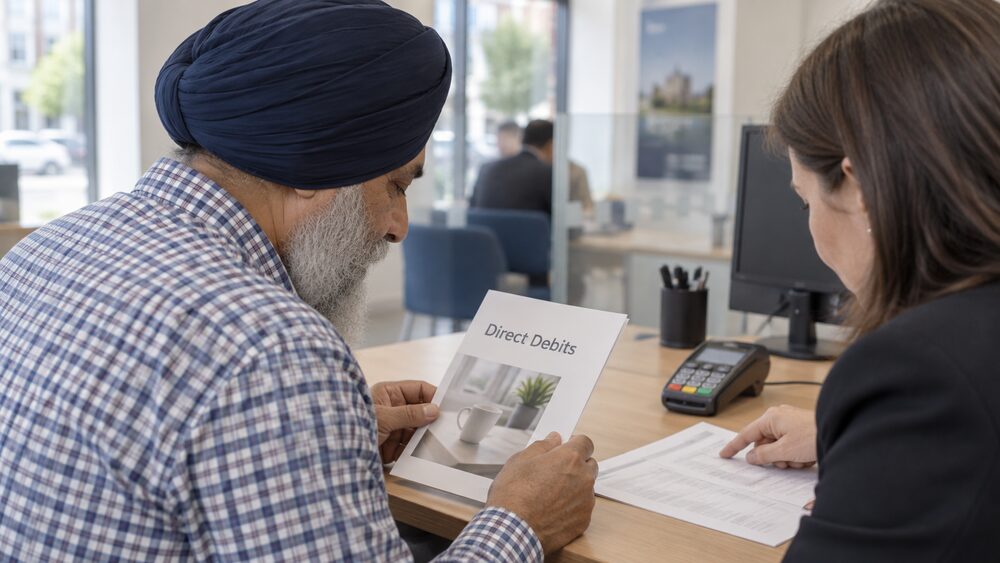
A Direct Debit and a standing order are both ways of paying the same amount regularly from your current account, but the person controlling the payment is different. With a Direct Debit, you give a business or organisation permission to collect money from your account, usually for bills or subscriptions1. With a standing order, you give your bank an instruction to pay a set amount to a person or organisation at regular intervals1. That single difference drives everything else: who can change the amount, how you cancel, what protection you have and what happens when a payment fails.
Both are very widely used. In 2025 there were 5 billion payments made by Direct Debit, an increase of 2% on the year before, and 551 million standing orders2. Direct Debit is forecast to keep growing, reaching 5.4 billion payments in 2035, with standing orders expected to reach 586 million2.
Direct Debit or standing order: who controls the payment
The core distinction is who sends the instruction. A Direct Debit is set up by the company you are paying, using your sort code and account number; a standing order is set up by you, with your bank3. With a Direct Debit, you provide a business with your bank account details and give it permission to take money from your account, usually on an agreed schedule4. With a standing order, you decide the amount, the date and how long the payments run, and the amount stays the same unless you amend your instruction3.
This makes each one suited to different jobs. Direct Debits are often used for mortgage, phone, energy or gas bills, where the amount changes as the bill changes3. Standing orders are typically used for rent payments, monthly charity donations and regular payments into a savings account, where the amount is fixed3. A debt charity that collects plan payments notes the same split: a third party paying by Direct Debit completes a mandate form that gives permission to collect, while a standing order payer simply arranges the transfer themselves5.
The flexibility is the main advantage of a Direct Debit, because the payments can vary in amount or frequency3. That flexibility is also the trade-off: you are trusting the company to take the right amount, which is why the Direct Debit Guarantee exists. A standing order gives you full control but no flexibility, and if the amount you need to pay changes, you must amend the instruction yourself.
Setting up each one: details you need and how long it takes
To set up a Direct Debit, you give the company you are paying your name and bank details, and the company arranges the payment6. What you are asked for varies by organisation. DVLA, for setting up vehicle tax by Direct Debit, asks for your address, date of birth and your bank or building society account details7. The details you need for a standing order are the amount you want to send, a payment reference, when you want the money to leave your account and how long you would like the payments to continue6.
Standing orders can be set up yourself, usually through online banking6. Direct Debits cannot be set up by you at all: only the company collecting the money can create the mandate, which is why you hand over your details rather than entering them in your banking app.
How long the set-up takes is worth knowing if a first payment is due soon. HMRC guidance on voluntary Class 2 National Insurance contributions says to allow 21 working days to set up a Direct Debit if you have not set one up before8. Revenue Scotland says setting up Direct Debit payments for Land and Buildings Transaction Tax may take up to 10 days9. The timing depends on the organisation, so if a first payment deadline matters, check with the company before relying on the mandate being live.
Both types of payment are available on even the most basic accounts. Basic bank account holders can set up Direct Debits and standing orders, use a debit card, have income paid in and check their balance10. Guidance on getting a bank account confirms that a basic account is designed to allow exactly these regular payments11.
Changing or cancelling: the deadlines that matter
A standing order is yours to change or cancel whenever you like, by contacting your bank1. The practical deadline matters: Which? advises doing this at least three working days before the payment is due3. National Debtline puts the latest point at usually before the close of business on the working day before the payment is due12. If you leave it later, the payment may still go out.
A Direct Debit can also be cancelled at any time by contacting your bank or building society, though written confirmation may be required, and the organisation being paid is normally notified as well3. It does not matter whether you owe money to the company or not: if a Direct Debit is cancelled, your bank should ensure no payments are taken3. Cancelling the payment is not the same as cancelling the underlying contract, so any money still owed remains payable under the contract with the company.
The law sets a cut-off of its own. Under the payment services regulations, in the case of a Direct Debit the payer may not revoke the payment order after the end of the business day preceding the day agreed for debiting the funds13. In other words, once the working day before collection has ended, the payment can no longer be stopped. The same regulations also protect you in the other direction: your bank must not debit your account before it has received the payment order13.
When a company changes a Direct Debit, it must tell you first. The Financial Ombudsman states that "the business must always notify you before making any changes to payments"1. Guidance on regular payments puts this notice at usually 10 days for changes to amounts or payment dates14, and a government guide to National Insurance paid abroad describes notifying you "10 working days in advance of your account being debited"15. Research on flexible payments for people on low incomes notes that a company changing the payment day cannot do so without giving at least 10 days' notice16.
The Direct Debit Guarantee protects you; a standing order has no guarantee
Direct Debits are covered by the Direct Debit Guarantee. The Financial Ombudsman explains how it works: if the bank, or the organisation you are paying, makes a mistake, your bank must refund the payment to you1. Which? makes the same point in its guidance: Direct Debits give you more consumer protection under the guarantee3. The guarantee also underpins the notification rules described above: the company must tell you in advance of any change to the amount, date or frequency17.
The guarantee has real teeth when a bank fails to act. In one ombudsman case study, a customer asked their bank to cancel a Direct Debit and the bank failed to do it; the ombudsman reminded the bank of its responsibilities under the Direct Debit Guarantee scheme, which covers exactly this sort of situation, and the customer got their money back18. Complaints about Direct Debits reach the ombudsman in numbers: 113 complaints about Direct Debits were opened in the first quarter of 2026/2719.
A standing order has no equivalent. You are not protected if a standing order payment goes out in error, so it matters that you enter the correct information in the first place3. Because you set the instruction yourself, the bank is carrying out your orders, and there is no third-party guarantee standing behind the amount or the recipient. If you send a standing order to the wrong person, your options are the ones covered on paid money to the wrong person by mistake.
The guarantee is also relevant when you are choosing how to pay for things in less obvious situations. StepChange notes that with push payment scams, your money is not protected unless you pay by credit card or Direct Debit20. The same protection gap explains why the type of recurring payment matters, as the next section on continuous payment authorities sets out.
When there isn't enough money: failed payments and charges
If a Direct Debit or standing order is presented and there is not enough money in your account, the payment can fail, and charges can follow. MoneyHelper warns that bounced Direct Debits and standing orders can leave you facing heavy bank charges, so it is worth making sure there is enough money in your account21. Citizens Advice notes that if you have set up a Direct Debit and there is not enough money to pay for it, you might be charged11.
Charges for failed payments are not evenly spread. Fair By Design's research describes a "volatility premium" affecting millions of people, which includes charging people if they do not have the exact amount of money in their account at the same time every month, a problem that falls hardest on people paid irregularly22. Timing your payments to your income is one way to reduce the risk: StepChange suggests changing your Direct Debits and standing orders to go out at the same time, soon after income arrives23.
Some protections limit what can be charged. FCA mortgage rules state that a firm must "not pass on any costs to the [customer] which were incurred as a consequence of presenting direct debit requests" where those requests have been refused in each of two consecutive months because of insufficient funds24. Citizens Advice explains a related point about the bank's right of set-off: setting aside money for priority bills will not stop the bank paying out Direct Debits or subscriptions, and the bank might add charges if there is not enough money in the account25.
Two further points are worth knowing. First, never simply stop paying a bill because you are struggling: during the payment freezes offered in 2020, the condition was that there must have been an agreement with your lender, because cancelling Direct Debits unilaterally records a missed payment default26. Second, if you are struggling with regular payments generally, free debt advice is available from charities such as StepChange and National Debtline, and the debt section of this site sets out the options.
Continuous payment authorities are not Direct Debits
A continuous payment authority (CPA), sometimes called a recurring transaction, is set up by giving a company your credit or debit card details rather than your bank account details27. The FCA defines it as consent given by a customer for a firm to make one or more requests to a payment service provider for one or more payments from the customer's payment account28. It is a type of recurring payment that lenders can set up on a customer's card account, with permission to take payments when they are due29.
CPAs are popular for magazine subscriptions, gym memberships, some debt collection agencies and payday loans30. They behave differently from Direct Debits in ways that catch people out: they can be hard to cancel, and the company can change the amount and the payment date27. Crucially, recurring card payments are not covered by the Direct Debit Guarantee4, and nidirect's guidance for Northern Ireland states plainly that a CPA "doesn't have the same guarantee" compared with a Direct Debit31.
You do have rights. You can cancel a CPA directly with your card issuer, by writing to it asking for the payment to be stopped32. If money is taken after you have withdrawn the CPA, your card issuer should give you a refund, including any interest or charges added to your account because the payment was taken12. In an ombudsman case study, a customer asked their bank to cancel a continuous payment authority and the bank cancelled the card; the ombudsman looked at whether the bank had handled the cancellation correctly29. There are also limits on repeated attempts: a CPA must not be used more than twice to recover money from your bank account31, and FCA consumer credit rules state that where a customer is in financial difficulties, a firm must not request payment on a CPA more than twice on the same agreement once it has already been refused33.
StepChange summarises the position: payments made by CPA are not covered by the Direct Debit guarantee, but the law offers you similar protections30. The dedicated page on the Direct Debit Guarantee and cancelling recurring card payments covers this in more detail.
What happens to your regular payments when you switch bank
If you switch using the Current Account Switch Service, your Direct Debits and standing orders are moved to your new account automatically as part of the switch. The rules behind this are set in legislation: the date from which standing orders and Direct Debits are executed must be at least six business days after the receiving provider receives the transferred documents34. The practical effect is that the switch is arranged so that no payment is missed in the gap between accounts.
A full switch closes your old account, and payments sent to the old account after the switch are redirected. Which? has reported that banks have worked together to make sure Direct Debits, standing orders or bill payments are automatically redirected35. The switching Direct Debits page covers what happens to individual payments, and payments to your old account after switching covers stragglers.
A partial switch, where the old account is kept open, is different. The main downside is that the service guarantee does not apply, so there is no automatic refund for any charges incurred as a result of a Direct Debit or standing order failing to transfer properly36. Citizens Advice Scotland describes the position where a transfer is arranged directly with the bank: where there is an arrangement in place, the bank or building society must transfer any account balance and make arrangements for Direct Debits and standing orders, and no bank charges should arise from mistakes or delays in the transfer37. The partial switching page sets out the trade-offs.
One warning applies around any switch: scammers use changes to sort codes and account details as a pretext. Which? has reported on scams that begin with a claim that your bank is changing your sort code, and advises checking directly with your bank before acting on any such message35. Never give your account details to someone who contacts you out of the blue.
Why Direct Debits often cost less to pay bills
Paying by Direct Debit is frequently the cheapest way to pay a regular bill. Fair By Design notes that Direct Debits "tend to be a cheaper way to pay for bills"38. Age UK's guidance on getting the best energy deal states that paying by Direct Debit "will generally save you hundreds of pounds a year compared with paying by cash, card or cheque"39. MoneyHelper makes the same point: you can get money off your bills by using Direct Debit to pay most energy and telephone companies, and many companies, councils and organisations give a discount for people paying this way21.
The size of the discount varies by company, so it is worth asking. Age UK's guidance on money transfers notes that you might get a discount by paying bills by Direct Debit and suggests speaking to the company to find out6. For energy specifically, National Debtline's cost of living guidance explains the mechanism: usually paying by Direct Debit allows you to be on your energy supplier's cheapest tariff, so your bill may increase a little if you cancel the Direct Debit40. Business Debtline's budgeting guidance makes the same point for household bills generally: gas and electricity may cost less if you pay by monthly Direct Debit from a bank account32.
The discount works both ways, and that is the trade-off to understand before cancelling a Direct Debit to regain control of payment dates. If you cancel an energy Direct Debit, you keep control of when you pay but you may lose the cheapest tariff40. For people whose income arrives irregularly, that saving can be hard to hold onto: Fair By Design's research on the volatility premium found that being charged for not having the exact amount in your account at the same time every month is part of what makes regular payment methods expensive for people paid irregularly22. A separate account for bills, with Direct Deits or standing orders set up on it, is one way some households manage this32.
Sources40 cited
- Regular payments Financial Ombudsman Service, 2026
- Payment Markets Report 2026 Summary UK Finance, 2026-08
- Direct debits and standing orders explained Which?, 2026
- Recurring card payments Financial Conduct Authority, 2025-06-23
- How to make your first DMP payment StepChange, 2026-09-25
- Online money transfers Age UK, 2026-03-23
- Tax your vehicle without a V11 reminder GOV.UK, 2026-09-25
- Pay Class 2 National Insurance GOV.UK, 2026-09-26
- How to pay LBTT Revenue Scotland, 2024-09-11
- Safe bank accounts National Debtline, 2026-09-25
- Getting a bank account Citizens Advice, 2026-09-25
- Payday loans National Debtline, 2026-09-25
- Payment Services Regulations 2017, Part 7 legislation.gov.uk, 2017
- Credit card bills due on bank holidays Which?, 2022-01-22
- Guidance on social security abroad NI38 GOV.UK, 2026-07-07
- Flexible payments for low-income consumers University of Bristol PFRC, 2024-10
- Safer ways to pay Consumer Council Northern Ireland, 2026
- Customer complains about bank failing to cancel a direct debit Financial Ombudsman Service, 2026-09-26
- Quarterly complaints data Q1 2026/27 Financial Ombudsman Service, 2026
- How to spot, avoid and report scams StepChange, 2026-09-25
- Make your money easier to manage by yourself MoneyHelper, 2026-09-25
- New report uncovers volatility premium for millions Fair By Design, 2024-11-22
- How can I stop living in my overdraft? StepChange, 2026-09-25
- MCOB 13.3 FCA Handbook, 2014-04-26
- Bank overdrafts Citizens Advice, 2023-01-10
- Coronavirus: what it means for mortgages, savings, borrowing and benefits Which?, 2020-10-31
- Dealing with payday loan debt StepChange, 2026-09-25
- FCA Handbook glossary G3308 Financial Conduct Authority, 2026-09-26
- Customer asks bank to cancel a continuous payment authority Financial Ombudsman Service, 2026-09-26
- Cancelling recurring payments or CPA StepChange, 2026-09-25
- Payday loans nidirect, 2026-02-25
- Your business and household budget Business Debtline, 2026-09-26
- Buy now pay later National Debtline, 2026-09-25
- The Current Account Switch Service regulations 2015 legislation.gov.uk, 2015-12-15
- Is your bank changing your sort code? Make sure you're not being scammed Which?, 2017-06-27
- How to switch your bank account Which?, 2026-09-07
- Getting a bank account (Scotland) Citizens Advice Scotland, 2026-09-26
- The poverty premium in 2026: payments Fair By Design, 2026-05-28
- Getting the best energy deal Age UK, 2026-09-10
- Cost of living: making the most of your money National Debtline, 2026-09-25


 MoneyHelperFree, impartial money and pensions guidance, set up by government
 FSCSProtects your money if a bank, insurer or investment firm fails
 Financial Ombudsman ServiceFree, independent help when a complaint about a firm is not put right
 Citizens AdviceFree advice on money, consumer and legal problems in England and Wales