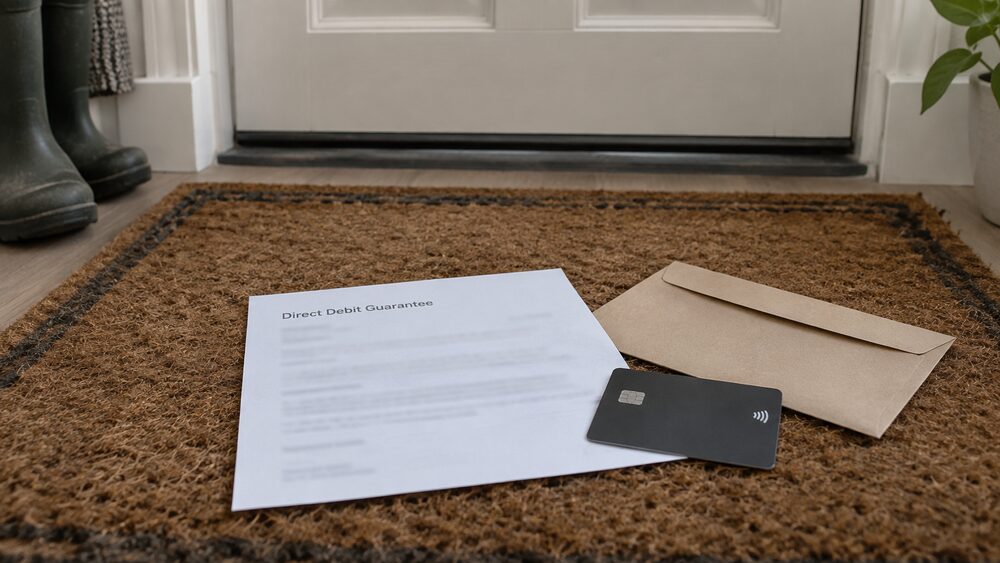
Every Direct Debit in the UK comes with a promise from your bank or building society: if a payment is taken in error, you get a full and immediate refund. That promise is the Direct Debit Guarantee, and it applies to all banks and building societies taking part in the direct debit scheme1. It is one of the reasons Direct Debits give you more consumer protection than most other ways of paying regular bills1.
The Guarantee covers three things: an immediate refund when a payment is taken in error, advance notice of any change to the amount, date or frequency of a payment, and the right to cancel a Direct Debit at any time through your bank2. It does not cover payments taken from your debit or credit card, which work under different rules3. This page explains what the Guarantee covers, how to claim a refund, how to cancel a Direct Debit, and how to stop recurring card payments, which are sometimes called continuous payment authorities.
What the Direct Debit Guarantee covers
The Direct Debit Guarantee is a set of protections that applies to every Direct Debit taken from a UK current account. All banks and building societies that operate the Direct Debit Scheme are committed to providing it for their customers4. You do not have to apply for it, pay for it, or check whether your particular bank offers it: if the payment is a Direct Debit, the Guarantee applies1.
The Guarantee rests on the way Direct Debits are built. The company you are paying, called the originator, does not hold your card details. Instead, it collects payments through your bank under a mandate you have given, and the beneficiaries of Direct Debits are subject to careful vetting procedures before they are allowed to collect payments this way1. Once approved, they are required to give indemnity guarantees through their banks1. That structure is what makes the refund promise possible: your bank stands behind the payment, so your bank is where you go when something goes wrong.
In practice the Guarantee gives you three protections. First, if an error is made, you get your money back immediately. Second, you must be told in advance about any change to the amount, date or frequency of the payment. Third, you can cancel at any time by dealing with your bank rather than the company. Each of these is covered in detail below.
Direct Debits are also, in general, a cheaper way to pay for bills than other methods5, and paying household bills by Direct Debit generally saves hundreds of pounds a year compared with paying by cash, card or cheque6. The flexibility is another advantage: the payments can vary in amount or frequency, which suits bills that change, such as energy1. The difference between Direct Debits and standing orders, where you set the amount yourself, is covered in Direct Debits and standing orders.
Full and immediate refund: how the Guarantee pays out
The core of the Guarantee is the refund. If a payment error is made by the company you are paying, or by your bank or building society, you are entitled to a full and immediate refund of the amount paid2. Which? puts it plainly: your bank should refund disputed payments without question, pending further investigation1. The investigation happens after you have your money back, not before.
Banks state this in their own terms. Cater Allen, for example, tells customers that in some situations they are entitled to a full refund under the Direct Debit Guarantee, and that the refund is made immediately7. The refund comes from your bank, not from the company that took the payment, which is why the claim route is different from a card payment dispute.
How a Direct Debit Guarantee refund claim works, from first contact to the Financial Ombudsman Service.
The refund rule also has a basis in law. Under the Payment Services Regulations 2017, which govern payment transactions in the UK, the payer is entitled to an unconditional refund from its payment service provider of the full amount of certain direct debit transactions10. So the Guarantee is not just a scheme promise: it sits alongside a legal right.
The refund also covers cases where the fault lies with the company collecting the payment rather than the bank itself. The bank is responsible for refunding the customer in the event of a mistake, even if the original error was made by the organisation collecting the payment11. The Guarantee's terms are broad on this point: if an error is made in the payment of a Direct Debit, by the originator or by the bank or building society, the customer is entitled to a full and immediate refund of the amount paid11.
If your bank refuses a refund you believe you are owed, complain to the bank first, using its formal complaints process. If the bank does not put things right, you can take the complaint to the Financial Ombudsman Service, which is free and covers complaints about banking and regular payments9. The ombudsman has published case studies showing it reminding banks of their responsibilities under the Guarantee, including a case where a bank failed to cancel a Direct Debit12.
10 working days' notice of changes to amount, date or frequency
The second protection is notice. If there are any changes to the amount, date or frequency of your Direct Debit, the company must notify you in advance2. The standard measure of that notice is 10 working days: official guidance states that you will be notified 10 working days in advance of your account being debited13, and Macmillan's guidance for people managing money during illness likewise says the company needs to tell you about any change to the amount and the payment date in advance, normally 10 working days before payment is due14.
The rule matters most with bills that move around, such as energy. Under the Direct Debit Guarantee, an energy supplier must tell the customer about any changes to their Direct Debit, and the day of a Direct Debit cannot be changed without at least 10 days' notice being given15. The same pattern appears from the other direction in research on flexible payments for low income consumers: a company cannot change the payment day without giving at least 10 days' notice15.
If a company takes a changed amount without giving proper notice, that is an error, and the refund route above applies: contact your bank and ask for the payment to be refunded under the Guarantee. The notice rule is also the reason to check statements when a bill is due to change, because the refund works best when you spot the problem quickly.
Where the Direct Debit Guarantee does not apply
The Guarantee is specific to Direct Debits. It does not follow the money to other payment methods, and the boundaries matter.
- Card payments. Recurring card payments taken from a credit or debit card are not covered by the Direct Debit Guarantee3. The FCA is clear on this, though it also notes that the law offers similar protections for card payments, set out below.
- Bank transfers and card payments under the scam refund rules. The mandatory reimbursement scheme for scam victims does not apply to debit or credit card payments, international transfers or cryptocurrency transactions16.
- Payments to companies under debt assignment arrangements. Households paying by Direct Debit or standard credit are not protected by the Debt Assignment Protocol, a Scottish policy statement on energy debt noted17.
- Variable recurring payments. Newer open banking payment methods, where you agree to a series of variable payments, have no equivalent to the Direct Debit Guarantee as things stand1.
- Partial bank switches. If you move payments to a new bank without using the full Current Account Switch Service, you are not covered by the service guarantee, so you are not automatically refunded for charges incurred if a Direct Debit fails to transfer properly18.
For card payments, separate protections exist but they are narrower. Section 75 of the Consumer Credit Act gives additional protection on credit card purchases, but it applies only to credit card purchases, not debit card purchases19. StepChange notes that with push payment scams, your money is not protected unless you pay by credit card or Direct Debit20. The practical point: if you are choosing how to pay a regular bill, the Direct Debit carries the Guarantee and a card payment does not.
How to cancel a Direct Debit
A Direct Debit can be cancelled at any time by contacting the bank or building society, and written confirmation may be required; the Guarantee also states that the payee company should be notified2. The cancellation is done through the bank, which is what makes it reliable: as Which? notes, it does not matter whether money is still owed to the company, because once a Direct Debit is cancelled the bank should ensure that no further payments are taken1.
The steps in order:
- Contact your bank or building society, by app, online, phone or in branch, and ask for the Direct Debit to be cancelled.
- Provide written confirmation if the bank asks for it.
- Notify the company you were paying, so it knows to stop billing you this way.
- Check your next statement to confirm no payment was taken after the cancellation date.
Some cancellations happen automatically. If you tell DVLA you no longer need vehicle tax, for example, and you pay by Direct Debit, the Direct Debit will be cancelled automatically21.
If money is tight, free debt advice is available before you cancel. National Debtline, Business Debtline and StepChange all publish guidance on when cancelling a Direct Debit is the right step and what to do about the underlying bill22. Bounced Direct Debits and standing orders can leave you facing heavy bank charges, so it is worth making sure there is enough money in your account for payments you keep23. The rules on overdraft charges are covered in overdraft charges.
Recurring card payments are not covered by the Guarantee
A recurring card payment, formally a continuous payment authority or CPA, is set up by giving a company your credit or debit card details24. In the FCA's glossary it is consent given by a customer for a firm to make one or more requests to a payment service provider for one or more payments from the customer's payment account25. In everyday terms, it is what happens when you give a gym, a subscription service or a lender your long card number rather than setting up a Direct Debit.
The FCA states it directly: recurring card payments are not covered by the Direct Debit Guarantee3. StepChange makes the same point, adding that the law offers similar protections26. The differences that matter in practice:
- Who holds the authority. With a Direct Debit, the mandate sits with your bank. With a CPA, the company holds your card details and requests payments when they fall due.
- Changes to the amount. A CPA can be hard to cancel and can change the amount and payment date24, without the 10 working days' notice rule that applies to Direct Debits.
- Attempts to collect. A CPA must not be used more than twice to recover money from your bank account27, and FCA rules state that where a customer is in financial difficulties, a firm must not request payment on a continuous payment authority more than twice on the same agreement once it has already been refused28.
CPAs are a popular method of payment for magazine subscriptions, gym memberships, some debt collection agencies and payday loans26. They are also used by buy now pay later companies, which is why debt charities publish specific letters for withdrawing a CPA from a buy now pay later company29.
How to stop a continuous payment authority
You have two routes to stop a CPA: contact the company taking the payment, or cancel directly with your card issuer. The second route is the stronger one. Once you have asked your card issuer to cancel, it must stop the payments immediately30, and the FCA states that once you have asked them to, your card issuer must stop the payments, even if you have not contacted the business3. This right comes from the Payment Services Regulations 2017, under which your bank or card provider must cancel the payment authority31.
The steps in order:
- Contact your card issuer, by app, online, by phone or in writing, and ask for the continuous payment authority to be cancelled.
- Put the request in writing if you can. Debt charities provide sample letters for withdrawing a CPA from your card issuer32, from a payday loan company33 and from a buy now pay later company29.
- Confirm with the card issuer that the authority has been stopped, and ask when it takes effect.
- Check your statement for any payment taken after the cancellation.
The same right applies if you were misled or tricked into agreeing to a CPA in the first place: you have rights under the Payment Services Regulations 201734.
If the card issuer cancels your card instead of the authority, that is not the same thing. The Financial Ombudsman has published a case study where a customer asked their bank to cancel a CPA and the bank cancelled the card, leaving the underlying authority in place35. If your bank offers to cancel the card rather than the payment authority, be clear that you want the authority itself withdrawn, and complain if payments continue.
Direct Debit or card payment: how each one behaves
Side by side, the two payment methods behave differently at every step that matters: how they are set up, what protection they carry, how changes are handled, and how they are cancelled.
The two regular payment methods compared on setup, protection, notice of changes and cancellation.
The Direct Debit route carries the Guarantee, the 10 working days' notice rule and cancellation through your bank1. The CPA route carries no Guarantee, but the law requires your card issuer to stop payments once you ask, and limits collection attempts on a single agreement3. nidirect's guidance on payday loans notes of the CPA that it does not have the same guarantee as a Direct Debit27.
For regular household bills, Direct Debits tend to be the cheaper way to pay5, and paying by Direct Debit generally saves hundreds of pounds a year compared with paying by cash, card or cheque6. For credit card payments specifically, Section 75 of the Consumer Credit Act adds protection on credit card purchases that debit cards do not have19. The choice between the methods is covered further in Direct Debits and standing orders, and the newer variable recurring payment options, which as things stand have no equivalent to the Guarantee, are covered in variable recurring payments.
Switching bank: what happens to regular payments
A full switch using the Current Account Switch Service moves your regular payments with you. Banks guarantee that payments in and out of your new account are switched over in time so that you do not miss any regular bills and payments36. Direct Debits are part of that guarantee, which is one reason a full switch is usually smoother than moving payments by hand. How the service works is covered in the Current Account Switch Service.
A partial switch is different. If you keep your old account open and move only some payments, you are not covered by the service guarantee, so you are not automatically refunded for any charges incurred as a result of a Direct Debit or standing order failing to transfer properly18. What happens to Direct Debits in each case is covered in what happens to Direct Debits when you switch, and the partial route in partial switching.
If you are in debt and worried about a lender taking payments from your account, a basic bank account or an account with a bank you do not owe money to can keep your income separate. National Debtline's guidance on safe bank accounts explains this option37, and it is covered on this site in basic bank accounts.
Refunds you must pay back, and debts that remain
The Guarantee refunds payments taken in error. It does not cancel debts you genuinely owe, and it does not turn every refund into money you keep.
- A refund is not debt forgiveness. If a payment is refunded under the Guarantee because it was taken in error, that is the end of it. But if you cancel a Direct Debit or a CPA while still under contract, the money you owe remains your responsibility to pay3.
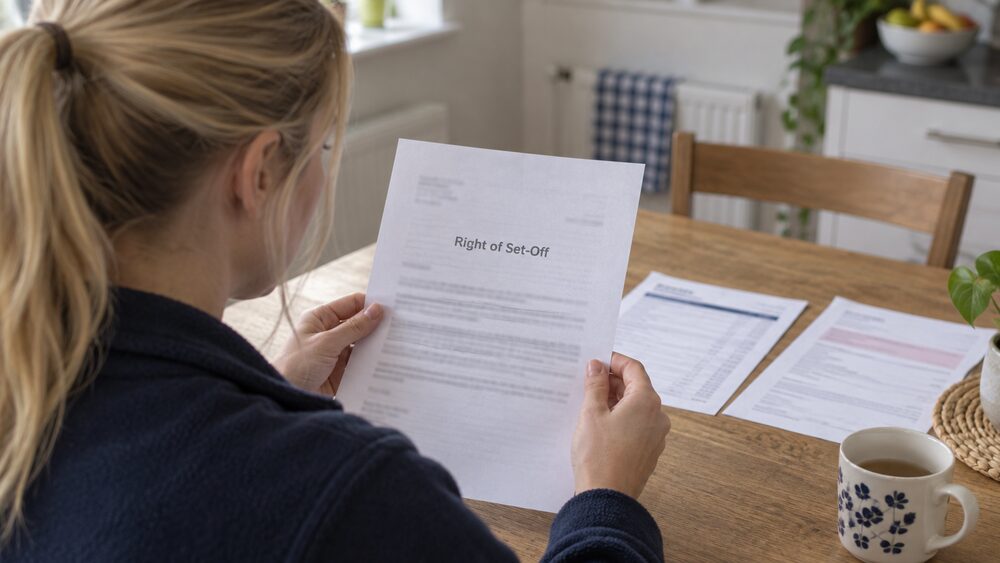
- The bank can take money it is owed. Under FCA banking conduct rules, if a firm has set off a debt against a consumer's subsistence balance or protected money, it should refund the sum debited unless it is fair not to do so, and if it does not refund it should be able to justify that it is fair not to do so and consider other remedial action38. How banks use their right of set-off is covered in the bank's right of set-off.
- Some borrowed money must always be repaid. Maintenance loans must be paid back39, and Budgeting Loans from the Social Fund also have to be repaid40. A Direct Debit refund does not touch these obligations.
- Guarantor debts pass on. If you guaranteed someone's loan, you have to pay back what they owe41.
The line to hold onto: the Guarantee protects the payment mechanism, not the underlying contract. If a company took money it should not have, the refund is yours. If the money was properly owed and you stopped the payment, the debt remains, and the company can pursue it through normal routes. Free debt advice before cancelling is the safer path, and the charities listed below will talk through whether cancelling a particular payment is the right step for your situation22.
Getting free help
Several free, independent services can help with Direct Debit problems, recurring card payments and the debts behind them:
- MoneyHelper, the government backed money guidance service, including guidance on managing regular payments when illness or disability makes money harder to handle23.
- National Debtline and Business Debtline, which provide sample letters for withdrawing continuous payment authorities from card issuers, payday loan companies and buy now pay later companies, and guidance on when to cancel a Direct Debit22.
- StepChange, which covers your rights on cancelling recurring payments and dealing with payday loan debt26.
- The Financial Ombudsman Service, which deals free of charge with complaints about banks failing to refund under the Guarantee or failing to cancel a Direct Debit or CPA9.
If a payment has gone wrong, the order to follow is: your bank first, then its formal complaints process, then the ombudsman. For the debt behind the payment, the charities above will talk through the options before anything is cancelled.
Sources41 cited
- Direct debits and standing orders explained Which?, 2026
- Safer ways to pay Consumer Council for Northern Ireland, 2026
- Recurring card payments Financial Conduct Authority, 2025
- Payment methods factsheet Building Societies Association, 2023
- The poverty premium in 2026: payments Fair By Design, 2026
- Getting the best energy deal Age UK, 2026
- Personal terms and conditions Cater Allen, 2026
- The Direct Debit Guarantee Together, 2026-09-26
- Regular payments complaints Financial Ombudsman Service, 2026
- Payment Services Regulations 2017, Part 7 legislation.gov.uk, 2017
- Fraudulent payments Financial Conduct Authority, 2016
- Customer complains bank failing to cancel direct debit Financial Ombudsman Service, 2026
- Guidance on Social Security Abroad NI38 GOV.UK, 2026
- Managing money when you have cancer Macmillan Cancer Support, 2022
- Flexible payments for low income consumers University of Bristol PFRC, 2024
- How scam refund rules are reducing fraud Which?, 2026
- Ofgem statutory consultation on acquisition only tariffs Consumer Scotland, 2024
- How to switch your bank account Which?, 2026
- Consumer Credit Act and Section 75 Which?, 2025
- How to spot, avoid and report scams StepChange, 2026
- Vehicle tax refund GOV.UK, 2026
- Cost of living: making the most of your money National Debtline, 2026
- Make your money easier to manage MoneyHelper, 2026
- Dealing with payday loan debt StepChange, 2026
- FCA Handbook glossary G3308 Financial Conduct Authority, 2026
- Cancelling recurring payments or CPA StepChange, 2026
- Payday loans nidirect, 2026
- Buy now pay later guide National Debtline, 2026
- Withdraw your continuous payment authority from a buy now pay later company National Debtline, 2026
- Payday loans guide Business Debtline, 2026
- Consumer advice: payment authorities Isle of Anglesey County Council, 2025
- Withdraw CPA from your card issuer letter National Debtline, 2026
- Withdraw CPA from payday loan company letter National Debtline, 2026
- Consumer advice: misleading payment agreements Isle of Anglesey County Council, 2025
- Customer asks bank to cancel CPA, bank cancels card Financial Ombudsman Service, 2026
- Safe bank accounts guide National Debtline, 2026
- Student money and debt guide National Debtline, 2026
- BCOBS 5, FCA Handbook Financial Conduct Authority, 2026
- Student money and debt guide (EW) Business Debtline, 2026
- Budgeting Loans Turn2us, 2026
- Debts not in my name StepChange, 2026


 MoneyHelperFree, impartial money and pensions guidance, set up by government
 FSCSProtects your money if a bank, insurer or investment firm fails
 Financial Ombudsman ServiceFree, independent help when a complaint about a firm is not put right
 Citizens AdviceFree advice on money, consumer and legal problems in England and Wales