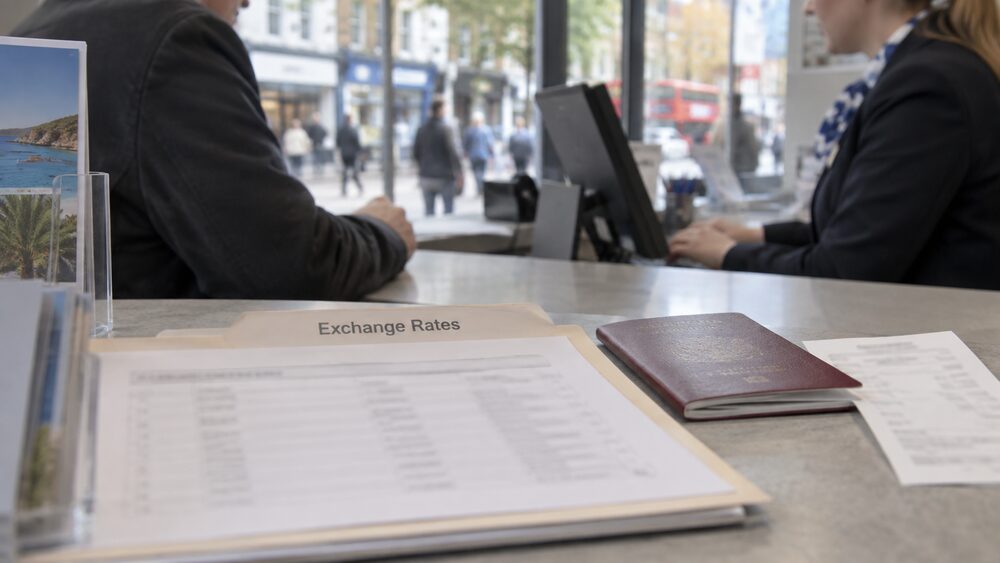
Bank Rate is 3.75%, and the Bank of England says higher interest rates can increase the value of the pound compared to other currencies1. That single sentence is the whole of the direct link between the two. Bank Rate is not set to manage the exchange rate, and the pound moves on far more than one announcement.
Bank Rate is 3.75%, and the Bank of England says higher interest rates can increase the value of the pound compared to other currencies1. That single sentence is the whole of the direct link between the two. Bank Rate is not set to manage the exchange rate, and the pound moves on far more than one announcement.
What the link means in practice is that when UK interest rates look more attractive relative to rates elsewhere, money tends to move towards sterling, and the pound can strengthen. When rates are cut, or when markets expect cuts, that pull weakens. The effect is rarely clean or immediate, and it can be reversed within days by inflation figures, jobs data or events overseas.
For a household, the pound's value shows up in three places: the cost of holiday money and anything bought in another currency, the interest earned on savings, and the interest paid on variable-rate borrowing. This page sets out how each of those works, how Bank Rate reached 3.75%, and what happens next.
Bank Rate: 3.75% and what it is
Bank Rate is the rate of interest the Bank of England pays to commercial banks, building societies and financial institutions that hold money with it5. It is the core interest rate in the UK, and setting it is the Bank's job6. Because those institutions can earn Bank Rate by leaving money with the Bank of England, it sets the floor against which they price their own lending and savings.
It is 3.75% now, following the decision on 17 September 20261. Barclays describes it in the same terms: the rate the Bank of England charges other banks and other lenders when they borrow money, currently 3.75%7. The Monetary Policy Committee voted to hold the base rate at 3.75% at that meeting8.
The rate applies to institutions, not to you directly. What reaches your household is the second-round effect: the interest a bank pays on your savings, the rate on a variable mortgage, the cost of an overdraft. A variable rate can change at any point, typically reflecting a change in Bank Rate9.
Bank Rate is also not the only thing that sets the price of borrowing. Lenders price fixed mortgage deals off swap rates and gilt yields, which move on expectations of future Bank Rate rather than the current level, so a fixed deal can get more expensive even on a day when Bank Rate is held.
Higher rates can strengthen the pound
The Bank of England states the mechanism plainly: higher interest rates can also increase the value of the pound compared to other currencies3. HSBC puts it the same way: higher interest rates can increase a currency's value10.
The reasoning is about relative returns. If sterling deposits pay more than deposits in another currency, holding sterling becomes more attractive, demand for it rises, and its price in other currencies tends to rise with it. The reverse applies when UK rates fall or when markets expect them to fall faster than rates elsewhere.
Two qualifications matter for anyone planning around this. First, the Bank of England does not set Bank Rate to manage the pound. Its remit is inflation, and higher rates work on prices by reducing how much money is spent in the UK3. The currency effect is a by-product, not the target. Second, exchange rates respond to expectations as much as decisions. A hold that was widely expected can move sterling less than the wording of the announcement that follows it.
How Bank Rate has moved: from 0.1% to 5.25% and back down
The recent cycle is the clearest illustration of how far and how fast Bank Rate can travel. The Bank of England interest rate rose from 0.1% in December 2021 to 5.25% in August 20234. Over that period the Bank raised interest rates 14 consecutive times11, and the bank rate was increased 13 times from 0.25% to 5.25% between January 2022 and August 202312.
The peak of 5.25% in August 2023 is the figure to remember for the recent period11. It is not the highest Bank Rate on record. In the years between 1975 and 2007, Bank Rate was 3.5% at its lowest point and 17% at its highest1.
The descent since then has been gradual. The Bank of England reduced interest rates twice in 2024, in August and November, from 5.25% to 4.75%11. In 2024 the base rate was cut four times, each by 0.25 percentage points, in February, May, August and December14. Interest rates were then lowered three times in 2025 by the Monetary Policy Committee, from 4.75% to 4%15. The Financial Ombudsman Service's own worked example of compensation interest shows the path in steps: 4.75% from 15 January 2025 to 5 February 2025, 4.50% from 6 February 2025 to 7 May 2025, and 4.25% from 8 May 2025 to 6 August 202516.
What a Bank Rate change means for your borrowing, savings and holiday money
Borrowing. A base rate change affects existing lending customers with overdrafts or loans linked to the Bank of England base rate17. Where a loan is on a variable rate, a rise means you are likely to pay more interest on what you have borrowed18. Tracker products move fastest: Virgin Money's Current Account Tracker terms say changes in Bank Rate may be made at any time and will normally be applied on the same or the next business day19. Mortgage lenders have more room. Afin Bank says it will give notice of any change to Bank Rate and to your monthly payment within a reasonable time after the change, and that changes take effect immediately and may be notified after they have affected your monthly payment20.
Savings. Banks set their own savings rates, and they do not have to follow Bank Rate. NS&I says its Direct ISA rate is variable and can be changed up or down from time to time, for example when the Bank of England base rate changes or when rates in the general savings market change21. Halifax says that for savings you might have with your bank, you could see an increase in the amount of interest you earn18, and that it might review the interest rate if Bank Rate changes22. Lloyds Bank's Easy Saver terms say the rate can change over time and may be reviewed if Bank Rate changes22.
Holiday money. This is where the currency link becomes concrete. A stronger pound buys more foreign currency for the same number of pounds, so the same holiday costs less in sterling terms. A weaker pound does the opposite. The rate you actually get also depends on the provider's margin, any commission and the day you transact, which is why the timing of one Bank Rate decision is a small part of the total cost.
Fixed or tracker: how each one behaves
The choice between a fixed and a variable rate is really a choice about who carries the risk of Bank Rate moving.
| Type of deal | How it responds to Bank Rate | What it means for the household |
|---|---|---|
| Fixed rate | Does not move during the fixed period | Payment is predictable; the rate you get reflects market expectations at the time you take it out |
| Tracker | Moves with Bank Rate, often on the same or next business day19 | Payment rises and falls with each decision |
| Standard variable rate | Can be influenced by Bank Rate but does not have to follow it23 | Lender decides when and by how much to move |
| Discount mortgage | Set at a discount to the lender's standard variable rate | Moves when the lender's standard variable rate moves, not directly with Bank Rate25 |
For anyone whose fixed deal is ending, the relevant question is not what Bank Rate is today but what deals cost now. Independent guidance notes that the base rate was forecast to be cut in March, which would put downward pressure on rates in the medium term26, but forecasts change and are not commitments.
Where the pound's value reaches your money
The exchange rate is not a single number that applies to everyone. It depends on what you are doing.
- Buying holiday cash or loading a travel card: the rate offered by the provider, less any commission or fee.
- Spending on a card abroad: the card scheme's rate on the day, plus any non-sterling transaction fee your card charges.
- Sending money overseas: the provider's exchange rate plus its transfer fee, which together make up the total cost.
- Receiving income in another currency: the rate on the day the money is converted.
Because each of these has its own margin, two people changing the same amount on the same day can get different outcomes. The Bank Rate decision moves the underlying market rate; the provider's margin decides how much of that movement reaches you.
Next decision: Thursday 5 November
The Bank of England will announce its next decision on Thursday 5 November 20261. The Monetary Policy Committee's next meeting is scheduled for that date27, and the next review is due on 5 November 20268.
There is a conflict in the published material about the timetable. One Bank of England page gives the next decision as Thursday 5 November 20261, while another gives 17 September 202628. One provider page gives 5 November 20268 and another gives 5 October 20266.
On frequency, the sources also differ. Independent guidance says the base rate is usually voted on by the Monetary Policy Committee eight times a year2, while the Bank of England describes making its decision on interest rates every six weeks or so1. The two descriptions do not match exactly.
Bank Rate has been kept unchanged at 3.75% at the last four Monetary Policy Committee meetings29. The decision is based on the financial state of the UK economy, including inflation, employment figures and consumer confidence30. The Bank of England does not publish a forecast path for Bank Rate, so any expectation of a rise or a cut is a market or commentator view, not a commitment.
What protects you if a rate move goes wrong
The rules that matter here are about how a change is communicated and what you can do if it is not.
- Notice of changes. Lenders set their own notice terms. Afin Bank's terms say it will give notice of any change to Bank Rate and to your monthly payment within a reasonable time after the change20.
- Variable rate terms. NS&I's Direct ISA terms state the rate is variable and can be changed up or down from time to time21.
- Complaints. If you are unhappy with how a firm has applied a rate change, you can complain to the firm first and then take the complaint to the Financial Ombudsman Service if it is not resolved.
- Compensation interest. From 1 January 2026, the Financial Ombudsman Service's compensation interest rate will track the Bank of England's base (average) rate plus 1%31.
"The new rate will track the Bank of England's base (average) rate +1 %."
Where the protection stops: Bank Rate itself is not a consumer protection. It is a monetary policy tool. Nothing in the rules guarantees that a savings rate will rise when Bank Rate rises, or that a mortgage rate will fall when Bank Rate falls. Standard variable rates can be influenced by Bank Rate without having to follow it23.
If a rate change leaves you struggling with debt, free and impartial help is available from StepChange and from MoneyHelper. StepChange explains how interest charges work and what options exist32, and its guidance on a mortgage term ending covers what happens when a deal finishes33.
Sources33 cited
- Current interest rate Bank of England, 2026-09-17
- Bank of England base rate and your mortgage Which?, 2026-06-23
- How do higher interest rates help to lower inflation? Bank of England, 2023-05-11
- The Bank of England interest rate House of Commons Library, 2026-07-08
- What are interest rates? Bank of England, 2026-07-30
- Savings accounts Raisin UK, 2026-09-17
- Base rate information Barclays, 2026
- Fixed rate bonds Raisin UK, 2026-09-17
- What do I need to know about debt? Bank of England, 2025-08-19
- How do exchange rates work? HSBC, 2026
- Understanding the cost of living crisis in Scotland Scottish Government, 2025-02-12
- Households' finances and saving, UK: 2020 to 2024 Office for National Statistics, 2024-07-22
- Understanding the cost of living crisis in Scotland Scottish Government, 2023
- Bank of England base rate and your mortgage Which?, 2026-06-23
- Scottish Economic Insights, September 2025 Scottish Government, 2025-08
- Guidance on our new interest awards Financial Ombudsman Service, 2026-09-26
- Bank of England base rates: recent changes TSB, 2026
- What are interest rates? Halifax, 2026-09-27
- Interest rates and fees Virgin Money, 2026
- Rates, fees and charges Afin Bank, 2025-07-31
- Direct ISA NS&I, 2026-09-04
- Easy Saver Lloyds Bank, 2026-09-27
- Standard variable rate mortgages Which?, 2026-04-02
- Mortgage term ending StepChange, 2026-09-25
- Discount mortgages Which?, 2026-09-25
- What to do if you need to remortgage Which?, 2026-02-18
- What's happening to the base rate? Which?, 2026-09-17
- A decade of falling incomes Joseph Rowntree Foundation, 2025-08
- Scottish housing market review, Q2 2026 Scottish Government, 2026-07-17
- Residential mortgages Precise Mortgages, 2026-09-26
- Financial Ombudsman Service announces change to compensation interest levels Financial Ombudsman Service, 2026
- Understanding interest charges StepChange, 2026-09-25
- Scottish economic bulletin, November 2024 Scottish Government, 2025-02-12









 MoneyHelperFree, impartial money and pensions guidance, set up by government
 Citizens AdviceFree advice on money, consumer and legal problems in England and Wales
 GOV.UKOfficial information on tax, benefits and government services
 StepChangeFree debt advice and solutions from a charity
 FSCSProtects your money if a bank, insurer or investment firm fails