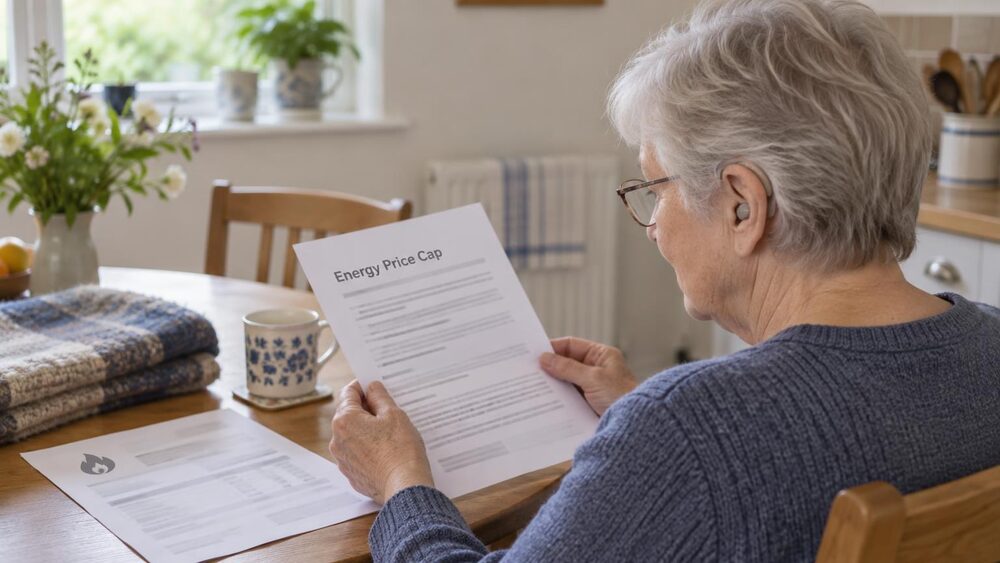
The energy price cap is the limit on how much energy suppliers can charge per unit of gas and electricity, and per day in standing charges, if you are on a standard variable or default tariff. It was introduced by Ofgem in 2019 to ensure fair prices for customers who don't actively switch energy provider1, and it applies to all households in Great Britain, meaning England, Scotland and Wales2. It does not apply in Northern Ireland, which has a separate energy market.
Between 1 July and 30 September 2026 the cap stood at £1,663 a year for a typical dual fuel household paying by direct debit3. From 1 October 2026 it increased by 4%, to £1,723 a year for the same typical household3. That headline number is not a limit on what you can be charged in total: the cap works on the price of each unit of energy, so a household that uses more than the typical amount pays more, and one that uses less pays less.
What the energy price cap is and who it covers
The price cap is a regulatory limit set by Ofgem, the energy regulator for Great Britain. It applies to most households in Britain and aims to protect customers by setting a maximum amount that suppliers can charge4. Its main purpose is to shield people who do not switch tariff or supplier, since those customers historically paid some of the highest prices in the market1.
The cap covers households on standard variable tariffs, the default deals customers move onto when a fixed deal ends or when they have never switched. It also covers prepayment customers: a separate cap for prepayment meters was one of the proposals that followed the Competition and Markets Authority's investigation into the energy market, and an illustrative model published by the UK government shows how that cap is calculated and updated in each region, for each fuel and for each period5.
The cap has not always been the only protection in place. During the energy crisis of 2022 and 2023 the UK government's Energy Price Guarantee sat below it: the government set maximum prices for gas and electricity that were lower than those under the existing price cap, and compensated suppliers for selling below cap prices3. Typical household bills were frozen at £2,500 under that guarantee from October 20226, before the guarantee level moved to £3,000 from April 20237. The Energy Price Guarantee is covered in detail on its own page.
The cap limits unit prices and standing charges, not your total bill
This is the point most often misunderstood. The price cap is effectively a cap on the price charged for each unit of energy, rather than a cap on your total bill8. As Turn2us puts it, the Energy Price Cap is not applied to your total energy bill, it is applied to each individual unit of energy9.
"Your bill is not capped. It is based on how much energy you use."
In practice this means two households on the same capped tariff can pay very different amounts over a year. A large home with poor insulation, or a household with high energy needs because of a disability or medical equipment, will pay more than the typical figure even though every unit is priced at or below the cap. A small flat that uses little gas will pay less. The standing charge, the fixed daily fee for being connected, is also capped, and you pay it regardless of how much energy you use.
The cap also does not apply if you are paying for a fixed tariff, so a household that has fixed its rate is protected in a different way, by the terms of that deal rather than by Ofgem's cap8.
Current cap rates: unit prices and standing charges per day
Under the July to September 2026 direct debit cap, the average price of electricity is 26.1 pence per kilowatt hour (p/kWh) and the average price of gas is 7.3 p/kWh. Average standing charges are 57.2 p/day for electricity and 29.0 p/day for gas3.
| Charge | July to September 2026 average | Change from 1 October 2026 |
|---|---|---|
| Electricity unit price | 26.1 p/kWh | rising 1% to 26.3 p/kWh, including the removal of VAT from electricity bills for six months3 |
| Gas unit price | 7.3 p/kWh | gas unit charges rising 8.8%10 |
| Electricity standing charge | 57.2 p/day | falling 4.1%10 |
| Gas standing charge | 29.0 p/day | rising 0.7 p/day, a 2.2% increase3 |
These are averages across Great Britain: the actual capped rates on your bill depend on your region, your payment method and your meter type, which is covered below.
Standing charges have been a persistent concern for consumers. In November 2025, energy customers paying by direct debit on an average price-capped tariff had standing charges of 53.68p per day for electricity and 34.03p per day for gas11. Standing charges have risen sharply over the crisis years: average standing charges increased by 13% for electricity and 6% for gas in the April to June 2024 cap alone3. Because the standing charge is paid no matter how much energy you use, it hits low-use households and homes that are empty for part of the year hardest.
How Ofgem sets the cap every three months
Ofgem reviews and resets the price cap every three months8. The level reflects what it costs suppliers to buy energy, with the wholesale price of gas and electricity the largest single driver. The 12-week assessment period used by Ofgem to calculate the July to September 2026 (Quarter 3) price cap ran from 18 February to 18 May 202612.
Each announcement covers the following quarter. The cap running from 1 October to 31 December 2026 was announced on 26 August 20269; the next announcement is due on 25 November 2026 for the period from 1 January to 31 March 2027, and the one after that on 23 February 2027 for April to June 20279.
The cap's level has moved a great deal since the crisis, and the recent path shows both directions:
| Period | Typical annual bill under the cap |
|---|---|
| April to June 2021 | £1,13813 |
| October to December 2023 | £1,8237 |
| January to March 2024 | £1,7233 |
| April 2024 | £1,69014 |
| October to December 2025 | £1,75515 |
| April to June 2025 | £1,84915 |
| January to March 2026 | £1,75816 |
| April 2026 | £1,64113 |
| July to September 2026 | £1,6633 |
| October to December 2026 | £1,7233 |
The cap level also feeds directly into the official inflation figures. The Office for National Statistics noted that Ofgem estimated the July 2026 cap equated to an annual bill of £1,862 for an average household paying by direct debit for dual fuel, a rise of £22112, and a decrease in the cap caused domestic energy prices and annual gas and electricity inflation to fall from April 202617. The 12.6% increase in the Energy Price Cap was reflected in Scottish economic reporting for the following quarter18. How this fits the wider picture is explained in what inflation is and how it affects your money.
Forecasts of future cap levels are made by analysts, not by Ofgem, and they change with wholesale prices. In late 2025 the forecaster Cornwall Insight was predicting a substantial decrease to £1,669 in April 202619, while forecasts in spring 2026 suggested the cap could rise by around 10% in July 2026, taking a typical bill to roughly £1,80120. Neither proved exact, which is the usual fate of these forecasts: treat them as indications of direction, not promises.
Why the cap varies by region, meter and payment method
There is no single national cap. A separate price cap is set for each of the 14 energy supply regions and applies throughout that region3. Within each region, the cap varies by payment method and by the type of electric meter, for example a standard meter or an Economy 7 meter10. The prepayment cap has its own calculation model, worked out for each region and each fuel for each period5.
The regional differences reflect what it actually costs to supply energy in different parts of the country, including the costs of the local distribution networks. Meter type matters because some meters, such as Economy 7, charge different rates at different times of day, so the cap sets different maximum day and night unit prices for them. Payment method matters because suppliers face different costs and risks in collecting money by direct debit, by cheque or cash on receipt of a bill, or in advance from a prepayment meter, and those differences are passed into the capped rates.
Direct debit, standard credit or prepayment: what each costs under the cap
The typical bill figures quoted with the cap, including the £1,663 and £1,723 figures for 2026, are for households paying by direct debit3. Households who pay their bills on receipt of bill, rather than by direct debit, pay around £143 more per year for their energy21. Fair By Design's analysis of the standard credit premium in 2025 argued that this premium bears hardest on people who cannot get a direct debit set up, often because of low income or irregular income, and that the premium is not always clearly explained, meaning consumers cannot make an informed choice about their payment method22. Ofgem's own move towards outcomes-based regulation has highlighted that less than half of people who pay by standard credit understand that they are paying a premium to do so23.
Prepayment customers have historically paid a premium too, and Ofgem has been reviewing ways to permanently remove the premium on prepayment meter prices since April 202424. The capped charges are inclusive of all costs associated with energy bills, including a £28 fee levied to recover debt owed to suppliers10.
The cap also sits above the cheapest deals in the market. Research published in 2026 found that dual fuel customers paying by direct debit on an Energy Price Cap tariff paid a premium of £171 a year compared with the best fixed rate tariff available25. The cap is a ceiling on default prices, not the lowest price on offer: households that can switch to a cheaper deal generally pay less than the cap allows.
How the typical bill figure is worked out
The £1,663 and £1,723 figures are not averages of what households actually pay. They are what a household with a defined "typical" level of consumption would pay over a year at the capped rates. For the January to March 2026 cap, the typical household was defined as using 2,700 kWh a year of electricity and 11,500 kWh a year of gas, equating to an annual bill of £1,75819. These assumptions are called Typical Domestic Consumption Values, and Ofgem revised them in July 2026; one official series records the revised values for the typical dual fuel household as 95,000 kWh gas and 2,500 kWh electricity, which does not agree with the figures used for the January cap, so the two documents conflict on the revised amounts10.
Because the figure is worked out for a typical household, it is better read as a way of comparing one quarter's cap with another than as a prediction of your own bill. Which? expresses the same figures monthly: under the July to September 2026 cap, typical energy bills for a medium use household were around £1,663 a year, or £139 a month, and in October the cap rose by £5 per month for a medium use household, to around £1,723 a year, or £144 a month1.
The longer view shows how far bills have risen. Bills for typical consumption under the October to December 2026 price cap will be 58% higher than in winter 2021/223, and a typical household's energy bill will have risen by 58% since winter 2021 by the time the October increase takes effect26. From October 2025 to October 2026, using Ofgem's new consumption values, the energy price cap increased by around 10%, from £1,576.4427. Even after falls in 2025 and early 2026, the July to September 2026 level was still 18% higher than its recent low in July to September 20243. The headline figure of £1,834 quoted in November 2023 was based on the same kind of typical household using a medium amount of gas and electricity and paying by direct debit28.
Where the price cap does not apply
The cap does not apply to fixed tariffs1. If you are on a fixed deal, your rates are set by the contract you signed, and the cap neither limits nor changes them. This works in both directions: a fixed tariff can be cheaper than the cap, or it can be more expensive if wholesale prices have fallen since you fixed.
Some variable products also fall outside the cap. Tracker tariffs, which follow wholesale prices, are not covered by the Ofgem price cap, and usually have a higher supplier-set cap or no cap at all. Standard variable green tariffs from some suppliers, including Ecotricity, Good Energy and Green Energy UK, are also not covered by the Ofgem price cap, so there is no limit on what you can be charged on them29. Checking whether a tariff is capped before signing is set out in Citizens Advice's guidance on choosing an energy tariff29.
Northern Ireland is outside the cap altogether. Energy prices in Northern Ireland are not controlled by the price cap3, because the market there is separate, with different suppliers and a different regulator. Since October 2023 the cheapest prices from Northern Ireland's largest supplier have been higher than prices under the cap in the rest of the UK3. This is covered in energy prices in Northern Ireland.
Struggling to pay: your rights with your supplier
If you cannot pay your energy bill, your supplier has obligations and options it must offer you. You can ask your energy supplier for a review of your payments or debt repayments, payment breaks or reductions, more time to pay your bills, access to hardship funds, and Priority Service registration4. Citizens Advice sets out that you can ask your supplier to delay your bill, remove late payment charges, and allow you to pay over a longer period, and that some suppliers offer hardship grants if you cannot pay your bills29. If you cannot afford to top up your prepayment meter, contact your energy supplier to check whether they have grants available30.
There are rules protecting you in debt. Ofgem's existing rules on back billing mean that customers cannot be charged for energy used more than 12 months ago if they have not had an accurate bill for it before32. Ofgem is currently assessing suppliers' performance against its billing rules to determine whether the current rules are fit for purpose, and is reviewing the timeframe within which suppliers can retrospectively bill customers where the error is the supplier's fault; it has already warned suppliers that they would face fines if they continued to send inaccurate bills34.
The scale of the problem is documented by the regulator's own research. Ofgem estimates the average debt level where there is no arrangement to repay was £1,617 for electricity accounts and £1,376 for gas accounts in March 2025, while the average debt remaining where there is an arrangement to repay was £715 for electricity consumers and £581 for gas consumers14. Ofgem research also found that 29% of consumers who fell behind on their energy bills had no contact from their supplier about it, and only 14% were contacted proactively14. Ofgem put in place new and updated rules at the end of 2023 to make it easier for domestic customers to contact their supplier32, and 3.6% of gas and electricity customers are in arrears with no arrangement to repay the debt32.
Suppliers can move indebted customers onto prepayment meters only under tightly regulated circumstances: Ofgem started to allow suppliers to re-engage in this practice from January 202414, having asked all suppliers to pause forced and remotely switched prepayment installations in February 2023 until new guidelines were agreed35. Ofgem has also announced that some energy suppliers can start installing involuntary prepayment meters again under these rules36, so a household in debt should engage with its supplier early rather than wait for enforcement action.
Where to get help
Free, independent help is available, and it is worth using before debt builds up:
- Citizens Advice provides free advice on energy bills, tariffs and what to ask your supplier29.
- StepChange, the debt charity, publishes information on grants and funding for energy bills, including supplier hardship schemes and the Energy Company Obligation, under which your supplier may fund part of an efficiency improvement and ask you to pay some of the cost yourself36.
- Shelter Cymru advises households in Wales on energy payment problems and how to avoid gas and electricity disconnection35.
- One Parent Families Scotland offers support and advice on help with fuel costs37.
- Age UK provides information for older households, including on meters and prepayment premiums24, and on the cost of living payments and supplier help available4.
- Turn2us explains the price cap and the support available if you are struggling with energy bills9.
If you switch supplier, there are also service guarantees: if your new supplier does not meet the five-working-day deadline for the switch, you are owed £40 compensation from your new supplier38.
Ofgem itself is moving towards a more outcomes-based approach to regulation, meaning it will be clearer about the outcomes it expects suppliers to achieve while being less prescriptive about how they deliver them, beginning with a first outcome that "Consumers receive accurate, timely, accessible and understandable energy bills"23. Citizens Advice, responding to the latest cap rise, noted that the increase pushes energy prices to a three year high39, which is the context in which these protections matter most. For how energy costs fit the wider rise in prices since 2021, see the cost of living crisis.
Sources39 cited
- What is the energy price cap? Which?, 2026
- Energy saving tips Scope, 2026
- Energy price cap research briefing CBP-9714 House of Commons Library, 2026
- Cost of living payments Age UK, 2026
- Domestic prepayment energy price cap illustrative model GOV.UK, 2016
- Cost of living bill: key statistics Scottish Government, 2022
- Energy Price Guarantee research briefing CBP-9722 House of Commons Library, 2023
- Energy tariffs explained Which?, 2026
- Energy price cap Turn2us, 2026
- Fuel poverty scenario modelling based on Ofgem energy price caps up to October to December 2026 Scottish Government, 2026
- Energy standing charges: what are they and could you pay less? Which?, 2025
- Consumer price inflation, July 2026 Office for National Statistics, 2026
- Insights from the 2026 energy affordability tracker Consumer Scotland, 2026
- Insights from the 2025 energy affordability tracker Consumer Scotland, 2025
- Scottish economic insights, September 2025 Scottish Government, 2025
- Scottish economic bulletin, December 2025 Scottish Government, 2025
- Household costs indices for UK household groups, April to June 2026 Office for National Statistics, 2026
- Scottish economic insights, September 2026 Scottish Government, 2026
- What changes are coming for energy bills in 2026 Which?, 2025
- April 2026 bill rises: what's going up and expert tips to cut costs Which?, 2026
- Our response to the May 2026 energy price cap announcement Fair By Design, 2026
- Standard credit price cap 2025 Fair By Design, 2025
- Will outcomes based regulation help lead to better energy bills? Fair By Design, 2026
- Energy meters Age UK, 2026
- Poverty Premium 2026 University of Bristol Personal Finance Research Centre, 2026
- The cost of living: ongoing pressures and recent developments Senedd Research, 2026
- More than a third of Brits worried about affording energy bills this winter Citizens Advice, 2026
- Every household to get £400 energy discount in cost of living measures Which?, 2023
- Choosing an energy tariff Citizens Advice, 2023
- Cannot afford to top up your prepayment meter: energy grants mygov.scot, 2026
- Emergency grants, loans and money help Shelter, 2026-07-03
- Powering up support University of Bristol Personal Finance Research Centre, 2025
- Help from charitable organisations Business Debtline, 2026-09-26
- Energy bills: why you should know about the back billing rules Which?, 2025
- How to avoid gas and electricity disconnection Shelter Cymru, 2026
- Grants and funding for energy bills StepChange, 2026
- Help with fuel costs One Parent Families Scotland, 2026
- Guide to switching energy supplier Which?, 2026
- Citizens Advice responds to latest Ofgem price cap Citizens Advice, 2026



 MoneyHelperFree, impartial money and pensions guidance, set up by government
 Citizens AdviceFree advice on money, consumer and legal problems in England and Wales
 GOV.UKOfficial information on tax, benefits and government services
 StepChangeFree debt advice and solutions from a charity
 FSCSProtects your money if a bank, insurer or investment firm fails