
Savings interest in the UK has one anchor: Bank Rate, set by the Bank of England. It is 3.75% now1, and it is the single most important number behind what banks and building societies pay on instant access accounts, fixed rate bonds and cash ISAs. The Government sets the Bank a target of getting inflation to 2%1, and Bank Rate is the main tool it uses to hit it.
The rate on your savings is not Bank Rate itself. It is whatever your provider chooses to pay, and providers move at different speeds and by different amounts. Over the past decade the averages have swung enormously: Bank Rate sat at 0.5% for years after the 2008 financial crisis, fell to 0.1% in December 2021, rose to a peak of 5.25% in August 2023, and has since been cut back to 3.75%2. A saver holding the same account through that period would have seen the interest they earn change beyond recognition.
This page explains how those numbers fit together: how Bank Rate feeds through to savings accounts, what the averages have done over time, how inflation and tax determine what interest is really worth, and how much UK households actually save. For how savings accounts themselves work, see the guide to savings accounts.
Bank Rate at 3.75%: where savings interest starts
Bank Rate is the core interest rate in the UK, and it is the Bank of England's job to set it5. It is not a rate anyone pays the Bank directly: it is the rate the Bank charges banks and building societies when they borrow from it, and it ripples out from there to every other rate in the economy, from mortgages and overdrafts to savings accounts. The Bank's statutory objective is monetary (price) and financial stability6, which in practice means keeping inflation at the Government's 2% target while keeping the financial system safe.
The level of Bank Rate matters to savers because it changes what it costs banks to hold and attract money. When Bank Rate is high, banks can earn more on the money they hold and can afford to pay savers more to attract deposits. When Bank Rate is low, the same logic pushes savings rates down. In December 2023, when Bank Rate was 5.25%, savings rates across the market were far higher than they are today7; with Bank Rate at 3.75%1, the room providers have to pay interest is correspondingly smaller.
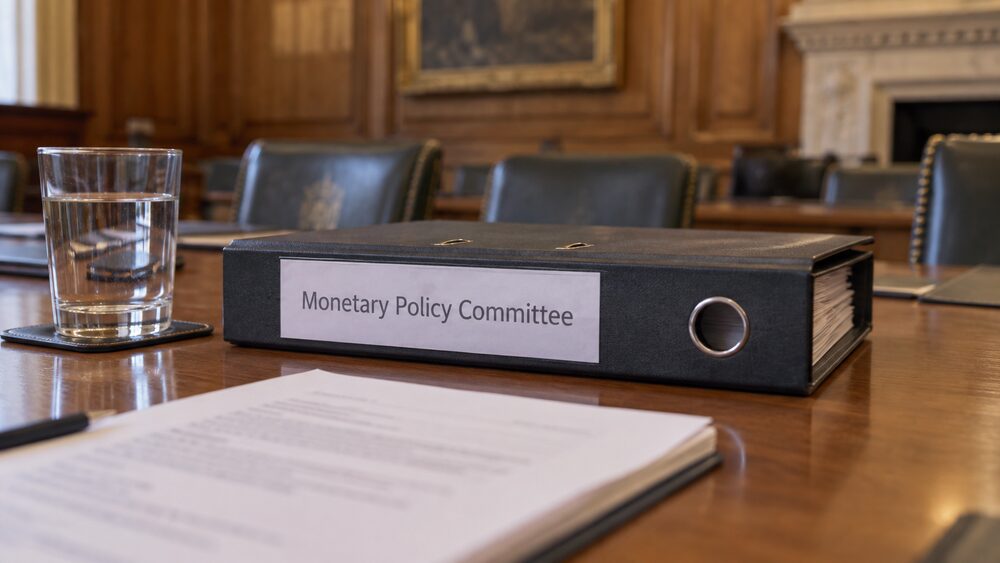
Bank Rate is decided by the Bank's Monetary Policy Committee, which meets roughly every six weeks. Each decision is announced with an explanation of the reasoning, and the full history of changes is covered in the guide to Bank Rate history. The wider economic context, including how rate decisions affect mortgages and borrowing, is in the complete guide to Bank Rate, inflation and the UK economy.
How Bank Rate feeds through to what savers earn
The interest rate on a savings account, sometimes called the savings rate, tells you how much money will be paid into your account, as a percentage of your savings5. If you have £100 saved and your interest rate is 3.5%, you will receive a total of £3.50 in interest over the course of a year8. That is the whole mechanism: the rate is a percentage of the balance, paid into the account, usually monthly or annually.
What the average saver earns depends on three things: the level of Bank Rate, how much of any change providers pass on, and what kind of account the money is in. The feed-through is not automatic and not instant.
Variable rate accounts, which include most instant access accounts, have rates the provider can change. NS&I, for example, states of its Direct ISA that "the rate is variable so we can change it up or down from time to time, for example when the Bank of England base rate changes or when rates in the general savings market change"9. Its Direct Saver carries the same wording10. So a variable rate can move after a Bank Rate change, but the provider decides when and by how much, and it can also move for reasons that have nothing to do with the Bank of England.
Tracker accounts follow a stated reference rate. Here the FCA's rules bite: for a savings account that tracks a reference interest rate, "the firm should indicate how the rate of interest is calculated and direct the banking customer to where the level of the reference interest rate may be accessed from time to time"11. A tracker that follows Bank Rate should therefore say so plainly, and the customer can check the underlying rate themselves.
Fixed rate accounts pay an agreed rate for a set term, whatever Bank Rate does in the meantime. The trade-off is access: the rate is locked, but so is the money, usually with penalties or no access at all until the term ends.
There are also rules protecting savers from silent rate cuts. Under FCA rules, a change to a rate of interest should always be considered material, and firms must give notice of it, except where the balance of the account is less than £100 at the time the firm would provide the notice11. So a provider cannot quietly reduce the rate on a variable account with more than £100 in it: it has to tell the customer first.
One more point on how rates move: central banks usually change their rates by 0.25%, but the Bank of England can alter Bank Rate by as little or as much as it needs to6. The step changes of the 2021 to 2023 period, when rates rose rapidly, and the cuts since, show how variable the pace can be.
From 0.5% to a 5.25% peak and back down
The past decade contains the full range of what UK savers have had to live with. In September 2014 the Bank of England base rate stood at 0.5%, where it had sat for years after the 2008 financial crisis12. Savings rates across the market were correspondingly minimal: with the anchor rate at 0.5%, instant access accounts commonly paid a fraction of one percent, and the tax rules of the time still carried a 10% starting rate for savings income13.
Then came the pandemic low. The Bank of England interest rate fell to 0.1% in December 20212, the lowest in the Bank's history, and savings rates followed it down. From there the direction reversed sharply: the rate rose to 5.25% in August 20232, a cycle of increases driven by inflation that peaked far above the 2% target. By December 2023 Bank Rate was still 5.25%7, and savers with variable accounts were earning more in nominal terms than at any point in the previous decade and a half.
The downward path since the peak has been steady. The Bank of England reduced interest rates twice in 2024, in August and November, from 5.25% to 4.75%16. In 2025 the Monetary Policy Committee lowered rates three times, from 4.75% to 4% by August17. By the second quarter of 2026 the Committee had kept Bank Rate unchanged at 3.75% at its last four meetings18. The feed-through of those higher rates to borrowing costs was already visible in 2024, when Bank Rate stood at 5% from August 202419.
What savers actually hold varies enormously, and the official statistics show it. In the 2021 to 2022 tax year, the highest proportion of ISA savers, around 46.2%, saved between £1 and £2,49920. By 2023 to 2024 that largest band had the same boundaries but a smaller share, around 30.7% of savers21, and 8.6% of savers on an income below £12,571 had at least £75,000 in ISA savings21. The tax treatment of savings income has also changed along the way: from 6 April 2015 the starting rate for savings income was reduced from 10% to 0%22, and for 2025-26 the savings starting rate band is £5,000, taxed at 0% where non-savings income is low enough, with 20%, 40% and 45% rates above the band4.
Inflation and savings: why the 2% target matters to your returns
The interest rate on a savings account is only half the story. The other half is inflation, because interest that does not keep pace with rising prices is a loss in real terms, whatever the balance says. The Government sets the Bank of England a target of keeping inflation at 2%6, and every savings rate has to be judged against that yardstick.
The recent history shows why. From a peak in October 2022, CPI inflation gradually reduced to reach the Bank of England's target rate of 2% by June 202416. At that point, a savings account paying above 2% was growing in real terms. But the path since has not been flat: the Bank's forecast published in late 2024 was for the inflation rate to rise to 2.8% in 2025 before gradually easing back towards 2% in 202716, and by September 2026 the Bank was projecting inflation to peak at 3.2% in the fourth quarter of 202623. A rate that comfortably beat inflation in mid-2024 may not beat it in late 2026.
This is the reason the 2% target matters directly to savers: it is the dividing line between money that is growing in real terms and money that is quietly shrinking. The guide to real returns covers this in detail, and the guide to what inflation is explains how the rate is measured.
Tax takes a slice as well. The savings basic rate will be increased by 2 percentage points to 22%, the savings higher rate to 42% and the savings additional rate to 47%, from 6 April 202724. Interest earned inside a cash ISA is free of income tax, which is one reason the ISA allowance matters to savers with larger balances; interest in an ordinary savings account is taxed once it exceeds the available bands and allowances. The starting rate band of £5,000 at 0%4 and the personal savings allowance between them shield many smaller savers from tax entirely, but the interaction is worth checking against your own income, and the guide to personal tax covers the rules.
What a typical balance earns: an example on £5,000
To see what a rate means in cash, take a balance of £5,000. At 3.5%, the rate used in NS&I's own worked example, £100 saved earns £3.50 over a year8, so £5,000 would earn £175 over a year at that rate. At 1%, the kind of rate that dominated the market when Bank Rate was near zero, the same £5,000 earns about £50 a year.
The long-run effect is larger than most people expect. An independent worked example of £5,000 in savings at 1% for 25 years gives £1,419 in interest earned26. That is the arithmetic of a low-rate decade and a half: the balance grows, but slowly, and whether it grows faster than prices is a separate question, as the inflation section above explains.
How much people actually have to earn interest on also varies hugely. The average saver has around £4,797 in easy access savings, according to evidence given to Parliament in 201727. On £500 at 3.5%, a year's interest is £17.50. The same rate on a large fixed sum produces a very different outcome, which is why the averages quoted in the press describe a wide range of individual experiences.
For most people the practical steps are unglamorous but effective: check the rate the account actually pays now (variable rates fall as well as rise), compare it with the inflation rate, and remember that interest inside an ISA is tax-free while interest outside it may not be. The guide to savings accounts covers the account types and how to compare them.
How much UK households save: the saving ratio explained
The household saving ratio is the official measure of how much the country saves. It estimates the amount of money households have available to save as a percentage of their gross disposable income, plus pension accumulations3. It is published quarterly by the Office for National Statistics as part of the UK Economic Accounts, and it moves with the economy: when incomes are squeezed or confidence falls, the ratio tends to rise as people build buffers, and when spending grows faster it falls.
The recent figures show both directions. The household saving ratio decreased during Quarter 1 2026 by 0.7 percentage points to 8.9%3. Before that it stood at 9.5% in Quarter 3 2025, a decrease of 0.7 percentage points driven by a fall in gross saving28, and at 10.7% in Quarter 2 202529, up from 10.5% in Quarter 1 202529. Further back, the ratio rose steadily to 11.1% in Quarter 1 202430, having been 10.1% in Quarter 3 2023, up from 9.5% in the previous quarter31.
The pandemic produced an extraordinary spike: the UK household saving ratio peaked at 27.4% in Quarter 2 (April to June) 202030, when spending opportunities collapsed and incomes were supported. Estimates of the total value of excess saving accumulated by UK households since the start of the pandemic range from £143 billion to £338 billion, between 7.9% and 18.7% of household annual total resources30. Some of that buffer has since been drawn down, which is part of why the ratio has fallen from its post-pandemic highs.
Beneath the average, the distribution is very uneven. The tenth of households with the most savings wealth was expected to receive an average of £20,000 each, before tax, from interest on their savings16. At the other end, the Family Resources Survey for 2023 to 2024 found that 18% of families had between £100 and £1,500 in savings32, and evidence to Parliament has put median average savings of households in Great Britain, including property, pensions and financial assets, at £233,000, while another 20% have less than £1,500 to cope with an unexpected event33. The narrow guide to what the household saving ratio is covers the calculation in more detail.
Where Bank of England rate decisions go next
Nobody outside the Committee knows what the next decision will be, and the Bank does not pre-announce it. What is known is the framework. The Bank's next rate decision was set for 17 September23, and decisions continue roughly every six weeks. The Committee's judgement rests on the inflation outlook: with the Bank projecting inflation to peak at 3.2% in the fourth quarter of 202623, the direction of Bank Rate depends on whether inflation is expected to return to the 2% target and how quickly.
For savers, the practical implication is that savings rates can move in either direction, and the averages of the past few years, from 0.1% to 5.25% and back to 3.75%2, show the full range of what is possible. Fixed rate accounts lock in today's rates but give up the chance to benefit if rates rise; variable accounts move with the market but can fall. The Bank has also used other tools alongside Bank Rate: it has used quantitative easing to stimulate the UK's economy since the 2008 financial crisis6, and the guide to quantitative easing explains how that works.
Rate decisions also reach places savers might not expect. The Financial Ombudsman Service's default interest rate, applied to some awards it directs financial service firms to make, is being revised to track the Bank of England's base (average) rate plus one percentage point34, and from 1 January 2026 the new rate tracks the Bank of England's base (average) rate +1%35. For complaints referred to the Ombudsman from 1 January 2026, the default is simple interest at the average Bank of England base rate plus one percentage point36, and the Ombudsman has also changed the interest rate to a time-weighted average of the Bank of England base rate plus one percentage point37. Government schemes use the Bank's figures too: Support for Mortgage Interest uses a standard interest rate based on the average mortgage rate published by the Bank of England38, and that standard rate changes when the Bank of England average mortgage rate differs by 0.5 percentage points or more from the rate in payment39.
Scams that use the Bank of England's name
Because the Bank of England sets interest rates, scammers use its name to lend credibility to fake savings offers. The Bank is explicit about what it will never do. It will never offer savings accounts, investments, cryptoassets or 'guaranteed returns'40. It will never contact you about unclaimed estates, refunds, fines or warrants; never ask you to move money 'for safety' or to 'release funds'; never verify your identity by requesting National Insurance numbers or bank statements, unless you are exchanging banknotes with it; never provide investment advice or endorsements; and never contact you from personal email addresses40.
"The Bank of England and its staff do not endorse, promote or advertise financial products."
The rule for savers is simple: the Bank of England does not want your money. Any call, email or advert that offers a savings account, a guaranteed return or a safe place to move your money "because the Bank of England is involved" is a fraud. Genuine savings providers are banks, building societies and NS&I, and their products are held in accounts in your own name. If you have been targeted, the Bank publishes guidance on reporting it40, and the guide to scams and fraud covers the wider warning signs and where to get help.
There is one related protection worth knowing. The Bank of England, as the operator of CHAPS, has set the maximum level for CHAPS APP (authorised push payment) scams reimbursement at £85,000 per claim41, which is the same level as the FSCS deposit protection limit. That covers high-value bank transfer scams through the CHAPS system; the rules for Faster Payments reimbursement are covered in the scams and fraud guide.
Sources41 cited
- Current interest rate Bank of England, 2026-09-17
- Bank of England interest rate briefing SN04769 House of Commons Library, 2026-07-08
- Quarterly sector accounts, January to March 2026 Office for National Statistics, 2026
- SA110 Notes 2026 HM Revenue and Customs, 2025-26
- What are interest rates? Bank of England, 2026-07-30
- Inflation and interest rates FAQ Bank of England, 2026-02-04
- Financial Stability Report, December 2023 Bank of England, 2023-12-06
- Saving your extra money NS&I, 2026-09-22
- Direct ISA NS&I, 2026-09-04
- Direct Saver product summary NS&I, 2026-08-18
- BCOBS 4.1, FCA Handbook Financial Conduct Authority, 2026-09-26
- CP14-20 consultation Financial Conduct Authority, 2014-09
- Income Tax Act 2014, section 3 notes legislation.gov.uk, 2026
- Understanding the cost of living crisis in Scotland, page 2 Scottish Government, 2025-02-12
- Bank of England base rate and your mortgage Which?, 2026-06-23
- Understanding the cost of living crisis in Scotland Scottish Government, 2025-02
- Scottish Economic Insights, September 2025 Scottish Government, 2025-08
- Scottish Housing Market Review Q2 2026 Scottish Government, 2026-07-17
- Scottish Economic Bulletin, November 2024 Scottish Government, 2024-08
- Annual Savings Statistics 2024 commentary HM Revenue and Customs, 2024-09
- Annual Savings Statistics 2026 commentary HM Revenue and Customs, 2023
- Interest rates on savings, House of Lords report House of Lords, 2015
- Scottish Economic Insights, September 2026 Scottish Government, 2026-09
- Budget 2025, Overview of Tax Legislation and Rates HM Government, 2027
- Income tax: changes to tax rates for property, savings and dividend income HM Government, 2025-11-27
- Offset mortgages Which?, 2026-04-02
- Written evidence to a parliamentary committee UK Parliament, 2017-12
- Quarterly sector accounts, July to September 2025 Office for National Statistics, 2025-12-22
- Quarterly sector accounts, April to June 2025 Office for National Statistics, 2025
- Households' finances and saving, UK: 2020 to 2024 Office for National Statistics, 2024
- Quarterly sector accounts, July to September 2023 Office for National Statistics, 2023-12-22
- Family Resources Survey, financial year 2023 to 2024 Department for Work and Pensions, 2023
- Written evidence on household savings UK Parliament, 2018-01
- New interest rate now applies to compensation awards Financial Ombudsman Service, 2026-01-01
- Financial Ombudsman Service announces change to compensation interest levels Financial Ombudsman Service, 2026
- Guidance on our new interest awards, from January 2026 Financial Ombudsman Service, 2026-01-01
- Policy Statement: interest on compensation awards Financial Ombudsman Service, 2026-09-26
- Support for Mortgage Interest guidance UK Parliament, 2023
- Support for Mortgage Interest briefing SN06618 House of Commons Library, 2026-09-26
- Scams and fraud Bank of England, 2026-06-18
- PS24/7: Faster Payments APP scams reimbursement, maximum level Payment Systems Regulator, 2024-10-07




 MoneyHelperFree, impartial money and pensions guidance, set up by government
 Citizens AdviceFree advice on money, consumer and legal problems in England and Wales
 GOV.UKOfficial information on tax, benefits and government services
 StepChangeFree debt advice and solutions from a charity
 FSCSProtects your money if a bank, insurer or investment firm fails