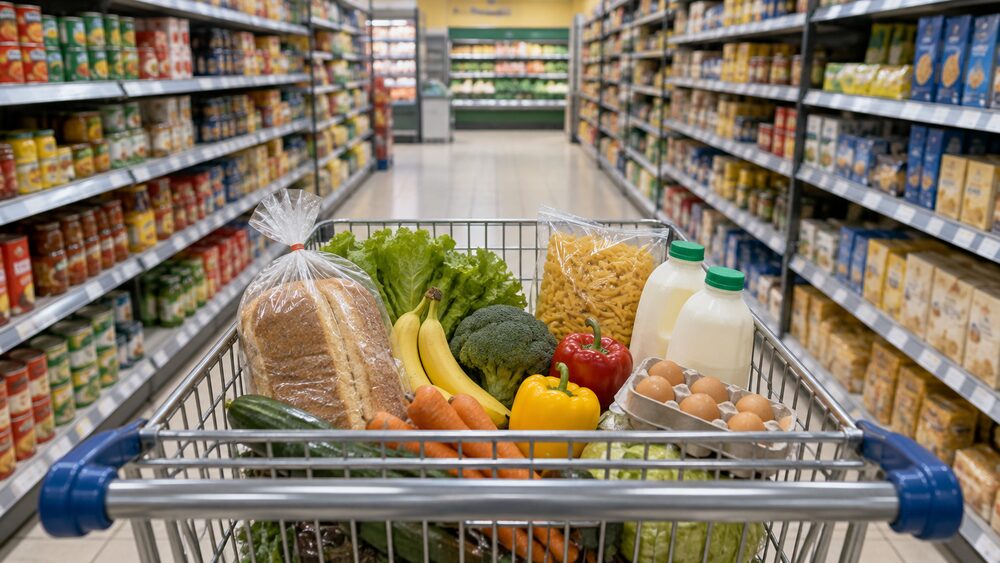
No. Falling inflation does not mean prices are going down. It means prices are still rising, just more slowly than before. If inflation drops from 3.1% to 2.6%, the average price of goods and services is still 2.6% higher than a year earlier. The rate of increase has slowed, but the level has not fallen.
No. Falling inflation does not mean prices are going down. It means prices are still rising, just more slowly than before. If inflation drops from 3.1% to 2.6%, the average price of goods and services is still 2.6% higher than a year earlier. The rate of increase has slowed, but the level has not fallen.
Inflation is conventionally quoted as an annual price change1. The Office for National Statistics works out the figure by comparing the cost of a basket of goods and services with what it cost a year ago1. So when the Bank of England says inflation reached 3.1% in August 2026, it means prices were 3.1% higher than in August 20252. They were not 3.1% lower. They were not even unchanged. They went up.
The only situation in which the general level of prices actually falls is deflation, when the inflation rate goes below zero3. That is rare, and it usually signals a recession rather than a bargain. For most households, the practical question is not whether prices are falling but whether the rate at which they are rising is slowing, and whether wages, benefits or savings are keeping pace.
What falling inflation actually means
Inflation is a rate of change, not a price level. When the rate falls, prices are still going up. A useful way to picture it: if a bottle of milk costs £1 and rises by 5p compared with a year earlier, milk inflation is 5%1. If the following year it rises by another 3p, inflation has fallen to about 3%, but the milk now costs more than it did two years ago. It has never gone back to £1.
The same logic applies across the whole basket. The ONS compares the cost of the basket, the level of CPI, with what it was a year ago1. A fall in the inflation rate means the gap between this year's basket and last year's is smaller than it was. The basket itself is still more expensive.
Inflation also erodes the purchasing power of money over time1. Even at a moderate rate, the effect compounds. At 2.0% inflation each year, £1,000 would be worth £820 after 10 years in terms of what it can buy6. That is why a moderate level of inflation is considered healthy for the economy, because it helps drive economic growth, but it still means money held in cash loses value1.
Why prices still rise when inflation falls
The inflation rate is an average. It is calculated from hundreds of goods and services, each with its own price change. Some rise faster than the headline figure, some rise more slowly, and some fall. When the average falls, it does not mean every item has become cheaper.
Food is a common example. Overall inflation has fallen over the year, but the price of some things, most notably food, continues to rise at a considerably faster rate than the headline rate of inflation8. A household that spends a larger share of its income on food will feel inflation differently from one that spends more on, say, transport or leisure.
The ONS publishes a separate measure, the Household Costs Index, designed to show how inflation feels to different types of household9. It exists because the headline rate is an average that may not match any individual household's experience. A pensioner household and a family with young children buy different things, so the same headline figure can translate into very different pressures.
When prices do actually fall
Individual prices fall all the time, even when overall inflation is positive. The most striking recent example is energy. Electricity, gas and other fuel prices fell by 18.3% in the 12 months to March 20244. That was a real fall in the price of a specific category, driven by a reduction in Ofgem's energy price cap from April 20269.
House prices are another category where falls happen. In London, prices decreased by 3.3% in the 12 months to July 2026, the lowest of any English region and the eleventh consecutive annual fall5. Earlier in the year, London prices fell by 2.1% in the 12 months to April 202610. On a monthly basis, London house prices fell by 1.9% since January 2026 as of February 202611, and by 0.1% since June 2026 as of July 202612.
These are genuine price falls, but they are category-specific. They do not mean the general price level is falling. They mean that within an overall rising price level, some things got cheaper.
| Category | Change | Period | Source |
|---|---|---|---|
| Electricity, gas and other fuel | Fell 18.3% | Year to March 2024 | 4 |
| London house prices | Fell 3.3% | Year to July 2026 | 5 |
| London house prices | Fell 2.1% | Year to April 2026 | 10 |
| London house prices | Fell 1.9% | Since January 2026 | 11 |
| London house prices | Fell 0.1% | Since June 2026 | 12 |
What deflation is and why it is not the same as falling inflation
Deflation occurs when the general price level in an economy is falling, as opposed to inflation when prices rise3. In other words, the inflation rate has gone below zero. Prices are not just rising more slowly; they are actually lower than they were a year ago.
Deflation sounds like good news for shoppers, but it is not necessarily a good thing. Lower prices are not necessarily a good thing because deflation tends to signal a recession3. It often happens when the economy is slowing because interest rates or unemployment are rising, demand for goods and services declines, and businesses respond with price discounts to attract customers3.
That is the opposite of a healthy economy. A moderate level of inflation is healthy because it helps drive economic growth1. Deflation can lead to a cycle where consumers delay purchases in the hope of lower prices, which reduces demand further, which leads to more price cuts, and so on.
"occurs when the general price levels in an economy are falling, as opposed to inflation when prices rise"
Who this affects and how
Everyone who buys anything is affected by inflation, but the effect is not uniform. The Household Costs Index exists precisely because different household groups experience different inflation rates9. A household that spends a large share of its budget on energy will have felt the 18.3% fall in fuel prices more than one that does not4. A household that rents privately will be watching rent inflation, which accelerated to 3.8% in August 2026, with average UK monthly private rent reaching £1,40013.
For savers, falling inflation is generally helpful. Money left in savings steadily loses its value when inflation is high7. If inflation falls, the rate at which savings lose value slows. If your savings earn more interest than the inflation rate, your money keeps its buying power in real terms. If they earn less, it does not. In real terms, an investment will be worth less if inflation is higher than the return you receive14.
For borrowers, the picture is more mixed. Falling inflation can reduce pressure on interest rates, but it does not automatically reduce the cost of existing debt. A credit card balance on minimum payments does not go down much, because most of the payment covers interest15. The interest rate on a Help to Buy equity loan increases each year from year 6, even when inflation is 0% or less16. Some payments are linked to inflation by rule, not by market conditions.
For people on benefits or the State Pension, the link between inflation and income matters. Child benefit was uprated based on the inflation rate from September 2024, when the Consumer Price Index fell to just 1.7%17. A lower inflation figure at the reference point means a smaller increase the following year. Legacy benefits fell by 5.5% in real terms, adjusted for CPI inflation, between 2017-18 and 2022-2318.
Where inflation-linked rules still push costs up
Some costs are tied to inflation by law or by contract, and they rise even when inflation is low or negative. The Help to Buy equity loan is one example: the interest rate increases each year from year 6, even when inflation is 0% or less16. That is a contractual rule, not a market outcome.
Student loan repayment plans can also be linked to inflation. Borrowers on Repayment Plan 2 earning £25,000 or less were charged at the rate of inflation, as measured by RPI19. When inflation falls, the interest charged on those loans falls too, but the loan balance does not shrink unless repayments exceed the interest.
The Pension Protection Fund, which compensates members of failed pension schemes, has a deflation protection rule. If CPI inflation falls below 0%, compensation will not be reduced20. That is a floor, not a cut. It means that in a period of deflation, the compensation does not fall in line with prices.
What falling inflation means for your money
The practical effect of falling inflation depends on whether your income, savings or debts are keeping pace. If inflation falls from 3.1% to 2.6%, the value of your money is being eroded more slowly. But it is still being eroded. Prices are still rising.
For savings, the question is whether the interest you earn beats inflation. If your investment grows by 8% but inflation is 5%, your real return is only 3%21. If inflation falls to 2.6%, the same 8% return gives a larger real return, because less of the gain is eaten by rising prices. The arithmetic is simple: the lower the inflation rate, the easier it is for savings to keep pace.
For debts, the question is whether the interest rate on the debt is fixed or variable, and whether it is linked to inflation. A fixed-rate mortgage does not change when inflation falls. A variable-rate debt might, if the fall in inflation leads to a cut in the Bank Rate. But the link is not automatic. The Bank of England held the base rate at 3.75% for a sixth consecutive meeting even as CPI inflation rose to 3.1% in August 20262.
For household budgets, the most useful step is to look at your own spending. The headline rate is an average. Your inflation rate is what you actually pay. If your rent, energy or food bills are rising faster than the headline figure, you are experiencing higher inflation than the average, regardless of what the ONS reports.
Where to get help
If you are struggling with the cost of living, there is free and impartial help available. Turn2us provides information on cost of living support, including discounted energy tariffs for people on low incomes22. Citizens Advice can help with debt and money problems. StepChange offers free debt advice15.
For energy bills specifically, the Warm Home Discount is intended to help people living on a low income or on a pension with the cost of energy bills during the winter23. Cold Weather Payments may be available if you are on a low income and the average temperature in your area falls to 0° Celsius or below for seven days in a row24. Social tariffs may offer reduced bills if you are on a low income, though what you can get and who qualifies varies by supplier25.
In Scotland, council tax reduction is available where the person has no income, or income does not exceed the applicable amount, in the week in which the day falls26. The rules differ between England, Scotland, Wales and Northern Ireland, so it is worth checking what applies where you live.
Sources26 cited
- What is inflation? Coutts, 2026
- Current interest rate Bank of England, 2026
- What is deflation? Coutts, 2026
- Household Costs Indices for UK household groups: January to March 2024 Office for National Statistics, 2024
- Private rent and house prices, UK: latest Office for National Statistics, 2026
- Glossary Scottish Widows, 2026
- What is inflation? Moneyfarm, 2026
- Inflation and tax cut comparison Full Fact, 2023
- Household Costs Indices for UK household groups: April to June 2026 Office for National Statistics, 2026
- Private rent and house prices, UK: June 2026 Office for National Statistics, 2026
- UK House Price Index for February 2026 HM Land Registry, 2026
- UK House Price Index for July 2026 HM Land Registry, 2026
- Private rent and house prices, UK: August 2026 Office for National Statistics, 2026
- Risk and return Scottish Widows, 2026
- Paying off credit card debt StepChange, 2026
- Paying interest on your Help to Buy equity loan GOV.UK, 2024
- How child benefit is changing this year Which?, 2024
- A decade of falling incomes Joseph Rowntree Foundation, 2025
- Student loan repayment plans: interest rates and calculations GOV.UK, 2026
- Will my payments increase? Pension Protection Fund, 2026
- Inflation and your money Lloyds Bank, 2026
- Cost of living support Turn2us, 2026
- Water help and costs Independent Age, 2026
- Benefits, Winter Fuel Payments and Cold Weather Payments Turn2us, 2026
- Struggling to pay energy bills Christians Against Poverty, 2026
- The Council Tax Reduction (Scotland) Regulations 2021 legislation.gov.uk, 2021




 MoneyHelperFree, impartial money and pensions guidance, set up by government
 Citizens AdviceFree advice on money, consumer and legal problems in England and Wales
 GOV.UKOfficial information on tax, benefits and government services
 StepChangeFree debt advice and solutions from a charity
 FSCSProtects your money if a bank, insurer or investment firm fails