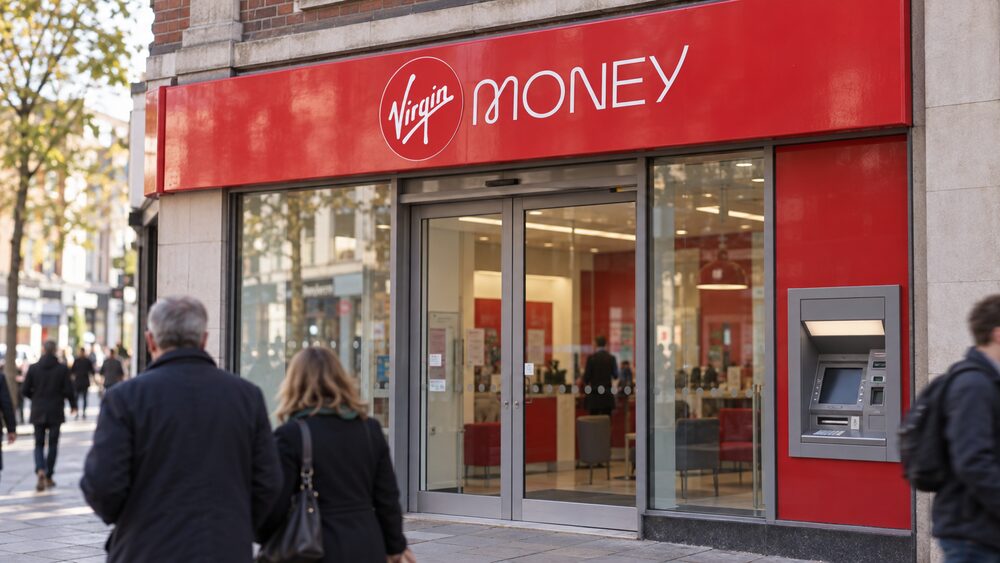
The Virgin Money Essential current account is a straightforward account for everyday banking: money in, Direct Debits and standing orders out, a debit card, and access through branches, the Post Office, the app, the phone and post. It is not a packaged account and it does not carry the extras that come with Virgin Money's M Plus, M or Club M accounts. You can hold up to three of them1.
It is also one of the accounts Virgin Money offers under the basic bank account arrangements, which exist so that people who cannot get a standard account, often because of a poor credit history, still have somewhere to bank2. The account has a £100,000 cap on the balance in each account, and a £2,000,000 cap across all your Virgin Money accounts1.
Virgin Money's business transferred to Nationwide on 2 April 2026. Accounts and products continue under the Virgin Money name for now, and sort codes, account numbers and day-to-day banking did not change3.
What it is and who it is for
The Essential account is the plainest current account Virgin Money offers. It is designed for people who want the mechanics of banking and nothing else: a place for wages or benefits to land, a way to pay bills by Direct Debit, a debit card for spending, and cash access. It is not aimed at people chasing interest, rewards or insurance bundled into a monthly fee.
That makes it a natural fit for two groups in particular. The first is anyone who has been turned down for a standard current account elsewhere, since it is offered under the basic bank account arrangements2. The second is existing Virgin Money customers who want a second account for a specific purpose, such as household bills, without paying for a packaged product. You can hold up to three Essential accounts1.
There are limits on what the account can be used for. It cannot be opened or used for a club, association or charity, or for any other business purpose, and it cannot be used as a trust account1. If you need an account for an organisation rather than yourself, this is not it.
The account is a member of the industry-wide Current Account Switch Service, so it can be opened as part of a full switch from another bank1. If you are weighing up whether a basic-style account is right for you at all, our guide to basic bank accounts sets out how they differ from standard accounts, and basic vs standard bank accounts compares the two side by side.
How it works
Day to day, the account behaves like any other current account. Money arrives by Faster Payment, Bacs or CHAPS, and goes out by card, Direct Debit, standing order or transfer. For Direct Debits and standing orders, you need enough money in the account before 2pm on the day the payment is due1. That is earlier than some people expect, and it is the single most common way an Essential account holder runs into an unpaid payment.
Cash and cheques go in at a Virgin Money branch or a Post Office. Larger transfers can be made in a Store or by writing to the Main Office, up to £100,000 a day4.
You can bank at a Virgin Money branch, at any Post Office branch, and through online, phone and postal services2. The app handles the usual tasks, including reporting a card lost, stolen or damaged5. Contactless payments work as they do elsewhere, and Apple Pay does not store your card information on the device or share it when you pay6.
One feature worth knowing about is set-off. Virgin Money can use the money in your account to reduce or repay money you owe it, including on joint accounts and mortgages, and it will give you notice beforehand1. Our explainer on the bank's right of set-off covers when this happens and what you can do about it.
How the fees and charges work
The Essential account is not a fee-paying account, but it is not charge-free in every circumstance either. Virgin Money publishes the current figures on its own site, and those are the ones to check before you apply, because they can change.
The charges that catch people out are the ones attached to specific actions rather than to holding the account. You get a monthly statement in the post, and a paper statement of fees at least once a year free of charge when the rules require one1.
On overdrafts, the picture is narrower than on many accounts. An arranged overdraft is not automatic, and Virgin Money has an eligibility tool that tells you whether you can get one without leaving a mark on your credit file7. Our guides to overdrafts and how overdraft interest and charges work explain the mechanics.
Spending abroad is where the Essential account's debit card differs from some rivals. If you use the card overseas regularly, that distinction between spending and withdrawing matters.
Closing the account costs nothing, and there is no charge for closing a Virgin Money current account4. If you change your mind, you can close without charge within the first 14 days of opening it1.
| Charge | Amount |
|---|---|
| CHAPS transfer | £251 |
| Extra paper statement | £51 |
| Closing the account | No charge4 |
| Foreign currency fee on a $100 purchase | No fee8 |
Who can apply and how to apply
To open an Essential account you have to be at least 18 years old1. That is older than the 16 that applies to Virgin Money's standard current account, so a 16 year old cannot hold this particular account4. The account is for personal use only and cannot be used for a club, association, charity or business, or as a trust account1.
You apply online or by downloading the Virgin Money app9. Virgin Money may be able to check your identity and address using an electronic verification check, and if it cannot, it will write to your address instead10. If you are asked for documents, our guide to what ID you need to open a bank account lists what banks generally accept.
If you are opening an account under a power of attorney, the process is different: it must be opened in a branch, and the attorney needs to bring valid ID and the supporting documents listed in the Add Legal Powers form11. Our page on power of attorney and third party access to bank accounts covers the wider process.
Switching in is done in two ways. You can fill out a simple form and agree a switch date with Virgin Money, alongside identity verification and the standard information10. Or, once the account is open, you can do it in the app: tap the three dots, select Switch to Virgin Money, then choose either a Full Switch or a Payment Transfer12. A full switch moves your balance, Direct Debits and standing orders and closes the old account; a payment transfer moves only the payments you choose. Our guides to the Current Account Switch Service and partial switching explain the difference.
How your money is protected
Eligible deposits in a Virgin Money Essential account are covered by the Financial Services Compensation Scheme. Since 2 April 2026, when Virgin Money's business transferred to Nationwide, that protection applies to your total combined eligible deposits with Virgin Money and Nationwide, up to £120,000 per person3. Before the transfer, separate protection was in place for each3. The limit applies to the total amount you hold, and any deposits above it are unlikely to be covered13.
That change matters if you bank with both. Our guide to FSCS protection for current accounts explains how the limit is counted, including for joint accounts.
On fraud, Virgin Money says it has eight key ways of protecting customers' money, including checking application information, monitoring accounts, checking payment details, sending one-time passcodes, getting money back, blocking accounts and securing connections14. If you are tricked into sending a payment to a fraudster, the account terms say you are protected for up to £85,000 if you contact Virgin Money within 13 months of the last payment1.
That protection has limits. Virgin Money will not refund money if you deliberately shared your security or account details, or were very careless with them, subject to listed exceptions15. The bank's own advice is to turn on payment and transaction alerts in the app, check statements regularly, never share your PIN, only enter card details on secure websites, use strong unique passwords, and be cautious of unexpected messages asking you to confirm payment details16.
If you get a call that seems wrong, hang up and dial 159, a secure number that cannot be spoofed or impersonated; it is voice automated, so say "Virgin Money" to be put through15. Suspected fraud can be reported to Action Fraud, the national fraud and cybercrime reporting centre15. Our section on scams and fraud covers the wider picture.
Problems, complaints and getting help
If something goes wrong with the account, the first step is usually the app or the phone. Virgin Money's current account helpline is 0345 600 610318. Card problems, including a lost, stolen or damaged card, are reported in the app5. If a payment has gone astray or you do not recognise a transaction, the distinction between fraud and a dispute matters: our guide to unauthorised payments and refunds sets out your rights.
To complain formally, you can use the complaints process at virginmoney.com/service/complaints, submit a complaint online, raise it in a branch, or write to The team at Virgin Money, Sunderland, SR43 4JB19. Virgin Money also accepts complaints online at virginmoney.com18. If you are not satisfied with the final response, you can take the complaint to the Financial Ombudsman Service, which is free to consumers.
Published complaint volumes give a sense of scale rather than of current service. In the quarter from July to September 2019, Virgin Money recorded 6,360 banking and credit card complaints across 3,285,027 accounts, equating to 1.94 complaints per 1,000 relevant accounts19. Earlier periods show 0.37 complaints per 1,000 relevant accounts for banking in the second half of 2014, 0.5 per 1,000 in the first half of 2014, and 3.27 per 1,000 for banking and credit cards in the second half of 201819. These are historical figures and the way complaints are counted has changed since.
If you are struggling with payments, Virgin Money publishes guidance for customers having difficulty meeting monthly payments, including budget help and contact options18. Our section on debt sets out the free advice services available, and struggling to repay an overdraft covers that specific situation.
What changed when Virgin Money moved to Nationwide
Virgin Money's business transferred to Nationwide on 2 April 20263. For Essential account holders, the practical effects are limited. Sort codes, account numbers, rates and day-to-day banking did not change, and accounts and products continue under the Virgin Money name for now3. Nationwide is the legal holder of agreements and contracts and the data controller3.
Two things did change. The first is deposit protection, which now applies across combined Virgin Money and Nationwide deposits up to £120,000 per person3. The second is membership: if you are an individual and held a Virgin Money mortgage, current account or savings account in your own name, you became a Nationwide member on 2 April 20263. From 3 April 2026, Virgin Money customers can ask to join Nationwide's Member Voice3.
Balance transfers between Virgin Money and Nationwide credit cards ended at 23:59 on the transfer date3. Virgin Money cash ISAs are now managed by Nationwide as approved ISA Manager3. Our page on Virgin Money accounts moving to Nationwide covers the transfer in more detail, and the Nationwide Building Society page explains what the society is and how membership works.
Sources19 cited
- Essential Current Account terms and conditions Virgin Money, 2026-04
- Essential Current Account Virgin Money, 2026
- Your questions answered: the Nationwide transfer Virgin Money, 2026
- Current account terms and conditions Virgin Money, 2026
- Complaints data Virgin Money, 2019-07-01
- Cash ISA Issue 32 Virgin Money, 2026
- Current account key features document Virgin Money, 2026
- Debit cards Virgin Money, 2026
- Current accounts Virgin Money, 2026
- Minimum documents and information required Virgin Money, 2026
- Current account and savings customers: the Nationwide transfer Virgin Money, 2026
- Switching to Virgin Money Virgin Money, 2026
- Saver Issue 51 Virgin Money, 2026
- How we're protecting you Virgin Money, 2026
- Savings terms Virgin Money, 2026-04
- Card fraud Virgin Money, 2026
- Latest scams Virgin Money, 2026
- Managing your complaint Virgin Money, 2026
- Contactless payments Virgin Money, 2026











 MoneyHelperFree, impartial money and pensions guidance, set up by government
 FSCSProtects your money if a bank, insurer or investment firm fails
 Financial Ombudsman ServiceFree, independent help when a complaint about a firm is not put right
 Citizens AdviceFree advice on money, consumer and legal problems in England and Wales