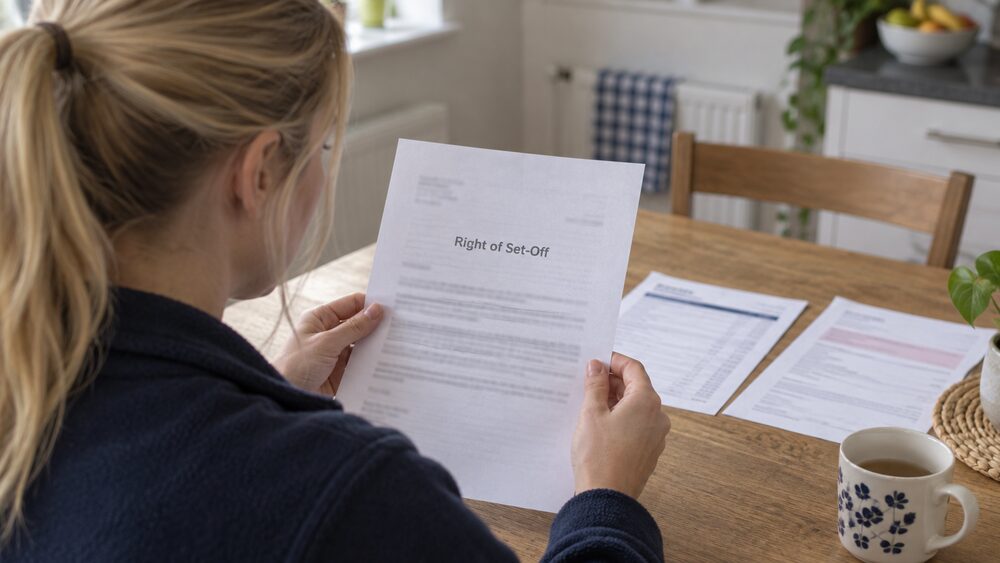
If you owe your bank money on one account and have money sitting in another account with the same bank, the bank may be able to move that money across to cover the debt. This is called the right of set-off. In the FCA's own words, it covers "any right of a firm, whether under a contract for a retail banking service or the general law, to set off or combine any debt due from a consumer or any debit balance on an account held by a consumer against or with any sum payable by the firm to the consumer or any credit balance on an account held by the consumer"1.
It is a real power, but a heavily conditioned one. The bank should only use it where you are not keeping up with the terms of the account where you owe money, for example where you have been missing loan repayments2. It should give you general information about the right at least 14 days before relying on it3. And there are whole categories of money it should leave alone: money you need for subsistence, money a third party is entitled to, and money received from a government department, local authority or NHS direct payment body for a specific purpose4.
What the right of set-off is
Set-off is the legal and contractual power a bank has to take money you hold with it and use it to reduce a debt you owe it. The FCA's Banking Conduct of Business sourcebook defines it broadly: it covers rights arising either from the general law or from the contract for a retail banking service, and it covers both combining a debt with a credit balance and setting a debit balance on one account against money payable to you on another1.
In practice it usually looks like this. You have a current account in credit and a personal loan, credit card or overdraft with the same bank that you have stopped repaying. Rather than chasing the debt through the usual collection route, the bank takes the money straight from your current account. The debt falls, your available balance falls with it, and the bank tells you what it has done.
The rule sits alongside the ordinary features of a current account. A current account usually lets you receive benefits and wages, spend in shops, withdraw cash, manage your money online or by mobile app, and set up Direct Debits and standing orders6. All of that is what set-off interrupts: money that arrives as wages or benefits can be swept out to cover the debt before you spend it.
Banks must be upfront that they have this power. The FCA says a firm should "provide an explanation of the nature and extent of the firm's right of set-off in good time before the consumer is bound by the contract", and that this information may be incorporated in the terms and conditions3. So the right is normally written into the account terms you agreed to when you opened the account, even if you never noticed it.
It only works for debts with the same bank that are in arrears
Two limits matter before anything else. First, set-off only operates within one banking relationship. A bank cannot take money from your current account to pay a debt owed to a different lender, because the right only exists between the bank and its own customer, on both sides of the transaction. If you owe money to a card issuer, a catalogue company or an energy supplier, they have no access to your bank account at all; they must use their own collection processes.
Second, the bank is expected to use set-off only when the debt has actually gone wrong. The Financial Ombudsman Service, which settles disputes between customers and banks, sets out when it would consider use of the right fair. It says:
"We'd only expect to see that you used the right of set-off if: - your customer wasn't meeting the terms of the account where they owed money (for example, they'd been missing their loan repayments)"2
So a debt that is being repaid as agreed, even if you are behind on other bills elsewhere, is not normally a candidate for set-off. The trigger is arrears on the debt owed to that bank itself.
The picture is different again when someone dies. You are not automatically liable for another person's debts: official guidance states "You're only responsible for their debts if you had a joint loan or agreement or provided a loan guarantee"7. Repayment of personal loans, credit cards and other credit debts must wait until other debts have been settled, and where cards were held jointly, any debts are the joint holder's responsibility7. Set-off does not create a new liability where none existed.
The warning your bank must give you first
A bank cannot simply take the money in silence. The FCA's rules impose two separate notification duties, one before and one after.
Before the bank relies on the right, it should have provided general information about the nature of the right and the generic circumstances in which it may be used. The FCA "considers that this information should be provided at least 14 [days]" before the firm seeks to exercise its right of set-off, and this applies to both the first and any subsequent use3. The same 14-day expectation appears in the BCOBS provisions on pre-contract information, which also require the firm to explain the nature and extent of its right of set-off in good time before you are bound by the contract8.
After the bank has used the right, a second duty kicks in. The rules state that where a firm has exercised a right of set-off, it "should provide prompt notification to the consumer, clearly identifying the date the firm exercised its right of set-off and the amount debited from the consumer's account in reliance on that right"3. The ombudsman puts the same expectation in plainer terms: "If you do use the right of set-off, you must inform your customer promptly that you've done so, mentioning the date and amount involved"2.
If your bank has taken money without any notification, or without the earlier general information about the right, that is a failure against these expectations and grounds for a complaint. The ombudsman takes the 14-day information requirement seriously when it decides whether a set-off was carried out fairly2.
Money for essential bills and priority debts is protected
The most important protection is about what the bank must leave in your account. FCA guidance says that on any occasion where a firm proposes to exercise a right of set-off, it "should review the information available on an individual basis and estimate the amount of any subsistence balance, and should refrain from setting off against the subsistence balance or against money a third party is beneficially entitled to, fiduciary money, or money received from a government department, local authority or NHS direct payment body for a specific purpose"4. Credit unions are treated differently under this guidance4.
A subsistence balance is the money you need to live on. The FCA's policy work gives a sense of what counts as essential. In a 2024 policy statement on credit, including overdrafts, the FCA set out that "priority debts and essential living expenses include, but are not limited to, payments for mortgages, rent, council tax, food and utility bills"9. Money earmarked for those things is what the bank should be estimating and leaving alone.
The same guidance singles out money that arrives for a specific purpose. Official consumer guidance says a bank should "Not take money that's intended for specific purposes, such as money given to you by the NHS for healthcare, or if a third party is entitled to the money"10. So a direct payment from a council for care, or money held on behalf of someone else, should not be swept to cover your debt.
There is a remedy if the bank gets this wrong. The rules say that "if it becomes apparent after exercising a right of set-off that the firm set off against the consumer's subsistence balance or protected money, the firm should refund the sum debited unless it is fair not to do so", and if it does not refund, it should be able to justify why not5. Consumer guidance states the practical outcome: banks should "Refund you, in most cases, if the bank realises that you needed to use the money for priority debts or essential living" expenses10.
Joint accounts: which transfers are allowed and which are not
Joint accounts complicate set-off, because the money in them is not simply yours. A joint account normally allows two or more people to receive payments, pay by debit card, transfer money and manage the account, depending on the bank11. Everyone named on the account is equally responsible for it and can withdraw cash or spend whenever they like11. Some banks offer an "all to sign" arrangement, meaning all account holders have to make decisions jointly, though this usually limits management to a branch11.
The liability runs both ways. Official guidance on joint accounts states that "you're each liable for the other's debts"12. So where a debt sits on the joint account itself, such as an overdraft run up by one holder, the bank can look to any holder, and set-off from the joint account to cover the joint account's own overdraft is within the ordinary scope of the right.
The harder case is a debt owed by one holder alone, with money in a joint account. Here the FCA's guidance on protected money bites: a firm should refrain from setting off against "money a third party is beneficially entitled to"4. The other holder of a joint account can be a third party beneficially entitled to their share of the balance, which means a bank that takes joint money for one person's sole debt may be taking protected money. If that has happened, the refund rule applies: the firm should refund the sum debited unless it is fair not to do so5.
If you are separating from a co-holder, or worried about their debts, the pages on joint bank accounts and on freezing a joint account after a separation cover the options. Switching is also possible: the Current Account Switch Service works for joint accounts provided you are switching to another joint account and all account holders agree, and you can switch a sole account to a joint account elsewhere11.
Terms that let a bank move money between any accounts may be unfair
The right of set-off usually lives in the account's terms and conditions. But not every term a bank writes is enforceable. The Consumer Rights Act 2015 lists terms that may be regarded as unfair, and two of the listed categories are directly relevant to set-off.
The first is about transferring rights and obligations. Schedule 2 to the Act includes as a potentially unfair term: "A term which has the object or effect of allowing the trader to transfer the trader's rights and obligations under the contract without the consumer's agreement where this may reduce the guarantees for the consumer"13. A term drafted so widely that it lets the bank move money between any accounts you hold, in any circumstances and without limits, may fall foul of this fairness standard, because it reduces the guarantees you were given about the account the money sits in.
The second is about one-sided discretion. The same schedule includes "A term which has the object or effect of authorising the trader to dissolve the contract on a discretionary basis where the same facility is not granted to the consumer"13. Terms that give the bank all the discretion and you none are the kind the Act flags.
This does not mean set-off terms are automatically unfair. The FCA's framework expects the right to be explained clearly before you are bound by the contract3, and expects its exercise to be individually reviewed and limited to unprotected money4. A term that meets those expectations is doing something different from a term that simply says the bank may take any money from any account at any time. If you believe a term has been applied unfairly, the ombudsman can look at both the term and the way it was used2.
How to stop set-off before it happens
The most reliable way to prevent set-off is structural: do not hold your income in an account with a bank you owe money to. Since set-off only works within one banking relationship, moving your wages or benefits to a bank you owe nothing to removes the opportunity entirely.
A basic bank account is often the practical route. Basic bank accounts are free to set up and use14, and you can apply if you have a low income or a poor credit history and think you might have trouble opening a bank account15. A parliamentary committee reviewing access to basic accounts concluded it "should be a right for customers to open a basic bank account irrespective of their financial circumstances"16, and the accounts are now subject to regulations under which designated institutions can only refuse to open one on limited prescribed grounds, or close one on limited grounds17. The page on basic bank accounts explains how they work, and who can get one covers the eligibility rules.
If you receive Universal Credit, guidance on choosing a bank account for your Universal Credit payment sets out what a current account lets you do and what to consider about where that money lands6. Keeping a benefits payment in an account with the bank you owe is doubly risky: the money is needed for living costs, and while FCA guidance says firms should refrain from setting off against money received from a government department for a specific purpose4, the safer course is not to test it.
Telling the bank you are struggling also matters. Under the Consumer Duty, firms must follow cross-cutting rules including the requirement to "Avoid causing foreseeable harm. Identify and mitigate risks before they materialise"18. A bank that knows you are in difficulty is expected to identify the risk that set-off will cause you harm, and to mitigate it, before taking money. Guidance on making money easier to manage also flags the practical side: bounced Direct Debits and standing orders can leave you facing heavy bank charges, so making sure there is enough money in the right account matters15.
What to do if your bank has already taken the money
If the money has already gone, act quickly and in order.
- Contact the bank straight away. Explain what the money was for. If it was needed for rent, mortgage, council tax, food or utility bills, say so in writing and keep a copy. The FCA's rules say that where it becomes apparent the firm set off against your subsistence balance or protected money, "the firm should refund to the consumer the sum debited from the account of the consumer in exercise of the right of set-off" unless it is fair not to19. Consumer guidance puts it plainly: banks should refund you in most cases where they realise you needed the money for priority debts or essential living expenses10.
- Check whether the process was followed. Ask whether you were given general information about the right at least 14 days before it was used3, and whether you were promptly told the date and amount after it was used3. Failures on either count strengthen a complaint.
- Make a formal complaint if the bank does not refund. Give the bank at least eight weeks to try to resolve your complaint; it should then send you a final decision letter telling you how to contact the Financial Ombudsman Service20.
- Take it to the ombudsman if needed. The Financial Ombudsman Service reviews complaints about set-off free of charge and decides whether the bank acted fairly, applying the expectations it has published for when the right should be used2.
The ombudsman's published approach is the yardstick it will apply. It expects set-off only where the customer was not meeting the terms of the account where they owed money, expects the 14-day information to have been given, and expects prompt notification afterwards2. A bank that cannot show these things was done is exposed on the complaint.
Where set-off does not apply
Some situations fall outside set-off altogether, or outside the enforcement tools that accompany debt problems.
Money held with an electronic money institution is one clear case. Under the Electronic Money Regulations 2011, if an e-money institution fails, the claims of electronic money holders are to be paid from the asset pool in priority to all other creditors, and "until all the claims of electronic money holders have been paid, no right of set-off or security right may be exercised in respect of the asset pool", except for set-off relating to the fees and expenses of operating the safeguarding account23. So money loaded on a prepaid card or held with an e-money provider is protected from set-off against the asset pool if the institution collapses.
Formal debt solutions also change the picture. A debt relief order is a formal insolvency solution, and official guidance notes that "A DRO does not clear the debt for a joint debt holder or a guarantor of a debt"24. That cuts both ways for set-off: the person in the DRO gets protection from enforcement, but anyone who guaranteed or jointly holds the debt does not, and their position, including their exposure to their own bank's set-off, continues.
Debts owed to other companies, as covered earlier, are simply outside the right's reach: a bank cannot set off a debt owed to a third party2. And where a debt is covered by breathing space rules, enforcement is paused: the debt respite scheme regulations define which debts are eligible and which are not, excluding among others secured debt that is not in arrears, non-eligible business debt, debts from fraud, court fines, child support obligations, crisis or budgeting loans, student loans and current-year council tax liabilities subject to exceptions25. While those rules govern creditors' enforcement generally rather than set-off specifically, they set the wider framework of what a creditor may and may not do while you seek help.
Getting free help
You do not have to work through this alone, and none of the help below costs anything.
MoneyHelper is the free government-backed money guidance service. Its guidance covers basic bank accounts14, joint accounts11, managing money when illness or disability makes it harder15, and choosing a bank account for benefit payments6. It is the right first stop for working out what to do before a debt goes into arrears.
The Financial Ombudsman Service settles disputes between consumers and financial businesses, free to the consumer. It has published its approach to complaints about set-off, including when it expects banks to use the right and what notification it expects2. Before going to the ombudsman, give the bank at least eight weeks to resolve the complaint and get its final decision letter20.
Debt advice charities help where the underlying debt is the real problem. The debt section of this site sets out the full range of options, from informal arrangements to formal solutions like debt relief orders, and where to get free advice on each.
If the underlying problem is an overdraft with the bank that took the money, the pages on overdrafts, on struggling to repay an overdraft and on opening a bank account when you owe your bank money cover the practical next steps.
Sources25 cited
- BCOBS instrument 2011/13: definitions and set-off rules FCA, 2011
- Bank accounts: right of set-off Financial Ombudsman Service, 2026
- BCOBS 4.1.4A: Right of set-off FCA Handbook
- BCOBS 5.1.3AG: subsistence balance and protected money FCA Handbook, 2026
- BCOBS 5.1.3BG: refunds after set-off FCA Handbook, 2026
- Choosing a bank account for your Universal Credit payment MoneyHelper, 2026
- Debt when someone dies nidirect, 2026
- BCOBS 4: pre-contract and ongoing information FCA Handbook
- PS24/2: overdrafts and priority debts policy statement FCA, 2024
- Right to set-off: what banks should do FCA, 2016
- Joint accounts MoneyHelper, 2026
- Dementia and managing money nidirect, 2026
- Consumer Rights Act 2015, Schedule 2: indicative unfair terms legislation.gov.uk
- Basic bank accounts MoneyHelper, 2026
- Make your money easier to manage by yourself MoneyHelper
- Basic bank accounts: July 2023 to June 2024 GOV.UK, 2025
- Payment Accounts Regulations 2015: refusal and closure grounds legislation.gov.uk, 2025
- Consumer Duty: about FCA, 2026
- BCOBS 5: set-off refunds FCA Handbook
- Overdrafts and other bank debts nidirect, 2025
- Right of offset StepChange, 2026-09-25
- Getting a bank account Citizens Advice, 2026-09-25
- Electronic Money Regulations 2011 legislation.gov.uk, 2011
- Guidance for creditors listed in a debt relief order GOV.UK, 2023
- Debt respite scheme regulations: eligible and non-eligible debts legislation.gov.uk, 2020





 MoneyHelperFree, impartial money and pensions guidance, set up by government
 FSCSProtects your money if a bank, insurer or investment firm fails
 Financial Ombudsman ServiceFree, independent help when a complaint about a firm is not put right
 Citizens AdviceFree advice on money, consumer and legal problems in England and Wales