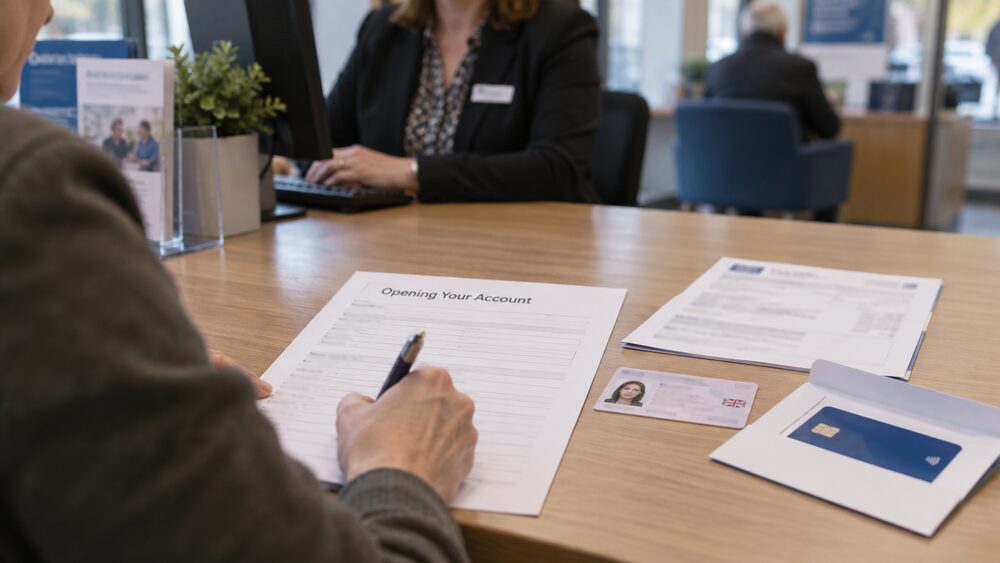
Opening a bank account means proving two things: who you are, and where you live. Banks usually ask for ID such as a driving licence, passport, recent bills or official documents1. If you do not have a passport, that is not a barrier: official letters, benefit documents and, since an agreement between banks and HM Treasury in December 2016, Universal Credit award letters all count as identity verification2. A debit or credit card can also serve as proof of identity with some providers3.
This page sets out the documents banks accept, what counts when you have no passport or bills in your name, and how the account you choose interacts with Universal Credit: where it can be paid, how couples and families are affected, when the money arrives, and how savings in the account change your payments.
Documents banks usually accept as ID
When you apply for a current account, you will usually need to prove your identity with documents such as a driving licence, passport, recent bills or official documents1. Turn2us lists the core options as a driving licence, a passport, or a debit or credit card3. The mix varies by bank, and each provider sets its own list, but the underlying requirement is the same everywhere: evidence of who you are and, separately, evidence of your address.
For people claiming Universal Credit, the government's own identity verification guidance shows how widely the net is cast. To verify your identity in person, at a jobcentre or at your home, you must show one photographic ID document, and the accepted list includes an identity card carrying the Proof of Age Standards Scheme (PASS) accreditation logo, issued in the UK or Channel Islands7. Refugees who have not yet had a UKVI account created by the Home Office can use an asylum application registration card (known as an ARC) presented together with a Home Office decision letter7. The same guidance accepts a savings account book as a supplementary ID document7.
If you have no passport, the practical route is to build the file from what you do hold: a PASS-accredited proof of age card, a driving licence, a debit or credit card, and official letters addressed to you. The full process of applying, including what to do if a bank refuses you, is covered in how to open a current account, and the specific problem of address evidence is covered in opening an account without proof of address.
Official letters and benefit documents as proof
The key fact for benefit claimants is that banks agreed with HM Treasury, confirmed by the Economic Secretary to the Treasury in December 2016, to accept Universal Credit award letters as identity verification2. That agreement matters because a new claimant often holds little else: no passport, no driving licence, and no utility bills if they have just moved or been staying with others. The award letter is an official document from a government department, addressed to the claimant, and banks treat it as such.
Beyond the award letter, the same principle applies to other official paperwork. The government's identity guidance for Universal Credit accepts a savings account book as supplementary ID7, which shows that established paper documents from financial institutions carry weight. Banks' own lists of "official documents" typically include letters from government departments and public bodies, alongside recent bills for the address check.
Two practical points follow. First, the letter must be an original or a formal printout, not a photograph on a phone, in most cases; check with the provider before applying. Second, if you are claiming Universal Credit and have not yet received your award letter, the identity check for the claim itself can happen at a jobcentre or at your home7, and once passed, the documents you used there can support a bank application. If you have no fixed address at all, there is a dedicated guide to opening a bank account with no fixed address.
Why you need an account to receive Universal Credit
Universal Credit is a monthly payment to help with your living costs, and it is paid into an account, not by cheque or cash. If you do not have a bank account, you will need to open one3. When you claim, you will be asked for bank, building society or credit union account details8. To receive benefits like Universal Credit, you will usually need an account that can receive automatic payments1.
The reason is mechanical rather than bureaucratic. Universal Credit is worked out monthly, in a period called the Assessment Period, and the payment is transferred directly into the account you nominate4. Without an account that can accept automated transfers, the payment cannot reach you. This is also why the type of account matters less than people fear: it does not need to be a full current account with an overdraft and cheque book, only one that can receive automatic payments, such as an account with a bank, building society or credit union1.
The timing creates a squeeze for new claimants. You will not receive your first payment for five weeks after claiming9, so the account needs to exist before the first payment date, not after. An advance payment can bridge the gap, but even that requires account details: before you can get an advance you must give details of your bank or building society account and prove your identity10.
Bank, building society or credit union
Official guidance is explicit about where the money can go: Universal Credit is paid into your bank, building society or Credit Union account4. The same rule appears in the general benefits payment guidance, which asks for bank, building society or credit union account details when you claim8. All three types of provider can receive automatic payments1.
For most people a standard current account is the default choice, and the options across the market, including fee-charging and reward accounts, are compared in the current accounts guide. But two alternatives matter for claimants who have been refused elsewhere. If you have a bad credit rating and have been refused bank accounts, you could ask to open a basic bank account or see if you can open an account with a credit union3. Basic bank accounts are designed for exactly this situation and are explained in the guide to basic bank accounts, with the eligibility rules in who can get a basic bank account. Credit unions, covered in the credit unions guide, are community providers that often accept people mainstream banks decline.
One protection is worth knowing whichever you choose. Money held in savings in banks, building societies and credit unions is protected by the FSCS up to £120,000 per eligible person, per eligible firm11. A current account holding a monthly benefit payment sits comfortably inside that limit.
Joint or individual account: how couples are paid
If you are claiming Universal Credit and live with your partner as a couple, you will usually get a single payment for your household1. This means the money can either be paid into a joint bank account in both of your names, or into one of your individual accounts1. There is no rule requiring a joint account, and no rule requiring the woman's or the man's: the household nominates one destination.
A joint account normally allows two or more people to receive payments, pay by debit card, transfer money and manage the account, depending on the bank12. Each account holder can withdraw money without asking the other person13, which is the feature that cuts both ways: convenient for a trusting couple, risky where the relationship is not stable. The tax treatment also differs from an individual account: any interest earned in a joint account will usually be split equally between each person, with tax only due if a share is above the annual allowance12. And on death, unless you were married or in a civil partnership, you might have to pay tax on some or all of the money in the account12.
The choice between joint and sole accounts, and what each means for control of money and for credit files, is set out in the guide to joint bank accounts and the comparison of joint versus sole accounts.
Separate payments if you are worried about your partner
A single household payment into one person's account can be a problem where one partner controls the money, or where there is fear of financial abuse. There is a route to separate payments: if you are in a couple making a joint claim, you can ask for your Universal Credit payments to be split between you and your partner by messaging your work coach in your online account4.
This is not automatic. It is a request, made through the journal in the online account, and the work coach handles it from there. For claimants who need it, it can be the difference between having money of their own and not.
If the relationship has broken down and the money is in a joint account, the account itself can be frozen: you can ask the bank to register a dispute and "cancel the mandate", freezing the account until everyone agrees how to split the money12. The steps for this are in the guide to freezing a joint account after a separation. People experiencing domestic abuse can also find specific banking help in the guide to banking help after domestic abuse.
Households with children: the main carer's account
If you have children, the payment usually goes into the main carer's bank account1. This is a deliberate rule: the payment intended to support children is directed to the person doing the caring, regardless of how the couple's other finances are arranged.
Households with children are a large share of the caseload. Households with children accounted for 44% of households on Universal Credit with a payment in February 202614. In the same month, 166,000 households received the Universal Credit childcare element14, and the highest average payment amount was £1,330 for the "Couple with children" family type14.
Childcare costs interact with the account in one further way. Universal Credit can help if you must pay childcare costs upfront and you are starting work or increasing the hours you work15. But there is a trap for the organised: if you claim Universal Credit, you cannot open a Tax-Free Childcare account until you close your Universal Credit claim15. A claimant who opens the wrong account first can find the two schemes pulling against each other.
Payment dates: monthly, with the first about five weeks after you claim
Universal Credit is paid every month8. You will get your first payment about five weeks after you claim, and after that payments follow monthly4. The gap exists because Universal Credit is worked out monthly, in an Assessment Period that starts when you make your claim, and the payment for a period is calculated at the end of it16.
Northern Ireland is different: there Universal Credit is paid twice a month into your bank, building society or Credit Union account4. The twice-monthly split is designed to help claimants budget, and claimants in Northern Ireland should expect a different rhythm from the monthly cycle in Great Britain.
The five-week wait is the single biggest shock for new claimants, and there is an official bridge for it. When you claim Universal Credit you will not receive your first payment for five weeks9. You can apply for an advance, using your Universal Credit online account, and you may be directed to contact the Universal Credit Service Centre or speak to your work coach9. Before you can get an advance you will need to give details of your bank or building society account and prove your identity10. Help is also available while you wait for your first payment10.
Payment dates on a weekend or bank holiday
If your payment date is on a weekend or a bank holiday, you will usually be paid on the working day before8. So a payment dated for a Saturday arrives on the Friday, and one dated for a bank holiday Monday arrives on the last working day before it. This is the general rule for benefit payments, and it means the money lands early rather than late: no bill or Direct Debit scheduled for the official date should be missed because of the calendar.
The contrast with tax deadlines is worth noting, because the rule runs the other way there. If a payment deadline falls on a weekend or bank holiday, a Self Assessment penalty payment must reach HMRC on the last working day before the deadline, unless paying by Faster Payments17. For benefits the early payment is automatic; for money owed to HMRC the sender has to make sure it arrives in time.
Savings in your account: the £6,000 and £16,000 limits
Money sitting in the account your Universal Credit is paid into is not neutral: it counts as capital, and capital changes your payment. The rules are set by thresholds. You will get less Universal Credit if you have savings over £6,00018. For each £250 above £6,000, your Universal Credit is reduced by £4.35 a month, and if your capital is not a complete £250 it is rounded up to the next £2505. Once your capital is £6,000 or less, your Universal Credit will no longer be reduced5. At the top end the rule is absolute: if you have capital valued over £16,000, you are not entitled to Universal Credit5.
The official guidance gives a worked example: if you have capital of £6,300, your Universal Credit will be reduced by £8.70 a month until the value of your capital is £6,300 or less5. A second official example describes capital of £6,250 or less reducing Universal Credit by £4.35 a month until capital is £6,000 or less5; the two documents describe the same rule at different capital levels, so treat the £4.35 per £250 rate as the fixed point and check your own figures against it.
Not everything in the account counts. Capital disregards include assets of a business that is trading, premises or land you live in, and occupational and personal pensions5. Some compensation and welfare support payments are not taken into account as savings either indefinitely or for up to 12 months5. Debt is not taken into account when working out your total savings, assets and investments5. And the rules have teeth: if you give false information about your savings, assets and investments, or deliberately reduce them to get Universal Credit, you may be prosecuted or have to pay a penalty5.
Savings interact with earnings too. You can earn a certain amount before your Universal Credit payments are reduced if you or your partner are responsible for a child or young person, or have a disability or health condition that affects your ability to work16. The work allowance is £427 per month for claimants who get help with housing costs16, and above it you keep 45p of each £1.00 you earn until your earnings are too high to get Universal Credit16.
One savings scheme is designed to sit alongside the benefit rather than be punished by it. Help to Save eligibility has been expanded to all working individuals in receipt of Universal Credit, earning £1 or more19; previously the regulations did not allow individuals receiving Universal Credit to open an account if their weekly household or individual earnings were less than the equivalent of 16 hours a week at national living wage rate20. A working claimant can now save into Help to Save regardless of hours.
Changing the account your Universal Credit is paid into
Account details are changed through your Universal Credit online account, the same place you manage the rest of the claim. After your claim is checked you will be given a case manager who will help you to maintain your claim, and depending on your circumstances you might also be given a work coach who will support you getting into work6.
Security around the account matters. Where someone thinks another person has accessed their account, Universal Credit guidance sets out changing the password straight away and contacting Universal Credit6. The journal is not the place for sensitive details: information that might put a claimant at risk of fraud, for example bank details or National Insurance numbers, is not to be included there6.
When you give new account details, it helps to get them right the first time. Confirmation of Payee works by checking the account name and account details to make sure there is a match, with alerts notifying the payer whether there has been a match before the payment is made21. The guide to Confirmation of Payee explains how the name check works on bank transfers.
Scams: Universal Credit will never ask for your bank details by text or email
The rule is stated flatly by the government: "We will never text or email you asking for your personal information or bank details."6 Any message that does ask, claiming to be from Universal Credit or DWP, is not genuine. The same warning pattern runs across official bodies: HMCTS will never telephone you to ask for your bank details or to make a bank transfer using your sort code and account number22, and FSCS will never ask for bank details, account passwords, or PIN numbers23.
The most damaging variant is the "safe account" scam. Your bank, the police and regulators will never ask you to move money to a "safe" account24. A caller who tells you your account is compromised and your money must be moved is a fraudster, whatever number appears on your phone. Your bank will never ask you for your PIN or your online account password, and neither will any trustworthy online retailer25.
The guide to scams and fraud covers how to report a scam and what refund rights exist.
Where to get free help
Free, independent help exists at every stage of this process. MoneyHelper, the government-backed money guidance service, publishes specific guidance on choosing a bank account for your Universal Credit payment, including what to do if you have been refused a standard account1. Turn2us, a charity supporting people on benefits, sets out how to claim Universal Credit and what documents you will need3.
For claimants in financial difficulty during the wait, an advance payment can be applied for through the Universal Credit online account, with the Service Centre or work coach as fallback routes9, and help is available while waiting for the first payment10. The wider picture of benefits and entitlements is in the benefits guide, and help with problem debts is in the debt guide. If a bank has refused you an account, the steps to take are in what to do if you are refused a basic bank account.
Sources25 cited
- Choosing a bank account for your Universal Credit payment MoneyHelper, 2026-09-25
- Banks and HM Treasury agreement on Universal Credit award letters as ID Parliament, 2016-12
- Universal Credit: how to claim Turn2us, 2026-02-25
- How much Universal Credit you get and how you're paid nidirect, 2026-07-15
- What will affect your Universal Credit payments nidirect, 2026-06-30
- Manage your Universal Credit claim after you apply GOV.UK, 2025-09-03
- Documents to verify your identity for Universal Credit GOV.UK, 2026-06-09
- How to have your benefits paid GOV.UK, 2026-09-26
- Universal Credit advance payments nidirect, 2026-05-20
- Help while waiting for a Universal Credit payment nidirect, 2026-06-30
- FSCS deposit limit FSCS, 2026-09-25
- Joint accounts MoneyHelper, 2026-09-25
- Dementia and managing money nidirect, 2025-09-03
- Universal Credit quarterly statistics, 29 April 2013 to 12 February 2026 GOV.UK, 2026-02
- Universal Credit if you have children GOV.UK, 2025-11-17
- Universal Credit if you're employed nidirect, 2026-06-30
- Pay a Self Assessment penalty GOV.UK, 2026-09-25
- Who can claim Universal Credit nidirect, 2026-06-30
- Amendment to the Universal Credit eligibility criteria for Help to Save accounts GOV.UK, 2025-04-06
- Help-to-Save Accounts (Amendment) Regulations explanatory memorandum legislation.gov.uk, 2025
- Consultation on general directions for the implementation of Confirmation of Payee Payment Systems Regulator, 2026-09-26
- Guidance on HMCTS related suspicious phone calls, emails and text messages GOV.UK, 2026-09-17
- Scams: what to look for FSCS, 2026-05-05
- Types of scam MoneyHelper, 2026-09-25
- Protect your identity nidirect, 2025-10-28



 MoneyHelperFree, impartial money and pensions guidance, set up by government
 FSCSProtects your money if a bank, insurer or investment firm fails
 Financial Ombudsman ServiceFree, independent help when a complaint about a firm is not put right
 Citizens AdviceFree advice on money, consumer and legal problems in England and Wales