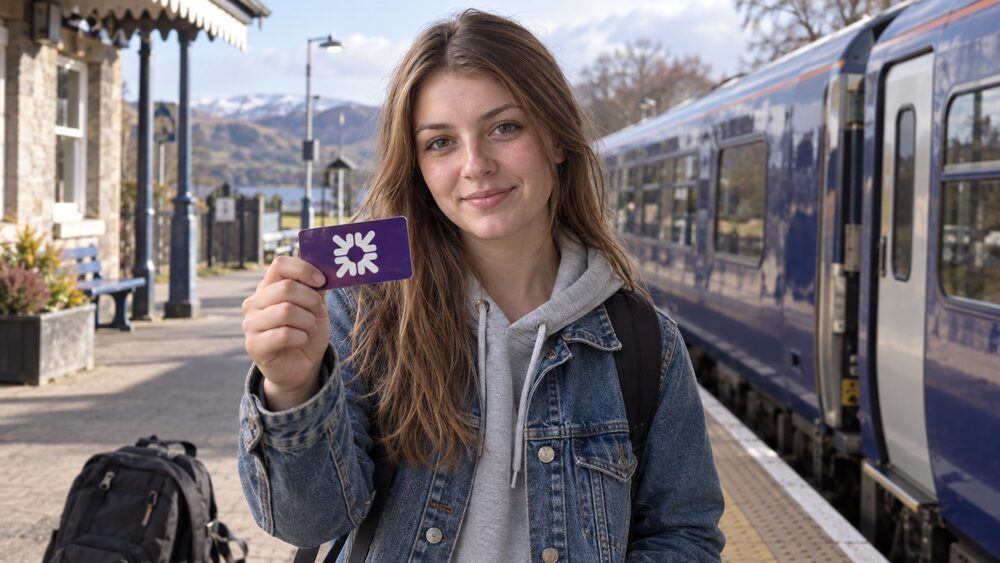
The Royal Bank of Scotland Student Account is a current account for people heading to university or college. It comes with an arranged overdraft option, cashback and Save the Change, and a cash offer for eligible customers who open or switch to it and meet the payment conditions1. Everyday banking is free while you stay in credit, and other fees can apply, for example when you use your Visa debit card outside the UK3.
To be eligible you need to confirm you are a student, and RBS asks for your unique 16-digit UCAS code to do that2. You also need to be able to prove you have been a UK resident for the last three years2. The account is designed to run for your time at university and then change: after you graduate it switches to a Graduate account, with about 60 days' notice, and later moves to the Select account after three years, again with 60 days' notice3.
This page covers what the account includes, how the overdraft works, what it costs to use at home and abroad, how to open or switch to it, how to keep it safe, and how your money is protected. RBS publishes today's figures for the account, including any interest-free overdraft amount and the current cash offer, on its own site.
What the RBS Student Account offers
Student bank accounts are designed to help people at university manage their finances, and many come with perks such as free railcards, vouchers and retail discounts5. They are available to anyone looking to enter higher education, and they commonly change into a graduate account once the course ends6. Typical extras across the market include an interest-free overdraft, a railcard, gift vouchers or other benefits7.
The RBS account follows that pattern. It is described as an account with cashback, Save the Change and an arranged overdraft option1. Student account holders can get deals on cinema tickets, attractions and more8. The account also carries a cash offer, which RBS lists on both its student account page and its budget calculator page1. The amount and the deadline are set by the bank and published there.
The cash offer has conditions attached. If you have held a student or graduate account with one of those brands, check the terms of the RBS offer before assuming you qualify.
Existing student account holders who continue straight onto a masters degree or PhD can extend the equivalent Bank of Scotland account for a maximum of six years2. RBS publishes the equivalent terms for its own account on its student pages.
Student overdrafts: arranged and unarranged borrowing
An overdraft lets you spend more than the balance in your account, up to a limit the bank agrees. Arranged overdrafts are subject to application and approval, and they are repayable on demand8. RBS states that all overdrafts are subject to its assessment of your circumstances and are repayable on demand1. That phrase matters: the bank can ask for the money back, and the overdraft is not a fixed loan.
Many student bank accounts may offer an interest-free arranged overdraft10. RBS charges interest on both arranged and unarranged overdrafts11. The interest-free element, where it applies, is usually limited to a set amount and a set period, and RBS publishes the current figure on its student account page.
When you are comparing student accounts, the things worth weighing are the size of the interest-free overdraft, the charges and interest on authorised and unauthorised overdrafts and loans, and how long you can keep using the account after graduation12. Those three factors decide what the account actually costs over a degree.
Unarranged overdrafts are different. They are not guaranteed, and if one is approved, interest is charged on the amount borrowed13. Going beyond an agreed limit, or having a payment taken when there is no arranged overdraft in place, is where charges build up fastest.
How charges work on everyday and international payments
Everyday banking on the account is free while you stay in credit, and other fees can apply, for example when you use your Visa debit card outside the UK3. That is the same structure used across the market: free domestic banking, with charges attached to specific actions rather than to holding the account.
Using a debit card abroad is the most common trigger. That is a market-wide figure rather than an RBS figure, and it shows the shape of the cost rather than the exact amount you would pay.
International payments are priced separately again. Those are another provider's published charges, given here to show how such fees are structured, not what RBS charges.
The practical point is that a student account is free to run in the ordinary course of things, and costs appear when you travel, send money abroad, or borrow beyond an agreed limit. RBS sets out its own current fees on its site.
Banking with RBS: app, online, branches and the Post Office
RBS runs its accounts through a mobile app, online banking, branches and telephone banking. The app is available to customers aged 11 and over with compatible iOS and Android devices and a UK or international mobile number in specific countries, and online banking is available to customers aged 11 and over with a Royal Bank account15. Video banking calls may be recorded and service hours apply, and a compatible device is required15.
Opening an account can be done in several ways. Independent guidance describes completing an application form online, in person or by phone16. RBS asks online applicants to upload photo ID, such as a driving licence, passport or EU ID card, and a selfie to compare with the photo ID2.
Post Office counters extend what you can do without visiting a branch. Most banks offer some banking services through local post offices17, and Post Office branches offer withdrawing cash, paying in cheques, checking your balance or paying bills, depending on who you bank with18. Some banks let you cash a current account personal cheque or use your cash card at the Post Office free of charge, and it is worth asking at your local post office what is available19.
Branch numbers have fallen sharply. Royal Bank of Scotland has shut 183 branches in Scotland since 201521. The group has said it closed hundreds of Royal Bank of Scotland branches in England and Wales because customers of that brand can now bank in a local NatWest branch22. Where branches have gone, banking hubs have opened in some towns: the Jedburgh hub offers a Post Office counter service and a Community Banker rota for TSB, Santander, Bank of Scotland and Royal Bank of Scotland customers23.
How to open or switch to an RBS Student Account
You need your university place confirmed before a student account application will be accepted24. RBS also asks for your unique 16-digit UCAS code to confirm you are a student and eligible for the account2, and it needs to be able to prove you have been a UK resident for the last three years2.
The steps are straightforward:
- Confirm your university or college place, and have your UCAS code to hand24.
- Apply online, in a branch or by phone, uploading photo ID and a selfie if you apply online16.
- If you are switching from another bank, use the Current Account Switch Service so your payments move across25.
- If you have already applied for student finance and then change course or university, log into your online account and update your university or college along with your course details26.
Switching incentives usually carry eligibility tests. One published example excludes anyone who has previously received a switching incentive from the same group, including NatWest, RBS or Ulster Bank, and blocks switching from another bank in that group25. If you have taken a switching bonus from a brand in the group before, check the terms before expecting a new one.
Keeping your account safe from fraud and scams
RBS draws a line between two things. Fraud is where you have identified suspicious activity on your account; a scam occurs when you have knowingly parted with your money or personal details, thinking you were dealing with a genuine person or company27. The distinction decides which refund rules apply.
The bank's own warnings are specific. Scammers can call pretending to be someone else, such as your family, a bank or the police28. They may use artificial intelligence to make themselves sound like someone you know or a trusted organisation28. A genuine organisation will never ask you to transfer money to a "safe" or "secure" account, and will never ask you to download a program that lets someone see your device28. RBS states that your bank or the police will never ask you to transfer money to a safe account or ask for your full PIN, password or passcode29.
If you gave away personal security details or card details during a suspicious call, tell your bank28. If you shared details in an email scam, call using the number on the back of your card30. RBS also offers a security profile tool in its mobile app with personalised actions, and recommends registering for biometrics within the app as an extra layer of protection30.
General precautions apply alongside the bank's own. Use strong and unique passwords for online accounts31, set separate passwords for different accounts and keep anti-virus software up to date32, and check your card and bank statements regularly for anything you do not recognise, along with your credit report33. Keep your chequebook somewhere safe and tell your bank about any missing or lost cheques34.
Students are a particular target around the start of term. The Student Loans Company says it saved £56.2 million last year through prevention measures, and warns never to share your name, date of birth, customer reference number, course information or current or previous address online, because criminals can use them to impersonate you35.
If a suspicious text claims to be from your bank, report it free of charge by forwarding it to 772636, the number used across the mobile networks for suspected scam texts. Messages claiming to be from HMRC go to 60599 or phishing@hmrc.gov.uk instead, and should then be deleted.
Will RBS refund money taken from my account by a fraudster?
For payments you did not authorise, you will usually get a refund if it is fraud and you report it quickly37. That is the position for unrecognised transactions: check your transactions and report anything you do not recognise straight away.
Scams are treated differently from fraud. Where you were tricked into making a payment yourself, a bank can deduct £100 from the refund it gives you unless you are considered vulnerable under the rules, and some banks do not apply that deduction at all. So the amount you get back can be less than you lost, depending on the circumstances and the bank's approach.
If your card is lost or stolen, report it to your bank immediately. If you lose your card, driving licence or passport, report it as lost straight away to the organisation that issued it. After a personal data breach, the steps recommended include reporting lost or stolen documents to the issuer, checking bank statements and your credit report, watching out for phishing, using strong passwords and multi-factor authentication, and applying for Cifas protective registration.
RBS publishes a victim support referral form for customers affected by fraud27. If a complaint about how a fraud or scam was handled is not resolved, the Financial Ombudsman Service can look at it.
FSCS protection for money held with RBS
Eligible deposits are protected by the Financial Services Compensation Scheme up to £120,000 per person. The FSCS Protected badge indicates that eligible deposits are protected under the deposit guarantee scheme up to £120,000 per person. The limit applies in total across all accounts a person holds, whether in their own name or where they are listed as the beneficial owner.
The group structure matters here. Royal Bank of Scotland and NatWest are part of the same group, and the group also includes Ulster Bank. Money held across brands that share a banking licence counts towards a single limit rather than one limit per brand, so it is worth knowing which brands sit together before spreading deposits.
If you hold money with more than one brand in the same banking group, it counts towards the same limit.
What happens if my local RBS branch closes
Royal Bank of Scotland has closed 183 branches in Scotland since 201521. Across the market, there were 410 closures in 2024, including 90 from Barclays, 83 from Lloyds, 76 from Halifax, 68 from NatWest, 31 from Bank of Scotland and 20 from Royal Bank of Scotland. The group has said it closed hundreds of Royal Bank of Scotland branches in England and Wales because customers of that brand can bank in a local NatWest branch22.
For a student, the practical effect is limited, because the account is run mainly through the app and online banking. Where a branch has gone, alternatives include Post Office counters, which offer cash withdrawals, cheque paying in, balance checks and bill payments depending on who you bank with18, and banking hubs, which bring a Post Office counter and community bankers from several banks into one site23.
RBS also offers a fee-free basic bank account, as do the other largest banks. The group is designated under the rules to offer basic bank accounts. That matters if a student account application is refused or an account is later closed, because a basic account is the fallback route to keeping a bank account.
If you are struggling with an overdraft after graduation, free and impartial help is available. National Debtline and StepChange both publish guidance on student money, graduate overdrafts and dealing with fraud12, and MoneyHelper covers opening, switching and closing bank accounts37.
Sources37 cited
- Student account Royal Bank of Scotland
- What you need to open a current account Royal Bank of Scotland
- Student account, existing customers Royal Bank of Scotland
- Tastecard for student account holders Royal Bank of Scotland
- Budget calculator Royal Bank of Scotland
- Student and youth accounts Bank of Scotland
- Student account comparison Bank of Scotland
- Selecting the right bank account for your child Bank of Scotland
- Student banking need to knows HSBC UK
- Borrowing money as a student HSBC UK
- What types of bank accounts are there? Co-operative Bank
- Open a bank account online Halifax
- Student loans and finance Prospects
- Student money and debt National Debtline
- Fraud guide Royal Bank of Scotland
- Telephone fraud Royal Bank of Scotland
- Impersonation scams Royal Bank of Scotland
- Email fraud Royal Bank of Scotland
- Card fraud Take Five
- Online scams Take Five
- Cheque scam Take Five
- What steps can I take if I've been affected by a personal data breach? Information Commissioner's Office
- Identity theft Information Commissioner's Office
- Students urged to stop and think before you click GOV.UK
- Guidance on suspicious phone calls, emails and text messages GOV.UK
- Fraud and scams UK Finance
- Check if a text message you've received from HMRC is genuine GOV.UK
- Dealing with fraud National Debtline
- Deposit protection: banks Financial Services Compensation Scheme
- Check your money is protected Financial Services Compensation Scheme
- How to switch your bank account Which?
- Bank branch closures: is your local bank closing? Which?
- Bank branch closures: is your local bank closing? Which?
- Getting a bank account Citizens Advice
- Making the most of your bank account Independent Age
- Basic bank accounts: July 2023 to June 2024 GOV.UK
- How to open, switch or close your bank account MoneyHelper
 MoneyHelperFree, impartial money and pensions guidance, set up by government
 FSCSProtects your money if a bank, insurer or investment firm fails
 Financial Ombudsman ServiceFree, independent help when a complaint about a firm is not put right
 Citizens AdviceFree advice on money, consumer and legal problems in England and Wales