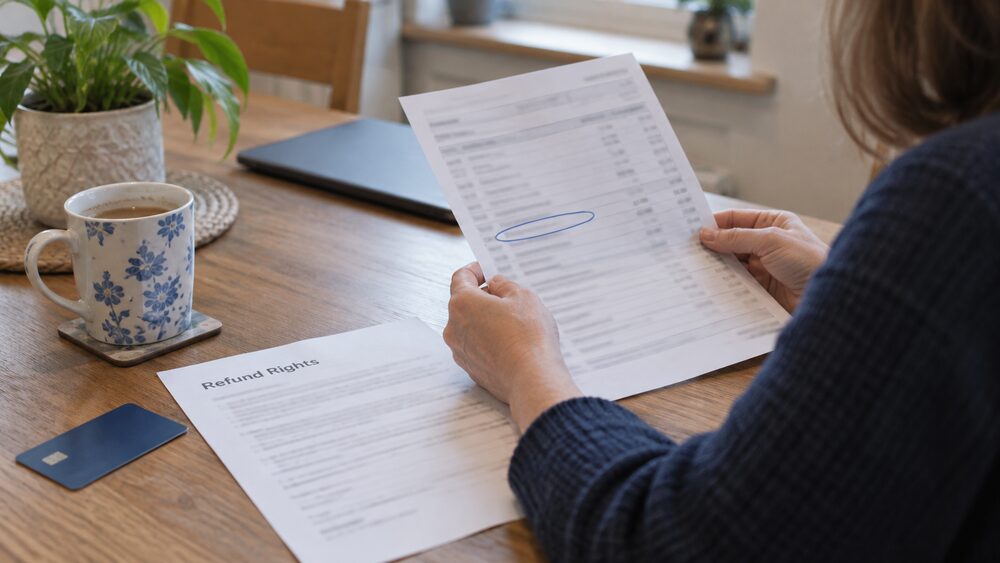
An unauthorised payment is one taken from your account that you, or someone acting on your behalf with your permission, never agreed to. In most circumstances your bank must refund you for any unauthorised payment1. The rules come from the Payment Services Regulations 2017, which set out how banks, building societies and debit card providers must handle payments, and they give you a refund deadline measured in hours, not weeks: the bank must refund you no later than the end of the business day after the day it becomes aware of the unauthorised transaction2.
Two limits shape every claim. Report the payment as soon as possible, and in any event within 13 months of the date it was made, or the bank can usually refuse3. And if your card or security details were lost or stolen, you may have to pay up to £35 of the losses taken before you notified the bank3. Where your card details were misused without the card ever leaving you, for example after a data breach, the refund is in full.
What counts as an unauthorised payment
A payment is unauthorised when it was executed without authorisation in the way the Payment Services Regulations require. The regulations place the duty on the bank: where an executed payment transaction was not authorised, the payment service provider must refund the amount of the transaction to you and restore the debited account to the state it would have been in had the transaction never taken place5. The same duty appears in the FCA's banking conduct rules, which require a firm to refund the amount of an unauthorised payment within a reasonable period and restore the account6.
Common situations that count as unauthorised include:
- your card is lost or stolen and someone spends on it
- your card is cloned, or your account data is exposed in a breach, and the details are used without the card leaving you7
- a business keeps taking recurring card payments after you cancelled the authority: any further payments taken after cancellation are considered to be unauthorised transactions8
- someone obtains your security details and moves money from your account without your knowledge
What an unauthorised payment is not: a payment you were tricked into making yourself. If you were deceived into authorising a transfer, perhaps by a fake investment or a bogus invoice, the payment was authorised by you even though it was fraudulent. Those are authorised push payment scams, and they are handled under a different reimbursement scheme described in the scams and fraud guide. The ombudsman can still help where reimbursement rules do not apply, for example card payments to genuine merchants, overseas payments and cash handed to a scammer9.
The refund is due by the end of the next business day
Once the bank is aware of the unauthorised transaction, the clock starts. The regulations require the refund to be provided as soon as practicable, and in any event no later than the end of the business day following the day on which the bank becomes aware of the unauthorised transaction10. This is a hard deadline in law, not a target. The FCA's conduct rules mirror it in plainer terms: the firm must refund the amount of the unauthorised payment within a reasonable period and restore the account11.
The deadline runs from the bank's awareness, not from the date the payment was taken, which is why reporting quickly matters. The sooner the bank knows, the sooner the next-business-day deadline bites.
For comparison, if your case is an authorised push payment scam rather than an unauthorised payment, the timetable is different: the bank should provide the refund within five business days of you making the claim3.
What a refund covers: the payment plus charges and lost interest
The refund is not just the money that left the account. Because the regulations require the account to be restored to the state it would have been in had the unauthorised payment not happened5, everything that flowed from the payment gets reversed too. The FCA states that a refund also covers any charges and interest paid, or credit interest lost, because of the payment1.
In practice this covers the knock-on costs that unauthorised payments often cause:
- overdraft fees or unpaid transaction fees triggered by the missing money, which are explained in overdraft charges
- debit interest charged on the resulting overdraft balance
- credit interest you would have earned on the money while it was gone
A related rule protects you when a payment you did authorise turns out larger than you expected. Where an authorised transaction initiated by or through a payee did not specify the exact amount, and the amount exceeded what you could reasonably have expected, you are entitled to a refund of the full amount12. This is the rule behind refunds for unexpected card charges from a business.
The ombudsman applies the same thinking. In one case it upheld a complaint and told the bank to refund the extra account fees the customer had paid, plus interest13. In a scam case involving £100,000 transferred from a bank account, it told the bank to refund the full amount plus interest from the date of the loss to the date of the refund14.
How to report an unauthorised payment and claim a refund
The first step is simple: if you see a payment from your account that you did not authorise, contact your bank as soon as possible and claim a refund15. Most banks have a dedicated fraud line, and many let you freeze your card instantly in their app while you report the problem.
A claim in order:
- Tell the bank that a payment was taken without your permission, and ask for a refund. Do this as soon as you notice the payment.
- Give the details: the date, the amount, the payee as it appears on your statement, and why you did not authorise it. Statement abbreviations that help you identify a payment are explained in bank statement codes.
- Ask for the account to be restored, including any charges or interest the payment caused.
- Keep a record of when you reported it and what the bank said, in case you need to complain later.
- Change your security details, and cancel the card or authority if it is still live.
Where the unauthorised payment was a card purchase made over the internet, by telephone, TV or teletext, you may have a right to get your money back, and the bank may be able to cancel the payment or put the money back into your account16. If your card provider will not give you your money back in that situation, you can report it to Trading Standards16.
The 13-month limit for making a claim
The regulations give you a long window, but not an unlimited one. You must report an unauthorised payment as soon as possible, or in any event within 13 months of the date the payment was made17. The same 13-month rule is repeated in guidance on continuous payment authorities taken from credit and debit cards4.
The limit runs from the date of each payment, not from when you noticed it. If a series of unauthorised payments was taken over months, the oldest ones may fall outside the 13-month window while the newest ones remain claimable. Missing the limit is one of the few grounds on which a bank can usually refuse a refund: it can refuse if you told them about the fraud 13 months or more after the payment was taken3.
When you pay up to £35 of the loss
If your payment instrument was lost, stolen or misappropriated, the regulations allow the bank to require you to bear a share of the losses, up to a maximum of £3510. Independent guidance puts the same figure in practical terms: tell the bank immediately, because you may have to pay up to £35 of any unauthorised payments taken before you notify the bank that your card was stolen or that someone has your security details3.
Three things to know about the £35:
- it is a cap, not a fixed charge: the customer's share cannot exceed £35 however large the losses
- it applies only to payments taken before the bank was notified; no liability falls on the customer for unauthorised payments taken after the bank has been told that a card was stolen or details compromised3
- it does not apply where the card was never lost or stolen, for example cloned card details or a data breach: in those cases the full refund is due as long as the transaction is reported promptly7
The position is different again for authorised push payment scams, where you authorised the payment after being deceived. There the bank can deduct £100 from the refund unless you are considered vulnerable under the rules, and the rules set a maximum the bank has to pay, currently £85,0003.
When a bank can refuse a refund
The starting point is firmly in your favour: in most circumstances, your bank must refund you for any unauthorised payments1. A refusal has to rest on specific grounds. In an unauthorised payment claim, your bank can only refuse to refund you if you authorised the payment, if you acted fraudulently, or if you failed to protect the details of your card, PIN or password in a way that allowed the payment1.
Independent guidance lists the same three doors a bank can use: it can prove you authorised the payments; it can prove you were at fault because you acted fraudulently or negligently; or you told them about the fraud 13 months or more after the payment was taken3.
The grounds are slightly different where the payment came from a credit card or an overdrawn current account. There, the bank can refuse if you, or someone acting on your behalf, authorised the payment, or if the person who used your card, including a virtual card, had it with your consent1. Credit card payments sit under the Consumer Credit Act 1974 rather than the Payment Services Regulations7, which is why the rules are not identical.
Case studies from the ombudsman show both outcomes. In one, a bank refused a refund because it said the customer had authorised the payments herself, and the ombudsman examined whether that was fair18. In another, a customer complained that his bank had failed to cancel a direct debit; the ombudsman did not think the bank had made a mistake in one dispute and did not ask it to refund the payment19. Refusal is not the end of the road: each decision can be challenged through the complaint route at the end of this page.
Strong customer authentication also affects liability. The regulations define it as authentication based on two or more independent elements, where the breach of one element does not compromise the reliability of any other20. Where strong customer authentication was required for a payment but your bank did not require it, you are not liable for the resulting loss, unless you acted fraudulently21. The regulations also require stronger authentication generally, including a unique authentication code that dynamically links remote transactions to the specific amount and payee7.
Cancelling card payment authorities and challenging Direct Debits
Recurring card payments, sometimes called continuous payment authorities, are the regular card charges used by subscriptions and gyms. You can cancel one by contacting the business taking the payment and asking them to stop, or by asking your card issuer to cancel the payment8. Your bank or card provider must cancel the payment authority when you ask4. If you did not consent to the recurring card payments at all, your card issuer should stop the payments and give you your money back8.
The key protection is what happens next: any further payments taken by the business after you cancel a recurring card payment are considered to be unauthorised transactions8. That brings them within the refund rules described above, including the next-business-day deadline once the bank is aware.
Direct Debits work differently, and are covered by the Direct Debit Guarantee: if the bank, or an organisation you are paying, makes a mistake, your bank must refund the payment to you22. The ombudsman enforces this in practice. In one case, a customer cancelled a direct debit but the payments continued; the ombudsman told the bank to refund him for the payments made since the cancellation23. Direct Debit problems remain a live source of complaints: the ombudsman's data for the first quarter of 2026/27 records 113 complaints opened about Direct Debits24. The differences between the two systems are set out in Direct Debits and standing orders, and the cancellation process in the Direct Debit Guarantee guide.
Credit cards, NS&I and credit unions: where different rules apply
Not every account sits under the Payment Services Regulations in the same way.
Credit cards. The refund provisions described on this page do not apply to credit cards, because the Consumer Credit Act 1974 already sets out rules that apply to credit card transactions7. Credit card purchases have their own protections, including Section 75, which is explained in the credit cards guide. The refusal grounds for credit card payments and overdrawn accounts are listed in the section above.
NS&I. National Savings & Investments states its own policy in the terms of its accounts: if you did not authorise a payment from your account, it will normally return the account to the position it would have been in had the unauthorised payment not happened25. The same wording appears across its accounts, including Direct Saver26, Green Savings Bonds27 and the Junior ISA28, and it extends to missed interest or prizes. The refund can be withheld where the customer failed to take reasonable care, did not report lost security details promptly, or where fraud by the customer is suspected.
Credit unions and others. The Payment Services Regulations do not apply to credit unions, municipal banks or the National Savings Bank20. This does not mean money in those institutions is without protection, but the specific refund deadlines and liability caps on this page come from regulations those providers are exempt from. Credit unions are covered in the credit unions guide.
E-money accounts. Prepaid cards and e-money firms are not banks, but the ombudsman can assist with complaints about an e-money business that has unfairly reversed a payment or placed restrictions on your account, and can tell it to put things right and pay compensation for distress or inconvenience29.
Complaining if your bank says no
If your complaint is about something your bank has done, for example refusing to refund an unauthorised payment, the route starts with the bank itself: contact the bank to make a complaint15. Give it the chance to investigate and issue a final response.
If the bank upholds its refusal, the Financial Ombudsman Service is the next step, and it is free. Its powers are wide: it may ask the bank to refund any payments you did not authorise, refund charges and interest the bank has applied, compensate you for any money you lost, and pay compensation for distress or inconvenience22. It can also look into complaints about the bank or payment provider that received the money, considering the steps it took to recover it and whether it should have had concerns about its customer's account9. Where reimbursement rules do not apply, such as card payments to genuine merchants, overseas payments and cash withdrawals handed to a scammer, the ombudsman can still help9.
The ombudsman's decisions are not automatic wins for consumers. In one case involving a holiday apartment rental scam, the ombudsman did not think the bank had made a mistake and did not ask it to refund the payment19. Each case turns on its facts, which is why keeping records of what you reported, and when, matters from the first phone call. More widely, your rights across financial services are set out in the consumer protection guide.
Sources30 cited
- Fraudulent payments Financial Conduct Authority
- Regulation 76, Payment Services Regulations 2017 legislation.gov.uk
- Dealing with fraud Business Debtline
- Consumer advice: card payments Isle of Anglesey County Council
- Part 7, Payment Services Regulations 2017 legislation.gov.uk
- BCOBS 5 FCA Handbook
- Payment Services Regulations 2017 Which?
- Recurring card payments Financial Conduct Authority
- Scams: you've been tricked into making a payment Financial Ombudsman Service
- Authorisation of payment transactions, Payment Services Regulations 2017 legislation.gov.uk
- BCOBS 5 (made version) FCA Handbook
- Regulation 79, Payment Services Regulations 2017 legislation.gov.uk
- Case study: account mis-sold with benefits not needed Financial Ombudsman Service
- Case study: Joyce transferred £100,000 after a bank account scam Financial Ombudsman Service
- Account information and payment initiation services Financial Conduct Authority
- Your payment card was used without your permission Citizens Advice
- Consumer advice: unauthorised payments Isle of Anglesey County Council
- Case study: customer asked to transfer money after an account threat Financial Ombudsman Service
- Case study: holiday apartment rental scam Financial Ombudsman Service
- Payment Services Regulations 2017 (full text) legislation.gov.uk
- Regulation 77, Payment Services Regulations 2017 legislation.gov.uk
- Regular payments Financial Ombudsman Service
- Case study: bank failing to cancel a direct debit Financial Ombudsman Service
- Quarterly complaints data Q1 2026/27 Financial Ombudsman Service
- NS&I Income Bonds brochure NS&I, 2024
- NS&I Direct Saver brochure NS&I, 2024
- NS&I Green Savings Bonds brochure NS&I, 2025
- NS&I Junior ISA brochure NS&I, 2024
- Electronic money Financial Ombudsman Service
- Festival refunds not guaranteed Financial Ombudsman Service, 2026-06-04




 MoneyHelperFree, impartial money and pensions guidance, set up by government
 FSCSProtects your money if a bank, insurer or investment firm fails
 Financial Ombudsman ServiceFree, independent help when a complaint about a firm is not put right
 Citizens AdviceFree advice on money, consumer and legal problems in England and Wales