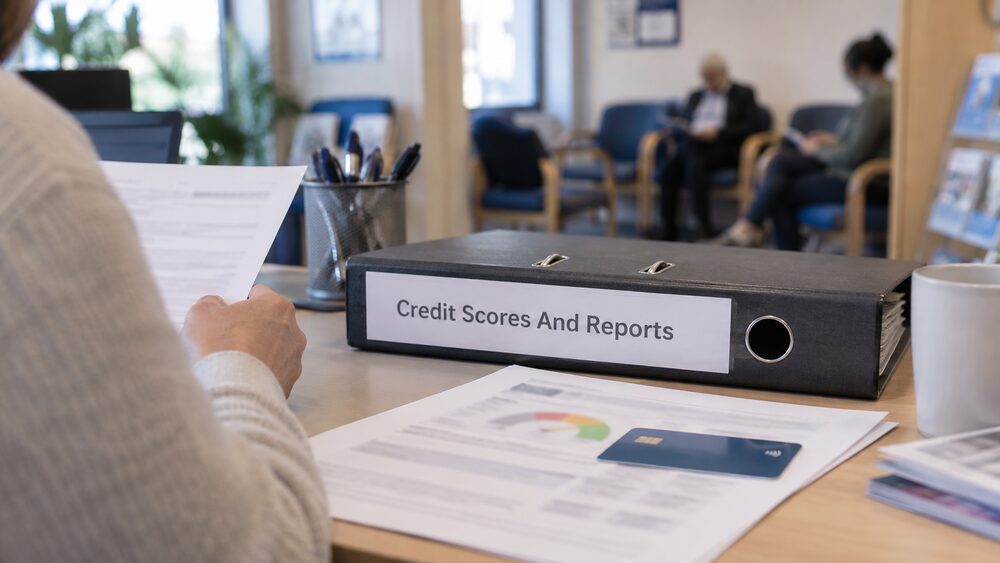
There is no single "good credit score" in the UK, because there is no single credit score. Lenders mainly use three credit reference agencies, Experian, Equifax and TransUnion, and each one scores you on its own scale with its own bands1. A score of 700 means something quite different at Equifax, where the scale runs to 1,000, than it does at TransUnion, where the old scale topped out at 7101.
So the honest answer to "what is a good credit score?" is: it depends which agency you ask. At Experian, good sits at 881 to 960 on the old scale, with the scale now running up to 1,2502. At Equifax, good is 531 to 670 out of 1,0002. At TransUnion, good was 604 to 627 out of 710, and the agency is now moving to a scale that runs to 9993. Each score is a three digit number accompanied by a word grading, so the label attached to your number matters as much as the number itself4.
A good score depends on which agency you ask
There are a fair few approved credit reference agencies in the UK, but lenders mainly use three: Experian, Equifax and TransUnion, and each must offer a free statutory credit report1. The three agencies do not share one scoring system. Experian's scale now reaches 1,250 points, Equifax's reaches 1,000 and TransUnion's new scale reaches 9993. The same person can therefore hold three perfectly accurate scores that look completely different on paper.
What the scores share is shape. Each credit score, regardless of the credit reference agency, is a three digit number and is accompanied by a word grading4. Those grades run from excellent down through very good, good and fair to poor and very poor8. So when people ask whether their score is good, the useful question is not "what is my number?" but "which band is my number in, on which scale?"
The practical consequence is that a number quoted without its agency means very little. An 800 at Equifax is excellent territory, while an 800 at Experian, on the new 1,250 scale, is a fair way below the excellent band. When a lender, a comparison site or an app quotes your score, check which agency's scale it is using before reading anything into the number. The dedicated guide to why your score differs between agencies takes this further, and the section on how lenders decide explains what happens to the information behind the number.
Experian credit score: 0 to 1,250
Experian has changed its scale. It previously scored consumers from 0 to 999, with five bands2:
| Band | Old Experian scale (0 to 999) |
|---|---|
| Excellent | 961 to 999 |
| Good | 881 to 960 |
| Fair | 721 to 880 |
| Poor | 561 to 720 |
| Very poor | 0 to 560 |
The scale now runs to a maximum of 1,250 points3. Under the new bands, very good runs from 1,001 to 1,120, replacing the old good band of 881 to 960, and excellent runs from 1,121 to 1,250, replacing the old excellent band of 961 to 9991. So a score that was 961 or more, excellent under the old scale, now needs to be 1,121 or more to carry the excellent label.
Not every source agrees on where the lines sit. StepChange's guidance states that good is between 861 and 1,000 at Experian7, while other guidance puts the old good band at 881 to 9602.
In practice, the band matters more than the number. A score of 900 was "good" on the old scale and a score of 1,100 is "very good" on the new one, but both describe broadly the same borrower. Experian's own free service shows both your credit report and your credit score, and downloading the Experian app is all you need to do to see both2. The guide to Experian's free account covers what it includes.
Equifax credit score: 0 to 1,000
Equifax scores run from 0 to 1,0001, and its bands are2:
| Band | Equifax scale (0 to 1,000) |
|---|---|
| Excellent | 811 to 1,000 |
| Very good | 671 to 810 |
| Good | 531 to 670 |
| Fair | 439 to 530 |
| Poor | 0 to 438 |
StepChange, whose own guidance is based on the Equifax scale, notes that a credit score shows as a number from 0 to 1,000 and that excellent is above 8007. That is consistent with the 811 to 1,000 excellent band, give or take the boundary. As with Experian, the label attached to your number is the thing to read: 531 to 670 is good at Equifax, while 811 to 1,000 is excellent12.
Because Equifax's maximum is lower than Experian's, the same borrower often shows a lower raw number at Equifax. Someone with an excellent Equifax score in the 800s might see a four-figure score at Experian on the new scale. Neither is wrong; they are just different rulers measuring the same credit history. Free services such as ClearScore show your Equifax data, so many people first meet the 0 to 1,000 scale there. The guide to checking your credit report for free lists which services use which agency.
TransUnion is moving from a 0 to 710 scale to 0 to 999
TransUnion has historically scored consumers from 0 to 71013, with these bands2:
| Band | Old TransUnion scale (0 to 710) |
|---|---|
| Excellent | 628 to 710 |
| Good | 604 to 627 |
| Fair | 566 to 603 |
| Poor | 551 to 565 |
| Very poor | 0 to 550 |
That scale is being replaced. TransUnion is expanding its range from 0 to 710 to a maximum of 999, with the excellent band now starting at 7865. The new score will roll out across credit monitoring partners in phases from late September 2026 to June 20275.
Two things about the change are worth knowing. First, the band names have changed: "Poor" and "Very Poor" have become "Low" and "Very Low"5. Second, the new score draws on a broader range of information, including how your account balances change over time and your credit card use5. Based on your score, you will be placed into one of five bands5.
What has not changed is what lenders see. The information shared with organisations about your credit history will remain unchanged5. The change is to the consumer-facing score and its presentation, not to the underlying record. Free services such as Credit Karma show TransUnion data, so this is the scale many people see without ever contacting TransUnion directly. The TransUnion page covers the agency in more detail.
Why your three scores can differ
The three main credit reference agencies in the UK, Experian, Equifax and TransUnion, may each hold different information about you14. Lenders do not all report to all three agencies, and do not all check all three when you apply, so the picture each agency builds of you can differ at the edges. A store card you took out years ago may appear on one file and not another, and that alone can push a score from one band into the next.
The scores also differ because each agency applies its own formula to the information it holds. Even where two agencies hold identical records, they weight them differently and map them onto different scales. That is why a borrower can be "excellent" at one agency and merely "good" at another on the same day.
Your own behaviour can move the scores at different times, too. Multiple hard searches, particularly within a short period, can lower your credit score13, and a lot of checks in a short amount of time can reduce your score7. If you apply for credit with lenders that check different agencies, each file collects a different trail of searches. The guide to hard and soft credit searches explains the difference, and eligibility checkers covers the tools that let you test your chances without adding a hard search.
None of this means any of your scores is wrong. They are three readings of the same person, taken with three different instruments. If one score is dramatically lower than the other two, that can be a sign that one agency holds something the others do not, which is worth investigating through the guide to correcting wrong information on your credit report.
What goes into your credit score
Credit scoring is a system used by creditors to decide how much of a risk it is to lend to you15. The inputs are the records on your credit file: borrowing you have now, borrowing you have had, how you have repaid it, and public records such as court judgments.
One of the biggest levers is how much of your available credit you are using. Guidance from debt charities suggests keeping your credit usage low, ideally below 50% of your agreed credit limits4. The arithmetic is simple: a £1,000 balance on a £5,000 limit means you are using 20% of the available credit12, while a £2,000 limit with £1,600 spent is 80% utilisation16. Where you hold several cards, the calculation covers all of them together: one example shows a total £3,500 limit with a £1,400 balance across two cards, a 40% utilisation rate17.
Other inputs include:
- Court judgments. A County Court Judgment (or decree in Scotland, or money judgment in Northern Ireland) is added to your credit history, and details stay there for six years18.
- Searches by lenders. Multiple hard searches in a short period can lower your score13.
- Joint borrowing. Lenders run a credit check on each applicant before granting a joint mortgage, and if one party has a poor credit score it could affect the lender's decision19.
The guide to what affects your credit score works through the full list, and how to improve your credit score sets out the steps in order. Research from Experian found that of people who had checked their credit report, just 26% said they knew their credit score20, so if you cannot currently answer that question about yourself, you are in the majority rather than a minority.
How lenders use your score band
When you apply for credit, the provider checks your credit record with a credit reference agency to see if you are credit worthy21. The score and band you see are a consumer-facing summary of that record; the lender sees the underlying file and applies its own rules on top.
A good score widens your options rather than guaranteeing any particular outcome. Mainstream mortgage lenders will all expect you to have a good credit score22, but a good score alone does not mean acceptance, because lenders also weigh income, outgoings and affordability. The band is a signal, not a promise.
The cost of a weak score is real. People with low credit scores could be charged over £800 more per year in interest than those with good ratings16. A bad credit rating can also affect your ability to rent a home, get a mobile phone contract or anything else that requires a credit check23. Some landlords and rental companies do credit checks and may not rent to you if you have bad credit24, and you can check your credit score for free online before you look for a property to rent25.
Not everyone who checks your file sees everything. Employers and landlords can also check your credit report, although they will usually only see public record information such as electoral register information, insolvency records and County Court Judgments (or Decrees in Scotland)26. The guide to who can see your credit report sets out the detail.
Checking your score for free without harming it
You can check your own credit score without hurting it7, and you can check it as often as you like without doing any harm6. Checking your own score is not a lender search and leaves no trace that other lenders can see.
There are several free routes. Some services, such as ClearScore and Credit Karma, let you check your score for free27, and ClearScore, Credit Karma and Money Saving Expert Credit Club are updated monthly8. You can check your credit score for free with credit reference agencies, though it is worth checking whether you have to pay before you use one23. For Experian's own service, all you need to do is download the Experian app to see both your credit report and your credit score for free2.
One thing to know about the statutory credit report: your statutory credit report does not come with a score attached27. The statutory report is the full record of your file, which every agency must provide free, while the score is an add-on that the free apps and websites supply. Both are useful for different purposes: the report for checking the underlying information, the score for tracking the direction of travel. The guide to how often to check your credit report suggests a rhythm.
If your score is in the lowest band
The grades used across the agencies are excellent, very good, good, fair, poor and very poor8. At Experian, very poor is the 0 to 560 band on the old scale16. At TransUnion, very poor was 0 to 550 on the old scale16. At Equifax, poor runs from 0 to 4382. A score in these bands usually reflects serious problems on the file rather than a small dip.
A County Court Judgment is one of the heaviest entries: it can impact your credit score, your borrowing, renting and employment opportunities28, and details stay on your credit history for six years18. The guides to defaults, missed and late payments and how long information stays on your file set out what each entry means and when it drops off.
A low score is not a permanent condition, and there are products designed for exactly this position. Credit cards for people with a bad credit history tend to have a low limit of around £200 and often have a high interest rate29. Credit builder cards take a "low and grow" approach, whereby your initial credit limit is very low, say £100 to £200, but increases as you prove you can manage it responsibly30. Used carefully and repaid in full, these are one route from the lowest band back up the scale; the guide to building a credit history covers others.
If debt is the reason your score is low, free help exists before you consider any paid service. StepChange's online debt advice service has no impact on your credit score31, and its debt helpline is free. The debt section of this site explains the options, and rebuilding credit after debt problems covers the years after a bankruptcy, IVA or DRO.
Sources31 cited
- New Experian credit score shake-up: find out what your new score means Which?, 2025-11-03
- How to check your credit score for free Which?, 2025-10-24
- Credit scoring Consumer Council Northern Ireland, 2026
- Credit reports and credit reference agencies Advice NI, 2026
- TransUnion credit score shake-up: what the changes mean for you Which?, 2026-09-06
- How to check your credit score for free Which?, 2025-10-24
- Your credit score StepChange, 2026-09-25
- Credit reports and credit reference agencies: mortgages and loans Advice NI, 2026-09-26
- What is a good credit score? Experian, 2026
- Equifax Credit Report and Score Equifax, 2026
- How does debt affect a credit file StepChange, 2026-09-25
- How to improve your credit score Which?, 2025-10-24
- How to check your credit score for free Which?, 2025-10-24
- Supporting customers separating finances from an abuser Surviving Economic Abuse, 2022-04
- How lenders decide whether to give you credit Citizens Advice, 2026-09-25
- Do you understand your credit score? Which?, 2025-05-10
- Getting a mortgage with credit card debt Which?, 2025-08-20
- DMPs and your credit score StepChange, 2026-09-25
- Mortgage types explained Which?, 2026-04-02
- Credit scoring: are you in the dark? Which?, 2018-10-06
- Choosing and applying for a credit card Citizens Advice, 2026-09-25
- Applying for a mortgage Which?, 2026-05-20
- How to rent with a poor credit history Shelter England, 2026-05-01
- Debt solutions and your home StepChange, 2026-09-25
- Credit checks when renting Shelter England, 2026-05-01
- Your credit report Surviving Economic Abuse
- 5 credit report myths debunked Which?, 2024-11-01
- What happens if you ignore a CCJ StepChange, 2026-09-25
- Credit card debt StepChange, 2026-09-25
- Should I get a credit card? Which?, 2026-09-18
- Debt helpline StepChange, 2026-09-25







 MoneyHelperFree, impartial money and pensions guidance, set up by government
 Financial Ombudsman ServiceFree, independent help when a complaint about a firm is not put right
 Citizens AdviceFree advice on money, consumer and legal problems in England and Wales
 StepChangeFree debt advice and solutions from a charity
 GOV.UKOfficial information on tax, benefits and government services