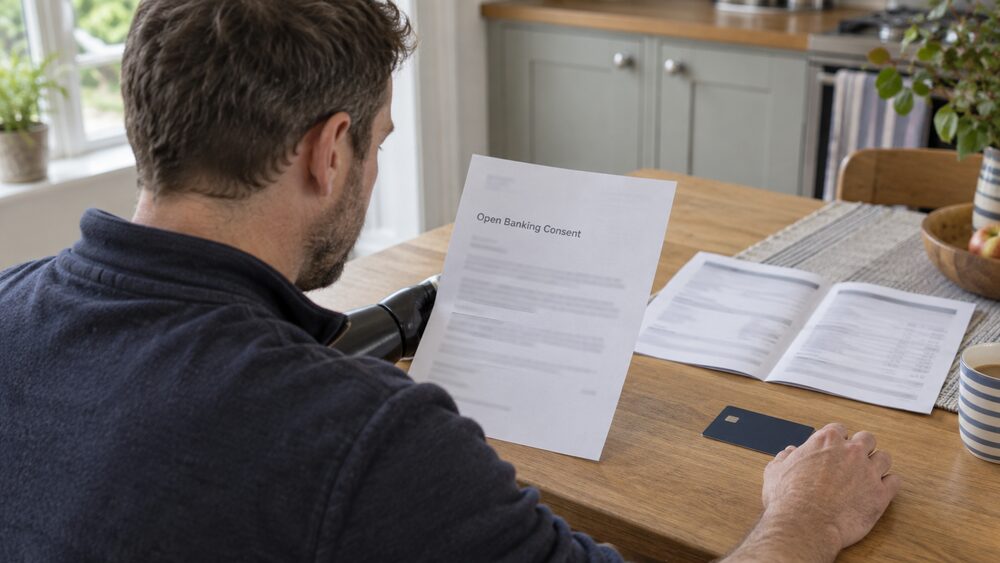
When you apply for a loan, a credit card or a mortgage, the lender has to check whether you can afford the repayments, not just whether you have repaid debts in the past. Any lender regulated by the Consumer Credit Act must complete affordability checks, which usually means asking about your household budget, your income, your regular bills and spending needs, and checking your credit file for details of your debts1. Increasingly, lenders invite you to speed this up by connecting your bank account through Open Banking.
Open Banking is, in the FCA's words, "a secure and regulated way for people and businesses to share access to payments data from their bank account with trusted apps and services"2. Third-party providers need your explicit permission before they can access your data, and depending on the service chosen you may be asked to share information such as your current account details, balance and transaction history3. This page explains what that involves, what it does to your credit file (nothing, in itself), how to say no, how to connect safely, and how to switch it off again.
Why lenders ask for Open Banking access when you apply for credit
An affordability check and a credit check answer two different questions. The credit check looks backwards: it shows the lender what you have borrowed and whether you have had problems paying money back. The affordability check looks forwards: it tests whether the new repayment fits alongside your income, your regular bills and your spending needs1. Both are part of a proper lending decision, and lenders should take the same steps again when they extend a credit agreement or refinance one1.
The traditional way to do the affordability half is to ask you to fill in a budget form, gather payslips and bank statements, and wait for someone to read through them. Open Banking offers a shortcut. Because it allows people and businesses to link their accounts with third parties offering payment services, as the Payment Systems Regulator describes, the lender can read the same evidence directly, with your permission, instead of asking you to photocopy six months of statements5. The FCA frames Open Banking as a secure and regulated route for exactly this kind of sharing2.
For you, the practical difference is speed and accuracy. The lender sees real figures from your actual account rather than estimates you typed into a form, which can work in your favour if your budget is tight but genuine, and can work against you if your account shows spending the lender treats as risky. Either way, the check happens with your explicit permission: a provider cannot simply help itself to your data3.
What a lender can see: balances, transactions and regular payments
What is shared depends on the service chosen, but the information a provider may ask for includes your current account details, your balance and your transaction history4. In practice that means the lender can see money coming in, such as salary or benefits, money going out, such as rent, bills, subscriptions and debt repayments, and the balance you typically keep. Regular payments show up as patterns, so a lender can see whether repayments to other creditors are being made on time and how much of your income is already committed.
This is different in kind from a credit file check. When a bank opens a current account it will usually run a credit check to see your credit history, including whether you have had problems paying money back6. When a lender gives you an agreement in principle for a mortgage, it checks your credit file to establish whether you are eligible to borrow and whether it is happy to lend the amount you need7. Those checks look at what credit reference agencies hold about you. An Open Banking connection looks at your live account instead: what you earn, what you spend and what you have left.
Two things are worth knowing about the limits of what is shared. First, the share covers what the service asks for, not your whole banking relationship, and you approve it before it happens3. Second, the lender is looking at affordability, not snooping on individual purchases for their own sake: the patterns that matter are income, committed spending and disposable income1.
Open Banking and your credit file are separate checks
It is worth being precise about this, because the two checks get confused. A credit search is a look at the record a credit reference agency holds about you: your borrowing, your repayment history and any problems. Open Banking is not that. It is a read of your bank account data, taken with your permission, and it does not involve a credit reference agency at all2.
Some applications involve both, and some involve only one. A basic bank account is an example of the lightest touch: you give permission for a "soft search" of your credit file, which is to check your identity and does not affect your credit score8. A mortgage agreement in principle involves the lender checking your credit file7. An Open Banking affordability check involves neither: it is a data share, not a search.
The distinction matters when you are deciding what to agree to. If a lender or broker asks you to connect your bank account, that is an Open Banking request, and it is governed by the consent rules described on this page. If it asks to search your credit file, that is a credit search, and the question of whether it is hard or soft, and what a hard search does to your score, is covered in hard and soft credit searches. The two can happen in the same application, but they are separate events with separate rules.
What does and does not affect your credit score
Connecting your bank account through Open Banking does not itself affect your credit score. It is not a credit search of any kind: no credit reference agency is consulted, and nothing is recorded on your credit file as a search2. What you share is used for the affordability assessment, and the decision the lender reaches, accept or decline, is a lending decision rather than a file entry caused by the data share.
Contrast that with the checks that do touch your file. A soft search, used for identity checking, does not affect your score8. A full application for credit typically involves a hard search, which does leave a mark, and multiple applications in a short period can weigh on your score; that is covered in how many applications is too many. The general rule of thumb is that borrowing and repayment behaviour moves your score, while information sharing and advice do not. StepChange makes the same point about its own debt advice process: "There is no impact on your credit score"11. Taking advice, or giving a lender evidence, is not the same as taking on debt.
One caveat: if the Open Banking data supports an application and that application proceeds, the lender will usually run a credit search as part of the decision, and that search is a separate event with its own consequences. The data share itself is neutral. If you are unsure what a particular lender will search, ask before you apply; the difference between a soft and hard search is set out in hard and soft credit searches, and eligibility checkers explains the pre-check tools many lenders offer.
Affordability Passport and other lender-led versions
The idea behind tools sometimes marketed as an "affordability passport" is that you verify your income and spending once, through Open Banking, and then reuse that verified picture across applications rather than connecting your account separately each time. The regulatory foundation is the same affordability framework described above: lenders must complete affordability checks covering income, regular bills, spending needs and your credit file, and must repeat those steps when extending or refinancing an agreement1.
The reach of these checks is widening. Legislation brought in for buy now pay later states that the regulatory regime will require firms offering BNPL products to perform affordability checks on borrowers and offer clear product information to consumers12. The FCA's own consumer guidance on buy now pay later tells people to check that a firm is "Authorised" and has permission to "Lend you money on an unsecured basis"13, which reflects the same regime. From 15 July 2026, most BNPL providers are regulated by the FCA, bringing affordability checks, clearer information and Financial Ombudsman Service access.
For a consumer, the practical points are these. A lender-led verification tool is still an affordability check under the rules: it must cover the same ground, and it cannot be used to lend you more than the standard assessment would support. And the consent rules still apply: whatever the tool is called, the provider needs your explicit permission to access your data3, and you can withdraw it afterwards through your bank's dashboard. A fancier name does not change your rights.
Saying no: Open Banking is optional, but some loans require it
Open Banking access is built on consent. Third-party providers need your explicit permission before they access your data, so you can decline to connect your account and the provider cannot proceed with that share3. What happens next depends on the lender. Some will accept documents instead, such as payslips and bank statements, and process the application the slower way. Others treat the connection as a condition of that particular product, in which case declining means the application does not go ahead with that lender. Saying no is always your right; it may narrow your options.
It helps to know that credit checks themselves are not a fixed barrier everywhere in banking. If you do not meet the opening criteria for a standard account, which might include a credit check, you will usually be offered a basic bank account instead14. With a basic bank account you do not have to pass a credit check, but the bank uses one to check your identity15. Credit union current accounts usually require no credit check either, even for an overdraft, because credit unions normally use manual checks to decide whether to lend16. After bankruptcy, most banks will not give you a current account until you are discharged, because they will credit check you17.
So the landscape is mixed: some products lean on data and checks, others are deliberately built without them. If a lender insists on Open Banking and you are not comfortable, the alternatives include applying to a different lender, or providing evidence by another route. If you are refused, the reasons a bank can give are limited: not agreeing to a credit check, failing the ID check, suspected unlawful or fraudulent use, or being threatening towards staff, and the reason must be given unless the bank suspects fraud or money laundering15. Being refused credit, and what to do about it, is covered in what to do if you are refused credit.
How to connect your bank account safely
The safety rules are simple and worth following in order. First, verify the company. You can check whether an authorised provider is listed in the Open Banking regulated providers directory and on the FCA Register4. The FCA also provides a Firm Checker tool to help consumers check whether financial services firms are authorised and have permission to sell products and services18, and for a lender specifically, its buy now pay later guidance describes searching the firm by name, selecting borrowing and credit information, and checking the firm is authorised with permission to lend on an unsecured basis13.
Second, never share your password or PIN. You do not need to share your online banking password or PIN with the third-party provider in order to use Open Banking services4. Instead, you are redirected to your own bank and log in there, in the normal way you use online banking. To access online banking at all you must already have an account with the relevant bank, and registration is done through your bank's own website, with identity verification and an activation code sent by post or text19. A genuine Open Banking flow respects that: the provider never sees your login details.
Third, keep an eye on your accounts afterwards. The Information Commissioner's Office advises people to regularly check credit card and bank statements for suspicious activity and to monitor their credit report20, and the nidirect government service makes the same point: checking your credit report regularly can help you spot suspicious activity early, giving you a chance to report it before it goes too far21. If you spot credit taken out in your name, you can check your credit file for free22, and identity fraud and your credit file explains what to do next.
Stopping access: how to withdraw consent
Consent is not a one-way door. Participating banks and building societies should provide an "authorisation dashboard" where you can see a list of the providers that have permission to access your account data, and you can withdraw permissions whenever you wish, at the press of a button3. That means after a credit application has finished, whether it was accepted or declined, you do not have to leave the lender's access in place: you can go to the dashboard, find the provider and switch it off.
It is good practice to review the dashboard periodically, in the same way you might review direct debits. A provider you connected for a one-off affordability check has no ongoing need for access once the decision is made, and withdrawing permission stops further reading of your data. Withdrawing consent does not undo a loan that has already been agreed, and it does not delete records the lender has already lawfully used or must keep: firms hold records of dealings with customers under regulatory rules, and mortgage lenders or administrators, for example, must keep records of dealings with customers in payment difficulties or sale shortfall for three years from the date of the dealing23. Access and record-keeping are separate things: you control the first, the rules govern the second.
If your bank does not offer a dashboard, or the withdrawal does not seem to work, complain to the bank first: it is the bank's permission system that governs who can reach your account data. If the bank cannot or will not help, the Financial Ombudsman Service can look at problems with banking and payments, as described in the next section.
If something goes wrong: refunds, complaints and the Financial Ombudsman
Problems with Open Banking usually fall into one of three groups: money taken or data used without proper consent, an IT failure at the bank, or a complaint about the lender's decision itself. The first port of call is always the firm involved: the bank, the lender or the provider. The Financial Ombudsman Service offers an online complaint checker where you answer a few questions and it tells you whether it can help and what to do next24.
The ombudsman's remit over banking and payments is broad. It helps resolve complaints about issues such as account closures, disputed transactions, IT failures and problems with switching services25, and its own summary for consumers lists bank accounts and bank cards, insurance, and problems with loans among the things it can help with26. Where a complaint is upheld, the remedies can include asking the bank to correct a credit file, refund extra costs, and pay compensation for distress or inconvenience27, and it may also ask a business to make changes to a product or account, or to do things differently for the customer in future28.
The scale of this route is worth knowing: the ombudsman received 101,031 banking and credit complaints in the first six months of 202429. It can look at complaints from individual customers, or from customers who share a financial product or service, such as a shared bank account or joint mortgage30. It can also investigate where a bank, payment service, insurance company, loan company or other financial firm put information about someone on a fraud prevention database by mistake31, and individuals and small businesses who feel they have been de-banked unfairly can complain to it if they are not satisfied with how their bank handled the matter32.
Affordability itself is also something you can complain about. In one published case study, a borrower was given a payday loan he could not afford: the lender had carried out a credit check before offering the loan and asked about his income and general living costs, but the ombudsman still found the lending irresponsible on the facts33. If you believe a loan was unaffordable when it was given, that is a complaint about the lender, and free debt advice charities such as StepChange can help you raise it1. Before complaining about any firm, check it is regulated using the FCA's Firm Checker34, and for the wider picture of your rights over your credit record, see your data rights over your credit file.
Sources34 cited
- Irresponsible lending and affordability checks StepChange, 2026
- Open Banking and Open Finance FCA, 2026
- Open Banking: sharing your financial data Which?, 2026
- Open Banking FBN Bank, 2026
- Account-to-account payments Payment Systems Regulator, 2026
- How to open, switch or close your bank account MoneyHelper, 2026
- Mortgage agreements in principle Which?, 2026
- Basic bank accounts with no credit check Shelter England, 2025
- Choosing and applying for a credit card Citizens Advice, 2026-09-25
- Credit checks when renting Shelter, 2026-05-01
- Debt relief orders StepChange, 2026
- Buy now pay later regulation: explanatory memorandum legislation.gov.uk, 2025
- Buy now pay later FCA, 2026
- Choosing a bank account for your Universal Credit payment MoneyHelper, 2026
- Basic bank accounts MoneyHelper, 2026
- Credit union current accounts MoneyHelper, 2026
- Bank accounts after bankruptcy StepChange, 2026
- Check if a firm is authorised FCA, 2026
- Online banking Age UK, 2026
- Identity theft ICO, 2026
- Protect your identity nidirect, 2025
- How to spot, avoid and report scams StepChange, 2026
- Mortgage Conduct of Business 13 FCA Handbook, 2024
- How to complain: video transcript Financial Ombudsman Service, 2026
- Banking and payments complaints Financial Ombudsman Service, 2026
- Who we can help: easy read leaflet Financial Ombudsman Service, 2026
- IT problems at banks Financial Ombudsman Service, 2026
- Supporting customers in vulnerable situations Financial Ombudsman Service, 2026
- Half-yearly complaints data H1 2024 Financial Ombudsman Service, 2024
- Who we can help: video transcript Financial Ombudsman Service, 2026
- Fraud and scams Financial Ombudsman Service, 2026
- Access to banking services and cash House of Commons Library, 2026
- Given a payday loan he couldn't afford: case study Financial Ombudsman Service, 2026
- Pensions and annuities complaints Financial Ombudsman Service, 2026


 MoneyHelperFree, impartial money and pensions guidance, set up by government
 Financial Ombudsman ServiceFree, independent help when a complaint about a firm is not put right
 Citizens AdviceFree advice on money, consumer and legal problems in England and Wales
 StepChangeFree debt advice and solutions from a charity
 GOV.UKOfficial information on tax, benefits and government services