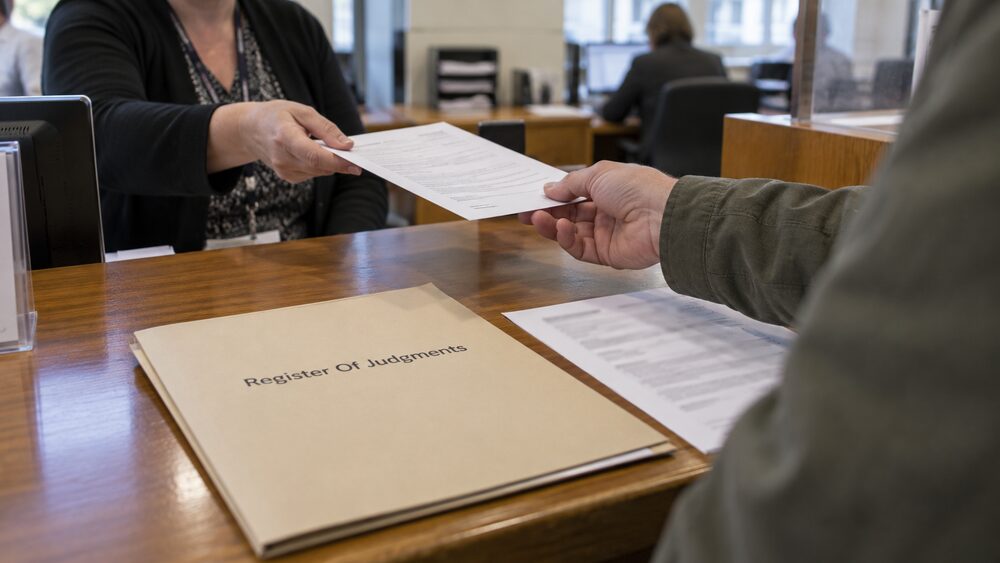
A county court judgment, usually called a CCJ, is a civil court order that says you owe money and sets out how and when it must be repaid1. If a CCJ is made against you, it is normally recorded on a public register called the Register of Judgments, Orders and Fines2. Courts send details of new CCJs to the Registry Trust, which operates the Register3, and anyone can search it online through a service called TrustOnline for a fee of £6 to £104.
The Register matters because it is public. Credit reference agencies take information from it, so a CCJ appears on your credit file for six years1, where it can make borrowing harder or more expensive5. The one big exception is timing: if you pay the debt in full within one month of the judgment date, you can apply to the court to have the entry removed6. Pay later than that and the entry stays for the full six years, though it can be marked as satisfied, meaning paid1.
What the Register of Judgments, Orders and Fines records
The Register of Judgments, Orders and Fines is the public record of court orders for money in England and Wales. Almost all county court and High Court judgments are recorded on it and kept there for six years4. When a court makes a CCJ, it sends the details to the Registry Trust, the body that operates the Register3, and the entry becomes a public record that others, including credit reference agencies, can access1.
Judgments are not the only things recorded. The Register is organised in sections: Section 1 covers England and Wales county court judgments, and Section 2 covers England and Wales High Court judgments, administration orders, magistrates' court fine defaults and Child Support Agency liability orders4. An administration order, which consolidates several debts into one court-supervised payment, is listed on the Register and publicly available at TrustOnline8, as is a composition order made as part of one9. Child maintenance liability orders can also be registered in the Register of Judgments, Orders and Fines, which may affect the paying parent's credit rating10.
CCJs are often used to recover non-priority debts, such as credit card debts and payday loans11. A creditor who wants a CCJ must usually send you a letter before action or a default notice first, depending on the type of creditor11, so a judgment is normally the end of a process rather than a surprise beginning. The advice on this page applies to residents in England and Wales only3; Scotland and Northern Ireland are covered in their own section below.
What an entry shows, and what it leaves out
A Register entry is deliberately sparse. The register shows your name and address, whether you have a CCJ or decree, the date of the judgment, the amount owed, and the name of the court that issued the judgment12. Another description of the public register of court actions puts it the same way: your name and address, details of the court action taken, and the date and the amount owed at the point the action happened13.
What the Register does not show is just as important. It does not say the name of the creditor, so you will need to contact the court for this12. It also does not track your payments: the amount shown is the amount owed when the action happened, not your current balance. And it does not show charging orders separately. Only CCJs are recorded on your credit file, not separate charging orders that secure a debt against your home14.
If you suspect a CCJ has been made against you, you can check your credit report with Experian, Equifax or TransUnion1, or search the Register itself. The Register is a public record, so the information can be accessed by others, including credit reference agencies1, which is why an entry reaches your credit file even though the Register and the credit file are separate things. The Registry Trust notifies credit reference agencies of all decrees, recalls and dismissals on a regular basis15.
Checking the Register on TrustOnline: £6 to £10 per search
The Register is searched through TrustOnline, the Registry Trust's online service. You can check for any judgments recorded against you through the public register for a small fee1. The fee depends on how much of the Register you search, because the Register is split into sections covering different order types4:
| What you search | Fee |
|---|---|
| One section | £64 |
| Two sections | £84 |
| Three sections or more | £104 |
| Each additional name or address search | the standard fee less 10%4 |
The same fee structure applies to the Scottish register: £6 to search one section, with each additional name or address search costing the standard fee less 10%16. Guidance on finding who you owe money to gives the £6 fee for accessing the Registry Trust's public register of judgments12, and the public register of court actions is searched by contacting Registry Trust online and paying a fee of £613. Anyone can check if you have an outstanding CCJ for a fee of £43; the sources give different figures for what a search costs, and the fee you pay depends on which service and how many sections you use.
Searching your own entry is worthwhile before applying for credit, because an old CCJ you have forgotten about can surface in a lender's check. If you find an entry you did not know about, the sections below on setting a judgment aside and on wrong entries set out what you can do. Free access to your credit report, which will show a CCJ that has reached the credit reference agencies, is covered in how to check your credit report for free.
How long entries stay: six years for judgments, five for fines
Almost all county court and High Court judgments are recorded on the Register and kept on it for six years4. The same six-year rule applies to the information held by the Registry Trust's public register of judgments12, to sheriff court decrees in Scotland16, and to a CCJ on the Register and your credit files5. The Information Commissioner's guidance on credit files records the same position: six years from the date of the judgment, even if it is paid in full, though it may be removed if it is paid in full within one month of the judgment date17.
Some magistrates' court fines are different. Where a fine default is added to the Register in specific circumstances, those entries stay on the register for five years7.
The judgment date starts the clock: pay within a month and the entry can be removed; pay later and it is marked satisfied but stays for six years.
The six-year clock runs from the judgment date, not from when you found out about the CCJ or when you last paid anything. A CCJ is removed from the Register and your credit file after six years, even if you have not paid it3. The debt itself may still be enforceable after that, although the creditor would usually need the court's permission to take certain steps once six years have passed5. How long other kinds of information stay on your file is covered in how long information stays on your credit file.
Paid within one month: getting a CCJ cancelled
The one-month rule is the only way a paid CCJ comes off the Register early. If you pay the debt in full within one month of the date of the CCJ, you can apply to the court to have your entry in the Register removed6. Pay the CCJ in full within one month of the judgment and apply to the court for a certificate of cancellation to stop it being added to the register18. If you pay off the full CCJ amount within a month of judgment, you can apply to have the CCJ removed3, and if you pay the full amount within one month of the judgment date, you can ask for the entry to be removed1. Pay it in full immediately and it will not be recorded on your credit file19.
The process is straightforward but it is not automatic. You apply to the court for a certificate of cancellation, paying a £15 fee19, which may be available free if you are on a low income19. Once the court has everything it needs, it tells the Registry Trust to remove the judgment from the public register19. Until that happens the entry can still be seen, so it is worth applying promptly rather than assuming payment alone clears the record.
The month runs from the date of the judgment, not the date you were told about it. That makes the rule harsh where papers went to an old address and you learned of the CCJ late; in that situation the route is usually to apply to set the judgment aside, covered below, rather than the one-month rule. The dedicated page on paying a CCJ within a month goes through the steps in detail.
Paid later: a satisfied entry stays for the full six years
If you pay after one month, the entry can be marked as satisfied but it will remain for the full six years1. A note is made against your entry on the Register to show that the debt has been satisfied, or paid6, and the CCJ will still stay on your credit report until the six years is up, but your record will show that you have paid the debt6.
To get the entry marked, apply for a certificate of satisfaction from the same County Court hearing centre that issued the judgment, providing proof of payment using court form N4433. There is a £15 court fee to apply3, which can be waived or reduced if you are on a low income6. Once the certificate is granted, the register will show the CCJ as paid off or satisfied3. If you pay the CCJ in full after one calendar month, you can ask for your entry to be marked as satisfied if you provide proof of payment, but the CCJ will still stay on your credit reference file20.
You cannot remove the entry early just because you have paid it3. The practical difference is real, though: a satisfied entry makes it easier to apply for credit in the six years before the CCJ drops off your credit file3, because a lender reading the file can see the debt is cleared rather than still outstanding. The steps for the certificate are set out fully in getting a certificate of satisfaction for a paid CCJ.
Scotland and Northern Ireland have their own registers
The Register of Judgments, Orders and Fines covers England and Wales. Scotland keeps its own record. Decrees are the Scottish equivalent to money judgments, known as county court judgments or CCJs, in England and Wales21. The Registry Trust maintains a public register containing all simple procedure, small claims and summary cause money decrees granted in the sheriff courts during the preceding six years21, with details of Scottish decrees supplied by the sheriff courts to the Registry Trust15.
The removal rules for decrees differ from the English one-month rule in detail: decrees are only removed from the Register if they are recalled by the court, entered in error or paid in full within one calendar month of the date of decree21. Satisfaction also works differently. In Scotland, it is not the court that issues the certificate; you get a letter of satisfaction from the pursuer in the action, or the pursuer's solicitor, explaining that the debt has been paid, then send it to Registry Trust Limited with their administration fee and confirmation of your name and address at the time of the decree21. The letter needs the name of the court, the case number, the date of decree, the amount of decree and the date the debt was repaid in full15. Marking a paid decree as satisfied carries a £6 fee, sent to Trust Online with evidence from the pursuer that the debt has been paid16. The Registry Trust notifies credit reference agencies of all decrees, recalls and dismissals on a regular basis21.
Northern Ireland has its own court system and its own arrangements for judgments; the Scottish and Northern Irish courts have similar orders to charging orders14, but decrees and NI judgments are not entries on the England and Wales Register. These differences are covered in credit files in Scotland and credit files in Northern Ireland.
Where an entry is wrong: setting aside a judgment
A judgment can be cancelled by the court, which removes it from the Register. If you only found out about a judgment after it was made, perhaps because the papers went to an old address, you may be able to apply to set aside the judgment5. Setting aside asks the court to cancel the CCJ and reopen the case so you can properly respond; it usually involves a fee and may require a hearing1. An entry is also removed if the judgment is set aside by the court4.
The court will not set a judgment aside simply because you would have preferred to defend the claim. The usual ground is that you did not receive the papers, or there is some other good reason the judgment should not stand. Once the court agrees and the judgment is set aside, it tells the Registry Trust to remove the judgment from the public register19.
A wrong entry on a credit file, as opposed to a wrong judgment, follows a different route. Under the Consumer Credit (Credit Reference Agency) Regulations 2000, an application by an objector or a business consumer must give particulars of the entry in the file, state why it is considered incorrect and why the applicant is likely to be prejudiced if it is not corrected22. That process applies to credit reference agency files; the Register itself is corrected through the court. Both routes are covered in when a CCJ or register entry is not yours or is wrong and how to correct wrong information on your credit report.
How a Register entry affects borrowing and renting
A CCJ can make borrowing harder or more expensive while it is recorded on your credit files5. It goes on your credit file for six years from the date it was issued23, and this will count against you if you apply for credit in the future24. Having a CCJ can affect your credit rating and may make it harder to obtain credit in the future22. The CCJ will appear on your credit report, the information a credit reference agency provides to companies6, and a county court judgment will stay on your credit for six years25.
Renting is affected too. It might be difficult to start renting a home from a private landlord or letting agent if you have a CCJ against you6, because landlords and agents commonly run credit checks on prospective tenants. In Scotland, a First-tier Tribunal decision that includes an order for payment or eviction may be sent to the Registry Trust and be accessible through Trust Online, which could affect your credit rating26.
The consequences of not dealing with a judgment go beyond credit. If you do not pay what is owed or make a payment arrangement, further action can include bailiffs visiting you, an attachment of earnings order, a third party debt order, a charging order, or a bankruptcy application23. If you owe more than £5,000 and do not pay, creditors can apply to make you bankrupt23. If you own a property, the creditor can apply for a charging order that secures the debt against your home25. If a judgment has already been made and the payment terms are too high, you can apply to vary the CCJ, asking the court to change the order so you pay in affordable instalments, with a detailed budget and possibly a small court fee1. Free, impartial help with all of this is available from debt charities and from the debt section of this site, and rebuilding your credit after debt problems covers what happens once the entry is gone.
Responding to a court claim before it reaches the Register
Everything above is easier to avoid than to undo. A creditor must usually send a letter before action or a default notice before going to court11. When the claim form arrives, the claims pack includes instructions and the N9a form you use to respond23. If you do not respond within the timeframe on the papers, which is normally 14 days from service, the creditor can ask the court to enter judgment in default1. If you disagree with the claim and need more time, you can usually acknowledge service to extend your deadline to file a defence1.
How you respond to a claim form decides what kind of judgment, if any, is made.
Depending on your response, the court can enter judgment by admission if you accept the debt and ask for time to pay, enter judgment in default if you do not respond, or list a hearing if you defend the claim5. The judgment can say you must pay the full balance straightaway (forthwith) or in instalments the court considers affordable for you5. If you attempt to defend the claim but are unsuccessful, the CCJ will not be registered unless the court has ordered instalments to be paid, or the creditor takes steps to enforce the debt2.
Ignoring the claim is the worst option. If you ignore a CCJ, more court action can be taken against you3, and you lose the chance to challenge the CCJ, make a payment plan, or pay it off23. There are alternatives even at the court stage: a Tomlin order can be agreed after the lender has issued a County Court claim but before the judgment18, and if the court makes a time order on a regulated agreement and you keep up to date with the payments, your creditor cannot apply for a county court judgment to be made, so a judgment will not appear on the Register of Judgments, Orders and Fines or on credit reference agency files27. How to defend a claim, and the deadlines that apply, is covered in the debt section.
Sources27 cited
- County court judgments and your credit rating National Debtline, 2026
- Replying to a county court claim Business Debtline, 2026
- How long does a CCJ last? StepChange Debt Charity, 2026
- Credit reference agencies in England and Wales Business Debtline, 2026
- County court judgments: enforcement, removal and what you need to know National Debtline, 2026
- County court judgments and your credit rating Citizens Advice, 2026
- Credit reference agencies in England and Wales National Debtline, 2026
- How will an administration order affect my credit rating? Debt Advice Foundation, 2020
- How will a composition order affect my credit rating? Debt Advice Foundation, 2020
- Child maintenance liability orders GOV.UK, 2013
- Dyfarniadau llys sirol (county court judgments) Shelter Cymru, 2026
- Finding out who you owe money to StepChange Debt Charity, 2026
- Public information about debt StepChange Debt Charity, 2026
- Charging orders and my home StepChange Debt Charity, 2026
- Money judgments and certificates of satisfaction FAQs Scottish Courts and Tribunals Service, 2026
- Credit reference agencies in Scotland Business Debtline, 2026
- Credit explained: data protection guidance Information Commissioner's Office, 2019
- Tomlin orders StepChange Debt Charity, 2026
- How to set aside a CCJ StepChange Debt Charity, 2026
- Varying a CCJ National Debtline, 2026
- Money judgments and certificates of satisfaction: general FAQs Scottish Courts and Tribunals Service, 2026
- County court judgments (CCJs) Shelter Cymru, 2026
- What happens if you don't pay or ignore a CCJ StepChange Debt Charity, 2026
- Overdrafts and other bank debts nidirect, 2025
- Getting credit card debt written off: your rights and options National Debtline, 2026
- Rent arrears: private tenant in Scotland National Debtline, 2026
- Time orders on unsecured debt Business Debtline, 2026





 MoneyHelperFree, impartial money and pensions guidance, set up by government
 Financial Ombudsman ServiceFree, independent help when a complaint about a firm is not put right
 Citizens AdviceFree advice on money, consumer and legal problems in England and Wales
 StepChangeFree debt advice and solutions from a charity
 GOV.UKOfficial information on tax, benefits and government services