Closing a credit card does not, by itself, put a black mark on your credit file. What it changes is the shape of your borrowing: the total credit available to you falls, so any balances you still hold take up a larger share of what is left, and the average age of your accounts can shift. Those two things are what lenders look at when they decide whether to accept you.
The decision is rarely about one card. It is about whether the limit on that card is doing useful work, whether the account costs you anything to keep, and whether you can still manage the payments on everything else. A card you never use can be a spare limit that keeps your utilisation low, or a dormant account that a provider may eventually act on.
There is also a practical side. A closed account cannot be reopened, subscriptions billed to the card need moving first, and the record of the account stays on your file after it is shut. This page sets out what happens at each stage, what the rules say, and where to get free help if a card has become a problem rather than a convenience.
What happens when you close a credit card
When a card is closed, the account stops working. You cannot spend on it, you cannot borrow more against it, and the limit disappears from the total credit available to you. The provider reports the account to the credit reference agencies as closed, with the balance changed to zero, so anyone running a search afterwards sees a settled account rather than an active one4.
The closure is usually permanent. Halifax tells customers that once a credit card is closed, the account cannot be reopened6. That matters if you close a card in a hurry and then want it back: the practical route is a fresh application, which means a fresh credit search and a fresh decision.
Closing is not the same as defaulting. A default arises when you fail to make agreed payments, and your credit file will show that you did not make your agreed payments, which impacts your credit score7. Closing an account you have kept in good order is a different event entirely.
There is one situation where closure happens without your involvement. Banks are required to close bank accounts if they cannot complete the know your customer checks required by the money laundering regulations8. That is a regulatory duty, not a judgement about your creditworthiness, and it applies to accounts generally rather than credit cards specifically.
How an unused card affects your credit score
An unused card is not neutral. It sits on your file as available credit, and available credit is one of the inputs lenders use. If you hold three cards with a combined limit and only spend on one, closing the two you do not use shrinks the denominator in your utilisation calculation, so the same balance looks heavier.
The evidence on why people stop using cards is worth knowing. In official research, 29% of former card users said they stopped using their credit card because they felt it was leading them into uncontrollable levels of debt, and 26% said it was leading them to spend more than they wanted3. For those people, closing the card is not primarily a credit score decision.
Applying for credit has its own effect. Applying for too many cards or regularly switching cards can affect your credit rating1. Each application leaves a footprint on your credit file that is visible to other lenders for at least 12 months, which means they can impact your credit report and score9. A soft search eligibility check does not impact your credit score, so it is possible to see whether you would be accepted before applying10.
The same research found that 42% of respondents who shopped around closed or permanently stopped using their credit card when they opened a new account, compared with 32% who did not shop around3. Closing an old card when you open a new one is common, but it is a choice rather than a requirement.
Keeping a card open: the benefits and the risks
Keeping a card open preserves the limit, which keeps your utilisation lower, and preserves the length of your credit history. It also keeps the account available if you need it, which for some people is the point and for others is the risk.
The risk is behavioural. Using credit cards, store cards and short term loans to cover daily costs can quickly turn into long term debt11. A card kept open for emergencies can become a card used for groceries, and the balance that builds is subject to interest unless you clear it in full each month.
There is an operational risk too. If the card company is suspicious about sudden unusual spending, they may freeze your card11. A card you have not used for months and then use abroad is exactly the pattern that can trigger a block, so it is worth telling the provider before you travel.
Fraud is a further consideration. Numberless cards, which hide the long card number, do not remove the risk entirely: the fact that a card still exists digitally means there is still a risk your details can be stolen and used online12. An unused card sitting in a drawer is still a live account with a live number.
Fees and charges on cards you do not use
A card you do not spend on can still cost you. Charges vary by provider and by card, so the credit agreement is the document that matters: you will usually be charged for going over your credit limit, for using the card abroad and for late payments1.
Missing a repayment is the most common trigger. Charges of more than £12 for missing a credit card repayment may be seen as unfair11. That threshold comes from the fairness rules that applied to default charges, and it is a useful benchmark when you are checking what a provider has charged you.
Balance transfers carry their own cost. Some credit card companies also charge a balance transfer fee to take over your unpaid debt, charged either as a flat fee or depending on the amount you are transferring13. If you move a balance to a card you then leave unused, the fee is still payable.
Interest is the largest variable. If you pay off the whole amount owed on the card by the due date, you will not be charged interest on your purchases11. If you do not, interest runs on the balance, and a card you have stopped using but not cleared continues to cost money every month.
There is one more charge worth knowing about, though it applies to corporate cards rather than consumer ones: there is a non-refundable fee if you pay by corporate credit or corporate debit card in some government payment contexts14. It is a reminder that card charges are not confined to interest.
Close or keep: how to decide for each card
The decision is easier if you take the cards one at a time rather than as a group. For each card, three questions do most of the work: what limit does it carry, what does it cost to keep, and what would you lose by closing it.
| Situation | What closing does | What keeping does |
|---|---|---|
| Large unused limit, no balance | Reduces available credit, may raise utilisation elsewhere1 | Preserves the limit and the account history |
| Small limit, no balance | Little effect on utilisation | Keeps a small line of credit open |
| Card with a balance | Cannot normally be closed until cleared15 | Interest continues on the balance11 |
| Card used for subscriptions | Payments must be moved first16 | Nothing changes |
| Card you overspend on | Removes the facility | Keeps the risk in place11 |
The rules give you some protection against a provider acting unilaterally. Under the persistent debt regime, firms should only suspend or cancel a customer's credit card where this is objectively justified3. If a provider closes your card and you do not think there was a good reason, that is a complaint.
If a provider raises your interest rate and you reject the increase, you can close the credit account and pay off what is left in instalments at the current interest rate17. That is a specific right attached to rate rise rejections, and it is worth knowing before you accept an increase you do not want.
How to close a credit card properly
The order of operations matters, because a card with a balance on it cannot simply be shut. Work through the steps in sequence.
- Stop using the card. The first thing to do is stop using the credit card you want to pay off, so the amount you owe stops growing and it becomes quicker to repay18.
- Move anything billed to it. Subscriptions and recurring payments need to be changed or cancelled by contacting the company taking the payment, although your card provider must cancel these payments if you ask them to16. Once you have asked them to, your card issuer must stop the payments even if you have not contacted the business19.
- Clear the balance. Paying off your credit card in full can save you money in interest and charges18. Check the final statement: if you want to pay your full outstanding balance, there may be residual interest6.
- Close the account. Halifax's process is typical: select Close credit card to begin6. Other providers use an app, online banking or a phone call.
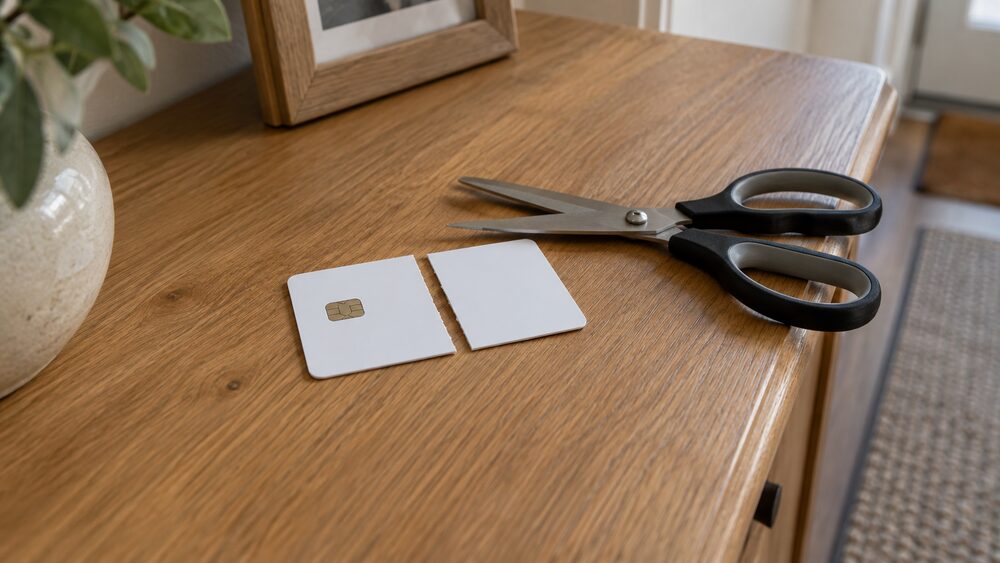
- Destroy the card. You will need to destroy your credit cards and any PINs, including those belonging to other cardholders6. If you are disposing of an old card, cut through the chip and dispose of the sections in separate bin bags20.
Where closing a card will not clear your record
Closing an account does not remove it from your credit file. You can expect to see your account showing as having been closed, with your balance changed to zero to show that there is nothing outstanding4. The history of how you ran the account stays alongside it.
Whether the account shows as settled depends on how it ended. An account can only show as settled on your credit file if it was closed within the original terms and conditions of the agreement21. If it was closed as part of a settlement for less than the full amount, the file may show a P flag for partial settlement instead22.
There is a separate point about who else appears on your file. If you hold a card jointly with someone, a financial connection is created, and that connection remains on your credit report until you file a notice of disassociation to end it23. Even if you disassociate, the account will still show on both your credit reports24. Closing the card does not undo the link.
Buy now pay later borrowing behaves differently again. Some providers, including Klarna and Clearpay, do not leave any trace of your interest-free borrowing on your credit report, while Laybuy does leave a trace25. If you are closing a credit card and relying on other forms of borrowing, it is worth knowing which of them lenders can actually see.
If a provider closes or changes your card
Providers do close accounts, and the reasons are not always about you. Banks have to close accounts when they are unable to conduct the know your customer checks required by money laundering regulations, or where they are concerned about accounts potentially being used for financial crime8. Basic bank accounts opened under the Payment Accounts Regulations may only be closed without the consumer's consent in limited circumstances, for example if the account has been used for illegal purposes or if there has been no transaction on the account for more than 24 consecutive months2.
If your account is suspended, you will not be able to borrow any more money and the card will no longer work26. That is a suspension rather than a closure, and it can be reversed, but it leaves you without the facility in the meantime.
Payment holidays have their own rules. Card providers should find out if customers can afford to restart payments at the end of a payment holiday and contact you to agree a plan for repaying missed payments26. If a payment holiday ends and you cannot restart, that conversation should happen before the missed payments start stacking up.
If a provider closes your card and you think the decision was wrong, the route is a formal complaint to the provider first. If you are unhappy with the credit card provider's response, then you can complain to the Financial Ombudsman Service27. The ombudsman service is free to consumers.
The volume of complaints gives a sense of scale. Credit cards were the third most complained about product in 2025/26, with around 22,800 complaints, of which 8,800 were about perceived irresponsible or unaffordable lending5. In 2024/25 there were 49,400 new credit card complaints on irresponsible or unaffordable lending28. In the first quarter of 2026/27, the service opened 5,783 complaints about credit cards and 62 about business credit cards29. Perceived unaffordable lending has driven complaints relating to credit cards30.
The regulator behind these rules changed in 2014. In April 2014, the OFT was closed and its consumer credit responsibilities were transferred to the FCA31. Complaints about how a card was sold or run now sit with the FCA's rules and the ombudsman's decisions.
Sources31 cited
- Choosing and applying for a credit card Citizens Advice
- Basic bank accounts: July 2023 to June 2024 GOV.UK
- Persistent credit card debt: our expectations of firms Financial Conduct Authority
- Full and final settlement offers National Debtline
- Annual complaints data and insight 2025/26 Financial Ombudsman Service
- Close your credit card Halifax
- Credit card market study: annex 3 Financial Conduct Authority
- Access to banking services and cash House of Commons Library
- How to check your credit score for free Which?
- Should I get a credit card? Which?
- The costs and charges of credit cards Citizens Advice
- What are numberless cards and could they help stop fraud? Which?
- Credit cards and debt nidirect
- Child Benefit overpayments GOV.UK
- How to open, switch or close your bank account MoneyHelper
- Direct debits and standing orders explained Which?
- New rules to speed up payment of credit card debts Which?
- Paying off credit card debt StepChange
- Recurring card payments Financial Conduct Authority
- Card fraud: protect yourself Take Five
- Getting credit card debt written off: your rights and options National Debtline
- Full and final settlement offers Business Debtline
- Credit reports and credit reference agencies Advice NI
- Your credit report Surviving Economic Abuse
- Can shopping with buy now pay later schemes impact your chance of getting a mortgage? Which?
- Credit card payment holidays StepChange
- Other problems: consumer advice Anglesey Council
- Annual complaints data and insight 2025/26 Financial Ombudsman Service
- Quarterly complaints data Q1 2026/27 Financial Ombudsman Service
- Ombudsman News 189 Financial Ombudsman Service
- CCA CP 211122 Final Review Department for Business, Energy and Industrial Strategy

 MoneyHelperFree, impartial money and pensions guidance, set up by government
 Financial Ombudsman ServiceFree, independent help when a complaint about a firm is not put right
 Citizens AdviceFree advice on money, consumer and legal problems in England and Wales
 StepChangeFree debt advice and solutions from a charity
 GOV.UKOfficial information on tax, benefits and government services