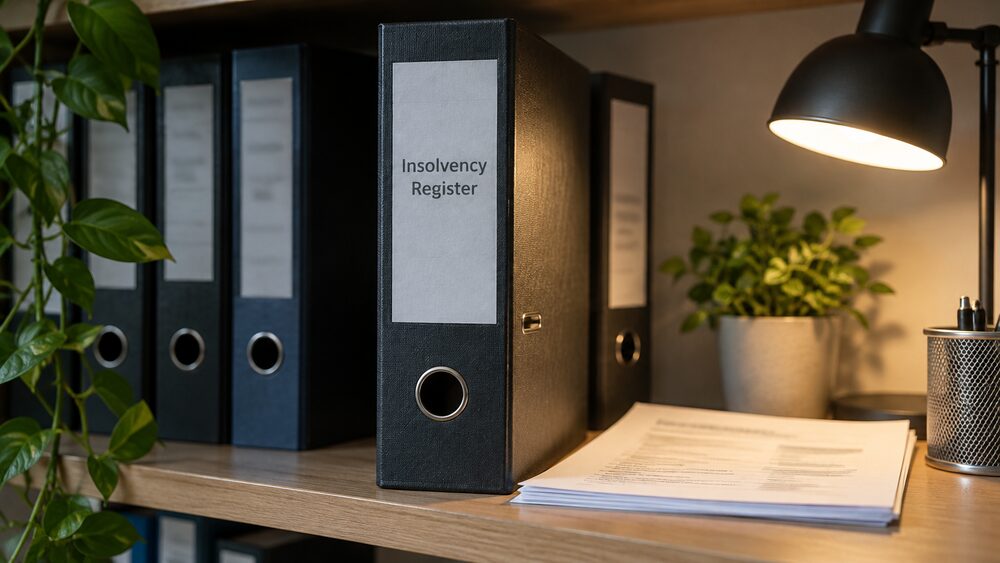
The Individual Insolvency Register is a public database of formal personal insolvencies in England and Wales. It lists current bankruptcies, debt relief orders (DROs) and individual voluntary arrangements (IVAs), together with anyone who currently has bankruptcy or debt relief restrictions, and it combines what were previously separate registers for individual insolvency, bankruptcy restrictions and debt relief restrictions1. It is maintained and kept up to date by the Insolvency Service3.
The register is free for anyone to search online, and entries normally stay on it until three months after the insolvency ends2. In practice, debt charities note that it is rare for anyone other than creditors to search it5. Scotland and Northern Ireland keep their own separate registers, so an insolvency recorded in Edinburgh or Belfast does not appear on the England and Wales register6.
What the Individual Insolvency Register is
The Individual Insolvency Register is a public record. Details of every bankruptcy in England and Wales are recorded on it, and it is a database that can be viewed by anyone2. Details of IVAs are listed on the same public register8, as are DROs, including any that were discharged in the last three months5.
The register is actually a combination of registers. It brings together the individual insolvency register, the bankruptcy restrictions register and the debt relief restrictions register into one searchable service, and these are maintained and kept up to date by the Insolvency Service3. So a single search can show not only whether someone is currently bankrupt, in an IVA or in a DRO, but also whether they are subject to restrictions order or undertaking following an investigation into their conduct before or during the insolvency.
The register exists mainly for creditors. When someone enters a formal insolvency procedure, the people and companies they owe money to need to be able to find out about it, both to stop them chasing debts that are now covered by the procedure and to register their claims. Credit reference agencies also use the register: nidirect notes that the Individual Insolvency Register is an online database used by credit reference agencies to update a person's credit rating when they have an IVA9. That is how an insolvency ends up reflected in your credit file even though the register and the credit file are two different things, a distinction covered later on this page.
The register can be searched using an individual's name, or a trading name in the case of sole traders3. It records bankruptcy orders, debt relief orders (DROs) and individual voluntary arrangements (IVAs), and it combines the individual insolvency, bankruptcy restrictions and debt relief restrictions registers, maintained and kept up to date by the Insolvency Service3.
Who is listed: bankruptcy, IVAs and debt relief orders
Three groups of people appear on the Individual Insolvency Register: those made bankrupt, those with a debt relief order, and those in an individual voluntary arrangement1. StepChange describes the same three, noting that your details appear on the public Insolvency Register if you are on any of these insolvency solutions, and that the register also covers trust deeds in Scotland through that country's own register10.
| Insolvency type | What it is | Appears on the register |
|---|---|---|
| Bankruptcy | A court order writing off most debts, usually lasting a year | Yes, for the duration and three months after discharge2 |
| Individual voluntary arrangement (IVA) | A binding agreement with creditors to repay part of what is owed, usually over several years | Yes, for the duration and three months after it ends11 |
| Debt relief order (DRO) | A formal write-off of debts for people with low income and few assets, lasting 12 months | Yes, for the duration and three months after it ends12 |
The scale of these procedures gives a sense of how many people are on the register at any time. In July 2026 in England and Wales alone there were thousands of individual insolvencies, and in Northern Ireland in the same month there were 169 individual insolvencies, made up of 137 IVAs, 15 bankruptcies and 17 DROs13. In August 2026, Northern Ireland recorded 140 individual insolvencies, comprising 117 IVAs, 16 DROs and seven bankruptcies, which was 4% higher than in August 202514.
Not every debt solution puts you on the register. Informal arrangements with creditors, debt management plans and administration orders are not formal insolvencies and are not recorded. The register is also not a list of everyone in financial difficulty: it records only the three formal procedures above, plus the restrictions orders and undertakings described in the next section.
What details the register shows about you
The information listed varies slightly according to the type of insolvency, but it generally includes your name, address, date of birth, occupation and details of the arrangement15. For bankruptcy, the register lists the personal details of the person declared bankrupt, including their name, address, occupation, the date of the bankruptcy order, and the details of the official receiver handling the case2. For an IVA, the recorded details are your name, last known address, date of birth, gender, and the date the IVA was approved5.
Your name, including previous names, and your address will usually be made available publicly on the register16. That is the part most people find uncomfortable: the register does not just confirm that an insolvency exists, it identifies you at your home address. There is one specific exception. If you are at risk of violence, you can apply for a Persons at Risk of Violence (PARV) order to stop your name and address from being listed on the Individual Insolvency Register16. This protection exists for people, including survivors of economic abuse, whose safety would be compromised by a public listing.
What the register does not show is the detail of your finances. It does not list your debts one by one, your income, or how much you are repaying. A creditor who wants that level of detail must go through the insolvency practitioner or official receiver, not the register.
Bankruptcy and debt relief restrictions on the register
As well as the three main insolvency procedures, the Individual Insolvency Register gives details of anyone who currently has bankruptcy or debt relief restrictions1. These come in four forms: a bankruptcy restrictions order (BRO), a bankruptcy restrictions undertaking (BRU), a debt relief restrictions order (DRRO) and a debt relief restrictions undertaking (DRRU)1.
Restrictions are imposed where there has been dishonesty or culpable behaviour connected with the insolvency, and they extend the restrictions that apply automatically during bankruptcy, in some cases for much longer than the bankruptcy itself. They take the form of a bankruptcy restrictions order (BRO), a bankruptcy restrictions undertaking (BRU), a debt relief restrictions order (DRRO) or a debt relief restrictions undertaking (DRRU). Anyone with a bankruptcy order, a debt relief order, bankruptcy restrictions or debt relief restrictions is banned from being a company director without the court's permission1.
The restrictions matter for eligibility too. You cannot take out a DRO if you are an undischarged bankrupt, subject to an IVA, or subject to a bankruptcy restrictions order or a debt relief restrictions order17, and you must not be involved in another formal insolvency procedure at the time you apply17. The same logic runs the other way: the rules are designed so that only one formal insolvency procedure can apply to a person at a time.
How long entries stay: usually three months after the insolvency ends
The general rule is simple: records are usually removed within three months of an insolvency case ending1. The Insolvency Service's own register page states that information may remain active on the register for a period of up to three months following the discharge, or following notification of completion to the Insolvency Service, depending on the type of insolvency3.
Applied to each procedure:
- Bankruptcy: details normally stay on the register until three months after you are discharged from bankruptcy2. The Debt Advice Foundation puts it the same way: details stay on the bankruptcy register for three months after the date of discharge15.
- IVA: your IVA is added to the online public register for its duration and removed three months after it has ended11.
- DRO: your DRO details are listed on the register and removed three months after the DRO has ended12. The Insolvency Service's guidance for creditors states the same: details remain on the register for three months after the DRO has ended18.
There are two ways an entry can last longer. First, if a bankruptcy is not discharged on schedule, the entry stays until it is. Second, in Scotland, the Accountant in Bankruptcy states that your details will normally be removed from the Register of Insolvencies 12 months after your trustee is discharged, and if you do not comply with your trustee, your details may remain on the register for longer20. So the three month rule is the norm, not a guarantee, and the Scottish rule works from the trustee's discharge rather than your own.
Who can search the register, and who actually does
Anyone can access the register8. It is a public database, and there is no requirement to have a particular reason for searching, no fee, and no record shown to the person searched. In theory, then, an employer, a landlord, a neighbour or a potential business partner could all look you up.
In practice, the picture is calmer. StepChange notes that anyone can access the register, but it is unlikely that anyone except the people you owe will search it8, and separately that it is rare for anyone but creditors to search it5. The main users are creditors checking whether a debtor is in a formal procedure, credit reference agencies updating credit files9, and people with a practical need, such as finding the relevant official receiver by searching the register and contacting the Insolvency Service office dealing with the case21.
That said, the register is public information, and there is nothing to stop anyone searching it. If you are worried about a specific person finding your entry, the PARV order described earlier is the protection that exists for exactly that situation16.
How to search the register for free
The Individual Insolvency Register is available to search online for free8. Details of bankruptcy can be found on the online register at no cost2, and the IVA register, which covers England and Wales, can be searched online at the Insolvency Service website or viewed at your local official receiver's office15.
To search:
- Go to the Insolvency Service's online register search.
- Enter the individual's name, or a trading name if you are searching for a sole trader3.
- Review the results for current bankruptcies, DROs, IVAs and restrictions.
If the person or company you are looking for is not on the register, they are not currently in formal insolvency proceedings1. That is a narrower statement than it sounds: the register shows current insolvencies, insolvencies that ended within roughly the last three months, and current restrictions such as bankruptcy restrictions orders6. Someone whose bankruptcy ended five years ago will not appear, and neither will someone whose insolvency was in Scotland or Northern Ireland.
For contrast, other public registers work differently. The public register of county court judgments can be searched by contacting Registry Trust online and paying a fee of £6 per search10, and a single inspection of the Debt Arrangement Scheme Register in Scotland costs £522. The insolvency registers are the more generous ones: free to search in all three nations.
Scotland and Northern Ireland have separate registers
Scotland and Northern Ireland each keep their own insolvency registers, and neither appears on the England and Wales register.
Scotland. Personal insolvencies in Scotland go on the Register of Insolvencies, a formal record of all bankruptcies awarded in Scotland, maintained by the Accountant in Bankruptcy under the Bankruptcy (Scotland) Act 201623. The register also covers company insolvencies, liquidations and receiverships25, and you can search it to find out whether a person is bankrupt, in a protected trust deed, wants to enter a protected trust deed, or has a debt arrangement scheme or debt payment plan26. The Register of Insolvencies has a free search facility which can be accessed by anyone who has an interest23. Scotland also keeps a separate Debt Arrangement Scheme register, and you can search either the DAS register or the Register of Insolvencies free of charge to find out whether a moratorium on diligence has been registered27.
Northern Ireland. The Insolvency Register in Northern Ireland is maintained by the Bankruptcy and Chancery Office at the High Court and contains records of all insolvencies in Northern Ireland for the last ten years29. To search it, you must contact the High Court in Belfast, and it is free to view2. The Department for the Economy in Northern Ireland also maintains a register of debt relief orders, debt relief restrictions orders and debt relief restrictions undertakings31.
The volume of insolvencies differs sharply between the nations. In Scotland there were 2,181 individual insolvencies in Q2 2026, up 13% on the year, comprising 1,332 protected trust deeds and 849 bankruptcies, also known as sequestrations13. In Northern Ireland there were 169 individual insolvencies in Q2 2026, up 10% on the year32. If you are searching for someone who may have gone insolvent in another nation, you need the right register: an England and Wales search will not find a Scottish sequestration.
The register and your credit file are not the same thing
The Individual Insolvency Register and your credit file are two separate records with different keepers, different rules and different timescales. Insolvency is recorded on your credit file as well as on the register6, but the credit file is held by the credit reference agencies, and the Insolvency Service is not able to correct any information on your credit file: if something is wrong there, you must contact the credit reference agency to resolve it12.
The two records also behave differently after the insolvency ends. Your entry on the insolvency register is normally removed three months after the insolvency ends1, but the record of the insolvency on your credit file stays for much longer, typically six years from the start of the procedure. So someone can be entirely off the public insolvency register while still carrying the insolvency on their credit file, which is what most lenders actually look at. The dedicated pages on how long information stays on your credit file and debt solutions and your credit file cover those timescales in detail.
There is a third record that can be affected. HM Land Registry sends a bankruptcy enquiry letter (form B10A) when it appears a property may be affected by bankruptcy proceedings. If you are the person named and you confirm this, HM Land Registry makes an entry about the bankruptcy proceedings in your title register; if you do not reply, the law requires it to make an entry to protect the interests of people who are owed money. HM Land Registry notes that a bankruptcy entry in your title register could affect your credit rating33.
Disqualified directors are on a different register
Disqualified company directors are not on the Individual Insolvency Register. They are listed on a separate register of disqualified directors, which includes details of directors disqualified by the courts and the Insolvency Service1. Disqualification can result in a director being banned from managing a limited company for up to 15 years34.
The two registers do connect in one direction: anyone who has a bankruptcy order, a debt relief order, bankruptcy restrictions or debt relief restrictions is banned from being a company director1. In Northern Ireland, the rules were extended so that the ban on undischarged bankrupts also covers debt relief restrictions orders35. But the disqualified directors register is a record of company director conduct, while the Individual Insolvency Register is a record of personal insolvency, and a search of one will not show entries on the other.
Mistakes on the register and getting your entry updated
The Insolvency Service states that while every effort has been made to ensure the information in the register is accurate, occasionally errors may occur, and it cannot accept responsibility for any errors or omissions3. If your entry is wrong, for example an incorrect address or date, the route to fixing it depends on what is wrong.
For the register itself, the Insolvency Service is the body to contact: it maintains the register and can update entries3. The Insolvency Service also provides general help through its support channels36. If the mistake is on your credit file rather than the register, the Insolvency Service cannot help: you must contact the credit reference agency directly12, and the page on correcting wrong information on your credit report explains that process.
A few related points from official guidance are worth knowing:
- Where a debt advice provider becomes aware that information it has supplied to a statutory register contains a mistake or inaccuracy, it must provide updated information to the Secretary of State37. That duty sits with the provider, not with you, but it shows the system expects corrections to be fed through.
- If you are dealing with HM Land Registry after a bankruptcy enquiry letter, you can correct information during the process of responding, and the title register entry follows from the replies33.
- Official statistics publications themselves are sometimes corrected: the Insolvency Service has noted data corrections in its own releases and commits to updating users on progress, in one case no later than December 202614. Registers and statistics alike are maintained bodies of data, and errors are acknowledged and fixed rather than ignored.
If your entry has stayed on the register well beyond three months after your insolvency ended, treat that as an entry needing an update rather than assuming the timeline has silently changed. The normal rule is removal within three months of the case ending1, and the bodies that maintain the registers can tell you why an entry is still there.
Where to get free help
Free, impartial help with insolvency and the registers is available:
- The Insolvency Service publishes the register, the guidance on what happens after a DRO is made, and the guidance for creditors listed in a DRO, and provides help through its support channels12.
- StepChange Debt Charity and the Debt Advice Foundation publish free guidance on the bankruptcy register, the IVA register and how insolvency affects your credit rating2.
- The Accountant in Bankruptcy is the official body for insolvency in Scotland, with guidance on the Register of Insolvencies and the Debt Arrangement Scheme23.
- The Department for the Economy publishes Northern Ireland's guidance on bankruptcy, debt relief orders and discharge17.
- MoneyHelper and the debt section of this site explain the full range of debt solutions and your rights alongside them.
If you are at risk of violence and worried about your details being listed, organisations supporting survivors of economic abuse set out the PARV order route, and a debt adviser can help you apply16.
Sources37 cited
- Find insolvency proceedings for people and companies GOV.UK, 2020-07-08
- The bankruptcy register StepChange Debt Charity, 2026-09-25
- Individual Insolvency Register The Insolvency Service, 2026-09-28
- What is insolvency? StepChange Debt Charity, 2026-09-25
- What is the IVA register? StepChange Debt Charity, 2026-09-25
- Public information about debt StepChange Debt Charity, 2026-09-25
- How an IVA affects your credit rating StepChange Debt Charity, 2026-09-25
- What is the IVA register? Debt Advice Foundation, 2020-06-04
- Individual voluntary arrangements (IVAs) nidirect, 2025-09-12
- Personal bankruptcy StepChange Debt Charity, 2026-09-25
- Key facts on the protocol for individual voluntary arrangements GOV.UK, 2025-04-01
- Once you have a debt relief order (DRO) GOV.UK, 2023-12-19
- Individual insolvency statistics, July 2026 GOV.UK, 2026
- Individual insolvency statistics, August 2026 GOV.UK, 2026-08
- What is the bankruptcy register? Debt Advice Foundation, 2020-05-26
- Debt solutions and coerced debt Surviving Economic Abuse, 2025-04
- Debt relief orders: eligibility Department for the Economy, 2026-08-06
- Guidance for creditors listed in a debt relief order (DRO) GOV.UK, 2023-09-19
- Debt relief orders (England and Wales) Business Debtline, 2026-09-26
- Will my name be on a public register? Accountant in Bankruptcy, 2026-07-15
- Complain about someone bankrupt GOV.UK, 2026-09-27
- Debt Arrangement Scheme (Scotland) Regulations 2004 legislation.gov.uk, 2004-11-01
- Register of Insolvencies Accountant in Bankruptcy, 2021-11-01
- Register of Insolvencies: form and contents legislation.gov.uk, 2016-11-24
- Creditor insolvency guide mygov.scot, 2021-10-01
- Check if a person is insolvent mygov.scot, 2023-11-24
- Moratorium on diligence: money adviser guidance Accountant in Bankruptcy, 2024-08-05
- Moratorium on diligence: creditor guidance Accountant in Bankruptcy, 2024-08-06
- Cancelling a bankruptcy order Department for the Economy, 2019-05-02
- Discharge from bankruptcy Department for the Economy, 2019-09-11
- Debt relief orders: register requirements Northern Ireland Assembly, 2014
- Personal insolvency statistics Q2 2026 House of Commons Library, 2026
- HM Land Registry bankruptcy enquiry letter B10A GOV.UK, 2017-06-23
- Insolvency and consumer credit Trading Standards Wales, 2025-03
- Company Directors Disqualification (Northern Ireland) Order 2002: amendment Northern Ireland Assembly, 2014
- Get help from the Insolvency Service GOV.UK
- Debt Respite Scheme Regulations 2020 legislation.gov.uk, 2020


 MoneyHelperFree, impartial money and pensions guidance, set up by government
 Financial Ombudsman ServiceFree, independent help when a complaint about a firm is not put right
 Citizens AdviceFree advice on money, consumer and legal problems in England and Wales
 StepChangeFree debt advice and solutions from a charity
 GOV.UKOfficial information on tax, benefits and government services