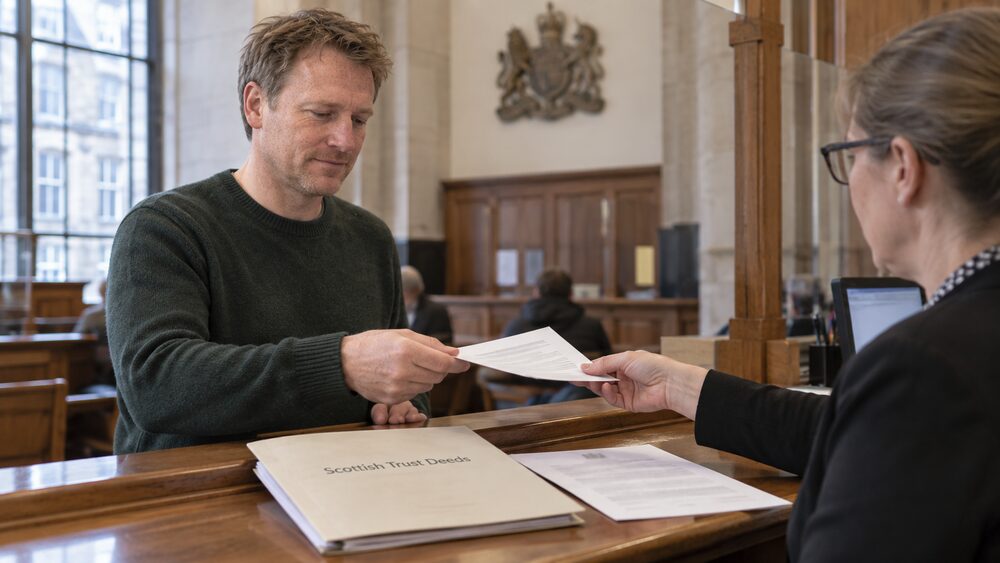
Scotland has its own court system, its own insolvency solutions and its own public registers, and each of them feeds information into your credit file. A decree from a sheriff court, a protected trust deed, sequestration or a debt payment programme under the Debt Arrangement Scheme (DAS) will each appear differently, for different lengths of time, and with different routes to have entries corrected or removed.
A decree is the Scottish equivalent of a county court judgment (CCJ) in England and Wales1. Like a CCJ, it stays on your credit file for six years from the original judgment date, whether or not the balance has been paid1. Trust deeds and protected trust deeds are also held by credit reference agencies for six years2, and a trust deed is listed on the public Register of Insolvencies for five years3. A debt payment programme under DAS is recorded on the DAS register, which is also a public online register4.
This page explains how each of these Scottish entries reaches your credit file, how long it stays, what you can do about it, and where to get free help.
How a Scottish decree gets onto your credit file
A decree is a court order for payment, granted by a sheriff court after a creditor takes action against you. Decrees are the Scottish equivalent to money judgments, known as county court judgments or CCJs, in England and Wales1. They arise from the small claims, summary cause and simple procedure court processes, and they exist to give a creditor formal, enforceable proof that you owe the money.
The decree itself does not reach your credit file directly from the court. Instead, details of Scottish decrees are supplied by the sheriff courts to the Registry Trust, which maintains the public register of decrees6. The Registry Trust then notifies credit reference agencies of all decrees, recalls and dismissals on a regular basis, and the agencies record them on credit files1. So the chain is: the court grants the decree, the Registry Trust records it, and the credit reference agencies pick it up from there.
The practical consequence is that a decree is visible to any lender that searches your file, in the same way a CCJ is in England and Wales. It signals that a creditor had to go to court to recover a debt, which is why lenders treat it seriously even after it is paid. The Register of Judgments, Orders and Fines covers the equivalent register for England and Wales, and what is on your credit report explains the other entries lenders can see.
One point worth knowing: the Debt Arrangement and Attachment (Scotland) Act 2002, which set up the framework that includes the decree register, allows the Scottish Ministers to modify the definitions of "decree" and "document of debt" by order, so the range of court orders captured by the register can change over time8.
The Scottish Register: six years from the date of the decree
The Registry Trust maintains a public register containing all simple procedure, small claims and summary cause money decrees granted in the sheriff courts during the preceding six years1. The decree stays on the register for six years from the date of the decree5, and on your credit file for six years from the original judgment date, whether the balance has been paid or not1. Independent guidance puts the same figure on it: a decree will stay on your credit file for 6 years9.
The six-year clock matters because of what it does not do. Paying the debt does not restart or shorten the period, and neither does ignoring it. The entry simply ages off after six years, provided no new decree is granted in the meantime. This mirrors the position with CCJs in England and Wales, which is why the general guide to how long information stays on your credit file treats decrees and CCJs together.
There is a separate Scottish rule that people sometimes confuse with this. In Scotland, the prescriptive period is five years in relation to debt10, which is the Scottish equivalent of limitation. Under Financial Conduct Authority guidance, in Scotland a statute barred debt ceases to exist and is no longer recoverable if a relevant claim has not been made and the debt has not been acknowledged during the relevant limitation period9. That is about whether a creditor can still enforce the debt through the courts. It is not the same as the six-year rule for how long the decree stays on the register and your file. A debt can become unenforceable while a decree relating to it still shows, and the entry still has to age off in the usual way. Statute-barred debts covers that distinction in more detail.
Getting a decree removed or marked as satisfied
There are only three ways an entry comes off the Scottish Register before the six years are up. Decrees are only removed from the register if they are recalled by the court, entered in error, or paid in full within one calendar month of the date of the decree1. Independent guidance states the same rule: you pay off the debt within one month of it being entered on the register, or the decree is set aside or recalled by the court5.
If you pay within that first month, you can ask to have the entry removed from the register11. This is the Scottish equivalent of the English rule that paying a CCJ within a month keeps it off the register, covered in paying a CCJ within a month.
If you pay later than a month, the entry stays, but it can be marked as satisfied. To do this, you get a letter of satisfaction from the pursuer in the action, or the pursuer's solicitor, explaining that the debt has been paid, then send it to the organisation that keeps the Register of Decrees, with their administration fee and confirmation of your name and address at the time of the decree6. The written evidence should confirm the name of the court, the case number, the date of decree, the amount of decree, and the date that the debt was repaid in full1. There is a fee of £6 for this, which you must send with evidence from the pursuer that the debt has been paid5. The narrow guide to getting a Scottish decree marked as satisfied walks through this step by step.
Recall is the other route, and it is for cases where the decree itself should not stand. In certain circumstances, you may be able to apply to the court to have the decree or decision of the sheriff recalled, for example if you had no knowledge of the case1. If you show a valid ground applies and the court does agree to recall the decree, you can request that the information on your credit reference file be corrected12. The process is covered in asking a sheriff court to recall a decree.
If an entry is simply wrong, for instance it relates to someone else or the details are incorrect, correcting wrong information on your credit report and when a register entry is not yours or is wrong set out the dispute routes.
Searching the Scottish Register: £6 per name and address
Anyone can search the Scottish Register, including lenders, landlords and employers who lawfully check credit files. It costs £6 to search the Scottish Register for your name and address5. That fee is per name and address combination, so if you have lived at several addresses during the six-year period, checking each one costs £6 each time.
Searching your own entry is worth doing before you apply for credit, because it shows you exactly what a lender will see from the register. The search will show any decree recorded against that name and address in the preceding six years, together with its status: whether it is outstanding, satisfied, recalled or dismissed. The Registry Trust notifies credit reference agencies of all decrees, recalls and dismissals on a regular basis1, so a satisfied or recalled entry should be reflected on your credit file too, though there can be a lag between the register being updated and the agencies catching up.
For context on the wider costs of checking your own credit information: a statutory credit report by post costs £2.0013, and the Consumer Credit Act 1974 sets a £2 fee payable with a request for a copy of the consumer's file14. The statutory routes are covered in how to check your credit report for free, which also explains the free options that have largely replaced the £2 postal route in practice.
Trust deeds on your credit file and the Register of Insolvencies
A trust deed is a formal agreement between you and your creditors, available to residents of Scotland, in which a qualified Insolvency Practitioner is appointed as Trustee and the rights to any assets you own are transferred to them15. You make reduced payments to your debts, based on what you can afford, and at the end the debts included are written off3. A trust deed is not legally binding for the people you owe at first, but if they agree to your terms they are bound by law, and it becomes a protected trust deed3. Protected status is governed by section 163 of the Bankruptcy (Scotland) Act 201616, and the Accountant in Bankruptcy publishes guidance on protected trust deeds under that Act18.
On your credit file, credit reference agencies hold information about trust deeds and protected trust deeds for a period of six years2. Separately, the trust deed is listed on the Register of Insolvencies for five years, which is a public register3. So there are two clocks: the public insolvency register entry and the credit reference agency record, and they do not run in sync.
The key features that matter to a consumer:
- Term: usually four years, but may vary2
- Minimum debt: you need to owe at least £5,000 to all your creditors before you are allowed to apply2
- Eligibility limit: if you can repay your debts in full within four years or less, you will not be able to set up a protected trust deed2
- Assets: you may have to sell assets, apart from one car worth less than £3,00019; you normally have to sell any asset worth more than £1,000, though you may not have to sell a property with less than £20,000 equity in it20
- Acceptance: it is accepted if half of the people you owe agree to it20
- Discharge: you are discharged from any outstanding liabilities included in the trust deed, no matter how much has been paid into the arrangement15
A trust deed includes most unsecured debts, like credit card debts, overdrafts and personal loans20. It cannot include court fines, penalties, compensation and forfeiture orders, debts incurred through fraud, student loans, maintenance to an ex-spouse under a court order, secured debts, or limited company debts unless a personal guarantee was given2.
While a protected trust deed runs, your creditor cannot take action to make you pay your debts or make you bankrupt21. A trust deed also stops court action if diligence has not started yet, and it stops interest and charges19. But you might find it harder to get credit3, and you must tell the lender about your trust deed if you apply to borrow more than £2,000, even if you are applying with a partner20. Fees are taken by the trustee directly from your payments, and there are no up-front fees for trustees that StepChange works with20. Debt solutions and your credit file compares how each solution appears.
The DAS register and borrowing while in a debt payment programme
The Debt Arrangement Scheme is a Scottish Government backed scheme23, run by the Accountant in Bankruptcy (AiB)24, set up under the Debt Arrangement and Attachment (Scotland) Act 200225. It allows you to repay your debts over an extended period, without the threat of creditor legal action23. A debt payment programme (DPP) is the agreement under DAS that allows someone in debt to pay debts off over an extended period26.
The DAS register is an online public register which holds information about those intending, or applying for, a debt payment programme in DAS4. The DAS Administrator maintains the DAS Register28. Once your programme is approved, it is recorded on the register29, and it is effective from midnight on the day before the date that the DAS Administrator confirms this on the DAS Register30.
The register works alongside a breathing space. Once on the DAS register, you are protected against creditor action for six months after your intimation of intent to apply30. You cannot normally make another intimation within 12 months of the last one30. Creditors asked to agree to your application have 21 days to respond, and if a creditor does not respond within 21 days, the DAS Administrator will treat them as if they have agreed30. Even if a creditor has objected, the DAS Administrator can still approve your debt payment programme by using the "Fair and Reasonable" test30.
While a debt payment programme is in place through DAS, all interest, fees and charges on your debt will be frozen from the date that you apply30. Over the course of your DPP, your creditors cannot take further action against you, such as a diligence or sending Sheriff Officers, add interest and charges, or take assets29. Your creditor cannot make you bankrupt if you're in a debt payment programme21. You make a single regular monthly payment, paid to an approved payment distributor who will send it on to your creditors31.
On borrowing: there is no rule in the scheme that bans you taking further credit, but the programme is visible on the public DAS register and on your credit file, and lenders will take it into account. The general position on how lenders decide and what to do if you are refused credit applies. If you later move into a trust deed instead, the £2,000 disclosure rule described above applies to that.
Who can use DAS, and what it does not write off
DAS is a legal scheme run by the Scottish Government32, set up to help people manage their debts26. A person who is habitually resident in Scotland may apply for approval of a programme33. You will be treated as a couple if you are spouses or civil partners of each other, or living together as if spouses of each other30.
You are not eligible if:
- you do not have a reasonable amount of money or an asset available to pay into a debt payment programme32
- you are in a protected trust deed, are bankrupt, or are subject to a bankruptcy restrictions order or undertaking32
- you are paying debts under a conjoined arrestment order32
- your single debt is being paid under a time to pay direction under the Debtors (Scotland) Act 198734
- you have a "time to pay direction", a "time to pay order" or a "time order" for your single debt30
What DAS does not do is write off the debt itself. It helps people repay debts at a rate they can afford35, and your DPP can last for as long as you need it to, with no time limit29. What is written off is the frozen interest, fees and charges: as long as you fully complete the debt payment programme and pay off your debts, the frozen interest, fees and charges will be written off30.
There is a limited early exit. The AiB will automatically send an offer of composition to each of your creditors when you have paid 70% of what you owed when the programme started and have made payments for a full 12 years29. One guidance source notes the 12 years must not include any payment breaks30; the sources agree on the 70% and 12-year conditions but differ on whether breaks count, so treat the detail as something to confirm with your money adviser.
Other features that matter day to day: you can choose to make payments monthly, every four weeks, every two weeks or weekly29. Fees are included in your plan and paid for by your creditors29, and the debt payment programme is normally free30. If you have a sudden and short term drop in your income of 50% or more, you may be able to arrange a payment holiday of up to six months30. There are also shorter crisis breaks lasting one month, of which you can have two in a 12-month period, and payment breaks of up to six months29. Your money adviser uses a calculation based on the Common Financial Tool to work out what you can afford30.
When a trust deed or DAS plan fails
Both solutions depend on you keeping up payments, and both have consequences if you stop.
If a trust deed fails, there is a risk of bankruptcy3. You are no longer protected from the people you owe, and they can take action to collect money you owe if you do not pay20. Your trustee could apply to make you bankrupt if they think it is in the best interests of the people you owe20. Where there is equity in your home, the options may include releasing equity on your home or extending your trust deed by a year20. You can enter a second trust deed, but only after completing the earlier one first20.
A DAS programme can be revoked by the DAS Administrator in a range of circumstances: if arrears reach the value of two months' payments and another is due, you make yourself bankrupt, you obtain a protected trust deed, you do not keep to a condition which is part of your debt payment programme, you were untruthful, a creditor petitions for your bankruptcy, a joint programme separates, or the debtor dies32. Revocation removes the protections: the interest freeze ends and creditors can resume enforcement.
The two solutions also constrain each other. Where a debt payment programme is approved, a debtor shall not enter into a trust deed33, and a person in a programme may not enter into a trust deed for a creditor under the Bankruptcy (Scotland) Act 198533. Going the other way, obtaining a protected trust deed is itself a ground for revoking a DPP32. In Scotland, solutions include an informal agreement, DAS, a protected trust deed or bankruptcy23, and the choice between them is what a money adviser helps with.
For scale: since DAS was introduced, just over 63,900 DAS DPPs have been approved36.
Where to get free debt advice and how to complain
Whoever you ask for money or debt advice, make sure the person you speak to knows you live in Scotland, because the solutions and the registers differ from the rest of the UK37. The Scottish Government supports organisations to give free debt advice38, and free help is available from StepChange Debt Charity, Citizens Advice Scotland and Business Debtline, among others. FSCS signposts people having trouble repaying money they owe to free debt advice from StepChange, Which? and Citizens Advice7.
A money adviser is the route into DAS: guidance, forms and publications are available through the DAS money adviser route27, and the Accountant in Bankruptcy publishes a debt advice and information package that advisers use37. Before entering any formal solution, the Accountant in Bankruptcy's guidance on being in debt sets out the options23.
If something goes wrong with a credit file entry rather than the debt itself, the complaint routes are the ones that apply across the UK: complain to the credit reference agency first, then to the Financial Ombudsman Service if you are not satisfied. Those routes, and the notice of correction you can add to your file in the meantime, are covered in correcting wrong information on your credit report and Notice of Correction. For the debt side, complaints about a money adviser or insolvency practitioner go through their own complaints process, and the Accountant in Bankruptcy oversees the DAS scheme24.
Sources38 cited
- Money judgments and certificates of satisfaction FAQs Scottish Courts and Tribunals Service
- Trust deeds Business Debtline
- Trust deed StepChange
- Debt Arrangement Scheme Accountant in Bankruptcy
- Credit reference agencies Business Debtline
- Money judgments and certificates of satisfaction FAQs Scottish Courts and Tribunals Service
- Debt advice in Scotland StepChange
- Debt Arrangement and Attachment (Scotland) Act 2002 legislation.gov.uk
- Statute barred debts Business Debtline
- CONC 7.15 Financial Conduct Authority
- Debt counselling StepChange
- Your non-priority debts Business Debtline
- Protect your identity nidirect
- Consumer Credit Act 1974, Section 158 legislation.gov.uk
- What is a Scottish trust deed? Debt Advice Foundation
- Bankruptcy (Scotland) Act 2016, protected trust deeds legislation.gov.uk
- Bankruptcy (Scotland) Act 2016, section 163 legislation.gov.uk
- Notes for Guidance: Protected Trust Deeds, Bankruptcy (Scotland) Act 2016 Accountant in Bankruptcy
- Free debt consolidation StepChange
- Getting a trust deed StepChange
- Can my house and my possessions be sold to pay my debts? Citizens Advice Scotland
- Freezing interest and charges StepChange
- Are you in debt? Accountant in Bankruptcy
- Debt Arrangement Scheme (DAS) National Debtline
- Debt Arrangement and Attachment (Scotland) Act 2002, latest available version legislation.gov.uk
- Recall of a decree National Debtline
- DAS money adviser Accountant in Bankruptcy
- Relevant legislation, DAS creditors guidance Accountant in Bankruptcy
- Debt Turn2us
- Money jargon A to Z, S Citizens Advice Scotland
- Debt Arrangement Scheme or DMP StepChange
- Debt Arrangement Scheme (DAS) Business Debtline
- Debt Arrangement Scheme (Scotland) Regulations 2004 legislation.gov.uk
- DAS client eligibility Accountant in Bankruptcy
- Scottish statutory debt solutions: annual statistics 2025-26 Accountant in Bankruptcy
- Debt advice and information package Accountant in Bankruptcy
- Debt and money Scottish Government
- Cost of living crisis debt support FSCS




 MoneyHelperFree, impartial money and pensions guidance, set up by government
 Financial Ombudsman ServiceFree, independent help when a complaint about a firm is not put right
 Citizens AdviceFree advice on money, consumer and legal problems in England and Wales
 StepChangeFree debt advice and solutions from a charity
 GOV.UKOfficial information on tax, benefits and government services