
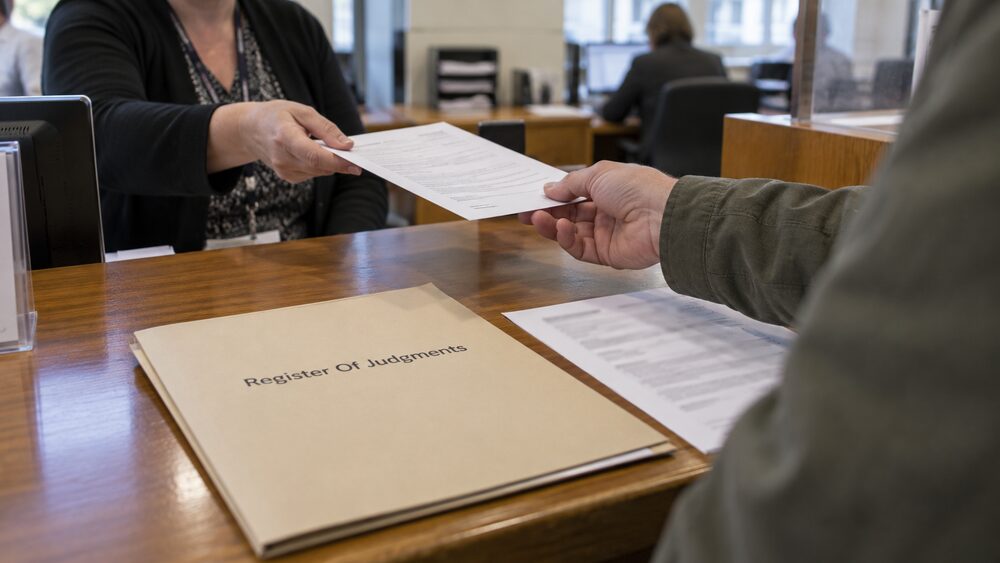
Court judgments in Northern Ireland are recorded on a public register and then copied to your credit file, where they stay for six years whether you pay them or not. Almost all county court and High Court judgments go on the Register of Judgments, Orders and Fines and are kept there for six years1. The register shows whether you have a judgment, the date it was made, the amount owed and the court that issued it, and the information is stored for six years2.
Paying the debt does not delete the entry. What paying does is allow the entry to be marked as satisfied, so a lender checking the register or your credit file can see the judgment has been settled. The judgment itself remains on your credit file for six years from the date it was made, whether or not it has been paid1. The only route that takes a judgment off early is having the court set it aside, which cancels the judgment and removes your name from the public register3.
This page explains how the register works in Northern Ireland, which judgments reach it, what an entry shows, how to get one marked as satisfied, and where the register is silent. The rules differ in places from England and Wales, and Scotland runs a separate system of decrees, covered in credit files in Scotland.
What the Northern Ireland register records
The Register of Judgments, Orders and Fines is the public record of court judgments in the UK. Almost all county court and High Court judgments are recorded on it and kept for six years1. In Northern Ireland, most types of unsecured debt, including credit cards, personal loans and store cards, are dealt with through the County Court, so it is county court judgments that most people in Northern Ireland will encounter7.
The register is not the only public record that matters to your credit file. Records of all insolvencies in Northern Ireland for the last ten years are held on the Insolvency Register5, and child maintenance liability orders can also be registered in the Register of Judgments, Orders and Fines, which affects the paying parent's credit rating8. A magistrates' court fine that has been registered appears on your credit file for five years4. So the picture a lender sees can be drawn from more than one register, and the retention periods differ: five years for a registered fine, six years for judgments, ten years for insolvencies.
The register is maintained by Registry Trust, and the information on it is stored for six years2. Anyone can search it, including lenders, landlords and employers carrying out checks. The full guide to the Register of Judgments, Orders and Fines covers how searches work and what TrustOnline shows.
Which judgments go on the register: default, small claims and High Court
Which court handles a debt in Northern Ireland depends on the amount and the type of debt. Most unsecured debts go through the County Court. To get a county court judgment against you, the people you owe issue a civil bill, which shows the amount owed and the reason for the claim7. Debts over £30,000, and mortgage proceedings, are usually dealt with in the High Court7.
Small claims are the County Court process for debts under £5,0006. The process runs on a set of standard forms: Form 125, the notice of action for a small claim, Form 126A, the notice of dispute, and Form 126B, the notice of acceptance of liability6. If the claim against you is successful, you get a county court judgment, and that judgment is what goes on the register and your credit file6.
You can defend a small claim. The recognised grounds for disagreeing with a claim are that the claim amount is incorrect, that you do not owe the money, that the debt is statute barred, or that you have paid the debt in full6. A hearing is then scheduled and a judge makes the final decision6. Defending the claim does not keep a successful judgment off the register: if the judge finds against you, the judgment is recorded like any other.
There is a court fee to pay if you are the one making a claim, and if you accept you owe the money you can apply for time to pay using Form 126B, stating your payment offer and sending a copy of your budget and a list of the people you owe6. If they accept your offer, the decree is granted and the court orders you to pay; if not, a judge reviews the claim and decides how much you have to pay6.
What a register entry shows about you
A register entry is deliberately narrow. The public register of judgments shows whether you have a judgment, the date of the judgment, the amount owed, and the name of the court that issued it2. That is all. It does not show the background to the case, whether you defended it, or how the debt arose.
The register does not say the name of the creditor, so you need to contact the court to find out who took you to court2. This matters in practice: people sometimes discover a judgment on their credit file without knowing what it relates to, and the route to finding out is the court named in the entry, not the register itself.
Your credit file, by contrast, holds a wider set of information: personal details, what you owe, defaults, court action including county court judgments, decrees and money judgments, home repossession, debts secured against an old address, and insolvencies9. So a judgment appears in two places: the narrow public register entry, and the fuller record a lender sees when it searches your file. What lenders can see is covered in more detail in what is on your credit report.
Judgments stay on record for six years
A county court judgment stays on your credit file for six years, and it makes it harder to take out further credit during that time6. The six years run from the date the judgment was made, and the entry is deleted at the end of that period whether or not the debt has been paid1. Paying early, paying late or never paying makes no difference to how long the judgment itself remains.
The same six-year period applies to other negative information on your file: missed payments, defaults and court judgments all generally stay for six years9. A registered magistrates' court fine is the exception worth knowing about in Northern Ireland: it appears on your credit file for five years4. Insolvencies run longer still, with the Insolvency Register holding records of all Northern Ireland insolvencies for the last ten years5.
The six-year rule is why the timing of payment matters to some people. In England and Wales, paying a CCJ within a month keeps it off the register altogether, and that route is explained in paying a CCJ within a month. In Northern Ireland, the practical equivalent of removing an entry early is setting the judgment aside, covered below. How long each kind of information lasts is set out more fully in how long information stays on your credit file.
Satisfied or unsatisfied: what the difference means
A register entry is marked as satisfied when the debt has been paid in full, and stays unsatisfied if it has not. The distinction matters because a lender reading your file can see not just that a judgment exists but whether it was settled. An unsatisfied judgment signals a debt still outstanding, and it is also the trigger for enforcement: money can be taken from your wages or bank account12.
The word "satisfied" also has a narrower legal meaning in consumer credit law. Under the Consumer Credit Act 1974, a debtor is deemed to have obtained satisfaction where they have accepted a replacement product or service or other compensation from the supplier in settlement of their claim13. That is a different context from court judgments, but it shows the same principle: satisfaction means the matter has been settled, in whatever way the relevant rules define settlement.
Where a debt is settled for less than the full amount, the marking is different again. If a creditor issued a default notice before agreeing to write off the debt, the account is likely to be marked as partially satisfied; if no default notice was issued, it is likely to be marked as a partial settlement10. Both markers tell a lender the debt was not cleared in full, and both remain on the file for six years like the underlying information. The difference between these markers is explained in partial settlement vs full settlement.
Getting a judgment marked as satisfied
Paying a judgment in full does not remove it, but it does allow the entry to be updated to show the debt has been paid. The process requires written evidence from the creditor. Guidance from the Scottish courts on the equivalent process for decrees sets out what that evidence should confirm: the name of the court, the case number, the date of the decree, the amount of the decree, and the date the debt was repaid in full14. You also send confirmation of your name and address at the time of the decree, together with an administration fee14. The Scottish guidance describes the Scottish process, but the same details, court, case number, dates and amount, are what identifies an entry in any register, and the Northern Ireland equivalent is handled through the register keeper once the creditor confirms payment.
The steps, in order:
- Pay the people you owe, not the court, the full amount including any court fee6.
- Get written confirmation from the creditor that the debt has been repaid in full, showing the court, case number, date of judgment, amount and date of repayment14.
- Send that evidence, with confirmation of your name and address at the time of the judgment and the administration fee, to the register keeper so the entry can be marked as satisfied14.
A judgment can only be marked as satisfied if the debt has been paid in full. Part-payment does not produce a satisfied entry; at best it produces a partial marker, as described above. The dedicated guide to certificates of satisfaction covers the process for CCJs in England and Wales, which runs on the same principle of creditor evidence plus a fee.
Setting aside: the only way a judgment comes off early
Setting aside a judgment cancels it. It puts you back to where you were before the judgment, and it does not write off your debt: the money is still owed, but the court record of the judgment goes3. If the court agrees to set the judgment aside, it contacts Registry Trust, which removes your name from the public register of judgments, and the judgment drops off your credit file, though that can take six to eight weeks3.
To apply, you write to the court dealing with your judgment, completing form 1293. Setting aside is normally used where the judgment should not have been made at all, for example where you did not receive the claim documents, where the amount is wrong, or where the debt was already paid. You need approval in writing from the people you owe to set aside a judgment by consent3.
There is a court fee, with help available on low income. The fee is waived if you receive Working Tax Credit, your pre-tax income is below the threshold set by Northern Ireland Courts and Tribunal Services, and either you receive Child Tax Credit or your Working Tax Credit award contains a disability premium3. If you do not meet those criteria but are on a low income, receive other benefits, or paying the fee would cause hardship, you can apply for fee remission, and the court writes back to tell you how much you pay towards the fee or whether the application failed3. If an entry on your file is simply wrong or not yours, the route is a dispute with the credit reference agency, covered in when a CCJ or register entry is not yours or is wrong.
How register entries reach your credit file
The chain from courtroom to credit file runs through the register. A judgment is made, it is recorded on the Register of Judgments, Orders and Fines, and credit reference agencies pick up that record so it appears on your credit file1. You do not need to do anything for this to happen, and there is no separate notification to the agencies: the register is the source.
Your credit file holds the judgment alongside everything else a lender sees: personal details, what you owe, defaults, court action, home repossession, debts secured against an old address, and insolvencies9. A judgment counts against you when you apply for credit in the future16. How lenders weigh that against the rest of your file is covered in how lenders decide whether to accept you.
Insolvencies follow a parallel route through the Insolvency Register, which holds records of all Northern Ireland insolvencies for the last ten years5. Bankruptcy in Northern Ireland has its own consequences: registrations, licences or permissions connected with your work or trade may be affected, and any value attaching to them may belong to the trustee17. The Debt Relief scheme in Northern Ireland is governed by the Debt Relief Act (Northern Ireland) 2010, which received Royal Assent on 15 December 201018, with entry thresholds set by prescribed limits on total debt, assets, vehicle value and surplus monthly income19. How debt solutions affect your file is covered in debt solutions and your credit file and the Individual Insolvency Register.
Where the register holds no details: claimants and part-payments
The register's narrowness catches people out. It does not name the creditor, so a person who finds a judgment on their file has to contact the court to learn who took them to court2. It also does not have full details of debts2: it records the fact, date, amount and court of a judgment, not the account behind it or the payment history.
Part-payments are another blind spot. The register entry shows an amount owed, and a satisfied marker once the debt is paid in full, but there is no satisfied status for a debt only partly paid. The partial markers that do exist, partially satisfied and partial settlement, come from the creditor's treatment of the account rather than the register10. Where repayments are made on a regulated agreement, Northern Ireland regulations set the order in which they are applied: first to outstanding penalties, costs, expenses or charges, then to amounts under Part 5, then to outstanding interest, and finally to outstanding principal20. That order can mean part-payments reduce charges and interest before they touch the principal sum recorded.
A further gap is identity detail. The register entry identifies you by name and the court record, not by date of birth or other identifiers, which is why confirming your name and address at the time of the judgment is part of getting an entry updated14. If an entry turns out to belong to someone else with the same name, the dispute route in correcting your credit report is the way to challenge it.
Where to get free help
Free, impartial help with debts and court action in Northern Ireland is available from debt advice charities. StepChange covers the Northern Ireland court process, small claims, magistrates' court fines and setting aside a judgment6, and National Debtline publishes guidance on credit reference agencies and on debts written off in part1. The Department for the Economy publishes a guide for creditors covering procedures in Northern Ireland, which sets out what the people you owe can and cannot do at each stage21.
Priority matters when money is tight. Magistrates' court fines are a priority debt, because the court has powers to enforce them, including attachment of earnings or deduction from benefits, registration of the fine, and a warrant of committal4. Non-payment of other priority bills can lead to a frozen bank account, a clamped or taken car, money taken from your bank account or benefits, or the creditor applying for a money judgment12. On hire purchase or logbook loans, the items you bought can be repossessed and the creditor can apply for a money judgment12. The general guide to debt sets out the help available, and what debts to pay first explains how priority works.
If you are struggling to check your file or understand what a lender is seeing, how to check your credit report for free explains how to see it without paying, and the credit scores guide covers the rest of the system.
Sources21 cited
- Credit reference agencies and your credit file National Debtline, 2026
- Finding out who you owe money to StepChange, 2026
- Setting aside a CCJ in Northern Ireland StepChange, 2026
- Northern Ireland magistrates' court fines StepChange, 2026
- Cancelling a bankruptcy order Department for the Economy, 2019
- Northern Ireland small claims process StepChange, 2026
- Northern Ireland court action on debts StepChange, 2026
- Child maintenance liability orders GOV.UK, 2013
- How does debt affect a credit file StepChange, 2026
- Getting credit card debt written off: your rights and options National Debtline, 2026
- DMP and credit score StepChange
- What debts to pay first StepChange, 2026
- Consumer Credit Act 1974, section 75A legislation.gov.uk, 2026
- Money judgments and certificates of satisfaction FAQs Scottish Courts and Tribunals Service, 2026
- How long does a CCJ last StepChange
- Overdrafts and other bank debts nidirect, 2025
- Effect of bankruptcy Department for the Economy, 2016
- Debt Relief Act (Northern Ireland) 2010, explanatory notes legislation.gov.uk, 2010
- Proposals to raise threshold levels for entry to the debt relief scheme Department for the Economy, 2015
- Consumer Credit (Northern Ireland) Regulations 2009 legislation.gov.uk, 2015
- A guide for creditors Department for the Economy, 2025




 MoneyHelperFree, impartial money and pensions guidance, set up by government
 Financial Ombudsman ServiceFree, independent help when a complaint about a firm is not put right
 Citizens AdviceFree advice on money, consumer and legal problems in England and Wales
 StepChangeFree debt advice and solutions from a charity
 GOV.UKOfficial information on tax, benefits and government services