A financial association is a link between your credit file and another person's, created when you borrow or bank together. If you have made a credit application in joint names, or held a joint bank account or a joint financial product such as a loan or mortgage, the credit reference agencies record that the two of you are financially connected, and the link continues after divorce or separation until it is removed1. The practical effect is that lenders can look at the other person's credit history when you apply for credit, even if you apply in your name only2.
The link is narrower than many people fear. A financial association is only created with someone who shares a joint account or joint credit with you, or in some situations someone you have agreed to act as a guarantor for, and no link is created merely because two people live at the same address3. Marriage itself creates no link, and debts your partner takes out in their own name stay in their name only2. But a joint debt is different: it connects your credit files, and how each of you manages it affects the other4.
What a financial association is
A financial association is an entry on your credit file naming another person with whom you share, or have shared, a financial product. It arises from joint credit applications, joint bank accounts or joint financial products such as loans and mortgages, and it continues after divorce or separation1. The entry does not mean the other person's credit history is pasted into yours. It means their name appears on your file as an associate, and lenders who see that name are entitled to look at their file as well as yours when assessing your application2.
The three main UK credit reference agencies, TransUnion, Equifax and Experian, each hold their own records, so an association may appear on your file with one, two or all three of them5. The link is a record of a financial relationship, not a judgement about it. It sits there quietly while the joint product is open, and it stays there after the product closes, because closing a joint account does not by itself remove the link to the other person from your credit file6.
This is why the association matters most at two moments: when you open a joint product with someone whose credit history you may not know, and when a relationship ends and you want your files to go their separate ways. The rest of this page covers both, and the guide to what is on your credit report shows where the associates section sits among the other parts of your file.
Three ways a financial link is made
The rules on when a link may be created are set out by the Information Commissioner's Office, the regulator for data protection. Its guidance is blunt: a financial association is only created with someone who shares a joint account or joint credit with you, or in some situations someone you have agreed to act as a guarantor for, and no link is created merely because two people live at the same address3. In practice, links come from three sources.
- Joint borrowing. A mortgage, loan or other credit agreement taken in both names links both files. If you have a joint debt with a partner, your credit files are connected, and how you each manage the debt affects the other4.
- Joint bank accounts. Opening a joint account adds a financial link to the other person, so companies looking at your application may look at both credit histories6.
- Guaranteeing a loan. In some situations, agreeing to act as a guarantor for someone creates a link3.
Each of these has consequences beyond the link itself. A joint bank account can damage your credit score if the other person has poor credit, and you could be responsible if they run up debt on it, which is why the guidance is to open one only with someone you trust7. A guarantee is more serious still: it is a promise to repay someone else's debt if they cannot. The guide to how lenders decide whether to accept you explains how lenders use the information in front of them, including associates.
Living together does not link your credit files
A persistent myth, dating from an older system of credit scoring by postcode, is that sharing an address with someone who has bad credit drags your file down. The ICO's guidance closes that door: no link is created merely because two people live at the same address3. Flatmates, relatives, landlords and previous occupants of your home do not appear as your financial associates, and their debts are not visible to lenders assessing you through the associates section.
Two related points are worth knowing. First, credit cards do not form a financial link with someone, even if they are an additional cardholder on your account1. A partner who holds a second card on your credit card account is not recorded as your associate, though they are spending on your account and you remain responsible for the balance. Second, some household arrangements involve money without involving credit. Student Finance England, for example, cannot share details of a loan with you without your child or partner's consent, because the loan is theirs, not yours8.
If an address link or associate you do not recognise appears on your file, that is a different problem, and it may be a sign of an error or of identity fraud. The page on an address link or alias you don't recognise covers what to do, and identity fraud and your credit file covers the worse case.
How a linked person's record can affect your applications
When a lender assesses an application from you, it may look at the credit history of anyone recorded as your financial associate2. This is not a courtesy glance. The lender is asking whether the person tied to your finances has a history that bears on your ability to repay, because your finances are, in the lender's eyes, partly shared.
The effect is indirect but real. Your own score is not reduced by an association, but a poor history on the other side of the link might lower your chances of acceptance, because companies look at both credit histories when a joint account has created the link6. If your associate has defaults, missed payments or court judgments, a lender may factor that into its decision on your application even though the debts are not yours.
The association works both ways. If you have a joint debt with an ex-partner, for example a mortgage or a loan, your credit files are connected, and how you manage your debts will affect your ex-partner if they apply for credit, and vice versa4. A missed payment on a joint mortgage is recorded against both names, not just the one who was supposed to pay that month.
What this means in practice depends on the strength of the rest of your file. An association with someone whose record is clean costs you nothing. An association with someone whose record is poor can slow you down at exactly the moments you need credit most, such as a mortgage application. The narrow page does a partner's bad credit affect yours? takes this question in more detail, and how to improve your credit score covers what is within your own control.
Your credit score stays your own, but joint accounts count
It is worth separating two things that often get muddled. Your credit score, the number the agencies calculate from your own history, is yours. Marriage or a civil partnership does not make you responsible for your partner's debts, and debts in their name stay in their name only2. There is no merged file and no shared score.
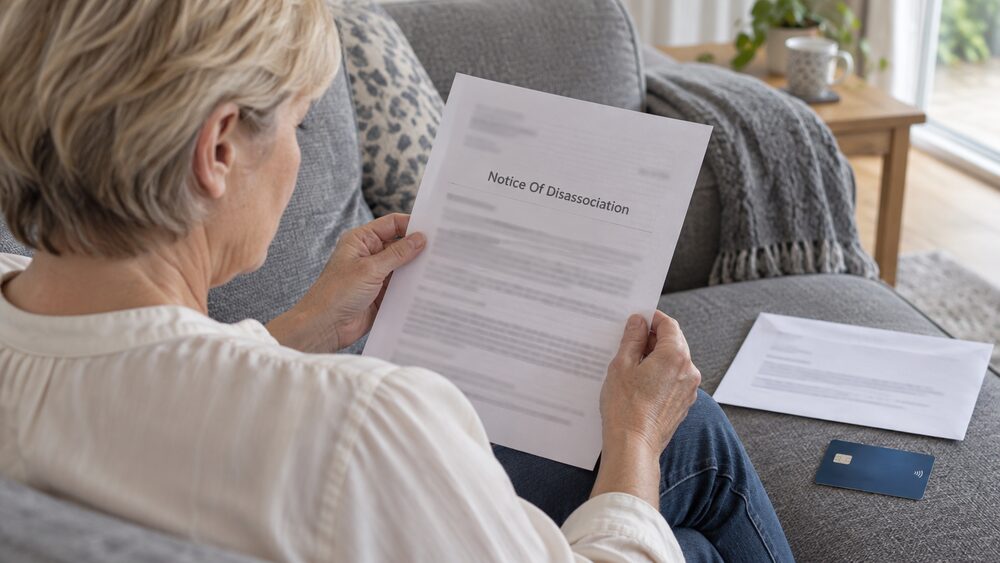
What is shared is the record of anything you genuinely did together. A joint account, a joint loan, a joint mortgage: these appear on both files, and the association entry tells lenders to look across. Opening a joint account adds a financial link to the other person, and a poor history on their side might lower your chances of acceptance6. Closing the joint account does not remove the link; a notice of disassociation can be requested from the credit reference agencies if there is no other financial connection6.
The risk runs in both directions and in two ways at once. A joint account could damage your credit score if the other person has poor credit, and you could be responsible if they run up debt on it7. That second point is not about scoring at all: it is about owing money. A joint account is a joint legal obligation, and money taken from it is money both of you owe.
This is why the standard guidance is to open a joint account only with someone you trust7. For most couples the convenience of a shared account for bills is worth the link, and the link is harmless while both manage the account well. The problems come at the end of a relationship, which is where the rest of this page concentrates.
Joint loans and mortgages: each person owes the whole debt
Joint borrowing is governed by a principle called joint and several liability. When you take out a joint credit agreement, you agree to pay back the whole debt if the other person does not pay, and you are responsible for the whole amount borrowed2. This is the single most important fact about joint debt, and it survives separation, divorce and every informal agreement between the two of you.
Suppose a couple separates and agrees between themselves that one will stay in the house and pay the joint mortgage. The lender is not a party to that agreement. If the paying partner stops, the lender can pursue the other for the entire outstanding balance, because each borrower promised the whole amount2. The same applies to a joint loan or a joint overdraft: the lender can ask either named borrower for everything owed.
Council tax has its own version of this rule. If you have been living in a property with your ex-partner, you are jointly and severally liable for any council tax debt built up while you were living together, even if only one name was on the bill1. Separating does not rewrite that history.
Death changes the picture but less than people expect. You are not automatically responsible for a husband's, wife's or civil partner's debts; you are only responsible for their debts if you had a joint loan or agreement with them, or provided a loan guarantee9. If you had a bank account in joint names, you can still usually use the account9. The page on credit files after someone dies covers the wider process, and the guide to debt: help, solutions and your rights covers joint debt problems while both of you are alive.
Financial associations after a separation
A separation does not end a financial association. The link created by a joint application, joint account or joint product continues after divorce or separation1, and it will keep connecting your files for as long as the joint product exists and, after that, until you ask for it to be removed.
This catches many people out. The divorce is final, the finances are divided, and months later one former partner finds a mortgage application slowed by the other's missed payments on the joint account that was never quite closed. Because the files are connected, how one manages the joint debt affects the other's applications4. The debt itself remains joint and several, so the lender can still pursue either of you for the whole amount2.
The order of operations after a separation therefore matters:
- Deal with the joint debts first, because they are both a liability and a link1.
- Close or separate the joint accounts, including any joint account with an overdraft1.
- Then ask the credit reference agencies for a notice of disassociation6.
MoneyHelper's guidance on dividing the family home and mortgage during divorce or dissolution covers the options for the biggest joint debt of all, including what happens when one person keeps the home4. Free debt advice charities, including StepChange and National Debtline, publish guidance on what happens to debts when you divorce, and the debt section of this site gathers the free help available.
When you can remove a financial association
A financial association cannot be removed while the financial connection behind it still exists. If you still have a joint debt, there is no way to remove the financial link until the account is closed, repaid in full, or your ex-partner's name is removed from it1. The rules differ slightly by product:
| Joint product | When the link can be removed |
|---|---|
| Joint mortgage | Once the account is closed, repaid in full, or the ex-partner's name is removed1 |
| Joint loan | Only once the loan is repaid in full1 |
| Joint bank account | Once closed, and only likely if there is no overdraft to repay1 |
The overdraft point deserves attention. A joint account with an overdrawn balance is an open joint debt, so the link stays until the overdraft is cleared and the account closed1. Many separated couples leave a joint account open with a small overdraft because it seems easier, and then find the association persists.
Once no joint debt remains, the link still does not disappear on its own. Closing a joint account will not remove the link to the other person from your credit file; a notice of disassociation can be requested from the credit reference agencies if there is no other financial connection6. The history of the joint account itself stays on your file, and adverse information such as a default stays on a credit file for six years10, but the association, the pointer to the other person, is what the notice removes.
How to apply for a notice of disassociation
A notice of disassociation is your formal request to a credit reference agency to remove a financial association from your file. The process is free and you can do it yourself. Because the three main UK credit reference agencies, TransUnion, Equifax and Experian, hold separate records5, you need to approach each one that shows the association.
- Close or settle the joint products. Repay joint loans in full, close joint accounts, and clear any overdraft on them first. For a mortgage, the link can only go once the account is closed, repaid in full, or the other person's name is removed1.
- Check your credit reports with all three agencies. You can check your credit report for free, and the associates section of each report shows who is listed5.
- Ask each agency that shows the link for a notice of disassociation. State that the relationship has ended and that no joint accounts or joint debts remain6.
- Let the agency check. The agency will look for open joint accounts; the link is removed only if none remain1.
- Check your reports again afterwards. The old joint account may still appear in your history, but the association to the other person should not6.
If an agency refuses to remove an association you believe is wrong, you can complain. The Financial Ombudsman Service, which handles complaints about credit reference agencies among many others, is free and easy to use13. The pages on how to correct wrong information on your credit report and when an agency refuses your notice of correction cover disputes in more detail.
Where to get free help
Several sources of free, impartial help exist for the problems around financial associations. MoneyHelper, the government-backed money guidance service, publishes guidance on joint accounts and on dividing the family home and mortgage during divorce or dissolution4. Debt charities including StepChange and National Debtline publish guidance on joint debts and on what happens to debts when you divorce, including the rules on removing financial links2.
For complaints, the Financial Ombudsman Service is free and easy to use13, and it can look at complaints about credit reference agencies, banks and lenders. For court judgments that are not yours, county courts handle claims for money owed by a person or business14, and the page on when a CCJ or register entry is not yours or is wrong covers the correction process. The wider guides to credit scores and credit reports and to debt gather the rest of what this site covers on both subjects.
Sources14 cited
- What happens to debts when you get divorced National Debtline, 2026-09-25
- How joint debts affect me StepChange, 2026-09-25
- Credit Information Commissioner's Office, 2026-09-25
- Dividing the family home and mortgage during divorce or dissolution MoneyHelper, 2026-09-25
- Once you have a Debt Relief Order (DRO) GOV.UK, 2023-12-19
- Joint accounts MoneyHelper, 2026-09-25
- Choosing a bank account for your Universal Credit payment MoneyHelper, 2026-09-25
- Support a child or partner's student finance application GOV.UK, 2026-09-26
- Debt when someone dies nidirect, 2026-06-26
- Payday lending report Financial Ombudsman Service, 2026-09-27
- From Control to Financial Freedom UK Finance, 2024-05
- Your credit report Surviving Economic Abuse, 2025-02
- Complaints we can help with: banking and payments Financial Ombudsman Service, 2026-09-25
- Make a court claim for money GOV.UK, 2026-09-25




 MoneyHelperFree, impartial money and pensions guidance, set up by government
 Financial Ombudsman ServiceFree, independent help when a complaint about a firm is not put right
 Citizens AdviceFree advice on money, consumer and legal problems in England and Wales
 StepChangeFree debt advice and solutions from a charity
 GOV.UKOfficial information on tax, benefits and government services