
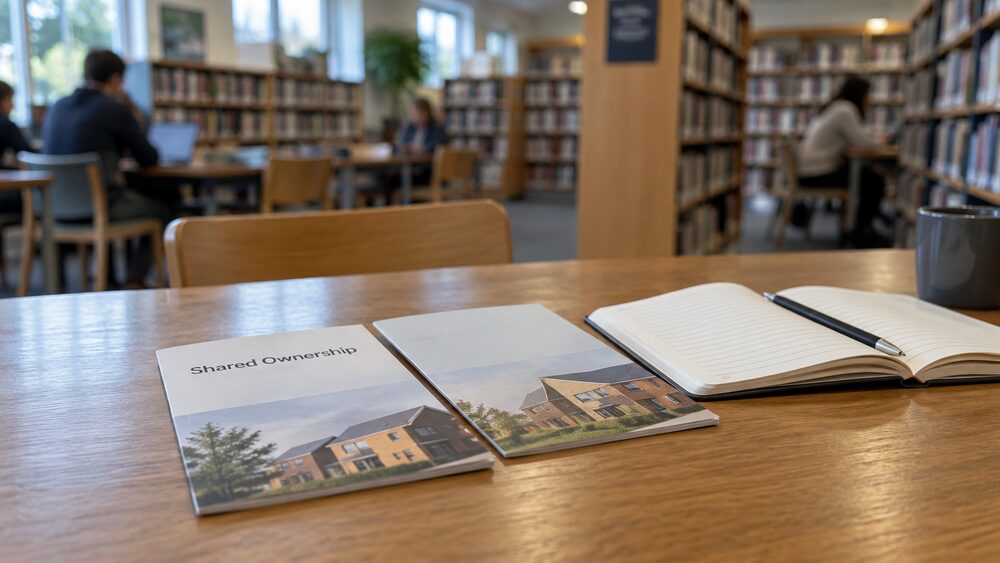
Shared ownership is a government-backed scheme that lets you buy a share of a home rather than the whole thing. You buy between 10% and 75% of the property, take out a mortgage on that share as you would any purchase, and pay rent to a housing association on the part you do not own1. It is sometimes called part-buy, part-rent, and it exists for people who cannot afford to buy a suitable home on the open market2.
The scheme is aimed at first-time buyers and people who do not currently own a home3. To qualify in England, your household income must be £80,000 a year or less, or £90,000 or less in London4. Housing associations have built and sold 103,000 shared ownership homes in the last decade, and homes are available across England from housing associations, local councils and homebuilders5.
Because you are buying a share, the deposit and mortgage you need are smaller than for an outright purchase: a deposit of at least 5% of your share, with a mortgage covering the rest5. But shared ownership is a long-term commitment with ongoing costs beyond the mortgage, and it comes with particular risks around repairs and rent arrears that outright buyers do not face. This page explains how the scheme works, what it costs, and where the pitfalls are.
How shared ownership works: buy a share of 10% to 75%
Under the current national model, you buy an initial share of between 10% and 75% of the property and pay a reduced rent on the rest to a housing association5. Earlier shared ownership purchases typically involved buying somewhere between 25% and 75% of the full market value10, and some providers still sell shares of 25%, 50% or 75%11. The share you can buy is based on your individual financial circumstances: the provider assesses what you can afford, and the smaller the share, the higher the rent on the remainder.
Although you only own a percentage, in law you are buying the whole leasehold title to your home. The National Housing Federation is clear that shared owners own their homes and can therefore be called homeowners10. The legal contract with the housing association is called a lease, and it sets out how long the lease runs, what the costs and fees are, and the responsibilities of the homeowner10. The rest of the home is owned by the housing association, and you pay rent to live in that part11.
Shared ownership is one of several routes into homeownership for people who cannot buy outright, and it works differently from the equity loan schemes, where you own 100% of the home from day one and owe the government a loan. The comparison page on shared ownership versus shared equity sets out how the two differ. If you are weighing up all the government schemes open to first-time buyers, see first-time buyer schemes.
Who can apply: household income up to £80,000, or £90,000 in London
The core eligibility rules for shared ownership in England are about income and current ownership. Your household income must be £80,000 a year or less, or £90,000 or less in London4. The scheme is open to first-time buyers and to people who do not currently own a home3. If you own a share of a property already, or you own a home elsewhere, you will generally not qualify.
One point worth knowing early: buying even an initial share in a property gives you a legal interest in it. A Financial Ombudsman Service case study on a Lifetime ISA found that a buyer who purchased an initial shared ownership share would not in future meet the definition of a first-time buyer, because the purchase gave her a legal interest in the property13. That matters for later purchases, because first-time buyer status affects Stamp Duty relief and the Lifetime ISA rules.
There are also routes into shared ownership for particular groups. Social housing tenants living in social and affordable rent homes funded through the new affordable homes programme can buy their own home through the Right to Shared Ownership, on the same terms: buying a percentage of the property and paying a reduced rent on the rest to a housing association5. People with a long-term disability can use the HOLD scheme, and buyers aged over a threshold can use Older Persons Shared Ownership; both are covered in full later in this page.
To find a home, the government provides a service to search for shared ownership homes by local authority area, and many organisations offer shared ownership homes across England, including housing associations, local councils and homebuilders6. The practical steps of buying are the same as any purchase once your share is agreed: making an offer, conveyancing, and exchange and completion.
Deposit and mortgage are based on your share, not the full price
The deposit you need is worked out on the share you are buying, not on the whole property. Under the Right to Shared Ownership, you will need to pay a deposit, usually between 5% and 10% of the share you are buying2. The same range applies to the HOLD and Older Persons Shared Ownership schemes14. More generally, shared ownership homes can be purchased with a deposit of at least 5% of your share of the property, with a mortgage covering the rest5.
This is what makes shared ownership accessible to people who could not raise a deposit for an outright purchase. On a £300,000 home, a 10% deposit on a 25% share is worked out on £75,000, not on £300,000. The mortgage you need is likewise smaller, because the lender is only lending against your share. The trade-off is that you then pay rent on the remaining 75% for as long as you own only a quarter of the home, and that rent is a cost that never builds you any equity.
Mortgage affordability is assessed in the usual way: lenders look at the monthly repayment amount, any fees including fees to set up or change the deal, the term of the loan, and changes to interest rates16. Because a shared owner's outgoings include rent and often service charges on top of the mortgage, providers check that the combined monthly costs are affordable, not just the mortgage payment. If you are buying with someone else, joint owners are treated as having equal shares17, and the page on buying a home jointly explains how joint purchases work.
For more detail, see how much deposit do I need for a shared ownership home? and the wider guide to deposits.
Monthly costs: mortgage, rent on the rest and service charges
As a shared owner you are a leaseholder: you buy a share of your home, pay rent to the landlord on the rest, and usually pay monthly service charges2. So the typical monthly bill has three parts: the mortgage on your share, the rent on the share you do not own, and any service charge, plus the ordinary costs of running a home such as council tax and utility bills.
The rent is set out in the lease. The rent payment covers the landlord's cost of financing the percentage value of the property that you have not yet paid for18. Under the Right to Shared Ownership, rent is limited to a maximum of 3% of the value of the equity stake you have not acquired7. The official guide for tenants gives a worked example: on a home valued at £300,000 bought at a 40% stake, with rent set at 2.75%, the first year's rent is £4,950, or £413 a month7. A second version of the official example shows £6,600 for the first year, or £550 a month, on the same terms7. Treat both as illustrations of how the calculation works rather than as a quote.
Service charges cover the upkeep of shared areas and, in flats, the building itself. Shared owners have the same benefits and rights in relation to the common parts as any other leaseholder18. Whether service charges are worked out on your share or on 100% of the property depends on the lease, which is covered in do shared owners pay service charges on 100% of the property?.
If money is tight, help exists. The Universal Credit housing costs element can help with rent and some service charges for people with a shared ownership property, though you will not get any help with your mortgage through Universal Credit19. You might be able to get help with mortgage interest instead through a Support for Mortgage Interest loan, which is available to shared owners alongside help with rent20. The page on Housing Benefit and Universal Credit for shared owners goes into this in detail.
Stamp Duty on a shared ownership purchase
Stamp Duty Land Tax applies when you buy a shared ownership home, as it does to any property purchase in England. What makes shared ownership different is that the price you pay at completion is only your share, while the lease also gives you the right to buy the rest later, and the tax rules allow more than one way to work out what you pay tax on. The choice between paying tax on your share or on the whole home, and the option to pay in stages, is explained in can I pay Stamp Duty in stages on a shared ownership home?, with the general rules in Stamp Duty Land Tax.
Two points from the wider tax rules are worth flagging. First, as noted above, buying an initial share means you acquire a legal interest in a property, so you would not count as a first-time buyer in future13, which affects first-time buyer relief. Second, the higher rates for additional dwellings have their own rules about who holds a major interest in a dwelling: under the legislation, a person who jointly inherits a major interest in a dwelling with a beneficial share not exceeding 50% is not treated as having the major interest for three years from the inheritance21. The pages on the higher rates on additional properties and when the higher rates do not apply cover this.
Stamp duty is one of several upfront costs of buying, alongside legal fees and the deposit. The full picture is in the costs of buying a house.
Staircasing: buying more of your home over time
You can buy more shares in your home in future, which is known as staircasing2. Each further payment to the landlord buys a further percentage of the value of the property, and it reduces the monthly rent, because rent is only charged on the share you have not paid for10. In some cases the shared owner may be able to purchase 100% of the property, which is referred to as final staircasing10.
The national model has made staircasing cheaper and easier for new shared owners. Under the new model, shared owners can buy additional shares in their home in 1% increments for up to 15 years, with heavily reduced fees8. The option exists to staircase in 1% increments per year for 10 years without undertaking a valuation5. Older leases typically required larger steps, often 10% at a time, with a valuation and legal fees each time, which is why the fee position matters so much: see what fees do I pay when I staircase? and what is the minimum share I can buy when staircasing?.
The specialist schemes work the same way. Under both HOLD and Older Persons Shared Ownership, you can buy more shares in your home in future, and if you buy more shares you will pay less rent14. The full process is covered in staircasing: buying more shares in a shared ownership home.
Repairs, the lease and what you can and cannot do
This is the area where shared ownership differs most sharply from both renting and outright buying, and where complaints most often arise. Because the lease makes the shared owner the homeowner, they are responsible for all the repairs and maintenance in their home, including major structural works and major repairs18. You will need to pay for repairs and maintenance no matter what share you own9. Even a 10% owner is responsible for 100% of the repair bill.
The reasoning is legal rather than practical: a shared ownership leaseholder purchases the full leasehold title to their home, so they take on full responsibility for the property18. The standard form of the shared ownership lease requires the leaseholder to keep the property in good and substantial repair and condition22.
There are two important qualifications. First, under the new national model, the cost of repairs and maintenance is met by the landlord for the first 10 years after purchase of a new property, with some limits8. Homes bought from 2021 onwards may have an "initial repair period" in the lease9. Under the Right to Shared Ownership, the initial repair period runs for a maximum of nine years7. Second, this protection is conditional: if you break the terms of your lease, for example by causing damage on purpose or failing to arrange routine servicing and maintenance, your landlord will not need to pay for repairs it is normally responsible for9.
Your usual responsibilities as a shared owner include looking after your home and keeping it clean, carrying out any external and internal repairs, paying the buildings and contents insurance, and getting permission before making improvements or alterations23. Permissions matter: you will usually need permission from the housing association and your mortgage lender before taking in a lodger23, and subletting the whole home is not what the lease intends. The narrow page on renting out a shared ownership home covers the rules in detail.
Because shared ownership homes in England are always leasehold8, the ordinary leaseholder rules and protections apply alongside the shared ownership ones. A shared ownership lease provides similar rights to an ordinary long residential lease, though there are some differences24. Due to a quirk in current leasehold law, shared ownership leases, together with all long leases with an annual rent above £250 a year, or £1,000 in Greater London, are technically Assured Shorthold Tenancies24. This does not make shared ownership just another form of renting: you own the leasehold title, and the lease, not the tenancy label, governs your rights10. The pages on buying a leasehold property and freehold versus leasehold explain the leasehold system.
Lease lengths have improved. The minimum shared ownership lease term has been extended from 99 to 990 years8, and a 990-year lease is now standard, a change that is also being applied to existing shared owners25. Leases granted under the older model usually run for 125 years24. If you are buying a flat, the government publishes key information documents for shared owners of flats in England, which set out what your lease means in practice22.
Selling a shared ownership home
You can sell a shared ownership home at any point, and people do so for the same reasons as any homeowner: moving for work, separating, or simply wanting a change. The mechanics differ from an outright sale because you can only sell the share you own, and the housing association usually has first claim on finding a buyer. The process, including the valuation and the association's nomination period, is covered in full in selling a shared ownership home.
Some life events need particular care. If you jointly owned your home and there is not enough money elsewhere in the estate to pay off a deceased person's debts, the home may have to be sold26. On divorce or dissolution, the options for the family home are to sell it and both move out, for one partner to buy the other out, to keep the home without changing ownership, or to transfer part of the property's value from one partner to the other27. MoneyHelper sets out these options and how the mortgage is handled in each case27.
If you own a home and are buying an Older Persons Shared Ownership home, the rules on selling are stricter: you must have formally accepted an offer for the sale of your current home, with written confirmation of the sale agreed, and the sale must complete on or before completion of the shared ownership purchase15.
Falling behind on rent: the risk of losing your home
Shared ownership has a risk that outright buyers do not face: you have the obligations of a homeowner, including mortgage payments, but you also owe rent, and the consequences of missing either can be severe.
If you miss mortgage payments, your lender could try to repossess your home23. If you fall behind on rent or other occupancy payments, the housing association could try to get a court order to force you to pay the debt or sell your share of the home23. Where the lender has to act, any cost it incurs will be added to the monies owed by the shared owner to its mortgage lender28.
The worst case is the loss of your investment. The standard form of the shared ownership lease states that if the leaseholder fails to pay rent or breaches their obligations, the landlord may terminate the lease, subject to a court order, and the leaseholder loses any acquired shares with no compensation22. In that situation the shared owner would lose their interest in the property and ownership would return in full to the landlord, and they would also lose any capital payment made when the lease was granted28.
This is not a reason to avoid shared ownership, but it is a reason to treat the rent as seriously as the mortgage. If you are struggling, help with rent may be available through Universal Credit19, and help with mortgage interest through a Support for Mortgage Interest loan20. The page on what happens if a shared owner falls behind on rent covers the process, and free debt advice is available from charities such as StepChange and from MoneyHelper.
HOLD and Older Persons Shared Ownership
Two specialist versions of shared ownership exist for people whose needs the main scheme does not fit well.
HOLD, or Home Ownership for people with a Long-term Disability, is for people who have a long-term disability as defined under the Equality Act 201014. It follows the same rules as the shared ownership scheme14, but with a crucial difference: instead of choosing from the homes a provider has for sale, you search for a home on the open market, because the point of the scheme is to buy a home that suits your disability. Homes can be second-hand or new build14. To be eligible you must be an adult receiving certain disability benefits, which include the Disability Living Allowance care component at the middle or high rate29. The share you can buy is between 10% and 75% of the home's full market value, based on your financial circumstances14.
The application process runs in order: you discuss your situation with your chosen shared ownership provider, and once confirmed you can proceed, you search for a home on the open market; the provider then checks that you can afford the home and the property, and you find a legal professional for the conveyancing14. Leasehold homes bought through HOLD should have a remaining lease length of at least 990 years, unless no available homes have that lease length, in which case a minimum of 125 years applies14. The landlord is responsible for the cost of some repairs for the first 10 years from the date the home was built, but you still pay the service charge during that period, and after it ends you are responsible for all repairs14. See HOLD: shared ownership for people with a long-term disability.
Older Persons Shared Ownership (OPSO) follows the same rules as the shared ownership scheme15, with one significant benefit: once you own 75% of the home, you do not have to pay rent on the remaining 25% share15. Eligibility is wider than the main scheme: as well as first-time buyers, it covers people who used to own a home but cannot afford to buy one now, people forming a new household, existing shared owners wanting to move, and people who own a home and want to move but cannot afford a new home that meets their needs15. The income limits are the same, £80,000 a year or less, or £90,000 in London15. Key Information Documents for OPSO homes were issued for homes funded through Homes England's Shared Ownership and Affordable Homes Programme 2016 to 202130. See Older Persons Shared Ownership.
The Right to Shared Ownership, which lets eligible social housing tenants buy their rented home on shared ownership terms, excludes a specialist home for older, disabled or vulnerable people2, which is why the dedicated schemes above exist for those groups.
Shared ownership outside England
This page covers England, where shared ownership is the standard low-cost home ownership product. The other UK nations run different schemes, and the rules do not transfer.
In Scotland, there is a shared ownership scheme, but the main low-cost purchase routes are shared equity schemes. The Open Market Shared Equity scheme helps first-time buyers on low to moderate incomes buy an existing home on the open market, with the Scottish Government holding a stake in the rest11. The New Supply Shared Equity scheme applies to brand new houses being built11. If you ever sell, the Scottish Government gets a share of the money32. You pay for your share of the home's price in the usual way, along with costs such as legal fees, registration fees and any stamp duty33. See shared equity and shared ownership schemes in Scotland.
In Wales, Shared Ownership lets you buy an initial share of 25% to 75% of a property with rent paid on the remaining share34. Eligibility requires you to be a first-time buyer, a newly forming household, or relocating for work to an area where property prices do not allow you to buy a home suitable for your family size35. The Welsh buyers' guide notes that small DIY jobs and general upkeep are allowed with the landlord's prior written consent, but significant or structural repairs and improvements, including loft conversions, extensions and conservatories, are not permitted36. See Shared Ownership, Homebuy and Rent to Own in Wales.
In Northern Ireland, the low-cost home ownership schemes work differently again, and the House Sales Scheme allows tenants to increase their equity share in multiples of five per cent at any time, which is known there as staircasing37. See the House Sales Scheme in Northern Ireland.
Sources38 cited
- Evaluation of the Help to Buy scheme: evaluation findings report GOV.UK
- Right to Shared Ownership GOV.UK
- Shared ownership guidance UK Parliament deposited papers
- 7 first-time buyer schemes that are available now Help to Buy has closed Which?
- Shared ownership National Housing Federation
- Find an organisation that sells shared ownership homes in England GOV.UK, 2025-12-04
- The Right to Shared Ownership: a guide for tenants GOV.UK, 2025-09
- Research briefing on shared ownership House of Commons Library, 2026-07-08
- Shared ownership homes: repairs and home improvements GOV.UK, 2026-09-28
- Why is shared ownership considered ownership? National Housing Federation
- Help to buy a home mygov.scot, 2026-06-24
- Shared ownership Which?
- Customer loses Lifetime ISA bonus after cashing in Financial Ombudsman Service
- Home Ownership for people with a Long-term Disability (HOLD) GOV.UK, 2025-12-03
- Older Persons Shared Ownership (OPSO) GOV.UK, 2025-12-03
- Mortgage with bad credit StepChange, 2026-09-25
- Gains on UK life insurance policies HS320 GOV.UK
- Why are shared ownership customers responsible for paying for major structural works within their home? National Housing Federation
- Universal Credit: how much will I get if I have a shared ownership property? Turn2us, 2026-02-25
- Universal Credit payments: housing nidirect, 2026-09-01
- Stamp duty land tax higher rates: jointly inherited dwellings legislation.gov.uk
- Key information for shared owners of flats in England GOV.UK, 2015-12-15
- Shared ownership rights Shelter Scotland, 2022-08-09
- A shared ownership lease is an Assured Shorthold Tenancy: is this just another form of renting? National Housing Federation
- Shared ownership National Housing Federation
- Debt when someone dies nidirect, 2026-06-26
- Dividing the family home and mortgage during divorce or dissolution MoneyHelper, 2026-09-25
- Can shared owners lose all of their investment in their home if they don't pay their rent? National Housing Federation
- Mortgages Scope, 2026-04-01
- Older Persons Shared Ownership key information documents GOV.UK, 2024-09-02
- Open Market Shared Equity (OMSE) scheme buyer information gov.scot, 2025-09-19
- Open Market Shared Equity scheme: how it works mygov.scot, 2026-03-17
- Open Market Shared Equity scheme: how to apply mygov.scot, 2026-03-17
- Help to buy home schemes GOV.WALES
- Shared Ownership Wales: eligibility GOV.WALES
- Shared Ownership Wales buyers' guide GOV.WALES, 2018-02
- Low-cost home ownership schemes nidirect, 2026-02-18
- Equity sharing nidirect, 2026-02-25




 MoneyHelperFree, impartial money and pensions guidance, set up by government
 Citizens AdviceFree advice on money, consumer and legal problems in England and Wales
 ShelterFree housing advice from a charity
 GOV.UKOfficial information on tax, benefits and government services
 Financial Ombudsman ServiceFree, independent help when a complaint about a firm is not put right