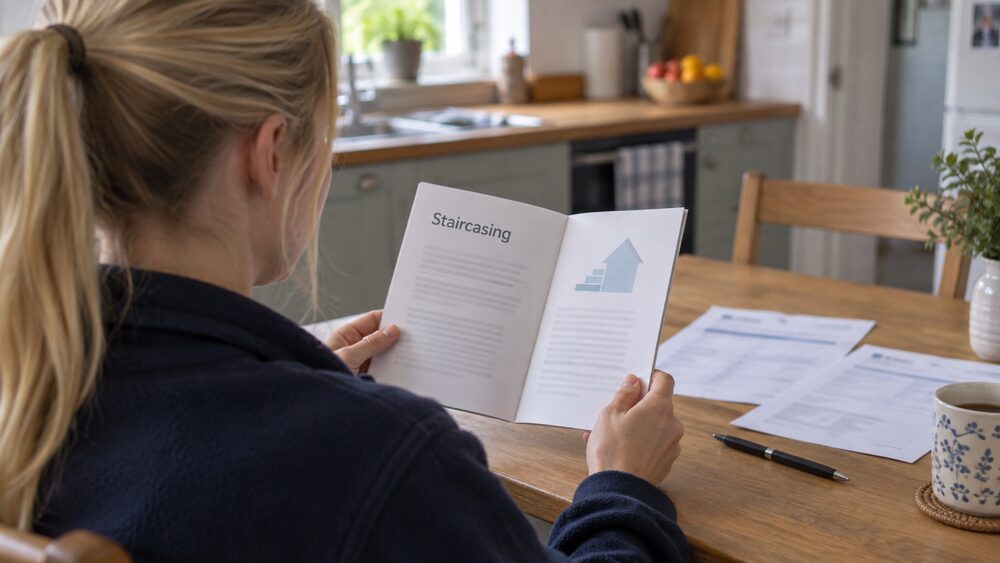
Staircasing is the shared ownership scheme's built-in way of buying your home bit by bit. When you bought your share, the housing association kept the rest, and you pay rent on the part you do not own. Staircasing means paying the landlord for a further percentage of the property's value, which reduces the monthly rent, and in most cases you can keep going until you own 100%1. The standard shared ownership lease in England states that the leaseholder can buy further shares at the market value of those shares at the time of purchase, until they own the whole property2.
The effect on rent is the main reason people staircase. The greater the share you own, the less rent you pay to the housing association, and if you reach 100% no rent is paid at all3. The Welsh Government's buyer guide gives a worked example: a home valued at £220,000 at the time of staircasing, where the owner buys a further 20% share for £44,000 (£220,000 x 20%), sees their monthly rent fall from £385 to £2754. Rent itself never buys you anything: under Co-Ownership in Northern Ireland, the monthly rent payment does not go towards ownership of the home, only a separate purchase of shares does5.
What staircasing is and how it changes your rent
The lease is the legal contract that makes you the homeowner, and staircasing is a right written into it. The lease states how long it lasts, what the costs and fees are, and what your responsibilities are1. When you buy a further share, the landlord's stake shrinks and, as the standard lease puts it, the rent is reduced proportionately to reflect that the landlord now owns less2. Nothing about the building changes hands physically: what changes is the split of ownership, the rent, and over time the share of any sale proceeds you would keep.
Because rent is charged only on the landlord's remaining share, each staircasing step cuts the rent in proportion. In the Welsh example, buying 20% of a home where the landlord owned 70% left the landlord owning 50%, and the rent was recalculated as £385 x (50/70), giving £275 a month4. The same arithmetic works in reverse if you later sell: the landlord's share of the sale price matches the share it still owns. Note that rent paid over the years buys nothing, which is the key difference between shared ownership rent and a mortgage: only the shares you purchase, with savings or borrowing, become yours5.
Minimum shares depend on when and where your lease began
How big a bite you must take at each staircasing step depends on which lease you have and which nation you are in. For shared ownership homes in England on the new national model, the minimum additional share purchase has been reduced from 10% to 5%6. On older leases, lenders describe the usual position as a minimum of 10% each time7. The initial share you bought is a separate question: in England the minimum initial stake is 10%, though many schemes require at least 25%9.
Wales works on the older pattern. The Welsh Government's guide states you need to be able to purchase additional shares of at least 10% of the value of your home, and the final staircasing to 100% must also be at least 10%4. In Scotland, shared equity schemes let you increase your share by at least 5% each year10. In Northern Ireland, the House Sales Scheme lets you increase your equity share in multiples of five per cent at any time11.
| Where your home is | Minimum further share | Notes |
|---|---|---|
| England, new model lease | 5% | Reduced from 10%; 1% option also available6 |
| England, older leases | usually 10% | Check your lease7 |
| Wales | at least 10% | Applies to the final staircasing too4 |
| Scotland (shared equity) | at least 5% a year | Scheme rules10 |
| Northern Ireland (House Sales Scheme) | multiples of 5% | At any time11 |
1% gradual staircasing on newer leases
The biggest change in recent years is the option to staircase in very small steps. Under the new national model for shared ownership in England, new shared owners can buy additional shares in 1% increments for up to 15 years, with heavily reduced fees6. Independent guidance describes the same right as the option to staircase in 1% increments per year for 10 years without undertaking a valuation13, so the period quoted varies between 10 and 15 years depending on the document; your lease is the definitive answer. Other staircasing transactions are reduced to a minimum of 5% rather than 10%8.
The point of the 1% option is cost. Buying 1% at a time avoids the valuation and administration fees that come with larger purchases, which makes staircasing affordable in small amounts rather than in thousand-pound leaps. The Right to Shared Ownership guidance illustrates what 1% means in cash: on a home with a full market value of £325,000 at the time of staircasing, it gives a cost of £3,250 for 1%, £16,250 for 5%, £48,750 for 15% and £81,250 for 25%14. A second version of the same official guidance gives different figures, £4,250 for 1%, £21,250 for 5%, £63,750 for 15% and £106,250 for 25%, on the same £325,000 value, and the two documents disagree; treat the figures as illustrations of the method rather than exact costs, and check the current value of your own home14.
The 1% option is not universal. It belongs to the new model lease in England, and the Grenfell Assisted Home Ownership Scheme matches the staircasing arrangements for the new model of shared ownership15. Shared owners on older leases, and those in Wales, Scotland and Northern Ireland's schemes, buy in the larger minimum steps described above.
Valuations: an independent RICS surveyor, and you usually pay
The price of your next share is not what you paid for the home, and not what a neighbour's home fetched: it is a current market valuation, and the lease says who must carry it out. In Wales, shares are sold at the current market value, disregarding any improvements your landlord consented to, and the valuation must be by a RICS qualified valuer4. A RICS-registered valuer will inspect your home inside and out, compare similar properties in your area, and provide a formal valuation16. The same standard appears across government schemes: Help to Buy valuations must be by a surveyor who is both RICS qualified and registered17, and the First Homes scheme requires a surveyor registered with the Royal Institution of Chartered Surveyors18.
Who pays is consistent: you do. In Scotland's shared equity schemes, the buyer pays all the valuation and legal costs as well as the administration costs of the organisation handling the request19. Under Co-Ownership in Northern Ireland, the valuation costs £75, is valid for 12 weeks from the date you receive it, and you usually receive the result within two weeks of the inspection16. In Wales, the valuation is normally valid for 3 months from the inspection listed in the report4.
If you believe a mortgage valuation was wrong, the Financial Ombudsman Service can look at complaints about valuations and surveys, which is one of the few routes to challenge a figure rather than simply paying for another valuation21.
Staircasing costs and fees
Beyond the price of the share itself, each staircasing transaction carries its own costs. Lenders note you may need to pay admin and legal fees each time you buy more of your home7. All of the details about the cost of the process are in the lease: the housing association provides cost details, and your solicitor can advise3. Under Co-Ownership, staircasing is in 5% steps with a subsidised valuation fee, and you can buy in 5% steps, larger blocks of 10% or 20%, or the remaining share all in one go16.
The typical cost pattern looks like this:
- The share itself: the market value of the percentage you buy, set by the valuation4
- Valuation fee: paid by you; £75 and subsidised under Co-Ownership, elsewhere set by the valuer16
- Legal fees: your own solicitor or conveyancer handles the transfer7
- Administration fee: the housing association's own charge for processing the staircasing7
The Welsh Government's illustration shows how the numbers fit together: a home worth £220,000 at staircasing, a 20% share purchased for £44,000, and rent falling from £385 to £275 a month afterwards4. Whether staircasing in small steps or one large step is cheaper depends on the fees each transaction triggers, which is why the lease, and the housing association's current fee schedule, are the documents to check before deciding3. The dedicated page on staircasing fees goes deeper on the charges.
How to staircase: checking your lease and getting permission
Staircasing is not a private matter between you and your savings: the landlord is involved at every step. You will need the permission of the company that owns the rest of the home22. The lease sets out your minimum share, any caps, and the fees, so it is the first document to read1. In Scotland, shared owners usually need permission from the housing association and their mortgage lender even to take a lodger, which shows how much control the lease retains over the property23.
The process, in order:
- Check the lease for the minimum share, any cap such as 80% in protected areas, and the fees1
- Ask the landlord for permission to staircase22
- Arrange the money, from savings or a further mortgage advance
- Instruct a RICS-registered valuer to set the price of the share16
- Instruct a solicitor or conveyancer for the legal work7
- Complete within the deadline your scheme sets
Deadlines bite at the end of the process. Under Co-Ownership, all funds and legal work must be completed within 12 weeks of the valuation date16. In Wales, the valuation is normally valid for 3 months from the inspection4, and under Help to Buy Wales, if a desktop valuation expires and a total of six months is reached without completing, a new RICS valuation with re-inspection is required25. If you are using a mortgage to fund the purchase, build the lender's timescales into that window.
Owning 100%: what changes when you staircase fully
Final staircasing, buying the remaining share to own the property outright, is the end point of the scheme for most leases. The standard lease allows purchases up to 100%2, and in some cases the shared owner may purchase 100% of the property, referred to as final staircasing1. Around 4,000 to 5,000 shared owners a year staircase to full ownership8. In Scotland's New Supply Shared Equity scheme, in most cases you can increase your share all the way to 100%, meaning the Scottish Government no longer has any stake20.
Owning 100% changes more than the rent, which stops entirely3. Under the standard lease, the landlord's consent is required if you assign or transfer the lease before staircasing to 100%, but consent is not required once you own 100%2. The landlord's right of first refusal, which can require you to offer your share back to the landlord or a nominated buyer when you sell, does not apply after staircasing to 100%, nor on divorce or death2. The ban on subletting also lifts: the leaseholder is not permitted to sublet or part with possession until staircasing to 100%2, so full ownership opens the option covered in renting out a shared ownership home.
Where staircasing can cost you: price falls and other risks
Staircasing buys at today's price, not yesterday's. The cost of the share is based on the price of your home at that time7, and house prices move in both directions. As the National Housing Federation puts it:
"However, house prices do fluctuate and so the value of the home may increase or decrease over time."26
That cuts both ways. If prices fall after you bought your original share, staircasing lets you buy more at the lower price; if prices have risen, each further share costs more. Someone who staircased up during a rising market and then sells into a falling one can lose money overall, which is the same exposure any homeowner has, concentrated in the shares bought at the top.
Improvements complicate the valuation. Official guidance for shared ownership homes says changes to your home may increase or decrease its market value, which can affect the price if you buy shares of 5% or more in the future27. Making improvements may add to the value26. In Wales, improvements the landlord consented to are disregarded for staircasing valuations, so you do not pay the landlord for value you created4. In Scotland's shared equity schemes the position differs: if major improvements requiring planning permission or a building warrant add value, Scottish Ministers share in that increased value if the house is sold while they still hold a stake28. Keep receipts and consent letters, whichever scheme you are in.
The other costs of getting it wrong are the fees of an aborted transaction: a valuation that expires before completion means paying for it again4, and legal work begun but not finished is rarely refunded. The pages on negative equity and selling a shared ownership home cover the downsides in more depth.
Staircasing in the specialist schemes
Several schemes have their own staircasing rules. Older Persons Shared Ownership and HOLD, shared ownership for people with a long-term disability, both state you can buy more shares in future, known as staircasing, and if you buy more shares you will pay less rent29. The Right to Shared Ownership, which gives qualifying social tenants the right to buy a share of their rented home, works the same way: you can buy more shares in the future and pay less rent on the rest31.
In Scotland, the Mortgage to Shared Equity scheme, part of the Home Owners' Support Fund, lets you buy as much additional equity as you can afford as often as you like after two years, and you are normally expected to re-purchase the Scottish Government's stake within 10 years32. The Help to Buy (Scotland) scheme allowed equity increases of a minimum of 5% of the home's prevailing market value in any one year, up to 100%34. Open Market Shared Equity requires a valuation from an independent professionally qualified valuer registered with the RICS, which forms part of the Home Report unless the property is a new build, in which case you obtain a valuation at your own expense35.
Co-Ownership in Northern Ireland staircases in 5% steps with a subsidised valuation fee, there are no deadlines or expectations involved, and each increase requires a fresh valuation16. The comparison of Co-Ownership with English shared ownership sets out the differences, and shared equity schemes in Scotland covers the Scottish options side by side.
Where to get help
Your lease is the primary document, and your solicitor can advise on it3. The housing association that owns the remaining share is the practical first stop for permission, fee schedules and valuation arrangements22. For complaints about a mortgage valuation, the Financial Ombudsman Service handles them free of charge21.
If money is the obstacle, two things are worth knowing. Shared ownership schemes are treated as Social Rented Sector cases for benefits purposes, and housing costs are based on the rent and any eligible service charges, so help with rent may continue alongside staircasing37; the page on housing benefit and Universal Credit for shared owners explains this. And if debt is the problem rather than the share price, free debt advice from a charity such as StepChange comes before any decision to borrow more38.
Sources38 cited
- Why is shared ownership considered ownership? National Housing Federation, 2026
- Key information for shared owners of flats in England HM Government, 2015
- Buying a shared ownership home outright National Housing Federation, 2026
- Shared Ownership Wales buyers' guide Welsh Government, 2018
- Can I increase my monthly payments to buy more of my home? Co-Ownership, 2026
- Shared ownership (England): Commons Library briefing CBP-8828 House of Commons Library, 2026
- Shared ownership mortgages Santander, 2026
- Shared ownership National Housing Federation, 2026
- Shared ownership explained Which?, 2026
- Affordable home ownership in Scotland Shelter Scotland, 2024
- Equity sharing: the House Sales Scheme nidirect, 2026
- Shared ownership homes in a designated protected area: 80% restricted staircasing KIDs HM Government, 2026
- Shared ownership National Housing Federation, 2026
- The Right to Shared Ownership: a guide for tenants HM Government, 2025
- The Grenfell Assisted Home Ownership Scheme (GAHOS) HM Government, 2024
- Owning more of your home Co-Ownership, 2026
- How to get a valuation of your Help to Buy home HM Government, 2025
- First Homes scheme: selling the property HM Government, 2026
- Open Market Shared Equity scheme: after buying mygov.scot, 2026
- New Supply Shared Equity scheme: after buying mygov.scot, 2026
- Complaints about mortgage valuations and surveys Financial Ombudsman Service, 2026
- Shared ownership mortgage guide NatWest, 2026
- Shared ownership rights in Scotland Shelter Scotland, 2022
- Shared ownership mortgages Barclays
- Help to Buy Wales post-completions guide Welsh Government, 2024
- Why do customers sometimes lose money when they sell their share? National Housing Federation, 2026
- Repairs and home improvements in a shared ownership home HM Government, 2026
- Shared equity post-sale information for buyers Scottish Government, 2017
- Older Persons Shared Ownership (OPSO) HM Government, 2025
- Home Ownership for people with a Long-term Disability (HOLD) HM Government, 2025
- Right to Shared Ownership HM Government, 2026
- Mortgage to Shared Equity scheme Scottish Government, 2015
- Home Owners' Support Fund information booklet Scottish Government, 2015
- Help to Buy (Scotland) information for buyers Scottish Government, 2016
- Open Market Shared Equity scheme buyer information Scottish Government, 2025
- Shared ownership in Northern Ireland Co-Ownership, 2026
- Shared ownership guidance (deposited paper) HM Government, 2025
- Mortgage jargon buster StepChange, 2026


 MoneyHelperFree, impartial money and pensions guidance, set up by government
 Citizens AdviceFree advice on money, consumer and legal problems in England and Wales
 ShelterFree housing advice from a charity
 GOV.UKOfficial information on tax, benefits and government services
 Financial Ombudsman ServiceFree, independent help when a complaint about a firm is not put right