
Selling a shared ownership home is not the same as selling an ordinary property, because you are selling only the share you own, and the housing association that owns the rest has a say in how the sale happens. The basic money rule is simple: you get the same share of the selling price that you own. If you own 25% of the home, you receive 25% of the selling price1. The association keeps the rest, and the buyer steps into your shoes as the shared owner.
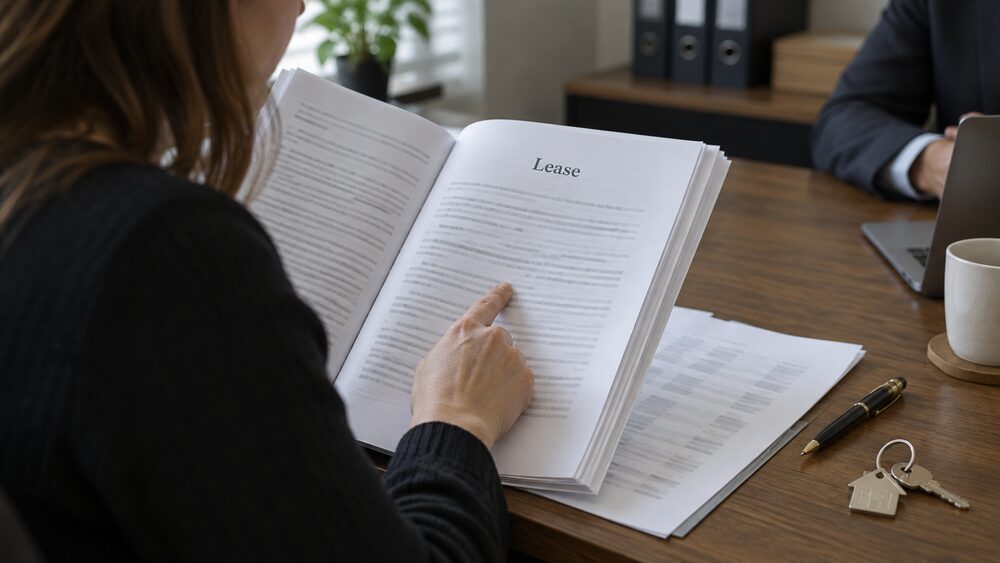
The process is governed above all by your lease. A shared ownership purchase is always initially bought on a long leasehold basis, with your name registered at the Land Registry as legal owner, and the lease is a legal contract with the housing association that states how long it runs, what the costs and fees are, and what you and the association are each responsible for2. Before doing anything else, read the lease or ask a conveyancer to explain it, because the timing, the fees and even whether you can sell on the open market at all are set out there.
This page explains how the sale price is split, who can buy your share, the association's right to find a buyer first, the valuation and documents a sale needs, what it costs, and how the rules differ in Scotland, Wales and Northern Ireland.
You sell only the share you own
The core rule of a shared ownership sale is that the price is divided in proportion to ownership. Official guidance gives the example plainly: if you own 25% of the home, you get 25% of the selling price1. The buyer does not pay the housing association anything extra at that point; they take over the lease, pay rent to the association on the share they have not bought, and become the new shared owner.
The same proportional principle applies to Scotland's shared equity schemes, though the mechanics differ. Under the Open Market Shared Equity scheme, if you have a 70% share of your home and you decide to sell, you get 70% of the selling price and the Scottish Government gets the rest6. The difference between the two models matters when you come to sell: in shared ownership the association owns a share of the property itself and receives its share of the price, while in Scottish shared equity the Government holds a financial stake that is settled out of the sale proceeds.
If you own the home jointly, the sale proceeds are divided according to how you own it. Joint tenants own the property equally, with no separate, identifiable shares7. Tenants in common own distinct shares, and those shares can be unequal. In Scotland, if you own something jointly with someone else, the other owner can still sell their share, and you can claim the value of your share before or after it is sold8. Evidence of how you own the property may be shown in the Transfer or Lease by which it was acquired, or in a Trust Deed or Will9.
One point worth checking early: whether your lease contains a "golden share" or similar restriction. Some shared ownership homes, particularly in protected rural areas, cannot ever be staircased to 100%, which affects both what you can sell and to whom. The lease is the document that answers this for your home.
Who can buy a shared ownership resale
A shared ownership resale is not open to any buyer with the money. The scheme exists to help first-time buyers and those who do not currently own a home purchase a share in a property10, and the housing association will normally check that a prospective buyer meets those eligibility rules and can afford the home before accepting them. This is one of the main practical differences from an open market sale: the association is a gatekeeper as well as a part-owner.
Resales are marketed through the associations themselves. Many organisations offer shared ownership homes across England, including housing associations, local councils and homebuilders11, and there is an official service to search for shared ownership homes by local authority area11. A buyer looking for a resale uses the same channels as a buyer looking for a new shared ownership home.
For the buyer, a resale carries some advantages over a new build. If you buy a home through a shared ownership resale, any remaining period on the building warranty will transfer to you12. The buyer will also want the standard information about the home, and providers funded through Homes England's programme issue Key Information Documents to prospective buyers, which set out the terms the new owner will take on13.
The restrictions on resale are not unique to shared ownership. The First Homes scheme in England applies a similar principle: you can usually only sell the property to someone who is eligible to buy a First Home14. Where a scheme is designed to keep homes affordable, the eligibility rules travel with the property from owner to owner.
The housing association's part in a sale
Because the housing association owns the remaining share, it is involved in your sale from start to finish. The lease, a legal contract with the association, states how long the lease is for, what the costs and fees are, and the responsibilities of the homeowner2. Nothing in the sale can be done without reference to it: it consents to the transfer, checks the buyer, and receives its share of the proceeds.
The association's first and most important role is the right to find a buyer itself. A comparable rule in the Right to Buy scheme shows how these rights of first refusal work: if your offer has not been accepted within 8 weeks, you are free to sell the property on the open market15. Shared ownership leases work on the same pattern, with the association given a set period to nominate a buyer before the property can be marketed openly. The length of that period is set in your lease.
The association also sets the information a buyer receives. Under the Shared Ownership and Affordable Homes Programme, providers give prospective buyers standard Key Information Documents covering the terms of the lease, the rent and the fees13. As the seller, you will be working with the association to produce or supply much of what the buyer needs.
Finally, the association handles the money. On completion, its share of the selling price is paid to it, your share to you (usually via your conveyancer to repay any mortgage and release the remainder), and the buyer's lease is registered. Your own conveyancer deals with the association's solicitors as well as the buyer's.
Where the open market is limited: protected areas
Some shared ownership homes cannot be sold freely on the open market even after the nomination period ends. In designated protected areas, the rules exist to keep affordable homes in the local community, and Homes England issues specific Key Information Documents for shared ownership homes in a designated protected area where staircasing is restricted16. The effect is that owners in these areas face limits on how far they can staircase, and the home must be sold as a shared ownership property to another eligible buyer rather than sold outright.
Rural restrictions of this kind appear in other schemes too. Under Right to Buy, if your home is in a rural area, your landlord may require you to offer your home to them if you want to resell within 10 years of buying15. The Right to Shared Ownership scheme similarly excludes homes in a remote rural area17. The common thread is that the restriction is attached to the property, not to you: it passes to every future owner until the rules say otherwise.
If your home is in a protected area, this changes your sale in two ways. First, the pool of buyers is smaller, because only people eligible for shared ownership can buy. Second, the price of your share may be less than it would be on the open market, because the buyer cannot acquire the whole property. Check your lease and ask the association directly whether the home is in a designated protected area before you plan the sale.
Nomination period and timing
The nomination period is the stretch of time, set out in your lease, during which the housing association markets your share itself and you cannot sell on the open market. The association advertises the home to people registered for shared ownership, checks applicants against the scheme's eligibility rules, and nominates a buyer it is satisfied with. Only if no buyer is found within the period does the lease normally free you to market the property more widely.
The lengths of these periods vary by lease and by provider, and the documents do not give a single figure for shared ownership. The closest official example is the Right to Buy right of first refusal, where if your offer has not been accepted within 8 weeks you are free to sell on the open market15. Right to Buy also gives up to 12 weeks to accept a landlord's offer15, which shows the order of magnitude these periods run to. Your own lease is the only reliable source for your period.
Timing also depends on how quickly documents move. In over half of cases, leasehold information is not received by the leaseholder until more than 30 days after payment is made18, so asking the association for the leasehold information pack early can save weeks. A sale that stalls because a valuation expired or a document is missing can push you back into paying rent and service charges for longer than you planned.
Selling after staircasing to 100%
Staircasing, buying further shares in the property, changes what you can sell. In some cases the shared owner may be able to purchase 100% of the property, which is referred to as final staircasing2. Once you own 100%, the housing association's share disappears, and in most cases you can then sell the home on the open market like any other owner, subject to any restrictions in the lease or the area.
Staircasing to full ownership is common. Around 4,000 to 5,000 shared owners a year staircase to full ownership5. The rules on how you staircase have also changed: the minimum shared ownership lease term has been extended from 99 to 990 years, new shared owners can buy additional shares in 1% increments for up to 15 years with heavily reduced fees, and the minimum additional share purchase for larger increments has been reduced from 10% to 5%4. A 990-year lease is now the standard, and this will also be applied to existing shared owners5.
The cost of staircasing is driven by the property's value at the time. An official worked example for the Right to Shared Ownership scheme, based on a full market value of £325,000 at the time of staircasing, puts the cost of staircasing by 1% at £3,250, by 5% at £16,250, by 15% at £48,750 and by 25% at £81,25020. The same example shows the rent side of the arrangement: rent for the first year set at 2.75% of the association's share, £6,600 a year or £550 a month on a 40% stake in a home valued at £400,00020.
In Scotland, the equivalent position depends on the scheme. Under the New Supply Shared Equity scheme, in most cases you can increase your share all the way up to 100%, meaning the Scottish Government no longer holds a stake21. If your lease contains a golden share clause, that route is closed, and the home must always be sold with the Government's share intact.
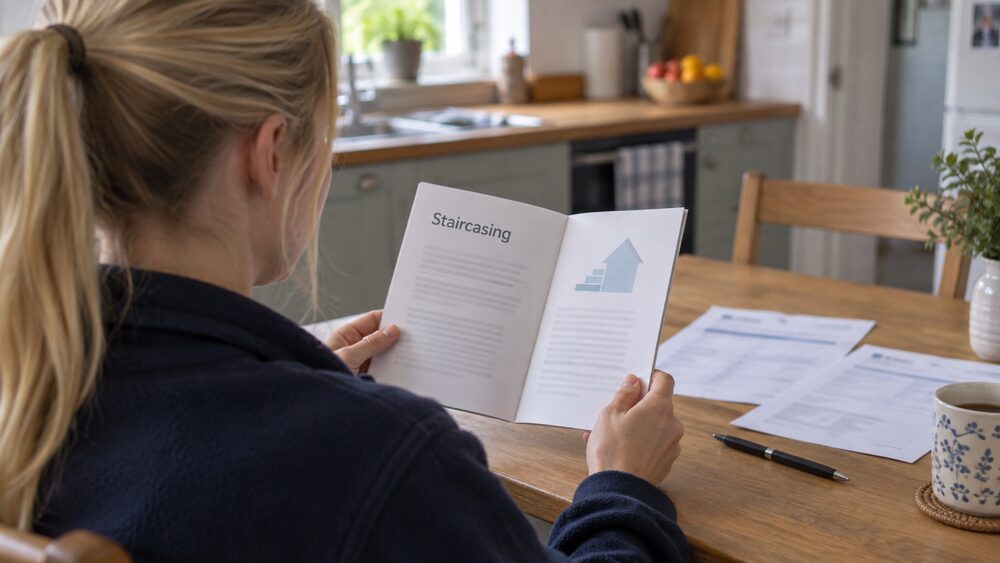
Whether staircasing to 100% before selling makes sense depends on the fees involved, the value of the property and the state of the local market. The dedicated page on staircasing explains the process and costs in detail.
Getting a RICS valuation, usually valid for 3 months
A shared ownership sale needs a professional valuation, because the price of your share is worked out from the full market value of the property. The standard is a valuation from a surveyor registered with the Royal Institution of Chartered Surveyors (RICS). Official guidance on equity scheme valuations states that a market valuation must be by a RICS certified valuer and is valid for 3 months22.
The valuer has to meet requirements that are set out in official guidance for the equity schemes. The valuer must be both RICS qualified and registered, be independent of any estate agent, not be related to or known to you, and inspect the inside of the property. The valuation must provide at least 3 comparable properties and sale prices from the last 6 months, which must be like for like in type, size and age and within 5 miles of the property3. Valuations prepared for a bank or mortgage purposes are not acceptable23.
The 3-month validity is the practical constraint to plan around. The RICS valuation will only be valid for 3 months from the date of inspection3, and the cost of the valuation is to be paid by you24. If the sale does not complete in time, an extension is possible: official guidance allows a 3-month extension by RICS desktop valuation report, which must be made within 2 weeks of the expiry date of the original report, completed, signed and dated by the same RICS surveyor, and sent in within 5 days of issue22. If a desktop valuation expires and a total of six months has been reached without completing the transaction, a new RICS valuation with re-inspection is required23.
In Scotland the valuation usually comes to you rather than from you. Under the Open Market Shared Equity scheme, once you have found a home you will be asked to provide a copy of the valuation, which will usually be provided in the Home Report given by the home's seller25, and the valuation must be from an independent professionally qualified valuer registered with the RICS25. The Scottish process is explained in buying a home in Scotland.
Documents a sale needs: TA6, leasehold information, EPC and EWS1
A shared ownership sale involves the standard conveyancing documents plus the leasehold information the buyer needs. The TA6 form is produced by the Law Society and covers 14 separate subjects with questions to be answered by the seller7. It is the main property information form: you answer questions about the property's history, boundaries, disputes, services and so on, and the buyer relies on your answers.
If the property is a flat, the EWS1 form is likely to come up. The EWS1 form is evidence that a building with potentially combustible cladding has had a fire safety assessment7. A buyer's lender will typically require one before lending on a flat in a building where cladding is a concern, so if you are selling a flat it is worth asking the association early whether the building already has an EWS1. The page on EWS1 forms explains which flats need one.
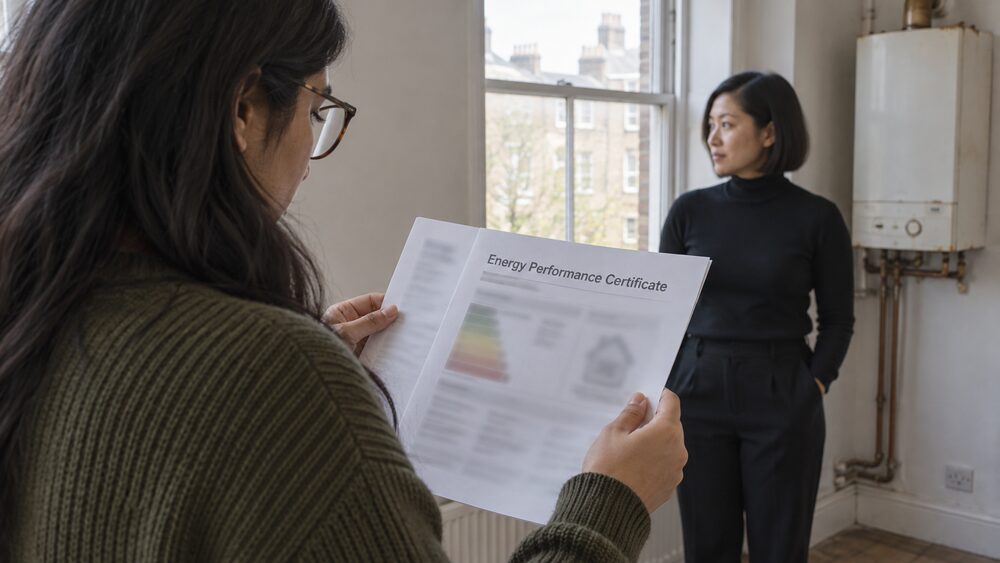
The leasehold information pack, sometimes called the management pack, comes from the housing association or its managing agent, and it can be slow: in over half of cases, leasehold information is not received by the leaseholder until more than 30 days after payment is made18. Request it as early as the lease allows. An Energy Performance Certificate is also needed to market a home, and if you own the property jointly, evidence of how you own it may be shown in the Transfer or Lease by which the property was acquired, or in a Trust Deed or Will9.
The buyer will also receive scheme-specific information. Providers give prospective buyers Key Information Documents setting out the terms of the shared ownership lease13, and any remaining period on the building warranty transfers to a resale buyer12. Having these ready shortens the time between an agreed sale and completion, which matters while the valuation clock is running.
Costs of selling a shared ownership home
Selling a share costs money before you see any proceeds. The main items are the valuation, your legal fees and the association's costs, some of which the lease allows it to pass to you.
- The RICS valuation: the cost of the valuation is paid by you24, and if the sale drags past 3 months you may pay again for an extension22.
- Legal costs: you pay your own solicitor or conveyancer, and you may also need a solicitor to act on your behalf in scheme transactions, as in Scotland where the Scottish Government has its own solicitor to handle work involving its equity share26.
- Housing association fees: the lease states what the costs and fees are2, so ask the association for its current resale fee schedule at the outset.
If you staircase before selling, that carries its own costs: on the Right to Shared Ownership example, buying a further 1% of a £325,000 home costs £3,25020.
One protection worth knowing about sits in the mortgage rules. The FCA's rulebook prohibits execution-only sales where the regulated mortgage contract is a shared equity credit agreement27, which in practice means a buyer taking on a shared ownership or shared equity arrangement is expected to receive advised mortgage advice rather than proceeding without it. For you as a seller, that is simply part of why buyers for these homes take longer to assemble than ordinary buyers.
Rent and service charges until the sale completes
Until completion, your obligations under the lease continue in full. You keep paying rent on the share you do not own, and you keep paying service charges where the lease provides for them. These do not stop when you agree a sale or when a buyer is nominated; they stop when the sale completes and the new owner takes over.
The rules are explicit in the specialist schemes. Under the Older Persons Shared Ownership scheme, the person inheriting your home must continue to pay service charges and rent until the property is sold28. Under the HOLD scheme for people with a long-term disability, you still need to pay the service charge while your home is in the initial repair period29. These examples show the general principle: the obligations attach to the property and the lease, not to your intentions.
What the charges are depends on the home. For flats and maisonettes in Northern Ireland's House Sales Scheme, the buyer or leaseholder must also pay an annual service charge30. In Scotland, where the rest of the home is owned by a housing association, you pay an occupancy charge to live in it31. If you own 100% of a house, check the lease: some charges end with full ownership, but service charges for communal services can continue, and the page on service charges at 100% covers this in detail.
Short leases: extension and marriage value
Lease length matters twice over when you sell: buyers and lenders look at the years remaining, and the cost of extending a lease rises as it shortens. Leases are normally granted for 99 years, but you may want to extend at the point of purchase if there is a shorter one7. Shared ownership leases have typically run for 125 years32, and a Right to Buy example shows how the term erodes: if you buy on a 125-year lease and sell after 15 years, the buyer gets a 110-year lease15.
The reform programme is changing this picture. The minimum shared ownership lease term has been extended from 99 to 990 years4, and a 990-year lease is now the standard, which will also be applied to existing shared owners5. The HOLD scheme already requires leasehold homes to have a remaining lease length of at least 990 years unless no such homes are available29.
For older leases, the question is when extension becomes necessary. The guidance conflicts: some sources say leases of 90 years or less should be extended, others say 80 years or less, and the documents do not resolve the difference. What is settled is the direction of reform: planned leasehold reform legislation will abolish marriage value, the premium that rises sharply as a lease runs down33. Until that takes effect, a shorter lease means a more expensive extension and a harder sale.
A quirk of leasehold law is worth knowing. Shared ownership leases, together with all long leases with an annual rent above £250 per year, or £1,000 in Greater London, are classed as assured shorthold tenancies32. The National Housing Federation notes that a shared ownership lease provides similar rights to an ordinary long residential lease, but there are some differences32. The page on buying a leasehold property explains the general leaseholder rights that apply.
How the rules differ in Scotland, Wales and Northern Ireland
The schemes described so far are largely the English shared ownership model. The other nations have their own versions, and the sale rules differ with them.
In Scotland, shared ownership works on the model where the rest of the home is owned by a housing association and you pay an occupancy charge to live in it31. Scotland also runs shared equity schemes, which are financially different: under Open Market Shared Equity you get your share percentage of the selling price and the Scottish Government gets the rest6, and under New Supply Shared Equity you can in most cases increase your share up to 100%, meaning the Scottish Government no longer holds a stake21. The pages on shared equity schemes in Scotland and increasing your share in an Open Market Shared Equity home cover these.
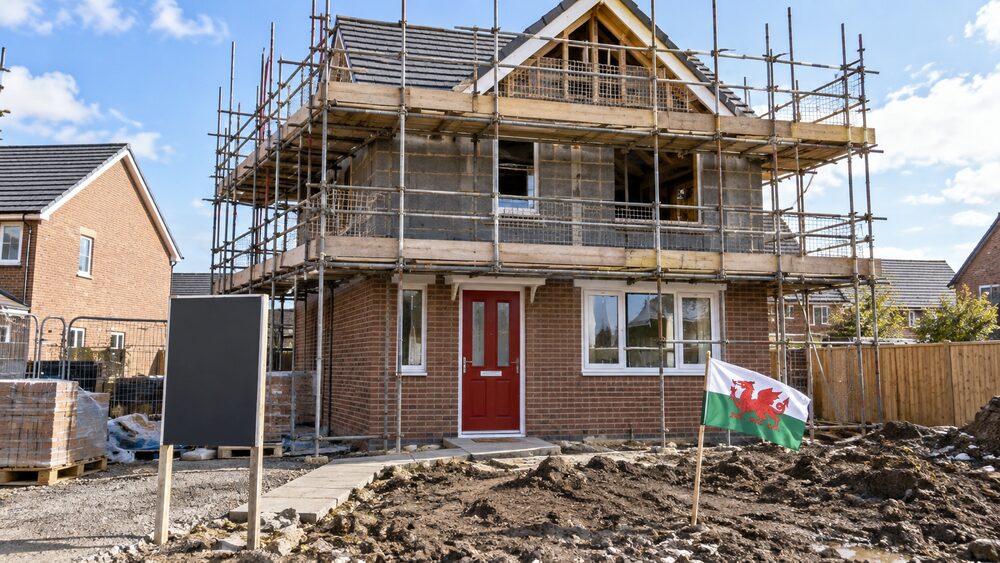
In Wales, shared ownership buyers purchase an initial share of 25% to 75% of a property with rent paid on the remaining share34. Wales also runs its own equity loan schemes with their own valuation and resale rules, covered in Help to Buy Wales.
In Northern Ireland, the House Sales Scheme allows you to increase your equity share in multiples of five per cent at any time, known as staircasing30. The scheme has exclusions: you are not eligible if you live in sheltered housing, a property which is part of a group housing scheme, or a single storey or ground floor property, other than a flat, with no more than two bedrooms35. The page on the House Sales Scheme explains it.
The Right to Shared Ownership scheme, which gives some social tenants the right to buy a share of their rented home, is available in England only, not in Scotland, Wales or Northern Ireland17.
Where to get help
Your first port of call is the housing association itself: it owns the remaining share, it runs the resale process, and it can tell you the nomination period, the fees and the buyer eligibility rules that apply to your lease. In England, there is an official service to find organisations that sell shared ownership homes by local authority area11, which is useful for identifying who manages your scheme if you are unsure.
For the legal work, a conveyancer is an alternative to a solicitor, qualified to act in the sale or purchase of a property7. Choose one familiar with shared ownership leases, and the page on solicitor or conveyancer explains the difference. For the general process of selling and buying, see how to buy a house and conveyancing.
If a sale has gone wrong, or a complaint against the association has not been resolved, the page on complaints when buying a home sets out the routes available.
Sources36 cited
- Shared ownership: after buying mygov.scot, 2026-06-24
- Why is shared ownership considered ownership? National Housing Federation, 2026-09-26
- Help to Buy valuation guide Welsh Government, 2024-07
- New shared ownership model briefing House of Commons Library, 2026-07-08
- Shared ownership National Housing Federation, 2026-09-26
- Open Market Shared Equity scheme: after buying mygov.scot, 2026-03-17
- Home buying and selling jargon HomeOwners Alliance, 2026-07-31
- Sheriff officer powers: taking things you own mygov.scot, 2023-11-07
- Debt when someone dies nidirect, 2026-06-26
- Shared ownership guidance UK Parliament deposited paper, 2025
- Find an organisation that sells shared ownership homes in England GOV.UK, 2025-12-04
- Shared ownership homes: repairs and home improvements GOV.UK, 2026-09-28
- Standard Shared Ownership Key Information Documents GOV.UK, 2024-09-02
- First Homes scheme: selling the property GOV.UK, 2026-09-28
- Your Right to Buy your home: a guide GOV.UK, 2026-04-08
- Shared ownership homes in a designated protected area: 80% restricted staircasing Key Information Documents GOV.UK, 2024-09-02
- Right to Shared Ownership GOV.UK, 2026-09-26
- Leasehold and Freehold Reform Act 2024 explanatory notes legislation.gov.uk, 2024-05-24
- Help to Buy equity loan repayment checklist GOV.UK, 2024-04-04
- The Right to Shared Ownership: a guide for tenants GOV.UK, 2025-09
- New Supply Shared Equity scheme: after buying mygov.scot, 2026-07-28
- How to get a valuation of your Help to Buy home GOV.UK, 2025-08-18
- Help to Buy Wales post-completions guide Welsh Government, 2024-07
- Help to Buy Wales buyers guide, phase 3 extension Welsh Government, 2024-09
- Open Market Shared Equity scheme buyer information Scottish Government, 2025-04
- Open Market Shared Equity scheme: how to apply mygov.scot, 2026-03-17
- MCOB 4.18: prohibited cases FCA Handbook, 2025-07-22
- Older Persons Shared Ownership scheme (OPSO) GOV.UK, 2025-12-03
- Home Ownership for people with a Long-term Disability (HOLD) GOV.UK, 2025-12-03
- Equity sharing nidirect, 2026-02-25
- Help to buy home schemes in Scotland mygov.scot, 2026-06-24
- Is a shared ownership lease an assured shorthold tenancy? National Housing Federation, 2026-09-26
- Leasehold reform briefing House of Commons Library, 2026-07-08
- Help to buy home schemes in Wales Welsh Government, 2026
- House Sales Scheme nidirect, 2026-02-18
- Buying a home: things to consider nidirect, 2026-02-25


 MoneyHelperFree, impartial money and pensions guidance, set up by government
 Citizens AdviceFree advice on money, consumer and legal problems in England and Wales
 ShelterFree housing advice from a charity
 GOV.UKOfficial information on tax, benefits and government services
 Financial Ombudsman ServiceFree, independent help when a complaint about a firm is not put right