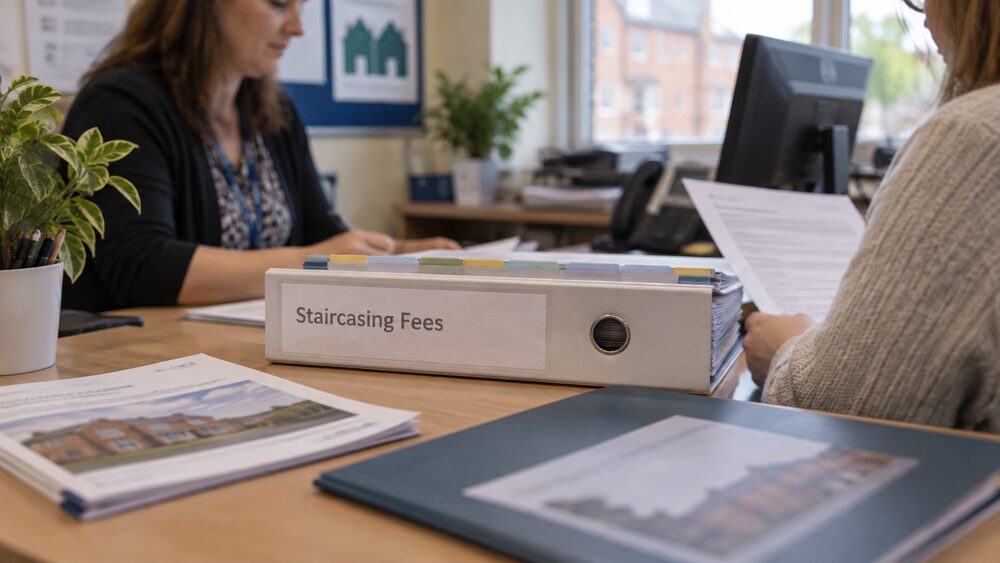
Staircasing means buying more shares in the home you already part own, and the fees fall into four groups: a valuation, legal work, any mortgage arrangement costs, and an administration fee charged by the housing association that owns the rest1. Stamp duty can also apply on the share you buy2.
Staircasing means buying more shares in the home you already part own, and the fees fall into four groups: a valuation, legal work, any mortgage arrangement costs, and an administration fee charged by the housing association that owns the rest1. Stamp duty can also apply on the share you buy2.
The single biggest variable is the valuation, because it sets the price of the share. The extra share is priced at today's value, not what you paid originally, so a rise in the value of your home raises the cost of each step. Co-Ownership in Northern Ireland illustrates the arithmetic: an extra 5% share of a £175,000 property costs £8,7503.
Under the newer national model for shared ownership, small steps are designed to be cheaper. New shared owners can buy additional shares in 1% increments for up to 15 years, with heavily reduced fees4, and can staircase in 1% increments per year for 10 years without undertaking a valuation5.
What staircasing is and what you pay for
Staircasing is a further payment to the landlord for a further percentage of the value of the property, which reduces the monthly rental amount8. It is the mechanism that turns a part-owned home into a fully owned one, and it is written into the lease rather than agreed case by case.
The costs that usually arise are valuation fees, legal fees, mortgage arrangement costs and a housing association administration fee1. Not every step triggers every one of them. A small step under the newer model may avoid the valuation altogether, while a larger purchase brings the valuation and the administration fee back in4.
All of the details about the cost of this process are available in the lease. The housing association provides details on the costs, and the shared owner's solicitor can advise8. That matters because the lease is where the rules for your particular home sit, and schemes differ between England, Scotland, Wales and Northern Ireland.
You will need the permission of the company that owns the rest of the home before you proceed2. That is a practical first step rather than a formality: it confirms what you are allowed to buy and what the association will charge for handling it.
Valuation: the extra share is priced at today's value
The share you buy is valued at the time you buy it, so the price moves with the market rather than with what you originally paid. That is why a valuation is central to the process and why the timing of a step matters as much as the fee.
Valuation fees vary. Some lenders charge a flat fee, for example £100, while others use a sliding scale based on the property's value, and a valuation should not cost more than a few hundred pounds9. Valuation fees can vary according to the property value but tend to be a few hundred pounds, and some lenders offer free valuations10.
Scheme valuations can be cheaper than open-market ones. Co-Ownership charges £75 per staircasing transaction, and the valuation is valid for 12 weeks from the date you receive it6. In Northern Ireland, Co-Ownership staircases in 5% steps with a subsidised valuation fee11.
If you need to borrow more to fund the step, there is often a fee for any further advance applications12. That is separate from the valuation and is charged by the lender, not the housing association.
Legal, survey, broker and mortgage costs
Buying a house or flat normally involves paying a solicitor, an independent surveyor, a mortgage arrangement fee, a Land Registry fee and stamp duty14. Staircasing is a smaller transaction than a purchase, but it draws on the same professional services.
Shared ownership buyers are told to expect legal fees, survey costs, broker fees, service charges and rent2. Legal costs incurred in investigating title, preparing the mortgage deed and completing the legal work associated with a mortgage will normally be payable by the borrower15. Lenders set out the same expectation in their own documents: borrowers may need to budget for a valuation fee, search fees, land registry fees and legal costs16.
Broker fees are not inevitable. They arise where a buyer uses a broker to arrange the additional borrowing, and they are one of the costs listed for shared ownership buyers generally2. Where a lender deals with the borrower directly, that cost does not arise.
Some of these charges are familiar from any mortgage transaction. Arrangement and solicitors' fees, plus valuation, survey and electronic transfer fees, are the standard set of costs attached to a lifetime mortgage, which shows how consistent the shape of these charges is across property borrowing17.
Stamp duty when you buy more shares
Each time you buy a share of the property, you must pay stamp duty. This can either be paid as a one-off lump sum based on the total market value of the property or in stages2. The choice matters: paying on the full market value up front usually costs more at the time but avoids a charge on every later step.
Stamp duty is payable at the point of completion7. In England and Northern Ireland, no stamp duty is due on the first £125,000 of a purchase18. For a first time buyer purchasing a house of £292,000, stamp duty costs would be zero19.
The rules differ across the UK. Scotland has Land and Buildings Transaction Tax and Wales has Land Transaction Tax, so a shared owner there is not paying stamp duty in the English sense at all. The Stamp Duty Land Tax page covers England and Northern Ireland, and there is a separate page on paying stamp duty in stages on a shared ownership home.
Small steps under the new model: 1% a year without a valuation
The newer national model for shared ownership changed the arithmetic of small steps. New shared owners can buy additional shares in their home in 1% increments for up to 15 years, with heavily reduced fees4. The same model allows staircasing in 1% increments per year for 10 years without undertaking a valuation5.
Larger purchases still carry the old machinery. It is possible to staircase in larger increments, with the minimum additional share purchase reduced from 10% to 5%4. In England, the pattern is 5% steps, or 1% a year for up to 15 years, with 5% and above purchases requiring a valuation and an admin fee11.
The saving from a 1% step is not only the valuation fee. Avoiding a valuation also avoids the risk that a higher market value raises the price of the share you were about to buy, because the price is fixed by the scheme rather than by a fresh assessment.
The Right to Shared Ownership scheme sets out worked examples of what a step costs at a full market value of £325,000 at the time of staircasing: £3,250 for 1%, £16,250 for 5%, £48,750 for 15% and £81,250 for 25%20. A second official document gives different figures for the same percentages: £4,250 for 1%, £21,250 for 5%, £63,750 for 15% and £106,250 for 25%20. The two documents disagree and the conflict is not resolved, so treat either set as an illustration of scale rather than a quotation for your home.
How your rent and monthly costs change as your share grows
Rent falls as your share rises. Each time you buy more, the amount of rent you pay each month goes down because you own a bigger portion13. Under the Right to Shared Ownership scheme you can buy more shares in the future, known as staircasing, and pay less rent on the rest of the property21.
The effect is proportional. If your home is valued at £100,000 and you own a 50% share, your monthly rent would be £104.1722. Buying more shares reduces the rented portion and therefore the rent, though the exact figure depends on the rent formula in your lease.
At the end of the process the rent stops. If you choose to buy the remaining amount, you will own 100% of the property and will not pay any rent2. Under the Older Persons Shared Ownership scheme the rent stops earlier: once you own 75% of the home you do not have to pay rent on the remaining 25% share of the property23.
Service charges are different. You will still need to pay the service charge while your home is in the initial repair period24. Service charges attach to the building and the estate, so they continue after the rent ends. There is more on this on the page about service charges on 100% ownership.
Where the rules differ across the UK
Shared ownership is not one scheme. In Northern Ireland, Co-Ownership sells a share of between 50% and 90% of the property26, and staircasing works in 5% steps with a subsidised valuation fee11. The House Sales Scheme in Northern Ireland lets a buyer increase their equity share in multiples of five per cent at any time, which is known as staircasing27.
In Scotland, the Open Market Shared Equity scheme puts the valuation and legal costs, and the administration costs of the organisation handling the request, on the buyer28. That is a different allocation from the subsidised valuation available through Co-Ownership, and it means a Scottish shared equity owner should budget for the full cost of each step.
In England, shared ownership offers people the option to buy a share of their home of between 10% and 75% and pay rent on the remaining share29. The newer model's 1% increments apply to new shared owners4.
The staircasing guide covers the process in more detail, and the shared ownership in England page explains how the tenure works from the start. For Northern Ireland, the Co-Ownership compared with English shared ownership page sets the two side by side.
Working out whether a step is worth taking
The cost of a step is the sum of the fees plus the price of the share. The price of the share is the percentage you are buying multiplied by the current value of the property, so a rising market raises the cost of every step and a falling one lowers it.
The benefit is the rent you no longer pay on the share you now own. Because rent falls each time you buy more13, the saving compounds as your share grows, and it ends entirely at 100%2.
The trade-off is liquidity. Money spent on a step is tied up in the property, and the fees are gone whether or not the step turns out to suit you. A valuation is valid for a limited period, 12 weeks in the Co-Ownership scheme6, so a delay can mean paying for a second valuation.
Where the numbers are close, the deciding factor is usually how long you expect to stay. The fees are a one-off cost spread over the years you remain in the home, so a short stay makes each step more expensive per year than a long one.
Getting help and complaining
Free, impartial help is available. MoneyHelper provides guidance on rent arrears and problems paying rent25. If you are behind on rent or service charges, that is the point to seek advice rather than to take on more borrowing.
Your lease is the document that governs what you pay and when. All of the details about the cost of the staircasing process are available in the lease, and the housing association provides details on the costs8. If a charge appears that the lease does not support, that is a dispute with your landlord rather than with a lender.
If you cannot resolve a complaint with your housing association, the complaints page sets out the routes available. For problems with the mortgage itself, the lender's own complaints process comes first.
Sources29 cited
- Deciding whether to staircase LEASE Advice
- Shared ownership mortgages NatWest
- Owning more of your home Co-Ownership
- The new national model for shared ownership House of Commons Library, 2026-07-08
- Shared ownership National Housing Federation
- Can I increase my monthly payments to buy more of my home instead of buying in 5% steps? Co-Ownership
- Home buying and selling jargon HomeOwners Alliance, 2026-07-31
- Paying both a mortgage and rent: can anyone buy the place outright? National Housing Federation
- Mortgage valuations explained Which?
- How to switch equity release plans to get a cheaper deal Which?
- Shared ownership in Northern Ireland Co-Ownership
- How we help with mortgages StepChange
- Costs and responsibilities Co-Ownership
- Buying a home: things to consider nidirect
- Mortgages general information and charges Teachers Building Society, 2026-07-27
- Existing customers: mortgages Santander International
- Equity release Legal & General
- Cost of moving calculator HomeOwners Alliance, 2026-06-11
- Cost of buying house calculator HomeOwners Alliance, 2026-06-11
- The Right to Shared Ownership: a guide for tenants GOV.UK, 2025-09
- Right to Shared Ownership GOV.UK
- Fees, costs and rent Co-Ownership
- Older Persons Shared Ownership (OPSO) GOV.UK, 2025-12-03
- Home Ownership for people with a Long-term Disability (HOLD) GOV.UK, 2025-12-03
- Rent arrears: problems paying your rent MoneyHelper
- Understanding Co-Ownership Co-Ownership
- Equity sharing nidirect, 2026-02-25
- Open Market Shared Equity scheme: after buying mygov.scot, 2026-03-17
- Evaluation of the Help to Buy scheme GOV.UK, 2026-09-16





 MoneyHelperFree, impartial money and pensions guidance, set up by government
 Citizens AdviceFree advice on money, consumer and legal problems in England and Wales
 ShelterFree housing advice from a charity
 GOV.UKOfficial information on tax, benefits and government services
 Financial Ombudsman ServiceFree, independent help when a complaint about a firm is not put right